Walk down any given street in Osaka, especially one of the covered shotengai shopping arcades, and you’ll see it. Squeezed between a gleaming drugstore and a boisterous takoyaki stand, you’ll find a doorway that looks like a portal to 1978. The windows might be tinted a smoky brown, the plastic food models in the display case have faded to pastel shades, and the swirling, vaguely European script on the sign spells out a name like “Cafe L’Amour” or “Coffee House Peak.” This is the neighborhood kissaten. Your first instinct, conditioned by a world of minimalist design and bright, airy cafes, might be to walk right on by. You might think it’s outdated, maybe a little grimy, probably filled with chain-smoking old men. And sometimes, you’d be right.
But if you walk past, you’re missing the point entirely. You’re skipping over one of Osaka’s most vital and misunderstood institutions. These aren’t just coffee shops. They are community living rooms, unofficial co-working spaces, quiet sanctuaries, and the beating heart of neighborhood life. They are a classic example of what urban sociologists call a “third place”—that essential space between the private world of home (the first place) and the structured obligations of work (the second place). In a city that can feel relentlessly energetic and overwhelmingly social, the kissaten offers a different kind of connection: a quiet, unassuming presence. It’s a space where you can be alone, together. To truly understand the rhythm of daily life in Osaka, to get beyond the neon lights of Dotonbori and the grand history of the castle, you need to understand the humble, persistent, and deeply comforting world of the kissaten. It’s where the city’s gruff exterior softens, where its famous pragmatism finds a place to rest, and where you, as an outsider, can slowly, quietly, find your own little corner of belonging.
Discover how these timeless neighborhood gems have transformed into indispensable community and work hubs by learning more about how the kissa-ten embodies Osaka’s unique third place.
The Vibe Check: What a Kissaten Is (and Isn’t)
Before you push open that heavy wooden door adorned with a small tinkling bell, you should recalibrate your expectations. This isn’t a modern café. The aim here isn’t a swift caffeine fix served in a paper cup. The entire ethos of the space is different, rooted in a post-war era when coffee was a luxury and time was meant to be savored, not optimized.
It’s Not a Cafe, It’s a Living Room
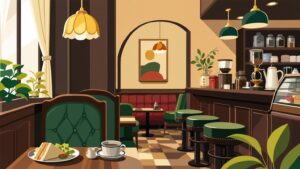
The sensory experience of a classic kissaten is immediate and immersive. The air is thick with the rich, slightly bitter aroma of siphon-brewed coffee, a scent that has permeated the dark wood paneling and the worn velvet of the booth seats over decades. The lighting is low and warm, casting long shadows from the ornate, occasionally dusty chandeliers. Instead of a high-energy pop playlist, the soundtrack is likely to be soft classical music, mellow jazz, or simply the gentle clinking of ceramic on saucer and the rustle of a newspaper. The proprietor, known as the “Master,” moves with a quiet economy of motion behind the counter. He or she is not a chatty barista asking about your day; they are the stoic guardian of this small universe, a steady, reassuring presence who has seen it all. In many ways, the Master is the human anchor of the establishment, their personality subtly shaping the unspoken rules and overall atmosphere of their domain. This isn’t a transactional space; it’s a deeply personal one, an extension of the owner’s own sensibility. It’s a stark contrast to the bright, anonymous, and often loud efficiency of a chain café, designed for rapid turnover. The kissaten is made for lingering.
The Unspoken Contract: You’re Renting a Seat, Not Just Buying Coffee
One of the first things you’ll notice on the menu is the price. A single cup of “blend coffee” might be ¥600, considerably more than you’d pay elsewhere. This isn’t a rip-off; it’s a fundamental misunderstanding of the transaction. You’re not just paying for the roasted beans and hot water. You’re paying for the seat, the quiet, the atmosphere, and, most importantly, the time. That ¥600 buys you the right to occupy that comfortable chair for an hour, or maybe two, without disturbance. It’s an admission ticket to a peaceful refuge from the city’s clamor. This is the unspoken contract of the kissaten. In exchange for your patronage, the Master provides a clean, calm space for you to read, think, work, or simply gaze out the window. Your side of the bargain is to respect the sanctuary. That means keeping your voice down, taking phone calls outside, and not spreading your belongings across multiple tables. It’s a mutual agreement to preserve the tranquility everyone comes to enjoy. This acceptance of lingering, or “nagai” (long stay), is a notable difference from the turnover-driven café culture in cities like Tokyo, where the pressure to free up a seat can be more palpable. In Osaka, as long as you are a quiet and respectful patron, you’re generally welcome to stay awhile.
Finding Your Kissaten: A Guide to Osaka’s Third Places
Not all kissaten are the same. They are hyperlocal establishments, each embodying the character and needs of its immediate environment. Finding the right one for you is an exploratory journey, much like discovering the perfect neighborhood pub. Each type fulfills a distinct role within the urban ecosystem.
The Shotengai Sentinel
These are perhaps the most traditional examples, tucked away in the city’s extensive covered shopping arcades, or shotengai. The patrons here represent a cross-section of the neighborhood’s essence. You’ll spot elderly women with their shopping carts, pausing for a cup of tea and a slice of toast. The owner of the adjacent fish market pops in for a coffee and a quick glance at the sports page. Local business owners hold quiet meetings. This is the community’s central hub, a place where information flows in hushed tones and familiar faces are acknowledged with a simple nod. It’s a stage for everyday life. As a foreigner, quietly sitting here lets you witness the subtle, unamplified interactions that define Osaka’s communal spirit. It offers a far richer cultural lesson than any museum, revealing how the city’s social fabric is woven daily on a local scale.
The Salaryman Sanctuary
Grouped around the towering office buildings of Umeda, Yodoyabashi, and Honmachi, you’ll find a different kind of kissaten. These serve as daytime retreats for the city’s white-collar workers. The décor tends to be more standardized, the tempo slightly faster, but the core purpose remains: escape. Here, a salaryman prepares quietly for a big meeting, reviewing his notes. It’s where colleagues can have discreet conversations away from the office. It’s also home to the institution known as “Morning Service” or simply “Morning.” This breakfast set, typically available until about 11 a.m., includes coffee, a thick slice of buttered toast, and a hard-boiled egg, often costing little more than coffee alone. It epitomizes Osaka pragmatism—a cheap, quick, and comforting way to start the day in a tranquil setting. It’s not about gourmet fare; it’s about delivering a practical, valuable service, a concept central to Osaka’s merchant culture.
The Student and Artist Hideout
In neighborhoods with a bohemian flair, like Nakazakicho with its maze of old houses, or in university areas such as Toyonaka, the kissaten adopts another character. These spots frequently have a more eclectic, lived-in vibe. Shelves are often packed with aging manga and obscure art books. The music tends toward obscure jazz or folk. The Master might be a younger, more artistic type. These are creative incubators, where students prepare for exams, writers draft novels, and artists sketch in notebooks. The atmosphere remains quiet and respectful, yet there’s an undercurrent of creative energy. They function as affordable, informal studios and libraries for those needing quiet space outside cramped apartments or noisy campuses. They showcase the kissaten’s remarkable adaptability, catering to the unique needs of whatever community surrounds them.
The Osaka Difference: Why Kissaten Thrive Here
The persistence of the kissaten in Osaka, despite relentless modernization, reveals much about the city’s core identity. It’s not merely nostalgia; it reflects a particular mindset that places different values on certain things than, say, Tokyo.
A Culture of “Ma, Iikka” (Ah, Whatever)
There’s a foundational attitude in Osaka often summed up as “ma, iikka,” roughly meaning “ah, well, it’s fine.” It embodies a pragmatic acceptance and a rejection of unnecessary formality and perfectionism. This mindset is deeply embedded in the kissaten. The Master won’t fuss over you. The cup might be slightly chipped. The décor hasn’t changed since the bubble economy. And that’s perfectly okay. The emphasis is on the essence of the experience: good coffee, a quiet space, and dependable comfort. This contrasts with the Tokyo sensibility, which often prioritizes aesthetic refinement and impeccable service. An Osaka kissaten feels lived-in rather than curated. It’s a place to relax, let your guard down, and simply be. There’s no pressure to perform or conform to a certain image. This easygoing, unpretentious vibe is distinctly Osaka.
The Practicality of the “Morning Set”
Osaka’s history as a merchant city has fostered a strong appreciation for value and practicality. Osakans are often stereotyped as thrifty or even stingy (“kechi”), but it’s better understood as a keen intolerance for poor value. The Morning Set perfectly exemplifies this principle. It’s undeniably a great bargain. You get a simple but complete breakfast and a seat for an hour, all for the price of one drink. It’s not about luxury; it’s about practical, economic sense. This emphasis on providing clear value is a hallmark of Osaka’s business culture, and the kissaten is a humble, daily expression of that philosophy. It’s a service grounded in mutual, practical benefit between customer and proprietor.
Community Over Polish
Many foreigners, upon first encountering an older kissaten, might mistake its worn appearance for neglect. This is a key cultural misunderstanding. The faded wallpaper and worn seats aren’t signs of failure; they are badges of pride. They represent history, stability, and a long-standing place in the community. A new, shiny café may draw transient customers, but the kissaten is built on a foundation of loyal regulars. The Master knows their orders. The regulars know one another. It forms a low-key social network based on nods and quiet greetings. In Osaka, a huge city that often feels like a collection of close-knit villages, this neighborhood-centered model is powerful. It offers a sense of anchor and belonging that can be harder to find amid Tokyo’s vast, more anonymous urban sprawl. The kissaten shows that in Osaka, community bonds are frequently valued more than superficial polish.
How to Be a Good Kissaten Citizen
Navigating the kissaten world becomes easy once you grasp the unspoken rules. It’s about maintaining a respectful, low-impact presence. Here’s how to blend in and make the kissaten your own third place.
Your First Visit
Don’t be unsettled if the space falls silent momentarily as you enter, or if a few regulars glance up from their newspapers. It’s simple curiosity, not hostility. Find an open seat, and the Master will bring you a glass of water (oshibori) and a menu. The basic expectation is one order per person. Don’t attempt to share a single coffee between two people. After placing your order, that’s it. You are now free to enter the kissaten’s bubble of calm. Settle in, read your book, check your phone (silently), and simply observe the quiet rhythm of the room. Don’t feel rushed. The whole point is to slow down.
Becoming a Regular
The key to becoming a regular is consistency. If you find a place you like, visit again. Maybe make it your quiet hour spot every Tuesday morning. The Master will begin to recognize you. A simple nod or a quiet “konnichiwa” upon arrival and “gochisousama deshita” upon leaving is all the communication needed. Don’t push for small talk; that’s not the nature of the relationship. Over time, the Master may start preparing your usual order as you walk in. This is a subtle sign of acceptance. You are no longer just a customer; you become part of the establishment’s regular rhythm, a familiar thread in the daily tapestry.
The Art of the Quiet Workspace
In today’s world, many people want to use kissaten as a workspace. This is generally acceptable but comes with its own set of etiquette. Using a laptop is fine, but be mindful of keyboard noise. Loud, aggressive typing will break the peace. Always use headphones for any audio without exception. Be spatially considerate. Don’t occupy a large four-person booth alone, especially during busy lunch hours. If you plan to stay more than a couple of hours, it’s polite to order a second drink, as if renewing your rent. The kissaten can be the best remote office you’ve ever had, as long as you remember you’re sharing that space with others who have also paid for tranquility.
A Personal Reflection: From Intimidation to Invitation
I’ll be honest, when I first moved to Osaka, I didn’t understand the kissaten. To me, they seemed like dark, smoky relics, and I was drawn instead to the bright, modern coffee shops that felt more familiar. The silence in the kissaten felt uncomfortable, and the stares from the regulars seemed judgmental. I felt like an outsider in a private club. It took me a long time to realize that the silence wasn’t awkward—it was intentional. The glances weren’t judgmental; they were simply brief acknowledgments of a newcomer.
The turning point came on a rainy Tuesday morning. My child was at preschool, I had a load of freelance work to finish, and our apartment felt unbearably small. On a whim, I slipped into a tiny kissaten near my local station, one I’d passed by countless times before. I ordered a coffee, opened my laptop, and got to work. No one disturbed me. The only sounds were the rain outside, soft jazz playing on the radio, and the quiet hiss of the coffee siphon. An hour passed, then two. When I finally packed up to leave, the elderly Master simply nodded at me from behind the counter. That was all. But in that simple gesture, I felt a sense of acceptance. I had found it—my own third place. A spot that wasn’t home or work, but a calm, neutral space where I could just be. Understanding the kissaten was, for me, a key to grasping the deeper spirit of Osaka. It’s a city that may seem loud and brash on the surface, but beneath that, it cherishes quiet, consistency, and community. It’s a city that will make space for you, as long as you’re willing to sit down, be silent, and stay awhile.