Walk through any Osaka neighborhood, from the bustling arcades of Shinsaibashi to the quiet residential streets of Tennoji, and you will inevitably encounter it. You’ll hear a sudden spike in conversational volume, a sharp, almost incredulous exclamation, perhaps followed by a light tap on an arm and then, most importantly, a shared burst of laughter. To the uninitiated ear, especially one accustomed to the more measured, harmoniously subdued tones of Tokyo, it can sound like a public argument. A disagreement, a correction, a moment of social friction. But you’ll quickly notice the smiles, the easy posture, the palpable sense of connection between the speakers. What you are witnessing is not conflict. You are witnessing the heart of Osaka communication in action. You are witnessing ‘tsukkomi’.
This conversational dance, a rapid-fire exchange of playful absurdity and witty retort, is the lifeblood of daily interaction here. It’s a linguistic and social ritual that separates Osaka from the rest of Japan more distinctly than any dialect or dish. While tourists come for the takoyaki and the neon lights of Dotonbori, to truly understand what it feels like to live in Osaka, one must first learn to decode this unique brand of banter. It is the key to unlocking the city’s social soul, transforming you from a passive observer into an active participant in its vibrant daily theater. This is not about telling jokes; it’s about a collaborative way of being, a method of building instant rapport that values wit, engagement, and a shared laugh over polite distance. To grasp tsukkomi is to grasp the fundamental rhythm of Osakan life itself.
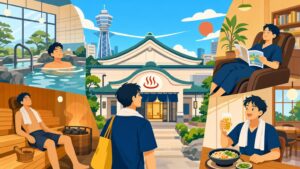
Embracing Osaka’s unique conversational rhythm can naturally lead to experiencing a 500-yen sento experience, where budget-conscious living meets genuine local charm.
The Conversational Duet: Understanding Boke and Tsukkomi
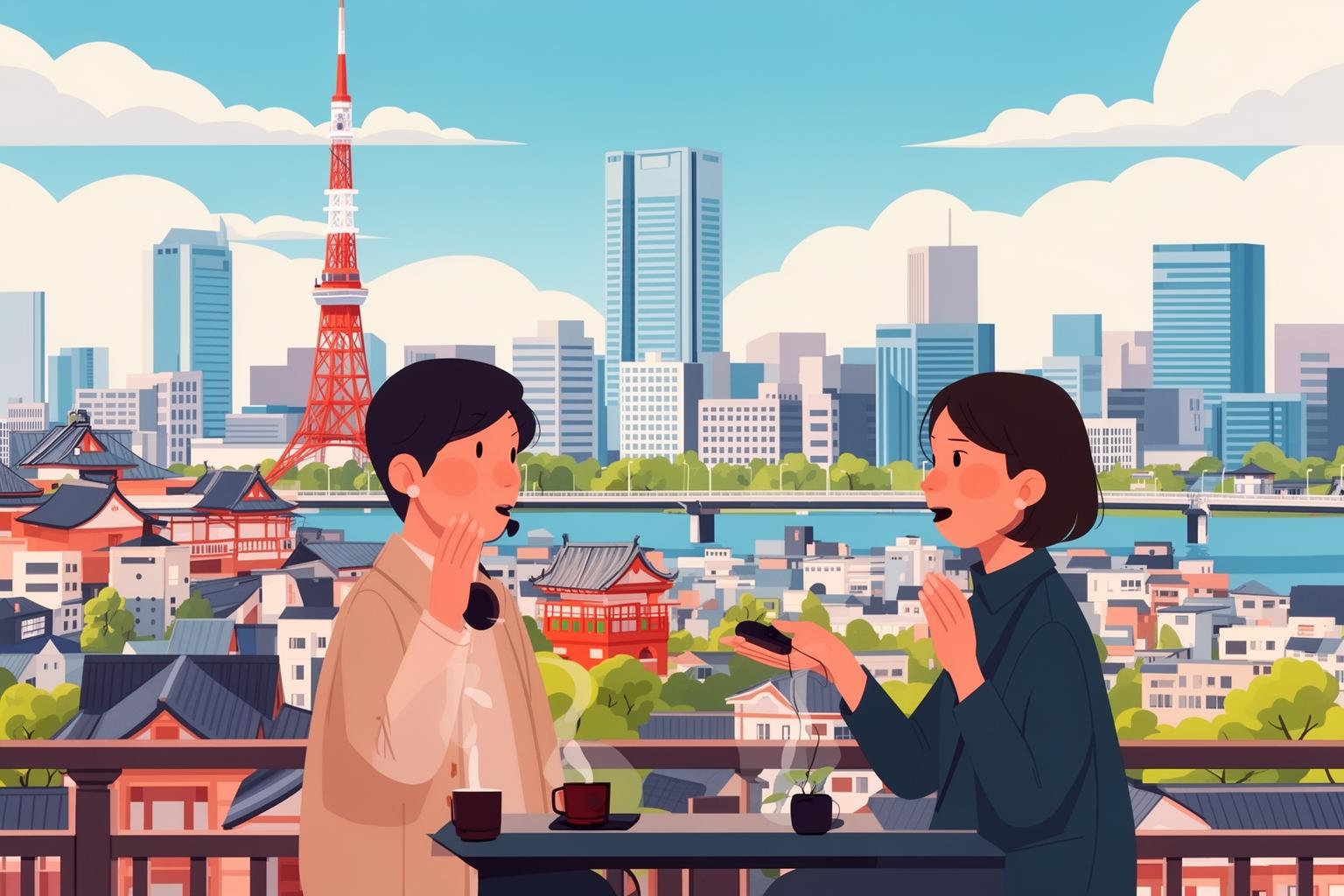
At its essence, the dynamic is a two-part performance, a structure directly drawn from ‘manzai‘, the traditional Japanese stand-up comedy style perfected and popularized in Osaka. The two characters are the ‘boke’ and the ‘tsukkomi’. Grasping this partnership is the first and most essential step.
The ‘Boke’ (ボケ): The Funny Man
The ‘boke’, derived from the verb ‘bokeru’ (to become senile or spaced out), is the one who says or does something foolish, absurd, incorrect, or out of place. This is seldom accidental. A true Osakan boke is a deliberate, calculated gesture. It is a conversational offering, a gentle toss of a verbal tennis ball, inviting a response. It could be a gross exaggeration, a deadpan statement of something blatantly untrue, or a moment of feigned ignorance. The boke creates a brief tear in the fabric of reality, a moment of cognitive dissonance that calls for resolution. It is an act of vulnerability and trust, presuming the other person is clever and engaged enough to play along.
Imagine being with an Osakan friend on a perfectly sunny day. Your friend might look up at the clear blue sky, sigh dramatically, and say, “Ah, I knew I should have brought my umbrella. It looks like a terrible storm is coming.” This is a classic boke. It’s clearly untrue, and that’s exactly the point. It’s an invitation.
The ‘Tsukkomi’ (ツッコミ): The Straight Man
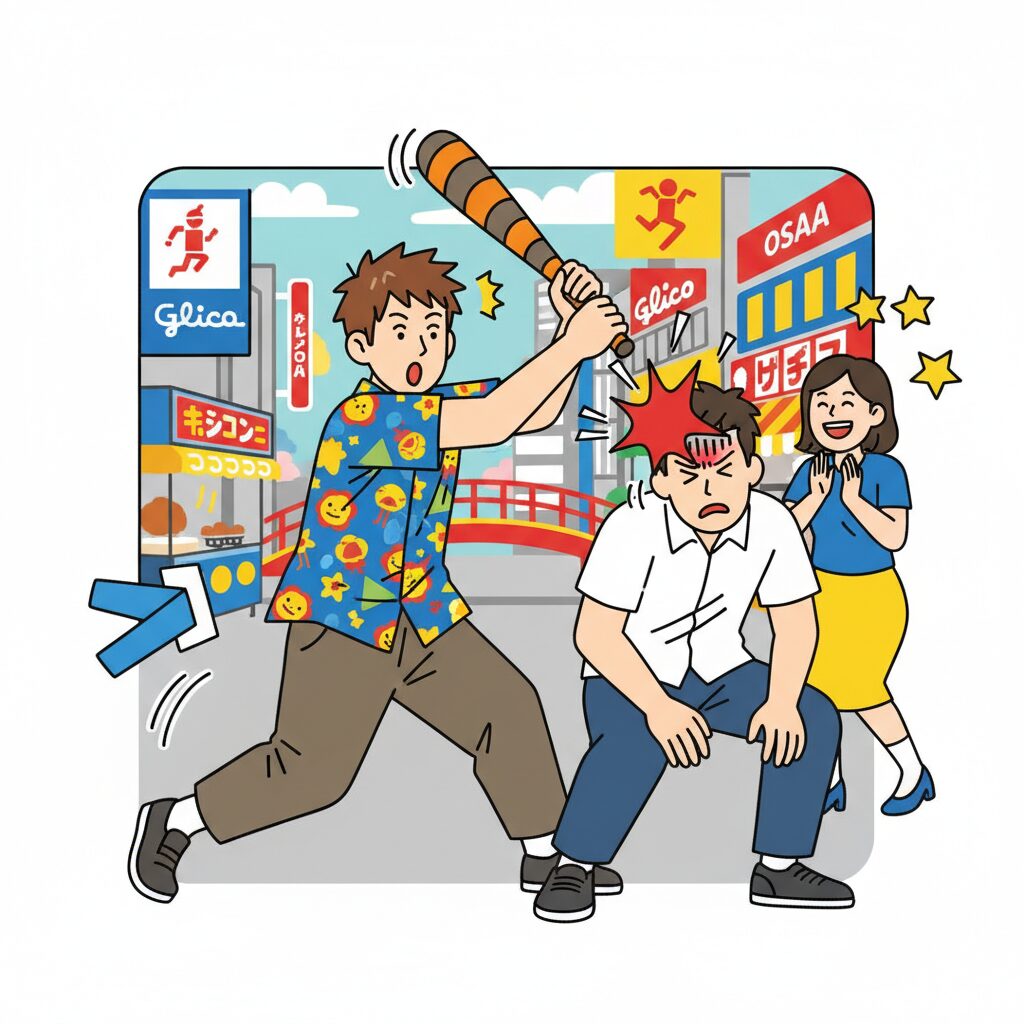
The ‘tsukkomi’, from the verb ‘tsukkomu’ (to thrust into or poke), is the one who delivers the resolution. They play the straight man in the routine. Their role is to promptly and sharply highlight the absurdity of the boke. The tsukkomi restores order to the conversation with a witty, sensible correction. Importantly, this isn’t a genuine scolding or angry rebuttal. It’s the verbal equivalent of a perfectly timed rimshot. It acknowledges the joke, validating the boke, and completes the comedic loop, eliciting laughter from both participants and any listeners.
In reply to the umbrella comment, the classic tsukkomi response would be a quick, sharp retort: “なんでやねん!” (Nande ya nen! – a phrase roughly meaning “Why?!” or “What are you talking about?!”). This isn’t a real question. It’s a formulaic reply that means, “I recognize your absurd statement, and I’m fulfilling my social role by calling it out, thereby concluding our shared joke.” This exchange sparks a small burst of shared energy, a moment of connection founded on mutual understanding of the unspoken rules.
More Than a Punchline: Why Tsukkomi is a Sign of Affection
A common and understandable misconception among foreigners is to view tsukkomi as rude, aggressive, or overly critical. In many Western cultures, and indeed in other regions of Japan, publicly and directly correcting someone, even humorously, can be considered a social faux pas. In Tokyo, for example, the prevailing social norm often values maintaining ‘wa’ (harmony) through indirectness and avoiding potential confrontation. A similar boke in a Tokyo context might be met with a polite, confused smile or simply ignored, subtly signaling a wish to return to safer conversational ground.
In Osaka, the opposite holds true. The greatest social misstep is not the tsukkomi; it is ignoring the boke. Leaving a boke unanswered is like rejecting a conversational offering. It’s like leaving a high-five hanging. It signals a lack of engagement, a failure to listen, or, even worse, a lack of a sense of humor. The tsukkomi, far from being an attack, is an act of social bonding. It conveys:
- “I am listening to you closely.”
- “I understand the game we are playing.”
- “I appreciate your wit and am sharp enough to respond in kind.”
- “We are close enough to have this kind of direct, playful exchange.”
This dynamic fosters a unique kind of intimacy. It enables people to bypass layers of formality and build a rapport based on shared cleverness and a willingness to be playful. It’s a shortcut to camaraderie. When a shopkeeper makes a tsukkomi at a customer’s expense, it signals familiarity, a way of saying, “You’re a regular, you’re one of us, so we can joke like this.” It’s a form of verbal grooming that strengthens social bonds.
A Foreigner’s Guide to Participation: The Tsukkomi Starter Kit
While mastering the art of tsukkomi requires time and deep cultural immersion, you can definitely begin participating. The key is to start small, listen closely, and apply your new skills in the appropriate context. It’s a performance art, and like any performance, you need to read the room.
Reading the Invitation: How to Spot a Boke
Recognizing a boke is half the challenge. It’s rarely obvious as a joke. You have to watch for subtle signs that disrupt the normal flow of conversation. Is someone making a wildly exaggerated statement? Are they using a deadpan tone to say something completely absurd? Is there a mischievous glint in their eye? For example, if you’re eating something delicious and your friend says with a straight face, “This tastes terrible, like old shoes,” that’s your cue. They aren’t insulting the chef; they are inviting a tsukkomi.
Your First Lines: Essential Tsukkomi Phrases
Having a few key phrases ready is essential. Your delivery should be quick and lively, not overthought or hesitant. Timing is everything.
- なんでやねん! (Nande ya nen!): The quintessential Osaka tsukkomi. It’s your all-purpose phrase, perfect for almost any situation. It means “Why?!”, “What the hell?!”, or “That makes no sense!”
- あほか! (Aho ka!): Literally “Are you an idiot?!” While it sounds harsh, among friends it’s a very common and affectionate tsukkomi. Use it with caution until you have a good rapport with someone. It’s like a playful shove in words.
- ほんまかいな (Honma kai na?): “Really?” or “Are you serious?” This is a softer tsukkomi, expressing disbelief. It’s a good beginner option if you’re not comfortable with more forceful phrases yet.
- あるかい! (Aru kai!): A retort meaning “As if!” or “No way!” Often used to dismiss a ridiculous suggestion or claim.
Mind the Gap: When to Hold Your Fire
This is perhaps the most important rule for newcomers. Tsukkomi depends on context. A perfectly appropriate tsukkomi among friends at an izakaya could ruin your career in a corporate meeting. Here are some guidelines:
- Hierarchy is Real: Don’t try to tsukkomi your boss, an elderly stranger, or anyone in authority unless they have clearly and repeatedly invited that kind of interaction.
- Read the Relationship: Tsukkomi is for people who already share or want to build a friendly, informal bond. With new acquaintances, it’s best to wait and get a sense of their communication style first.
- Distinguish Joke from Fact: The biggest pitfall is mistaking a sincere statement or honest mistake for a boke. If you tsukkomi someone for a real error, you’re not playing along; you’re just being rude. When in doubt, a gentle “Honma kai na?” is safer than a full-throated “Nande ya nen!”
Tsukkomi on the Streets: Scenes from Daily Osaka Life
Once you start tuning into it, you’ll notice the boke-tsukkomi rhythm everywhere. It’s the city’s ambient soundtrack.
The Takoyaki Stand Banter
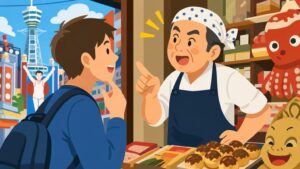
A customer points at the sizzling octopus balls. Customer (Boke): “Just give me the one that’s the most burnt. I like the charcoal flavor.” Vendor (Tsukkomi): “Aho ka! I’m a professional, I don’t burn any of them! You’ll get the best one and you’ll like it!” Both laugh. The transaction becomes more than just about food; it transforms into a shared moment of entertainment.
The Neighborhood Greengrocer
An elderly woman inspects a cucumber. Woman (Boke): “This cucumber is so bent! It must have had a hard life. You should give it to me for half price out of pity.” Shopkeeper (Tsukkomi): “Akan! That bent one has the most flavor! It costs double for character!” She chuckles, pays full price, and the bond between shopkeeper and regular customer is strengthened.
The Office Exchange
Two colleagues face a tight deadline. Colleague 1 (Boke): “I think I’ll just go home now. This report will magically finish itself by morning, right?” Colleague 2 (Tsukkomi): “Yeah, and I’ll be the one magically doing it for you! Get back to work!” The tension is briefly broken by a shared laugh, making the stressful situation a bit easier to handle.
The Architecture of Connection: Beyond Comedy to Community

Ultimately, the widespread presence of the boke and tsukkomi culture reveals something essential about the Osakan mindset. It reflects a history shaped by merchants and artisans rather than samurai and bureaucrats. In the competitive, fast-moving world of commerce, quickly building rapport was crucial for survival. You had to assess a person’s character, establish trust, and close deals with speed and wit. This direct, transparent, and human-focused style of communication became a cultural strength.
Tsukkomi is the contemporary expression of that spirit. It serves as a form of social efficiency, cutting through layers of pretense to forge an honest connection. It prioritizes active engagement over passive harmony. It embodies a deep-rooted belief that every interaction, no matter how ordinary, is an opportunity to create a small moment of shared joy. It represents a ‘service’ mindset, where everyone plays a role in making the collective experience more lively and entertaining.
For foreigners learning to live in Osaka, embracing this dynamic is transformative. It gives you permission to be more direct, playful, and verbally engaged than you might be elsewhere in Japan. It’s the recognition that the loud conversation you overheard wasn’t an argument, but an invitation. And when you finally spot your first boke and deliver your first tentative ‘Nande ya nen!’, the laughter you receive in return will be the sound of a city welcoming you not only as a resident but as a fellow participant in its wonderfully chaotic and deeply human comedy.