You hear it before you see it. The cadence of a conversation in Osaka is just different. It’s faster, the peaks are higher, the laughter is louder. And if you’re here to work, you’ll find that rhythm pulses right through the office walls. My first business meeting in this city felt less like a formal procedure and more like a high-speed negotiation at a market stall. My Tokyo colleagues had prepped me with binders of data and flowcharts for every contingency. I walked in ready for a slow, deliberate dance of consensus-building. Instead, after a quick greeting and a cup of tea, the company president leaned forward, looked me straight in the eye, and asked, “So, what’s the bottom line? Is this going to make us money?” The directness was a splash of cold water. In Tokyo, that question might be hinted at after an hour of careful context-setting. Here, it was the starting pistol.
This isn’t rudeness. This is Osaka. This is a city built not on the rigid honor codes of samurai and shoguns, but on the pragmatic, fast-moving, and deeply human principles of the merchant. To understand how to live and work here, you have to understand the city’s animating force: ‘Akindo Gokon’ (商人根性), the merchant spirit. It’s a concept that’s as fundamental to Osaka as the castle that looms over its center. It dictates the pace of life, the style of communication, and the very definition of a successful relationship, both in and out of the workplace. It’s the invisible software running on this city’s hardware, and if you don’t learn the code, you’ll constantly be getting error messages. This isn’t just about business; it’s a philosophy for life that has shaped one of Japan’s most dynamic, and often misunderstood, urban centers.
To fully appreciate Osaka’s dynamic urban spirit, consider exploring the vibrant realities of its shotengai life.
The Merchant’s DNA: Where Akindo Gokon Comes From
To understand Osaka, you need to look back in time. While Edo (modern-day Tokyo) was established as Japan’s political and military center—a city of warriors and bureaucrats governed by strict protocols—Osaka was shaping a very different identity. It became the commercial heart of the nation, where goods from every corner of Japan were gathered, stored, and traded. This earned it the nickname ‘Tenka no Daidokoro’—the Nation’s Kitchen.
A City Built on Rice and Profit
Picture a city where the most influential figures weren’t sword-wielding samurai but savvy rice brokers. The Dojima Rice Exchange, founded in the late 17th century, was among the world’s first futures markets. Here, fortunes were made and lost not on the battlefield, but on the trading floor. This history is woven into Osaka’s very fabric. The city’s heroes aren’t stoic warriors; they’re clever merchants who outsmart rivals, build empires from the ground up, and understand that money, not military power, truly drives the world. This creates a fundamental difference in mindset from Tokyo. In Tokyo, the system, process, and hierarchy often dominate. Its cultural DNA derives from a bureaucracy designed to maintain order. In Osaka, the goal is paramount. The culture stems from a marketplace built to generate profit. The system is merely a tool to achieve that end, and if the tool proves inefficient, an Osakan will readily seek a better one.
The Philosophy: Profit with a Human Touch
Hearing ‘merchant spirit’ might conjure images of ruthless, cutthroat profit-seeking, but that’s a misunderstanding of Akindo Gokon. The idea is more subtle. It involves ‘shobai’ (商売), meaning business, but with a sense of creating win-win situations. A truly skilled Osaka merchant knows the best deal is one where everyone feels they’ve gained value. Why? Because that person will return. Your reputation and network of trusted partners are your greatest assets—far more valuable than the cash from a single transaction.
Here the human element is essential. In Osaka, business is personal. While contracts matter, it is the handshake and the relationship behind it that truly seal the deal. This sharply contrasts with the more impersonal, process-driven corporate culture found elsewhere. Loyalty here is often directed not toward an abstract corporate entity, but to the specific people you work with, the partners you trust, and the shared ambition to see a venture succeed. It’s a pragmatic loyalty rooted in mutual benefit and respect, and it’s a powerful force.
The Osaka Meeting Room: Unspoken Rules and Rhythms
The professional environment in Osaka is shaped by a distinctive set of social and communicative signals. The boardroom atmosphere here is unique, negotiations follow a different playbook, and grasping this rhythm is essential for success. It’s a performance where efficiency, personality, and a keen sense of value take center stage.
Speed, Straight Talk, and ‘So, How Much?’
Forget the lengthy introductions and subtle indirect hints that often define business in Japan. Meetings in Osaka dive straight into the core issue with remarkable speed. Initial pleasantries are sincere but brief, aimed at quickly assessing your character: Are you trustworthy? Are you direct? Once this is established, the conversation shifts entirely to business. Time is money, and wasting it on unnecessary small talk is considered a serious offense. It’s not only inefficient; it’s seen as disrespectful to the other party’s time and resources.
This is why the well-known Osaka phrase, ‘De, nanbo nan?’ (‘So, how much is it?’) is so iconic. It perfectly embodies this results-driven mindset, cutting through the clutter to focus on the key element of any business deal. For foreigners used to a more roundabout style, this can feel abrupt. But in Osaka, it’s a mark of respect. It shows the other party is taking your proposal seriously and wants to engage with the actual details. They aren’t interested in business theatrics; they want the deal.
The Power of the Personal Connection
While conversations are direct and focused on results, the decision-making process is deeply personal. Numbers on a spreadsheet tell only part of the story. The other equally important factor is the person presenting them. An Osakan businessperson constantly asks: ‘Do I like this person? Do I trust them? Can I envision working with them long-term?’ Here, the city’s famed friendliness becomes a strong business advantage.
Building rapport is vital, but it’s an active, lively process. It happens through sharp banter, shared laughter, and showing that you’re an ‘ee hito’—a good person. It’s about proving you have common sense, a sense of humor, and a practical problem-solving attitude. They want to see the real you, not a polished corporate robot. If they feel a connection and decide you’re their type of person, doors open that no amount of data could unlock. The deal transforms into a partnership, a collaboration between people who respect and understand each other.
The ‘Nomiya’ Negotiation
This focus on personal connection means some of the most crucial business takes place outside the office. The ‘nomikai,’ or after-work drinking party, is a staple of Japanese corporate culture, but in Osaka, it has a distinct role. In Tokyo, it can be a structured event reinforcing office hierarchy. In Osaka, it’s where genuine conversations happen. Over plates of yakitori and glasses of beer, formal facades drop.
This is the second phase of negotiation. Issues too delicate for the formal meeting are openly discussed. Creative solutions emerge. The real sticking points in a deal are identified and often resolved. It’s a fluid, dynamic setting where a well-timed joke can be as persuasive as a well-formulated argument. For anyone working here, skipping these events means missing the real discussion. Agreements made in the boardroom often merely formalize the understanding reached in the izakaya the previous night.
Navigating the Osaka Workplace: Hierarchy, Humor, and Hustle
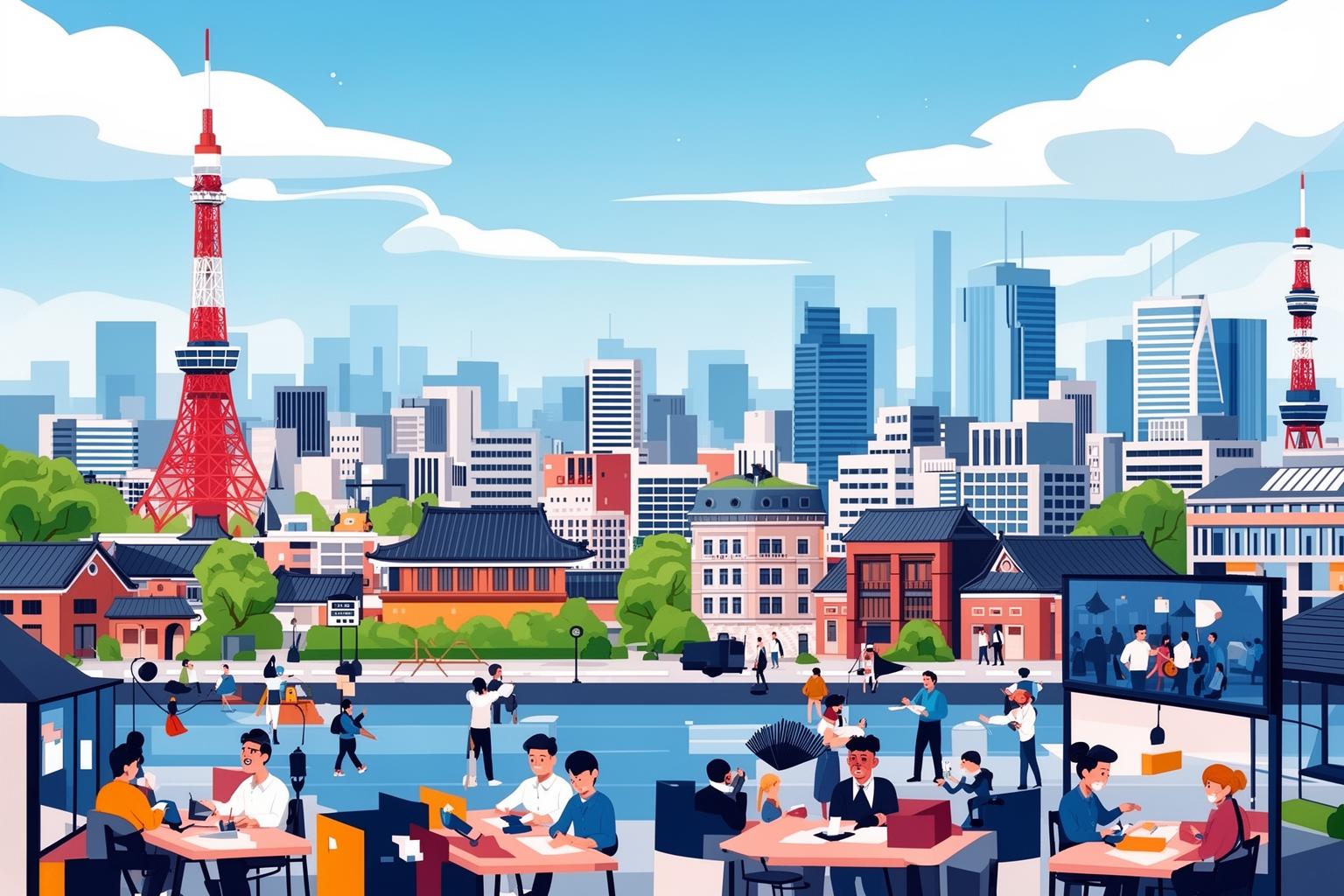
Step inside an Osaka office, especially in a small or medium-sized enterprise that serves as the backbone of the local economy, and you’ll notice a distinct energy. The corporate culture directly embodies the Akindo spirit—pragmatic, people-focused, and constantly evolving.
Flatter Structures, Faster Decisions
Unlike the towering, multi-layered hierarchies typical of major Tokyo corporations, many Osaka companies maintain a notably flat structure. The ‘shacho’ (company president) is often not isolated in a top-floor office but actively involved in daily operations, with their desk right on the main floor. This accessibility is transformative, significantly accelerating the decision-making process.
There’s less reliance on ‘nemawashi,’ the lengthy practice of quietly building consensus by consulting every stakeholder along a chain of command. In Osaka, the ideal is to gather the key people for a straightforward discussion and have the person with decision-making authority decide on the spot. This agility and speed are regarded as a major competitive edge. As the world changes rapidly, Osaka businesses pride themselves on their ability to quickly pivot and seize opportunities while larger rivals are still organizing meetings.
Humor as a Business Tool
This is often the biggest culture shock for foreigners. In many professional settings, humor is viewed as frivolous or as a sign of not taking work seriously. In Osaka, it’s a vital skill. Laughter acts as a lubricant for business. It’s used to build relationships, ease tension during tough negotiations, and create a shared sense of purpose.
The comedic duo dynamic of ‘boke’ (the funny one) and ‘tsukkomi’ (the straight one) that characterizes Japanese manzai comedy plays out on a smaller scale in daily office interactions. A sharp, witty remark or clever observation signals intelligence and social awareness. It shows quick thinking. Being overly stiff, formal, or literal can make you seem difficult or unapproachable. Appreciating this ongoing undercurrent of humor is essential. Participating, even modestly, will earn you tremendous respect and goodwill.
The ‘Can-Do’ Attitude and Frugality
The merchant spirit fosters a strong sense of resourcefulness. The mindset isn’t “Is this possible according to procedure?” but rather “How can we make this happen?” There’s a hustle culture that values creative problem-solving and a readiness to bend rules when common sense calls for it. Alongside this is a profound appreciation for frugality, which is often stereotyped as Osakans being ‘kechi’ or stingy.
However, this is a crude misunderstanding. The true concept is ‘shimatsu,’ the art of eliminating waste and maximizing what you have. It’s not about being cheap; it’s about being smart with resources. This shows up in many workplace practices: turning off lights in empty rooms, using both sides of paper, and negotiating fiercely with suppliers for the best possible price. This isn’t seen as poverty or desperation; it’s a source of pride. It demonstrates sharp business acumen. Wasting money is just bad business, and in Osaka, there’s no greater sin.
Common Misunderstandings and How to Adapt
Foreigners arriving in Osaka often interpret their experiences through the perspective of what they know about Japan, which is usually centered on Tokyo. This can result in various misunderstandings. Grasping the reasons behind Osaka’s distinctive behaviors is the first step to adapting and thriving here.
Misunderstanding: ‘They’re just being cheap.’
When you notice your boss carefully calculating the cost-benefit of purchasing a new coffee machine or negotiating for a ten-yen discount on a bulk order, it’s easy to label it as stinginess. In truth, they are strongly value-driven. An Osakan will eagerly spend a lot on something if convinced of its worth and potential return on investment. The focus is always on ‘cospa,’ or cost performance.
Practical tip: When pitching an idea, project, or product, lead with the value proposition. Don’t just describe features and quality abstractly. Frame everything in terms of how it will either generate revenue or save money for the company. Provide clear, practical evidence of its ROI. If you prove the value, you’ll find them enthusiastic and decisive investors.
Misunderstanding: ‘Their directness is rude.’
After weeks of carefully building a relationship with a prospective client, being asked “So are we doing this or not? My time is valuable” can feel like a blow. It might seem like all your efforts at establishing rapport have failed. But often, it’s quite the opposite. This directness signals that they’ve moved beyond pleasantries and are seriously considering the business proposal. They view beating around the bush as dishonest, a way to string someone along. A clear ‘no’ is seen as kinder than a vague ‘maybe.’
Practical tip: Expect direct questions early and often. Have your numbers, timeline, and non-negotiables ready before you enter the room. Don’t take direct questions personally; welcome them. Answer clearly and confidently. This directness invites an honest conversation, and responding with clarity will build trust faster than anything else.
Misunderstanding: ‘They are not serious because they joke around.’
In a tense negotiation, the other party might suddenly make a joke seemingly out of nowhere. It’s easy to misinterpret this as a lack of seriousness or a sign they aren’t treating the matter with the gravity it deserves. The truth is, humor is a strategic tool. It’s used to ease tension, re-establish human connection when things get adversarial, and foster an atmosphere where a mutually beneficial agreement can be reached. They are absolutely serious about the outcome; they simply believe a positive, collaborative environment is the best way to achieve it.
Practical tip: Loosen up a bit. Show your human side. You don’t need to be a comedian, but smiling, appreciating their jokes, and perhaps offering some light, self-deprecating humor will demonstrate you’re not a robot. It signals social intelligence and a willingness to engage on their terms. Just be sure to follow the laughter with a focused attention on the business at hand. The blend of warmth and competence defines the Osaka style.
Living the Akindo Life: How It Spills into Daily Interactions
The merchant spirit isn’t something people simply put on when they head to the office and take off when they go home. It’s a core part of the local culture that influences every aspect of daily life. You can see and feel it everywhere, from the lively shopping arcades to the quiet exchanges in neighborhoods.
The Art of the Bargain
Stroll through any shotengai, the covered shopping arcades that serve as the heartbeat of Osaka’s communities. The interactions here exemplify the Akindo spirit. Shopping is not just a silent, impersonal transaction—it’s a conversation. You chat with the fruit vendor about the weather, you compliment the butcher on their cuts of meat. This exchange is part of the experience. Often, it leads to the charming ritual of bargaining or an ‘omake’—a little extra given for free as a gesture of goodwill. It’s not about fiercely haggling over every yen; it’s a custom that strengthens the human bond between buyer and seller. It’s a small, daily ‘shobai’ that leaves both parties feeling satisfied.
A Community Built on Mutual Favors
This transactional yet deeply human approach extends to community life. There’s an unspoken norm of mutual support. Your neighbor might share their leftover curry with you, and you’ll return the kindness with some fruit you bought. The local bar owner might let you run a tab if you forget your wallet because they trust you will pay. This isn’t just random generosity; it reflects the merchant’s logic applied to social capital. Building a network of people you can depend on, and who can depend on you, is the wisest investment you can make. It forms a safety net and a sense of belonging that often feels stronger and more tangible than in more impersonal, transient cities. In Osaka, your reputation as a good neighbor holds as much weight as your business reputation.