
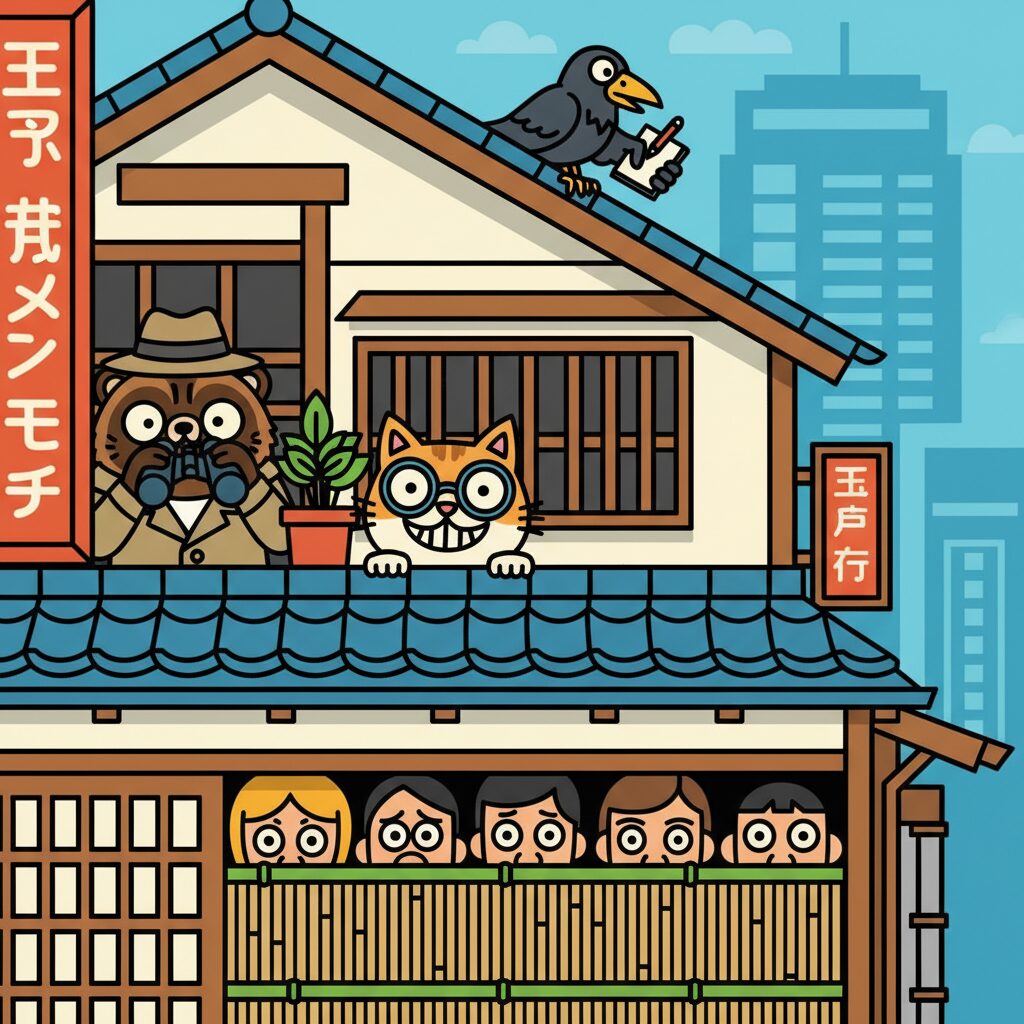
Welcome to Osaka, a city that moves to a different beat. You’ve probably heard the clichés: the food is incredible, the people are loud, and the vibe is a world away from the buttoned-up precision of Tokyo. But once you start living here, you’ll discover a cultural quirk that guidebooks rarely explain, a social phenomenon that will either charm you completely or drive you up a wall. It’s a force of nature called ‘Osekkai’. Picture this: you’re a newcomer, trying to find your footing. You’re wrestling with your garbage bags, utterly bewildered by the city’s labyrinthine sorting rules. Suddenly, an elderly woman you’ve never met marches over, tuts disapprovingly, and starts rummaging through your trash, explaining exactly what you’ve done wrong in rapid-fire, indecipherable Kansai-ben. Or maybe you’re at the checkout, and the cashier isn’t just scanning your items; she’s providing a running commentary. “Only instant ramen again? You’re young, you need to eat proper vegetables!” In Tokyo, such an intrusion would be unthinkable. It would violate the unspoken social contract of polite, respectful distance. But here in Osaka, this isn’t rudeness. This is connection. This is the city’s way of pulling you into its orbit. This is Osekkai—a brand of meddlesome kindness that defines daily life. It’s a culture of caring so intense it blurs the line into nosiness, and learning to navigate it is the true key to unlocking the heart of this magnificent, maddening, and deeply human city.
Embracing the energetic spirit of Osekkai goes hand in hand with experiencing local life, and learning how the Osaka train system shapes daily connectivity can deepen your understanding of the city’s vibrant pulse.
What Exactly is ‘Osekkai’? Decoding Meddlesome Kindness
So what is this powerful social force that seems to shape half the interactions you’ll experience in Osaka? The term ‘Osekkai’ (お節介) roughly translates to ‘meddlesome’ or ‘officious’, but that clinical definition misses the heart of the idea. It’s not about being a busybody just for gossip’s sake. Osekkai is kindness in action. It’s proactive, unsolicited help and advice, given with the assumption that you belong to a community, and thus, your affairs are, to some extent, everyone’s concern. It acts as a social glue—sticky and sometimes a little messy—that binds the city’s neighborhoods together.
More Than Just a Helping Hand
In much of Japan, kindness is reactive. You drop your wallet, and someone politely taps you on the shoulder to return it. You look lost, and someone might tentatively ask if you need directions. Osekkai is different. It’s a preemptive act of care. It doesn’t wait for you to seek help; it assumes you need it and steps in immediately. It’s the shopkeeper who notices you eyeing a daikon radish and spends ten minutes explaining her secret oden recipe, whether you wanted the info or not. It’s the man at the station who overhears your struggle to buy a ticket and takes over the machine, expertly pressing the buttons for you. It’s the neighbor who sees you brought home a new plant and knocks an hour later with special fertilizer, insisting your pot is facing the wrong way for optimal sunlight. This is more than friendliness; it is deep involvement. It’s a form of social participation that says, “We’re all in this together, so let me help you fix that.”
The Thin Line Between Caring and Prying
For many foreigners, especially those from cultures valuing individualism and privacy, Osekkai can feel like a direct invasion of personal boundaries. The questions can seem intensely personal: “Are you married?” “Why not?” “How much is your rent?” “You look tired; are you working too hard?” These aren’t small talk—they’re data gathering disguised as conversation. It’s easy to misinterpret this as rude intrusion, to feel judged or scrutinized. The natural reaction is often to withdraw, give vague answers, and try to escape. But to an Osakan, these questions aren’t breaches of privacy—they’re the foundation of a relationship. They’re trying to understand you, to locate you within their social network. Knowing your situation helps them offer more tailored, more ‘helpful’ Osekkai going forward. It’s a mindset rooted in the belief that a community thrives when its members are known—not as anonymous faces in a crowd, but as individuals with stories, struggles, and questionable taste in instant noodles.
The Osaka-Tokyo Divide: A Tale of Two Social Contracts
To truly understand the essence of Osekkai, you need to recognize how fundamentally different the social climate in Osaka is compared to Tokyo. The two cities embody opposite ends of the Japanese social spectrum. Living in one after the other feels like relocating to a different country, where all the unspoken societal rules have been completely rewritten. The contrast goes beyond accents or attitudes; it speaks to the very definition of what it means to coexist in a densely populated urban environment.
Tokyo’s Cool Distance vs. Osaka’s Warm Intrusion
Tokyo functions on the principle of elegant, efficient anonymity. The city is a model of public order, grounded in the idea of ‘meiwaku’—the concept of not disturbing or inconveniencing others. You keep to yourself on the train. You avoid loud phone calls. You maintain a polite, invisible bubble around yourself while respecting those of others. This creates a smooth, frictionless society where millions coexist in close quarters without conflict. It’s calm, predictable, and for many, comforting. Osaka, in contrast, sees that invisible bubble and immediately bursts it with a friendly poke. The social contract here isn’t about avoiding inconvenience; it’s about active involvement. Silence in a small ramen shop feels awkward. Not talking to the person beside you at the bar is considered somewhat odd. The city’s background noise is the sound of people connecting—laughing, bargaining, and yes, meddling. In Tokyo, you’re a silent passenger on a perfectly synchronized train. In Osaka, you’re a participant in a lively, ongoing street festival.
The Historical Roots of Osekkai
This cultural difference is not a recent phenomenon; it’s embedded in the cities’ histories. Tokyo, formerly Edo, was the city of samurai and bureaucrats. It was a place defined by hierarchy, rules, and formality. Social interactions followed strict structures and the need to maintain face. Osaka, on the other hand, was known as the ‘kitchen of the nation,’ a city of merchants (‘shonin no machi’). For centuries, commerce was its lifeblood. In a merchant town, your reputation was everything. Business wasn’t conducted through impersonal transactions but through relationships built on trust, banter, and a nuanced understanding of your customers and competitors. You needed to know who was trustworthy, who was struggling, and who was about to make a major move. This necessity permeated everyday life, cultivating a culture where being involved in your neighbors’ affairs wasn’t just accepted; it was crucial for survival and prosperity. Osekkai, therefore, is not merely a personality trait; it’s the enduring spirit of the shonin—a practical, community-focused mindset where human connection is the greatest form of currency.
Navigating Osekkai in Your Daily Osaka Life
Understanding Osekkai in theory is one thing; experiencing it in everyday life is quite another. It tends to catch you off guard in the most ordinary moments, turning a simple trip to the store or a casual walk around the block into an unpredictable social adventure. The key lies in learning to recognize the patterns and grasp the unwritten rules that guide these interactions.
The Supermarket Interrogation
Consider a typical scenario: you’re at your local ‘supa’. You’re simply picking up some milk and bread. The elderly woman behind you in line glances into your basket. “Oh, that’s the expensive bread,” she might say, not judging, but in a friendly, conspiratorial tone. “If you go to the bakery down the street after 7 PM, they sell theirs for half price. Much better.” Before you can even take this in, the cashier chimes in, holding up your block of curry roux. “Are you making curry? You know, if you add a little instant coffee and a square of dark chocolate, it makes the flavor much deeper.” This isn’t an attempt to sell you something—it’s a genuine, unsolicited cooking tip from a stranger. The initial response is often confusion. Why do these people care about what I’m eating or how much I’m spending? The answer is simple: they see you. You’re not just another customer; you’re their neighbor who’s cooking curry tonight, and they want you to make the best curry possible.
The Neighborhood Watch You Didn’t Sign Up For
Your apartment building and the surrounding streets are the main Osekkai hotspots. Your neighbors aren’t passive onlookers; they’re active gatherers of information, motivated by a strong mix of curiosity and communal care. If you bring a friend home, expect your landlady or the woman who’s always sweeping her stoop to ask, “Who was that nice young man who visited yesterday?” It’s not a suspicion—it’s an update to their mental map of who’s coming and going in the neighborhood. If you come home late at night, don’t be surprised when your neighbor spots you the next morning. “You were out late! Having fun? Don’t wear yourself out!” This constant, low-level monitoring can feel overwhelming at first, but it helps to see it differently. This is the neighborhood’s natural security system. These are the people who will notice if your mail starts piling up. They’re the ones who’ll spot anyone dubious lurking nearby. They are watching, yes—but they’re also watching out for you.
The Unsolicited Gift of Food (and Obligation)
One peak Osekkai moment is the unexpected knock on your door. You open it to find a neighbor offering a plate of food—some tempura they made too much of, a few skewers of yakitori from a local festival, or a container of simmered daikon. This is called ‘osusowake‘, the custom of sharing surplus. It’s a gesture filled with warmth and inclusion. Accepting it, however, involves entering a social contract. The first rule is never to return the dish empty-handed. You must wash it and, at some later time, reciprocate with a small gift of your own—cookies you bought, a piece of fruit, or something you made. This creates an ongoing, gentle cycle of giving and receiving. It’s a way to check in and maintain a connection that goes beyond a simple nod in the hallway, weaving you into the fabric of the community, one plate of pickles at a time.
How to Respond and Turn Osekkai into an Asset
Your attitude toward Osekkai will shape your entire experience of living in Osaka. If you resist it, build barriers, and retreat into a private shell, you’ll perceive the city as cold and intrusive. However, if you learn to embrace it and engage with the dynamic, you’ll discover an incredible source of support, friendship, and belonging.
Embrace the Chaos: Don’t Withdraw
When faced with a flood of personal questions or unsolicited advice, many foreigners instinctively respond with a tight smile, vague answers, and a quick exit. In Osaka, this behavior can be misunderstood as coldness or arrogance. A better approach is to engage. If a cashier comments on your cooking, laugh and ask for another tip. If your neighbor inquires about where you’re headed, share your plans and ask about theirs. By revealing a small part of your life, you show openness to being part of the community. You communicate that you understand the local way of connecting, which is based not on privacy but participation. This doesn’t mean sharing your deepest secrets, but offering a little of yourself goes a long way.
Master the Art of the ‘Tsukkomi’
Osaka’s culture is deeply rooted in the comedy style of ‘manzai‘, a duo of a funny man (‘boke’) and a straight man (‘tsukkomi’). The tsukkomi reacts to the boke’s absurdity with quick, witty remarks. This pattern influences daily conversations. When an Osakan offers a piece of Osekkai, they are often, consciously or not, playing the role of the boke. A skillful response is a gentle tsukkomi. For example, if your landlord says, “You have a lot of empty bottles here! Drinking too much?” instead of becoming defensive, you might reply with a grin, “I’m supporting the local economy! You should be thanking me!” This playful exchange is at the core of Osaka communication. It eases potential discomfort and turns an intrusive moment into shared humor and connection. Mastering this will earn you great respect.
View Osekkai as Your Safety Net
The greatest advantage of enduring all the meddling is the development of a strong, informal support network. This is the true gift of Osekkai. In the vast anonymity of Tokyo, if you fall ill, you might be alone for days. In Osaka, the neighbor who comments on your trash will likely be the first to notice if it hasn’t been taken out in a week and will come knocking with a container of rice porridge. When you struggle to understand a tax form in the mail, the nosy shopkeeper is the person you can ask for help—she’ll probably sit down with you for an hour to sort it out. This web of watchful, caring neighbors is an invaluable resource, especially for foreigners navigating the challenges of life in a new country. They become your emergency contacts, cultural interpreters, and first defense against loneliness.
The Takeaway: Osaka’s Love Language is Involvement
Ultimately, Osekkai is a choice. It represents a city’s collective decision to value community over privacy, engagement over anonymity. It can be messy, inconvenient, and at times downright exhausting. The constant buzz of social interaction isn’t for everyone. If what you seek in life in Japan is quiet, orderly predictability, the calm and respectful distance of Tokyo may suit you better. But if you came to Japan looking for connection, if you want to experience the vibrant, chaotic heartbeat of a city, then Osaka and its Osekkai culture could be the perfect fit. You give up a bit of your personal space, but what you gain is far more precious: a safety net woven from casual conversations, a sense of belonging built around shared bowls of soup, and the understanding that you’re not just living in a city—you’re a part of it. Embracing the meddlesome kindness of your Osaka neighbors means learning to speak the city’s true language. And once you’re fluent, you’ll discover that you haven’t just found a place to live; you’ve found a home.








