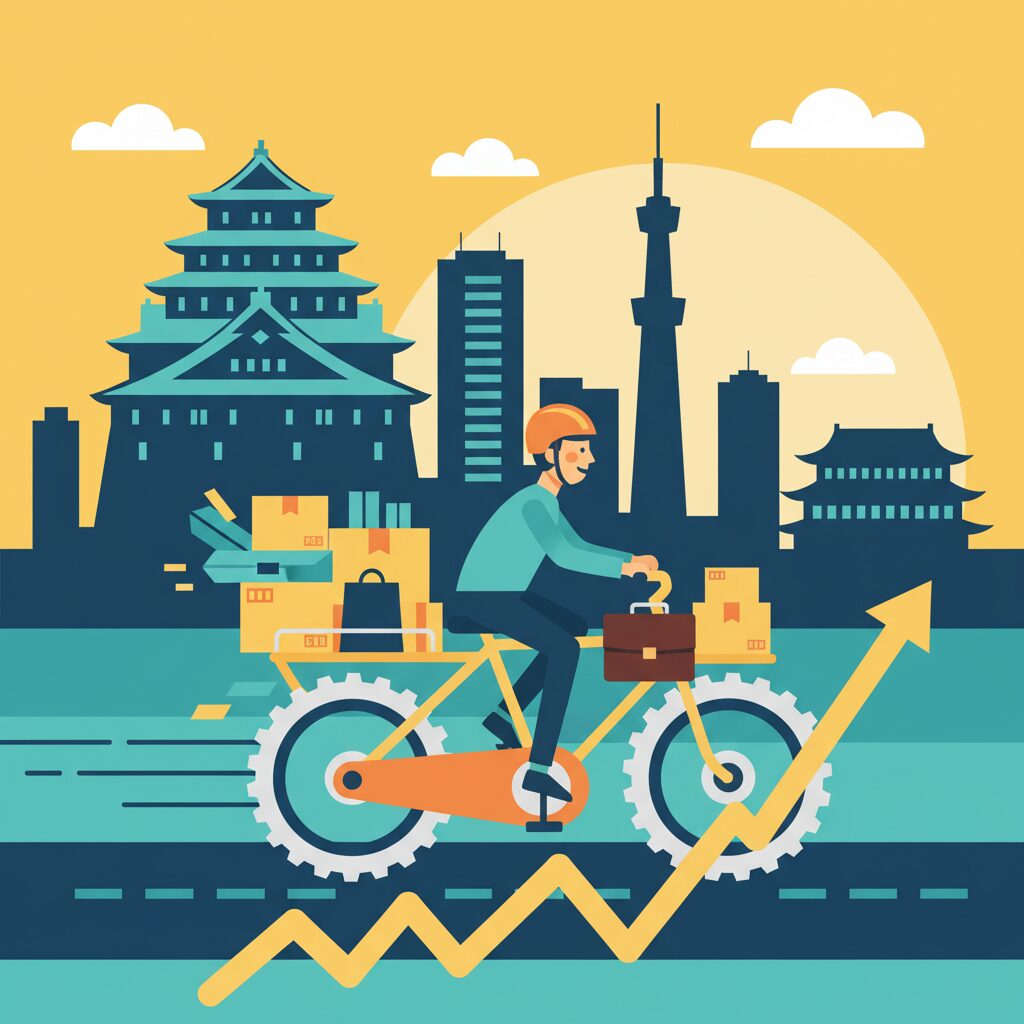
You see it in the first five minutes you’re here. A mother, a toddler strapped to the back seat, a basket full of groceries, pedaling with the steady, unhurried rhythm of a metronome. You see a high school student in a crisp uniform, one hand on the handlebars, the other holding a smartphone, weaving through the afternoon crowds of a shopping arcade. You see a salaryman, suit jacket folded neatly in his front basket, gliding silently toward the nearest JR station. The bicycle, in Osaka, is not a hobby. It’s not a choice for the environmentally conscious or a tool for athletic weekend warriors. It is the city’s circulatory system, the unspoken default for life lived on a human scale. It’s the answer to a question you haven’t even asked yet.
Foreigners often see the swarms of bikes and think, “Ah, a cheap way to get around.” And they’re not wrong, but they’re not entirely right, either. Viewing the bicycle through a simple lens of “cost-saving” is like describing a plate of takoyaki as just “fried octopus.” You miss the texture, the technique, the entire cultural context. The bicycle in Osaka isn’t just about avoiding a train fare; it’s a complex economic instrument that fundamentally reshapes your relationship with the city’s geography, your monthly budget, and your perception of time and distance. It’s the key that unlocks the city’s true layout, revealing a map based not on train lines, but on fifteen-minute pedal strokes. This isn’t about sightseeing. This is about understanding the financial and logistical engine of daily life in a city that always prizes pragmatism over polish.
Complementing its well-worn cycle network is Osaka’s pragmatic spirit, which shines through in the city’s direct merchant communication style that defines everyday interactions.
The Initial Investment: More Than Just the Bike
Your initial step into Osaka’s cycling scene starts with a decision, but it soon escalates into a series of small, unavoidable expenses that many newcomers completely miss. This isn’t just a straightforward cash-for-bike deal; it’s an introduction to a regulated system, and understanding these initial costs is essential for comprehending the true bicycle economy.
Selecting Your Ride: The Mamachari vs. The Alternatives
The undisputed, heavyweight champion of Osaka’s streets is the mamachari, or “mom’s chariot.” This is the quintessential Japanese utility bike. It’s heavy, slow, and built like a tank. It comes standard with a front basket, a built-in wheel lock, a kickstand sturdy enough to support a small car, a chain guard to protect your trousers, and often a rear rack designed for a child seat. To an outsider, it may seem clunky and old-fashioned. To an Osakan, it’s perfect. It’s not meant for speed; it’s meant for everyday life. It’s ideal for hauling a week’s worth of groceries from Mandai supermarket, for taking your child to the local clinic, or for a quick trip to the post office. A brand-new, single-speed mamachari can be purchased for as little as 15,000 yen. It’s a reliable workhorse, not a show pony.
Naturally, there are other possibilities. Younger riders might prefer a sleeker cross bike. Some favor the convenience of a folding bike for easier train travel on longer trips. But the real game-changer in recent years is the electric-assist bicycle, or denki-jitensha. These are the supercharged mamacharis you see effortlessly climbing bridges. They represent a significant financial investment, often costing well over 100,000 yen, but are considered worthwhile for parents ferrying multiple children or anyone with a hillier commute. The used bike market is also a huge, thriving ecosystem, with shops like Cycle Paradise offering refurbished bikes at a fraction of the new price. Regardless of your choice, however, the purchase is only the beginning.
The Mandatory Bureaucracy: Registration and Insurance
After you pay for your bike, you can’t simply ride away. The shop owner will ask for about 600 yen for the jitensha bouhan touroku, or bicycle crime prevention registration. This isn’t optional; it’s required by law. They will record your name, address, and phone number, then affix a small orange sticker with a unique registration number to your bike’s frame. This legally links the bicycle to you. If your bike is ever stolen and found, this is how the police contact you. If you’re stopped by police for a random check (which will happen), this is how they confirm you’re not riding a stolen bike. It’s a simple, low-cost procedure but the first layer of hidden administrative costs tied to bike ownership.
The second, more recent addition to these requirements is mandatory bicycle liability insurance. This became law in Osaka Prefecture a few years ago following several high-profile accidents, where cyclists—especially those on fast electric bikes—caused serious injuries to pedestrians, resulting in massive lawsuits. Many foreigners are completely unaware of this rule. The insurance itself isn’t expensive—you can get a basic plan for a couple thousand yen annually, often bundled with other insurance products or available at any convenience store kiosk. But the cost of going without it can be devastating. This mandate fundamentally changed the image of the bicycle from a simple, unregulated tool into a vehicle carrying real-world responsibilities and consequences. The era of carefree, consequence-free cycling is over.
The Running Costs: Maintenance, Parking, and Fines
The economic tale of your bicycle doesn’t conclude once you leave the shop. Instead, it transforms into a slow trickle of small, recurring expenses alongside the constant risk of larger, more punitive costs. These everyday outlays are what truly shape the bicycle-centric lifestyle, turning a simple machine into a regular item in your monthly budget.
Keeping It Rolling: The Neighborhood Bike Shop
Every neighborhood in Osaka boasts at least one: a small, cluttered bike shop, usually run by a quiet, weathered man who has seen it all. These shops are the unsung heroes of the city’s transportation network. They serve as pit stops where the daily challenges of city cycling are tended to. A flat tire, or panku, is the most frequent issue, a quick repair that costs about 1,000 yen. You’ll also stop by for brake adjustments, a new bell, or to oil a squeaky chain. These are minor expenses, but unavoidable.
One fascinating element of this system is the culture of the free air pump. Many bike shops, and some larger supermarkets, have a manual air pump chained outside for anyone to use, free of charge. It’s a small gesture but speaks volumes about the shared understanding that keeping the city’s bikes rolling is a collective responsibility. It acts as communal infrastructure, as essential and expected as a public mailbox. Here, the community aspect of the bike economy becomes evident—a support network that keeps the entire system running smoothly.
The Parking Predicament: Where to Leave Your Two-Wheeled Life
Here lies the single greatest source of stress, confusion, and unexpected expense for Osaka cyclists: parking. The romantic idea of leaning your bike against a lamppost and ducking into a café is just a fantasy. The reality is a relentless, high-stakes game of territorial Tetris. Major train stations, department stores, and even supermarkets are surrounded by designated bicycle parking lots, or churinjo. These come in two types: municipal lots and private lots.
Municipal lots near train stations are the most common. You can either pay a daily fee, usually 100 to 200 yen, or apply for a monthly contract, which ranges from 2,000 to 4,000 yen. Securing a monthly spot in a popular area, however, can be like trying to get tickets to a sold-out concert. Waiting lists are long, and the application process fiercely competitive. Private lots, often run by companies like Times, use automated systems where a metal lock secures your front wheel. They are generally free for the first hour or two and charge about 100 yen for every few hours after. Supermarkets and shopping centers use a similar system, offering the first couple of hours free if you validate your parking ticket with a purchase. This subtly encourages shopping, weaving parking costs into daily commerce.
The Impound Lot Tango: When Your Bike Disappears
What happens if you ignore the rules and park illegally? The temptation is always there. You’re just running in for five minutes. Everyone else does it. But this is a gamble you will eventually lose. The city deploys teams of workers who patrol the streets in small trucks, systematically collecting illegally parked bicycles. They are ruthlessly efficient. They leave a notice on the spot where your bike was, informing you of its capture.
This is when you encounter the true hidden cost of convenience: the impound lot tango. First, there’s the fine, typically around 2,500 to 3,500 yen. Second, you must prove the bike is yours, which is where that small orange registration sticker becomes your golden ticket. Third, you have to make a trip to the municipal bicycle impound lot, the jitensha hokanjo. These locations are notoriously inconvenient. They are vast, soulless fields of confiscated bikes, often situated beneath highway overpasses or in forgotten industrial corners of the city, far from the nearest train station. The journey to reclaim your bike is a punishment in itself—a long, frustrating trip to pay a fine for the privilege of retrieving the very transportation that would have eased the journey. Nearly every long-term resident has a story about their first trip to the impound lot. It’s a humbling, and costly, rite of passage.
The Unspoken Economics: Time, Access, and Opportunity
If the story ended with registration fees, parking charges, and impound fines, no one would bother with a bicycle. But the real economic brilliance of the Osaka bike lifestyle lies not in the expenses you face, but in the much larger costs you avoid. The bicycle is a tool that fundamentally reshapes your financial and geographical reality, unlocking savings that far outweigh the modest costs of its upkeep.
The 15-Minute Kingdom: Redefining Your Neighborhood
Without a bike, life in Osaka revolves around the train station. Your world shrinks to the 10-minute walking radius around your apartment and nearby station. This is the bubble you live in. A bicycle breaks that bubble. Suddenly, your effective neighborhood expands from a small circle into a vast, interconnected kingdom. An area that was a 20-minute walk away now becomes a 7-minute ride. A different train line that was previously an inconvenient walk turns into an easy connection.
Take living near Nagai Park in the south of the city as an example. On foot, you are confined to the Midosuji subway line. With a bike, you can effortlessly reach the JR Hanwa line to the east or the Tanimachi line to the west. You can access the extensive Komagawa Nakano shopping street, known for its affordable produce and lively vibe. You gain entry to multiple supermarkets, enabling you to shop for groceries in a way that’s impossible on foot. You discover local bakeries, hidden coffee shops, and family-owned restaurants that you wouldn’t find if you only stuck to the main roads. The bicycle transforms the city from a collection of disconnected station nodes into a continuous, explorable terrain. This access directly benefits your wallet, saving you money on everything from vegetables to haircuts.
Dodging the Train Fare Trap
Osaka’s public transport system is excellent, but it’s operated by a patchwork of competing private companies. JR, Hankyu, Hanshin, Kintetsu, Nankai, and the Osaka Metro all operate their own lines, and they don’t integrate smoothly. A short trip involving a transfer between two companies means paying two separate fares. For example, traveling from Umeda (served by JR, Hankyu, Hanshin, and the Metro) to Kyobashi (served by JR and Keihan) can result in either one straightforward fare or two costly ones, depending on your route.
The bicycle is the ultimate workaround in this system. It acts as a free transfer between any two points in the city. A trip from Namba to Shinsaibashi costs 190 yen for one stop on the Midosuji line, or it’s a five-minute, zero-yen bike ride through a bustling shopping arcade. Commuting from Tanimachi 6-chome to Osaka Business Park involves a subway transfer and a 240-yen fare. On a bike, it’s a pleasant 10-minute ride across a bridge. These small, daily savings of a few hundred yen add up quickly. Over a month, you can easily save thousands of yen, covering your bike’s maintenance and parking costs many times over.
The “Last Mile” Solution and Its Impact on Rent
This is where the biggest and most significant economic advantage of owning a bicycle in Osaka lies: its influence on the housing market. Real estate prices in Japan obsessively focus on proximity to the nearest train station. An apartment five minutes from a station is significantly more expensive than an identical one fifteen minutes away. The price gap can be substantial—often 10,000 to 20,000 yen per month or more.
The bicycle exploits this inefficiency perfectly. A fifteen-minute walk is a daunting daily challenge, especially in summer heat or winter rain. But a fifteen-minute walk shrinks to a five-minute bike ride. It’s effortless. By embracing the bicycle, you free your housing search from the tyranny of the five-minute walk. You can live in quieter, more residential neighborhoods farther from the station, pay significantly lower rent, and still enjoy the same or even better convenience. This isn’t a minor saving; it’s a fundamental reshaping of your cost of living. Over the course of a year, the rent savings enabled by a simple mamachari can easily total hundreds of thousands of yen. The bike isn’t just a mode of transport; it’s a key to affordable housing.
The Osaka Rules of the Road: An Unwritten Code
Navigating Osaka by bike involves less strict adherence to formal laws and more an understanding of a flexible, unwritten social contract. The streets have a distinct rhythm, a shared choreography that often confounds and sometimes intimidates newcomers. Here, you witness Osaka’s renowned pragmatism in action.
Sidewalks, Bells, and the “Sumimasen” Dance
The most perplexing aspect for foreigners is the sidewalk situation. Technically, bicycles are vehicles that belong on the road. However, in practice, especially on busy main roads with heavy traffic, nearly everyone rides on the sidewalk. This isn’t an act of rebellion; it’s a tacit agreement between cyclists and pedestrians. The rule is straightforward: pedestrians always have the right of way. As a cyclist, you are a guest in their space. You must go slowly, be predictable, and be ready to yield instantly.
This gives rise to the famous “Osaka weave.” In crowded spots like Shinsaibashi or Tenjinbashisuji, you’ll witness a graceful, chaotic ballet of people and bikes flowing around each other without a single crash. There’s no anger, no shouting. It’s a dance of mutual awareness. The bicycle bell plays a key role here. Unlike many Western cultures where ringing the bell is an aggressive demand to move, in Osaka, a soft chirin-chirin acts as a polite auditory signal. It means, “Pardon me, I’m coming from behind,” or “Excuse me, just letting you know I’m here.” It’s an audible sumimasen (excuse me), a courteous request for passage rather than a command.
The Umbrella Question and Other Balancing Acts
You’ll witness scenes on Osaka’s streets that defy both the law and the laws of physics. The most common is kasa-sashi unten, or cycling while holding an umbrella. It’s completely illegal, extremely dangerous, yet on any rainy day, nearly half the cyclists will be doing it. You’ll also see people texting with one hand on the handlebars, mothers maneuvering with a child on the back and another in a front-mounted seat, and individuals carrying impossibly large loads balanced in their baskets.
This isn’t due to recklessness but relentless practicality. The bicycle is simply a tool to get the job done. If the job is to get home in the rain, then the umbrella comes out. This starkly contrasts with Tokyo, where public order and rule-following are more rigorously observed. In Osaka, the prevailing mindset is to get on with life. The unspoken rule seems to be: don’t cause trouble for others, and you’ll be left alone. This improvisational, results-driven approach to rules is pure Osaka.
The Bicycle and the Osaka Mindset
Ultimately, the bicycle represents more than just a means of transport in Osaka; it is a tangible expression of the local spirit. To truly grasp the mamachari is to grasp the essence of the city. It embodies pragmatism, value, and a subtle yet strong sense of independence.
Pragmatism on Two Wheels
At its core, the Osaka mindset revolves around ken-yaku, or thriftiness, but it’s a particular kind of thriftiness. It’s not about cutting costs at all odds; it’s about making wise use of resources. It’s about getting the most value. Paying 190 yen for a three-minute subway ride strikes the Osaka mindset as fundamentally irrational. It’s poor value. Riding a bike for five minutes achieves the same outcome for free, with the added perks of exercise and fresh air. Opting for an apartment that saves you 15,000 yen a month in rent by accepting a five-minute bike commute isn’t a compromise; it’s a smart financial decision. The bicycle serves as the ultimate tool for refining the cost-benefit calculation of everyday life. It acts like a mobile calculator constantly hunting for the most efficient route in terms of both time and money.
A Different Kind of Freedom
Living in Tokyo can feel like existing within a digital network. You seem to teleport between stations via the subway, and your experience of the city is shaped by these hubs. Thanks to its bicycle culture, Osaka evokes a more analog experience. It links you to the physical space between stations. The bike grants you the freedom to stray from prescribed routes, to explore the small streets and alleys that reveal the city’s authentic character. It offers the liberty to decide on a whim to visit that new ramen spot you noticed down a side street or to take a detour through the park on your way home. It empowers you to be the cartographer of your own journey.
This is a subtle yet profound distinction. The bicycle breaks down the rigid, train-defined zones and transforms Osaka into a fluid, cohesive whole. It cultivates a more personal, ground-level connection with your environment. You learn the slopes of the hills, the rhythm of the traffic lights, the locations of the best shortcuts. You become more than just a passenger being transported through the city; you are an active participant in its daily, rhythmic flow. And in that simple, everyday act of pedaling, you find that you don’t just understand Osaka’s economy better—you come to understand Osaka itself.