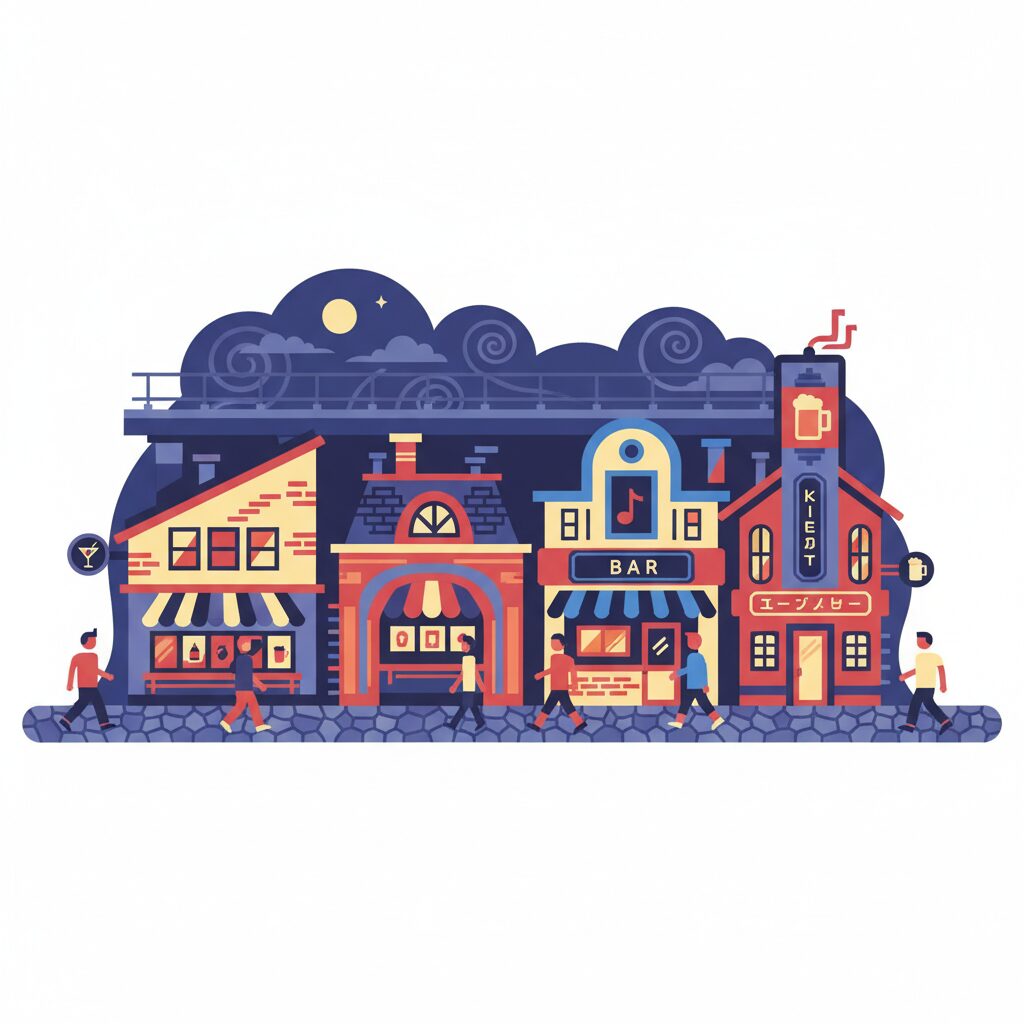
Walk out of Kyobashi Station on a Tuesday night, and you’ll feel it. It’s not the neon buzz of Dotonbori or the polished cool of Shinsaibashi. It’s something raw, a humming human energy spilling out of narrow alleyways. You smell charcoal smoke, fried oil, and cheap beer. You hear the roar of laughter, the clatter of plates, and the rumbling of the JR Loop Line overhead. This is the real Osaka, unfiltered and unpretentious. For many foreigners, these cramped, smoke-filled standing bars—the tachinomi—are a social black box. You see them packed shoulder-to-shoulder with salarymen, grizzled old-timers, and young couples, all seemingly locked in effortless conversation. The question isn’t just what they’re doing, but how. How do you breach that wall of chatter? How do you order? How do you fit in without feeling like a tourist who took a wrong turn? In Tokyo, nightlife can often feel curated, a series of reservations and well-defined spaces. In Osaka, especially in a place like Kyobashi, the social fabric is woven in these chaotic, spontaneous encounters. This isn’t just about finding a cheap drink; it’s about tapping into the city’s circulatory system. Forget the guidebooks. This is your primer on navigating the beautiful, bewildering world of the Kyobashi tachinomi, a place that teaches you more about the Osaka mindset than any museum ever could.
Before you call it a night, dive deeper into Osaka’s spirit by exploring how locals relish authentic kuidaore meals.
The Kyobashi Philosophy: It’s Never Just About the Beer
Before you step into a Kyobashi alley, it’s important to grasp the fundamental difference in purpose. A Tokyo standing bar might be a sleek, minimalist spot for a quick, efficient drink before catching the last train. An Osaka tachinomi serves as a pressure valve—a community center with alcohol. The key idea here isn’t just saving money; it’s about maximizing social return from a minimal investment of time and cash. This is the hallmark of Osaka pragmatism in action.
The Zero-Distance Rule
Throughout much of Japan, personal space is respected. You learn to maintain a polite distance on trains, in queues, everywhere. But in a Kyobashi standing bar, that rule is flipped. The entire setup relies on a lack of personal space. You’ll find yourself elbow-to-elbow with a construction worker on your left and an office manager on your right. This isn’t a drawback—it’s the whole point. The close proximity breaks down social barriers. It’s impossible to stay detached when sharing a counter the size of a placemat with three others. This enforced closeness acts as a social lubricant, encouraging interaction and forming a temporary, fleeting community. Foreigners often mistake this for an invasion of privacy, but it’s really an invitation. The closeness says, “We’re all in this together, so let’s drop the formalities.” It’s a physical symbol of the city’s psychological directness.
The Gospel of Cost Performance
Just look at the menus scribbled on the walls: a draft beer for 350 yen, a plate of grilled skewers for 400 yen. This isn’t a happy hour deal; it’s the regular price. To outsiders, it appears as a simple bargain. To Osakans, it’s a principle known as kosupa, or cost performance. It’s the belief that value is the highest virtue. Paying a premium for ambiance, branding, or unnecessary extras is seen as foolish. A Kyobashi bar owner knows their customers want a good drink, a decent bite, and a place to chat without feeling overcharged. The worn counters, mismatched stools, and smoke-stained walls aren’t signs of neglect. They’re badges of honor. They show that every yen goes straight to the essentials: the food, the drink, and the staff keeping it all running. This mindset sharply contrasts with the brand-focused consumerism found in Tokyo’s upscale districts. In Osaka, value always triumphs over aesthetics.
Reading the Room: The Unspoken Rules of the Game
Walking into a crowded tachinomi for the first time can feel like trying to hop onto a moving merry-go-round. There’s a rhythm, a flow, and a set of unwritten rules that locals grasp intuitively. Mastering these isn’t about memorizing phrases; it’s about understanding the underlying logic of efficiency and mutual respect that governs the space.
The Art of the Entrance
The biggest mistake a newcomer can make is hesitating at the door. You’ll see tourists peeking in, whispering, trying to figure out if there’s space. This instantly marks you as an outsider. The local approach is swift and confident. You slide open the door, scan the counter for a gap—any gap—and head straight for it. A simple nod to the person you’re squeezing next to and a quick, “Sumimasen, koko iidesuka?” (Excuse me, is this spot okay?) is all you need. You’re not really asking for permission but signaling your intention. The expectation is that space is fluid. People shift, breathe in, and make room. This confidence isn’t arrogance; it shows you understand the communal nature of the bar. You’re not a guest in a private room; you’re a temporary participant in a public space.
The First Order: Speed is Everything
Once you’ve secured your sliver of counter, the clock starts ticking. A tachinomi is a high-turnover environment. The staff is busy, and the regulars know the routine. Don’t be the person who spends five minutes studying the handwritten menu on the wall. The unspoken rule is to order your first drink almost immediately. This is where the magical phrase, “Toriaezu, biiru.” (For now, a beer.) comes in. It’s the universal starting signal for a night out in Osaka. It gets a drink in your hand, grounds you in the space, and buys you time to figure out your food order without slowing down the flow. This isn’t about rushing; it’s about showing respect for the rhythm of the establishment. You’re signaling, “I’m ready to go. I’m not here to waste anyone’s time.” This efficiency is a key part of Osaka’s merchant culture, applied to the art of drinking.
Cash On the Counter: The Trust Economy
Many classic Kyobashi bars run on a cash-on-delivery system, often called kyasshu on. You’ll be given a small tray or bowl, where you place a couple of thousand-yen notes. When you order, staff takes the exact amount from your tray and leaves the change. This system might feel unusual at first, but it’s a social engineering masterpiece. First, it’s incredibly efficient, eliminating the need to flag down busy staff for a bill at the end. Second, it creates a subtle psychological contract. By placing your money down, you commit to being a responsible patron. But most importantly, it operates as a micro-economy built on trust and transparency. The money is right there, out in the open. The transaction is immediate. There’s no ambiguity. It’s a very Osaka way of doing business: direct, honest, and with no hidden fees. It feels worlds apart from the formal, often detached process of paying a bill at a table in a more conventional restaurant.
The Art of Conversation: It’s Not Friendly, It’s Interested
The most common cliché about Osaka is that “people are friendly.” While this isn’t incorrect, it’s a simplistic explanation that misses the underlying dynamics. In a Kyobashi standing bar, the interactions don’t stem from generic friendliness; they arise from a deep, active curiosity. People don’t merely smile and nod; they engage. They ask questions. They pry. For many foreigners used to more reserved social customs, this can be surprising.
The Opening Salvo: “Where Are You From?”
You will almost certainly be asked, “Doko kara kitan?” (Where did you come from?). In a Tokyo bar, this might be a polite but shallow question that leads nowhere. In Osaka, it serves as a genuine conversation starter. Follow-up questions come rapidly: What do you do? Why Osaka? Do you like baseball? Can you eat natto? This isn’t an interrogation; it’s how Osakans establish rapport. They collect details to find common ground or, more often, a playful point of disagreement. They’re not just making small talk; they’re actively trying to understand you and place you within their worldview. One-word answers will halt the conversation. The important thing is to respond with something more and to ask questions in return. It’s conversational catch, and you’re expected to participate.
The Language of Banter: Understanding Ijiri
This represents the biggest cultural challenge for many non-Japanese. A conversation with an Osaka local, especially after a few drinks, will almost certainly include ijiri—teasing or light-hearted ribbing. An elderly man might laugh at your broken Japanese. A woman might joke about your unusual t-shirt. This is not meant as an insult. It signals acceptance. In Osaka’s communication style, teasing is a way to break down formality and create an equal footing. If someone teases you, it means they feel comfortable enough to shed polite façades (tatemae) and engage sincerely (honne). The right response is not to take offense but to join in. The true measure of fluency isn’t perfect grammar but the ability to engage in self-deprecation. If you can laugh at yourself, you’ve passed the test. You’ve shown you don’t take yourself too seriously—a major faux pas in Osaka’s social code.
The Conversational Glue: “Se-ya-na” and “Honma ni”
Tune into the flow of conversations around you. You’ll hear constant back-and-forth affirmations. “Se-ya-na” (That’s right, isn’t it?) and “Honma ni” (Really / For real) are the rhythmic beats of Osaka-ben. They aren’t mere filler words. They serve as active listening cues, expressing “I’m with you, I understand, keep going.” Using them yourself signals that you’re not just hearing the words but also catching the feeling behind them. It’s a way to build instant camaraderie, turning a simple chat into a shared experience. Tokyo conversations often feel like a series of polite, individual statements. Osaka conversations are collaborative constructions, and these phrases are the mortar that holds them together.
The Graceful Exit: Mastering the Art of Leaving
Just as there is an art to entering a tachinomi, there is also an art to leaving. The culture of these bars is fleeting. You are not meant to settle in for the night. The aim is to hop around, sample different atmospheres, have a few brief interactions, and then move on. Staying for hours at one place is a rookie mistake.
The Senbero Philosophy
Many locals operate under the principle of senbero—a blend of sen-en (1,000 yen) and berobero (drunk or tipsy). The concept is to enjoy a pleasant buzz for about a thousand yen. This typically involves two or three drinks and a small dish. It’s a mission with a clear goal and endpoint. Once you’ve reached your budget or your buzz, it’s time to either head home or move on to the next bar. This keeps the energy in the alleys fresh. New people arrive as others depart, ensuring the social flow never becomes stagnant. It’s a philosophy of savoring the moment without overstaying your welcome, a practical approach to a night out.
The Clean Break
When it’s time to leave, the exit should be as swift as your entrance. There’s no need for lengthy goodbyes, even if you’ve been chatting with your counter-mates for the past hour. The etiquette is simple. You gather your belongings, make sure your bill is paid (or your tray is empty), and offer a clear “Gochisousama deshita!” (Thank you for the meal/drinks!) to the staff. A slight nod or a quick “O-saki ni” (I’m leaving ahead of you) to those nearby is polite but not always required. Then you turn and walk out. The conversation you were having blends back into the general hum of the bar. The spot you occupied will be taken within seconds. This isn’t rude; it’s the system working perfectly. The charm of the tachinomi lies in its impermanence. It is a temporary crossing of lives, and the clean exit honors that fleeting nature.
Ultimately, the standing bars of Kyobashi reflect Osaka itself. They are loud, efficient, somewhat rough around the edges, and deeply human. They reward confidence and discourage hesitation. They prize a good story and a quick laugh over pretension and polish. Learning how to drink in a Kyobashi tachinomi is learning the city’s unspoken language—a language of shared space, mutual trust, and the simple joy of honest connection. Forget your travel checklist. Spend an evening wandering these alleys, and you’ll discover a side of Osaka that truly feels like home.