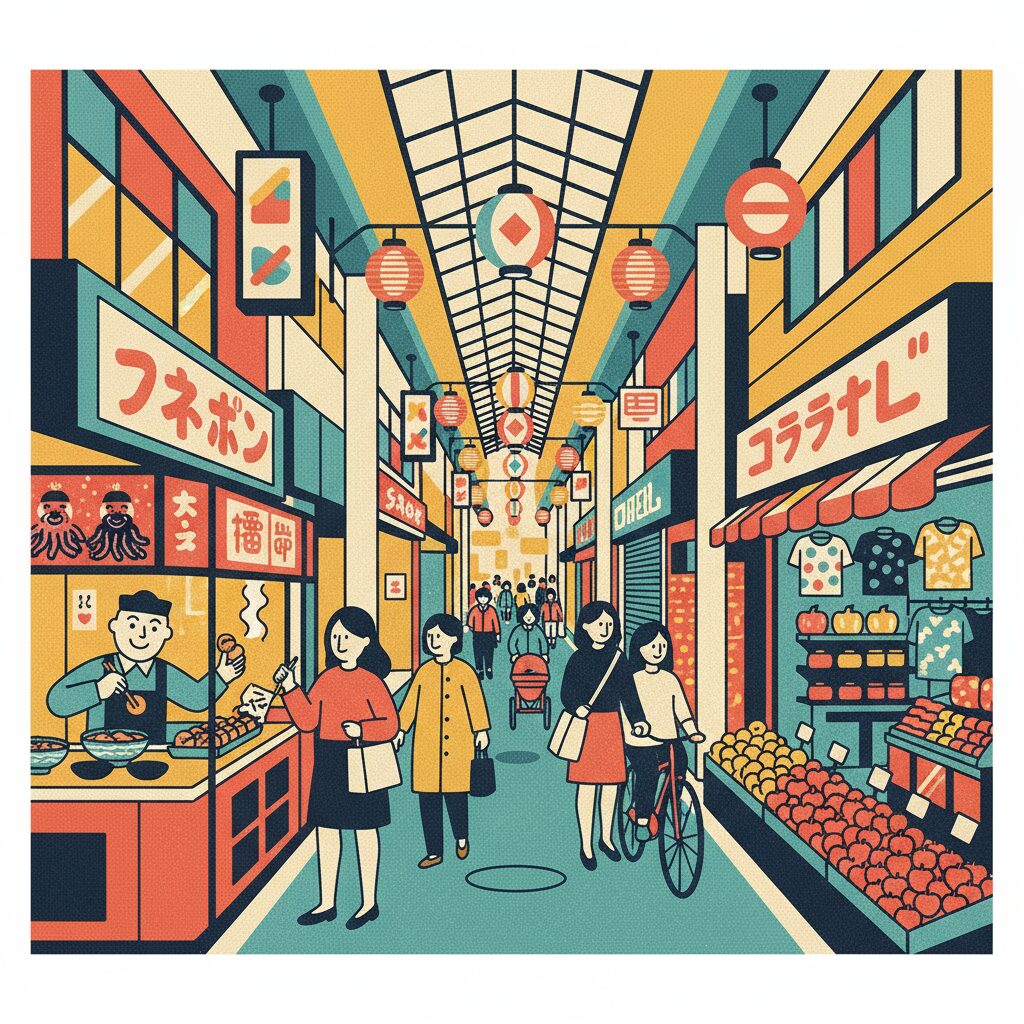
Walk through Osaka for more than ten minutes, and you’ll inevitably find yourself under the covered roof of a shotengai. For the casual visitor, these shopping arcades are a spectacle. You see Shinsaibashi-suji, a polished river of brand names and tourists flowing from one end to the other. You see Kuromon Ichiba Market, a vibrant, chaotic theater of sizzling scallops and premium-priced tuna, where every stall seems to be performing for a sea of smartphones. It’s easy to see them as attractions, as living museums of a bygone era or convenient places to grab photogenic street food. You check them off a list, snap a few photos, and move on.
But then you start to live here. You move into an apartment in a neighborhood like Nakazakicho, or Tenma, or even deep in the southern sprawl of the city. And you notice something else. The shotengai near your home isn’t filled with tourists. It’s filled with people on bicycles, grandmothers pulling squeaky shopping carts, and shopkeepers yelling out greetings to familiar faces. The products aren’t novelty keychains or matcha-flavored everything; they’re daikon radishes, fresh tofu, laundry detergent, and cheap, sturdy socks. This is where the postcard image of the shotengai collides with its reality as the living, breathing heart of daily Osaka life. The real question then becomes: how do you cross that invisible line? How do you stop being a spectator in the arcade and start becoming a participant? This isn’t just about learning where to buy your groceries. It’s about learning the rhythm, the language, and the unwritten rules of the most fundamentally Osakan of institutions. It’s your gateway to understanding the city’s soul, one conversation with a fishmonger at a time.
For those looking to widen their urban exploration, checking out this Kobe lifestyle guide can offer complementary insights into the everyday rhythm of regional living.
Beyond the Souvenirs: The Shotengai’s Real Purpose
The first mental shift you need to make is to distinguish between the kanko (tourist) shotengai and the jimoto (local) shotengai. While they may appear similar—a long, covered street lined with shops—their purpose is completely different. A tourist shotengai is a performance. Its aim is to dazzle and extract money from visitors in a brief, intense burst. A local shotengai is a utility. Its purpose is to sustain a community consistently, day after day.
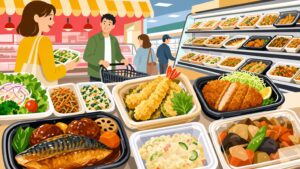
In Tokyo, the typical choice for daily necessities is often the supermarket. It’s efficient, sterile, and anonymous. You enter, pick what you need off a perfectly refrigerated shelf, scan it at a self-checkout, and leave. The transaction is quiet and seamless. Osaka has these supermarkets as well, of course, but the shotengai presents a powerful—and for many, a better—alternative. It’s a conscious decision. Why? Because the Osaka mindset is grounded in pragmatism and a deep respect for nebuchi—not just being cheap, but achieving great value for the price.
The shotengai is the physical embodiment of this concept. It’s a decentralized marketplace where each section is run by its own small family business. You don’t simply go to “the store.” You visit the butcher, then the tofu maker, then the fish vendor, then the greengrocer. Each is a specialist. The butcher doesn’t sell only pre-cut meat in plastic trays; they can break down an entire pig carcass for you. The tofu shop doesn’t just offer firm or silken varieties; they have fresh yuba (tofu skin), thick atsuage (fried tofu), and silky smooth kinugoshi for your miso soup, all likely prepared in the back of the shop that very morning. This specialization creates a level of quality and freshness that a centralized supermarket finds hard to match. It’s a living ecosystem of commerce, with sounds and smells that are part of the experience. It’s the rhythmic call of the vegetable vendor announcing a limited-time sale, the savory smoke rising from a stall grilling eel, the friendly chatter of neighbors catching up in the middle of the walkway. It’s beautifully, unapologetically human.
The Art of the Conversation: How to Shop Like a Local
For many non-Japanese residents, the greatest challenge in embracing the shotengai is the interaction. In the quiet, point-and-pay environment of supermarkets or convenience stores, your level of Japanese doesn’t matter. But in the shotengai, conversation is the currency. This might feel intimidating, but it’s also where the magic unfolds. It’s the difference between a mere transaction and forming a connection.
Let’s be practical. Fluency isn’t required. You just need to show curiosity and a willingness to engage. The key is to shift from a declarative shopping style (“I want this.”) to an inquisitive one (“What’s good today?”).
The Butcher (Oniku-ya san)
Instead of simply grabbing a pre-packaged portion of ground pork, approach the counter and make eye contact. You can ask, “Kyou no o-susume wa nan desu ka?” (What’s your recommendation today?). Or be specific about your plans: “Kare- ni tsukaitain desu kedo…” (I want to use it for curry…). The butcher will immediately brighten up. They’ll point you toward a better cut, perhaps one not even on display, and say, “This one has just the right amount of fat; it will melt perfectly.” They might ask how many people you’re cooking for and cut exactly the amount you need. This isn’t just a sale; it’s a consultation.
The Fishmonger (Sakana-ya san)
Fish can be intimidating due to the variety and confusing names. This is where you rely on the expert. Point to a fish that interests you and ask, “Kore, dou yatte taberu no ga oishii desu ka?” (What’s the best way to eat this?). The owner will provide a mini-lesson. “Ah, this one is perfect for grilling with just salt. This other one, you should simmer with soy sauce and ginger.” They’ll often offer to clean, gut, and fillet the fish for you on the spot, a service that builds strong loyalty. They’d rather have you cook their fish perfectly and return happy than mess it up and never come back.
The Greengrocer (Yao-ya san)
Here, conversations often focus on seasonality and ripeness. You can ask, “Kono mikan, mou amai?” (Are these mandarins sweet yet?). The owner might cut one open for you to taste. They’ll tell you which spinach is best for a quick stir-fry and which suits a blanched salad. They are guardians of the seasons, and talking with them helps you learn to eat in tune with the local calendar.
This conversational approach does more than secure better food. It signals that you’re not a tourist. It says, “I live here. I cook here. I want to learn.” This is the quickest way to earn your place in the neighborhood. In Osaka, unlike the more reserved culture of Tokyo, this effort is almost always met with warmth, humor, and genuine appreciation.
Cracking the Code: Understanding Shotengai Economics
For centuries, Osaka has been known as akindo no machi, the city of merchants. This commercial heritage is deeply ingrained and explains the economic principles behind the shotengai. While the environment is highly competitive, the rivalry is rooted in trust and value rather than simply offering the lowest prices. Recognizing this will change the way you view every price tag.
To begin with, there’s the well-known Osaka tradition of omake. This refers to the small extra gift you receive, a bonus not openly advertised. It serves as a powerful way to foster customer loyalty. If you become a regular at a fruit stand, the owner might add an extra apple or a handful of strawberries as you pay. A butcher might give you a small piece of fat to enhance your dishes. This isn’t a discount you can request; it’s a gift. It’s the shopkeeper’s way of saying, “I see you. I appreciate your business.” This transforms a commercial transaction into a personal connection.
This brings up the topic of haggling. Foreigners often hear that Osaka is a place to bargain, but this is a misconception, particularly in the context of a local shotengai. These are not tourist markets. Because of small profit margins and fair pricing, aggressive haggling is seen as impolite. That said, there is a style of playful banter that can feel like negotiation. It’s more about the interaction and relationship. For example, you might jokingly say, “Mou chotto makete!” (Give me a little discount!), and the owner might respond with a laugh, “Akan, akan! Kore de genkai ya!” (No way, no way! This is my final price!). The price remains unchanged, but you’ve shared a classic moment of Osaka exchange. It’s about the bond, not the money.
What you can take advantage of is the rhythm of the day. As closing time nears, usually around 5 or 6 PM, the atmosphere shifts. Shops selling fresh, perishable goods need to clear their inventory. This is when the true energy of the shotengai emerges. Calls become louder, more urgent, and more rhythmic. “Saba, yasui de! Dou ya!” (Mackerel, it’s cheap! How about it!). Prices are slashed. A pack of vegetables priced at 300 yen might drop to 100 yen. This isn’t bargaining; it’s a clearance sale. Learning to shop at these times to catch the best end-of-day deals is a genuine local skill.
Finding Your “Third Place”: The Shotengai as a Community Hub
The shotengai is much more than just a collection of retail shops. For the community it serves, it acts as a “third place”—an essential social hub that is neither home nor work. It serves as the neighborhood’s public living room, and understanding it this way is crucial for deeper integration.
You’ll notice this in the institutions that flourish within the arcade’s ecosystem. Look out for the kissaten, the traditional coffee shops with their dark wood paneling and worn velvet chairs. Here, neighborhood elders gather for their “morning service” (a budget-friendly breakfast set with coffee), reading the newspaper and discussing the world’s issues for hours. It’s a spot to linger, to see and be seen.
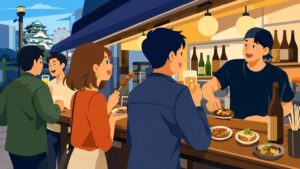
Then there are the tachinomi, or standing bars. These small, no-frills venues are deeply embedded in the fabric of the shotengai. They offer a quick, inexpensive drink and a bite to eat on the way home from work. You stand shoulder-to-shoulder with strangers, yet you’re all part of the same temporary community, united by a beer and a shared plate of fried chicken. The entry barrier is low, and these spots are fantastic for practicing your Japanese and soaking up the local atmosphere.
Beyond these, the shotengai itself serves as a stage for community life. Notice the seasonal decorations, banners celebrating the local baseball team’s victory, or posters for an upcoming neighborhood festival (matsuri). These are meant for locals, not tourists. By taking part—even simply by walking through and observing—you become part of that shared experience.
Your aim should be to become a jouren-san, a regular. This is a status earned over time. It begins with picking a few shops and visiting them often. Gradually, the shopkeepers will recognize you. Their greeting will shift from a formal “Irasshaimase!” (Welcome!) to a more familiar “Maido!” (Thanks, as always!). They’ll start to remember your preferences. This recognition is incredibly meaningful. It’s a remedy to the anonymity and isolation that often accompany life in a foreign country. When the tofu lady greets you by name, you’re no longer just a foreigner living in Osaka; you’re a member of this neighborhood.
A Tale of Two Arcades: Contrasting the Famous with the Functional
To truly understand the difference between a tourist trap and a daily hub, let’s examine two real-world examples. One is a place you’re almost certainly familiar with; the other is the type of place you should be seeking out.
First, take a look at Kuromon Ichiba Market. For decades, it was genuinely known as “Osaka’s Kitchen.” Local chefs and discerning home cooks visited for the finest produce and seafood. Today, its role has nearly completely shifted. Walk through it now, and you’ll encounter massive crowds of tourists. The main language you’ll hear isn’t Japanese. The products sold are aimed at immediate, on-the-spot consumption: single oysters, grilled wagyu skewers, sea urchin served in its shell. Prices are inflated to match tourist demand. You can pay 1,000 yen for a single large shrimp on a stick. It’s an enjoyable, stimulating experience, like a food theme park. But ask locals living a few blocks away if they do their weekly shopping there. The answer will be a firm no. It’s no longer their kitchen.
Now, consider places like Komagawa Shotengai in the city’s south or the vast, sprawling Tenjinbashisuji Shotengai. Choose any random stretch far from the main tourist entry points. The atmosphere is completely different. The pace is slower, more intentional. You’ll see mothers with children in tow, people heading home from work. The shops aren’t selling single, grilled items. Instead, they sell whole fish, trays of meat priced for a family meal, and bags of onions and potatoes. Handwritten signs in Japanese advertise daily specials. Shopkeepers chat with their customers about their families or the weather. This isn’t a performance. This is the ordinary, beautiful, essential business of daily life. Prices are reasonable, designed for repeat customers from a community with a budget. Discovering and embracing this kind of shotengai is the goal.
Your First Steps: Practical Advice for Making the Shotengai Yours
Ready to get started? Here’s a straightforward, actionable plan to help you begin.
Start Small and Stay Consistent
Don’t attempt to explore the entire shotengai right away. Choose one or two shops you’ll visit regularly—a bakery, a fruit stand, or a tofu shop—and make them your go-to places. Visit them exclusively for those items. Consistency builds familiarity and transforms you from a stranger into a regular customer.
Learn a Few Essential Phrases
Go beyond “Kore o kudasai” (I’ll have this). Equip yourself with some questions:
- “O-susume wa nan desu ka?” (What do you recommend?)
- “Kore wa nan desu ka?” (What is this?)
- “Itsumo arigatou gozaimasu” (Thank you, as always) – Use this once you’re recognized.
Your effort, even if imperfect, will be warmly received.
Bring Cash and a Reusable Bag
Although things are evolving, many of the best traditional stalls in a shotengai remain cash-only. Having cash and small coins on hand makes transactions easier. Carrying your own eco-bag also shows you’re a committed local doing everyday shopping, not just a tourist buying a souvenir.
Observe How Things Flow
Before making a purchase, take a moment to watch. How do other customers interact with the stall staff? What’s their usual banter? Notice the patterns of greetings and goodbyes. In Osaka, for example, people often say “Ookini!” rather than the more formal “Arigatou gozaimasu.” Using these local expressions demonstrates that you’re attentive and respectful.
Purchase Small Quantities
Don’t feel obligated to buy in large amounts. It’s perfectly fine to purchase just one tomato, two slices of ham, or a single piece of fried fish for dinner. This is one of the key benefits of shopping at a shotengai compared to bulk-focused supermarkets.
Why It Matters: The Soul of Osaka Living
Ultimately, learning to navigate and appreciate your local shotengai involves much more than simply buying food. It serves as a direct gateway to the heart of Osaka culture. This city thrives on human connections, face-to-face commerce, good-natured humor, and a strong sense of community. The shotengai is where these intangible values become real, everyday experiences.
The typically polite, reserved, and often indirect communication found elsewhere in Japan gives way here to something more straightforward, expressive, and forgiving. The shotengai reveals Osaka’s honne (true feelings) rather than its tatemae (public facade). It’s loud, somewhat chaotic, and deeply, fundamentally human.
Making the effort to become part of this world will reward you greatly. It will provide better food at better prices, certainly, but more importantly, it will offer a sense of belonging. It will root you in your neighborhood and connect you with the people who share it with you. When you can stroll through your local arcade, exchanging nods and greetings with those who sustain your community, you’ve achieved something special. You’ve moved beyond merely living in Osaka. You’ve begun to truly experience life here.