You’re standing in a tiny, cramped izakaya in the backstreets of Tenma, the air thick with the scent of grilled skewers and cigarette smoke. You’ve lived in Osaka for six months, and you think you’re getting the hang of it. You order a beer. The bar master, a man with a face like a roadmap of the city, squints at you. He places the frosty mug on the counter and says, with zero hesitation, “Just one? Trying to save money for a train ticket back to Tokyo?” He cracks a grin. You freeze. Was that an insult? A joke? A genuine question about your financial situation? In most places, it would be a bizarre, even rude, thing to say to a customer. But here, in the heart of Osaka, it’s a handshake. It’s an invitation. It’s the opening note in a conversational duet you didn’t know you were a part of. Welcome to the world of tsukkomi, the artful, lightning-fast retort that underpins the entire social fabric of this city. Understanding this concept isn’t just about learning a new word; it’s about deciphering the very rhythm of Osaka life, a rhythm that feels worlds away from the polite, measured cadence of the rest of Japan.
The spirited banter you encounter here mirrors the business world, where humor-driven professionalism in Osaka plays a key role in forging success.
The Comedy Duo in Every Conversation
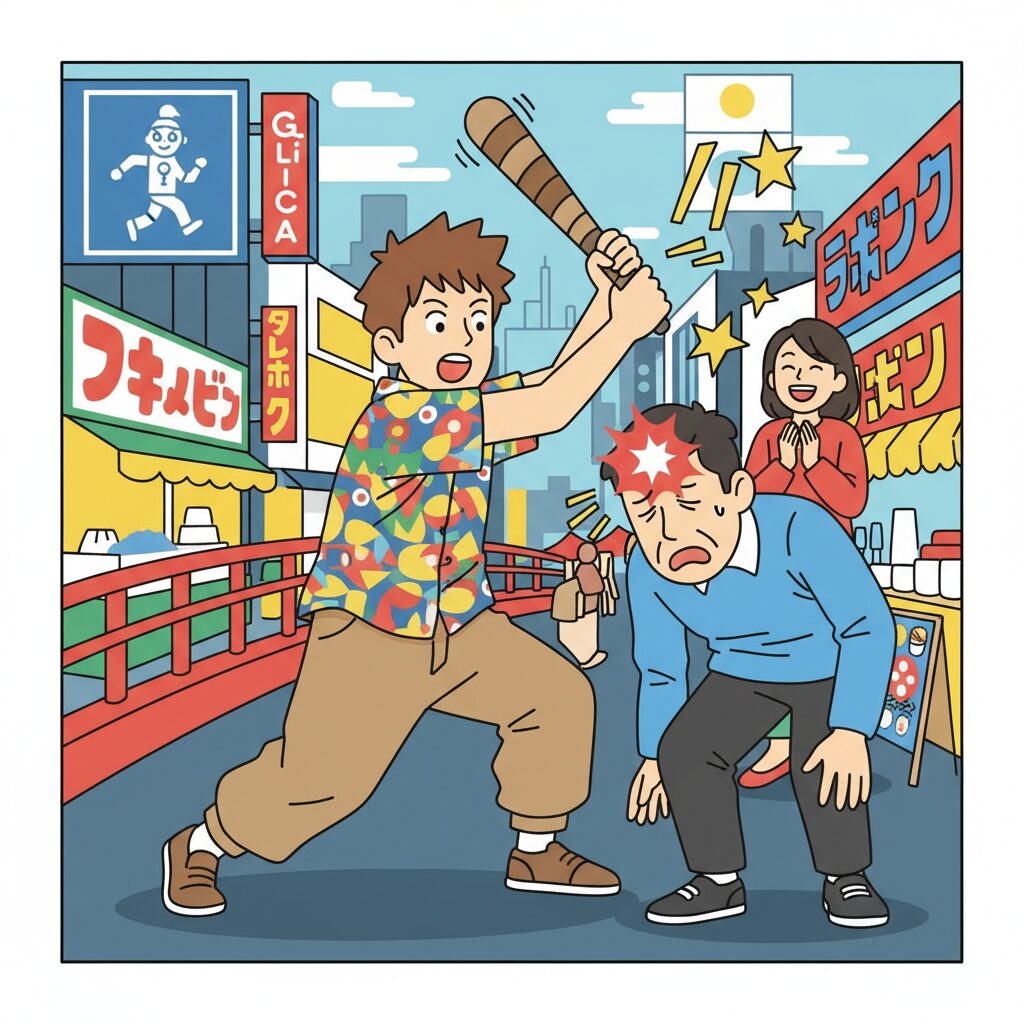
To understand tsukkomi, you must first recognize its counterpart: boke. Together, they form the essential structure of Japanese stand-up comedy called manzai. In a traditional manzai pair, the boke plays the fool—the airhead who utters something absurd, illogical, or simply silly. The tsukkomi is the straight man, the quick-witted partner who promptly corrects the boke, highlighting the absurdity with a sharp verbal retort, sometimes accompanied by a playful tap with a paper fan. The boke builds the tension, and the tsukkomi releases it with laughter. Think of it as a back-and-forth exchange: the boke presents a ridiculous idea, and the tsukkomi returns it with a dose of reality.
This dynamic isn’t confined to the stage at the Namba Grand Kagetsu theater. In Osaka, it’s the default form of communication. It’s embedded in the banter among friends, the interaction between shopkeepers and customers, and even the gentle scolding from a grandmother to her grandchild. Life itself is a performance, and everyone is expected to play their role. The aim isn’t merely to exchange information but to create a shared moment of amusement. An Osaka conversation without this playful give-and-take can feel oddly flat and lifeless, like a meal without seasoning. People are always watching for a potential boke moment—an exaggeration, a slip of the tongue, a quirky fashion choice—as an opportunity to step in with a friendly tsukkomi. It’s a game, and the reward is a shared laugh.
“Nande ya nen!”: Decoding the Osaka Retort
The quintessential tsukkomi phrase, heard throughout every shopping arcade and train station in the city, is “Nande ya nen!” Though it might literally translate to “Why?!” or “What the heck?!”, such translations don’t capture the true spirit of the expression. It’s rarely a sincere question seeking an answer; rather, it acts as a verbal punctuation mark meaning, “What you just said is so absurd that I have to call it out.” It’s a tool for pointing out ridiculousness.
Picture yourself with an Osaka friend, commenting on the summer heat with, “It’s so hot, I feel like I’m going to melt.”
A Tokyo friend might respond with polite agreement: “Sou desu ne. Atsui desu ne.” (Yes, it is. It’s hot, isn’t it?).
Your Osaka friend, however, will seize the moment. They’ll likely retort: “Nande ya nen! You’re not an ice cream cone!”
The goal isn’t to debate the physics of melting humans. It’s to take your exaggeration, your boke, and use a tsukkomi to spark a small, shared moment of humor. This phrase is exceptionally versatile. It can convey disbelief at a friend’s exaggerated tale, react to an outrageously high price on fruit, or be muttered quietly when your train is delayed. It’s the Swiss Army knife of Osaka dialect—a single phrase that creates a shared understanding of a situation’s absurdity.
The Shopkeeper’s Jab and the Stranger’s Quip
The culture of tsukkomi is at its liveliest in everyday commerce. Osaka was built by merchants, and the city’s communication style still reflects a preference for quick, efficient, and good-natured relationship building. Formality obstructs business; a good laugh fuels it.
Step into a clothing store in the Shinsaibashi-suji shopping arcade and hold up an outrageously flamboyant shirt. The obachan (older lady) running the shop probably won’t say, “That’s a very bold choice, sir.” Instead, she might say, “Are you trying to join a circus? That’ll scare the pigeons away!” This isn’t a criticism of your taste. It’s a performance—a way of saying, “I see you, let’s have some fun, and now let me show you a shirt that really suits you.” The tsukkomi breaks the ice and turns the transaction into a memorable human exchange.
This spirit extends to strangers. Imagine you’re struggling with your wallet at a ticket machine, holding up the line. In many cities, you’d face silent, impatient looks. In Osaka, it’s common for the person behind you to lean in and joke, “Having trouble there? If you’re that slow, the last train’s going to leave without you!” It’s said with a laugh, not hostility. The aim is to lighten the mood with shared humor. It’s a way of saying, “We’re all in this together, and it’s a little ridiculous, isn’t it?”
A Tale of Two Cities: Tsukkomi in Osaka vs. Tatemae in Tokyo
The sharpest contrast to Osaka’s communication style is undoubtedly Tokyo. The difference is fundamental and extends well beyond dialect. Tokyo’s social interactions are largely shaped by the concepts of tatemae (the public face or façade) and honne (one’s true feelings). Communication tends to be indirect, layered, and aimed at preserving surface-level harmony (wa) at all costs. You learn to read the air (kuuki wo yomu) and avoid saying anything that might cause friction or embarrassment.
In this framework, an Osaka-style tsukkomi would be like a social grenade. Teasing a colleague about their loud tie or joking with a shopkeeper would be viewed as tactless, unprofessional, or outright rude, disturbing the carefully maintained harmony. The Tokyo style emphasizes politeness and distance as a mark of respect, aiming for smooth, friction-free interactions.
Osaka’s approach is almost the exact opposite. Harmony is not achieved by keeping polite distance, but through affectionate, direct engagement. A playful jab is not a disruption; it’s a shortcut to familiarity. It signals, “I’m comfortable enough with you to tease you, and I trust you’ll get the joke.” It closes the gap rather than maintaining it. Many Osakans find Tokyo’s style cold, stiff, and inefficient. They wonder, “Why waste time with all these formalities when we could just laugh and get straight to the point?” This mindset reflects the pragmatic, no-nonsense spirit of a merchant city where time is money and strong personal bonds are the most valuable currency.
The Fine Line Between a Jab and an Insult
For foreigners, this is the million-yen question: how do you tell if someone’s delivering a friendly tsukkomi or just being mean? It can be startling at first, especially if you come from a culture where teasing is reserved for close friends. The key is to look beyond the literal words and consider the context.
A genuine tsukkomi is almost never a personal attack on your character, intelligence, or core values. It targets a specific, temporary action, statement, or situation. It’s about the absurdity of the moment. Delivery matters. Watch for non-verbal cues: the twinkle in the eye, the quick grin following the jab, the playful tone. A tsukkomi is quick and light; an insult is heavy and lingers.
Moreover, tsukkomi signifies engagement. It’s a way of acknowledging you and inviting you into the local rhythm. Silence or overly polite, generic replies can, ironically, signal distance. If an Osaka local teases you, it often means they like you—they feel comfortable dropping formalities to engage on a more human level. They don’t see you as a fragile foreigner to be handled with care but as someone who can take a joke and belong. In a way, receiving your first tsukkomi from a local is a rite of passage—a sign you are beginning to be accepted as an insider.
How to Navigate the World of Boke and Tsukkomi
So, how should you respond when the izakaya master questions your drinking habits? Becoming defensive or taking the remark literally is the worst possible reaction. It disrupts the flow and marks you as someone who doesn’t “get it.”
The simplest and most effective response is just to laugh. A hearty laugh shows you grasp the spirit of the comment. You can add a casual, “Hontou da ne!” (You’re right!) or simply shake your head with a smile. This completes the comedic exchange. The boke (your act of ordering only one beer) has been set up, the tsukkomi has landed, and your laughter is the audience’s applause. The interaction is a success.
If you feel more confident, you might try a gentle comeback. To the bar master, you could reply with a grin, “I’m just getting started! This is only my warm-up beer!” This shows you can join the game, bouncing his tsukkomi back and keeping the exchange going.
For newcomers, the safest role to play is the boke. It’s much easier and less risky than attempting your own tsukkomi, which demands skillful use of language, timing, and cultural nuance. A poorly executed tsukkomi can come across as genuinely aggressive. But playing the boke is straightforward. Make a small exaggeration. Say something obviously silly. Wear that loud shirt on purpose. Essentially, you’re tossing the ball to your Osaka friends and colleagues, giving them the perfect chance to do what they do best. In doing so, you demonstrate your understanding and appreciation of their unique style of communication.
More Than Just Jokes: The Philosophy Behind the Banter
Ultimately, the culture of boke and tsukkomi is more than merely a quirky communication style. It reflects the core philosophy of Osaka itself. It represents a city that prioritizes human connection over strict protocol, humor over solemnity, and authenticity over pretense. It serves as the social glue in a place that has long defined itself in contrast to the formality of the political centers in Tokyo and Kyoto.
This city was built by merchants who needed to quickly size each other up, establish rapport instantly, and get down to business. A shared laugh was, and remains, the most effective way to build trust. This conversational style dismantles barriers, flattens hierarchies, and puts people at ease. It enables a more direct, honest, and ultimately warmer form of interaction. While it might seem abrasive to newcomers, the playful jab of a tsukkomi is one of the most profound expressions of acceptance and affection you can experience in Osaka. It’s the city’s way of drawing you close, looking you in the eye, and saying, “You’re one of us now. Let’s have a laugh.”