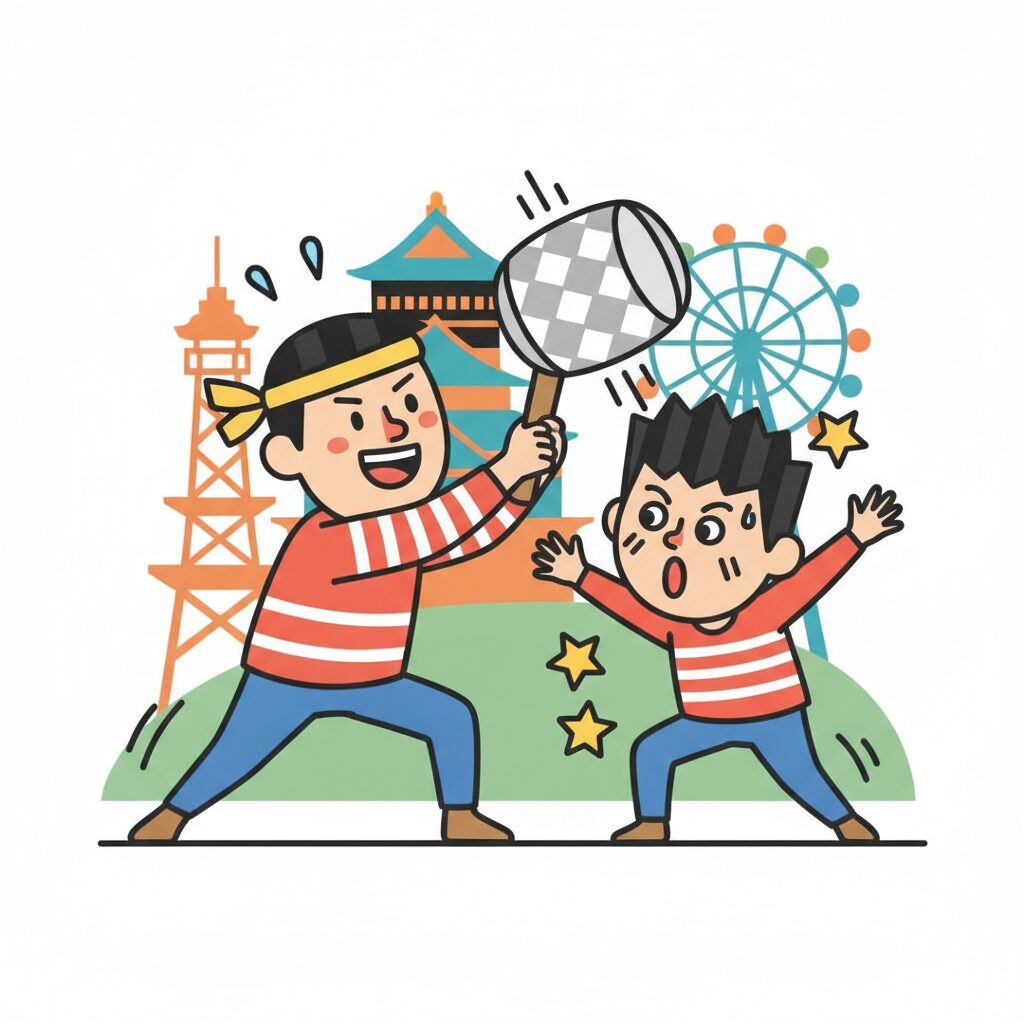
Walk into a bakery in Osaka, point to a croissant, and ask how much it is. The woman behind the counter, probably in her sixties with a perfectly coiffed perm, might look you dead in the eye and say, with a completely straight face, “For you? One million yen.” In Tokyo, this would be a baffling, perhaps alarming, moment of confusion. You’d check the price tag, stammer an apology, and wonder what you did wrong. But you’re in Osaka. This isn’t a price check; it’s an invitation. This is the opening act of a conversational duet that defines the city. This is the boke. Your role, should you choose to accept it, is to deliver the tsukkomi. You scoff, you wave your hand dismissively, you shoot back, “You’d be rolling in dough if you charged that much!” And just like that, a smile breaks across her face. A connection is made. You’re not just a customer anymore; you’re a participant in the city’s favorite pastime.
This constant, low-level hum of banter is the city’s heartbeat. It’s a rhythmic exchange of feigned foolishness (boke) and sharp, witty retorts (tsukkomi) that forms the very foundation of social interaction here. For foreigners, especially those coming from the more reserved atmosphere of other Japanese cities, this can be the single most disorienting and exhilarating part of daily life. It feels like everyone is in on a joke you haven’t been told yet. The truth is, the joke is the conversation itself. Understanding this dynamic isn’t just about getting local humor; it’s about understanding the fundamental operating system of Osaka. It’s the key to unlocking real communication, to moving from an outsider looking in to an insider who gets the rhythm.
Embracing Osaka’s spirited daily exchanges is complemented by exploring affordable UR housing options that showcase the city’s pragmatic, light-hearted approach to modern living.
The Boke and Tsukkomi Dynamic: Osaka’s Social Glue
At its heart, the manzai comedy duo format of boke and tsukkomi is a straightforward concept. One person says or does something absurd, silly, or nonsensical—this is the boke. The other person quickly points it out with a sharp, witty correction or comeback—this is the tsukkomi. On stage, it’s considered a refined art form. In the streets of Osaka, it’s as natural as breathing. This goes beyond mere joke-telling; it’s a fundamental way of communicating that builds rapport, fosters trust, and keeps social energy flowing. It’s a conversational dance in which each partner knows the rhythm.
More Than Just Jokes: A Conversational Rhythm
The tsukkomi is not meant as an insult. This is the most important lesson. When someone delivers a tsukkomi, they are not being hostile, rude, or mean. On the contrary, they are paying you a compliment, signaling, “I’m listening closely enough to catch your intentional mistake and feel comfortable enough to call it out playfully.” A dull, literal response to a boke kills the conversation, but a sharp tsukkomi fuels it. It says, “I get it. I’m playing along. What’s next?”
Think of it as a form of social validation. The boke offers a slice of absurdity, a humorous test balloon. The tsukkomi meets and acknowledges it, completing the cycle. This quick back-and-forth establishes a shared rhythm, a sense of being on the same wavelength. For example, when buying takoyaki from a street vendor who claims the octopus inside is a rare mythical creature from the deep sea, the right response isn’t to question the source but to reply, “No wonder it smells so legendary!” The exchange becomes more than just a transaction; it turns into a memorable, human interaction.
Why Does This Happen? The Merchant City Roots
This verbal agility isn’t accidental; it’s ingrained in Osaka’s DNA. For centuries, Osaka was Japan’s commercial center, the “nation’s kitchen,” a city of merchants (shonin no machi). Unlike the samurai and bureaucrats of Edo (now Tokyo), who lived under strict hierarchy and formal protocol, Osaka’s merchants relied on their wits. Success depended on quickly building relationships, shrewd negotiating, and earning the trust of customers and suppliers. Humor was a vital tool in this environment.
A quick, clever remark could break tension during negotiations. A shared laugh could build bonds faster than formal ceremonies. Banter became a way to size someone up, testing their wit and character. This culture of sharp, practical, and personable communication became a survival skill, passed down through generations and evolving from a business tactic into a defining feature of the city’s social identity. While Tokyo culture was shaped by the stoic samurai class, Osaka’s evolved in a bustling, noisy, and competitive marketplace. That historical difference is still evident today in every playful jab from a shopkeeper.
Navigating Daily Life: Tsukkomi in the Wild
Once you begin tuning into it, you’ll notice the boke-tsukkomi dynamic is everywhere. It’s not limited to longtime friends or comedians. It serves as the default mode for casual interactions with complete strangers—a continuous performance where the entire city becomes the stage. Learning how to navigate these moments is crucial to feeling at home here.
At the Supermarket, the Station, and Beyond
Let’s walk through a few situations. You’re at the checkout in a local supermarket. It starts raining outside. The cashier scans your items and comments, “Ah, you brought the rain with you, didn’t you?” A Tokyo-style response might be a polite, slightly puzzled smile and a noncommittal murmur. An Osaka-style reply—a sharp tsukkomi—would be, “Of course! I’m very important, you know.” The cashier bursts out laughing, and the tension of a routine transaction melts into a shared moment of connection.
Or picture yourself a bit lost in the maze-like Umeda Station. You ask an attendant for directions to the Hankyu line. With a grin, he might point in the completely opposite, obviously wrong direction and say, “It’s that way, about a three-day walk.” The boke has been set up. Your role isn’t to get annoyed but to play along. “Perfect, I was hoping for a good hike!” you reply. He’ll chuckle and then give you the actual, and likely very helpful, directions. He wasn’t trying to deceive you; he was trying to connect.
Even with neighbors, the language of humor prevails. An elderly woman next door sees you struggling with a complicated IKEA piece. She might ask, “Building a rocket to the moon?” A straightforward explanation about bookshelves would fall flat. The tsukkomi is to sigh dramatically and answer, “Yes, but I think I forgot the fuel tank.” She laughs, and suddenly you’re not just the quiet foreigner next door—you’re the neighbor with a sense of humor.
The Foreigner’s Dilemma: To Tsukkomi or Not to Tsukkomi?
This is the million-yen question for many non-Japanese residents. What if I mess it up? What if my comeback is awkward or ill-timed? The fear is real, but the reality is much more forgiving. Osakans know their communication style is unique. They don’t expect foreigners to be manzai masters. The key isn’t flawless delivery but a sincere effort.
A blank stare or a serious, literal response can be misread. It might seem cold, distant, or as if you’re rejecting their friendly gesture. Conversely, almost any attempt to play along will be warmly welcomed. A simple laugh, a big smile, or even learning the ultimate, all-purpose tsukkomi phrase, “Nande ya nen!” (roughly, “Why the heck?!” or “What are you talking about?!”), can do wonders. The aim is to show you grasp the intent, even if you can’t match the verbal gymnastics.
This contrasts sharply with Tokyo. In a Tokyo department store, service is flawless, polite, and professional to a fault. Staff maintain a respectful distance. A clerk cracking a personal joke about your purchase would be highly unusual, possibly unprofessional. In Osaka, that same joke signals good, friendly service. They’re not just processing your payment; they’re acknowledging you as a person. It’s a shift from transactional efficiency to relational engagement.
The Language of Osaka Comedy: Beyond “Nande Ya Nen”
While “Nande ya nen!” is the iconic phrase of Osaka, the everyday banter vocabulary is far more extensive. Tuning your ear to these expressions, and perhaps trying a few yourself, can deepen your connection to the city’s conversational rhythm. These words form the foundation of the daily comedy routine.
A Vocabulary of Banter
Beyond the classic comeback, listen for these frequent expressions:
- Akan! – Literally meaning “no good,” it’s used with the force of “Absolutely not!” or “That’s a terrible idea!” When a friend suggests going for ramen right after a large meal, “Akan!” is the perfect, punchy tsukkomi.
- Honma ka? – “Really?” or “Are you serious?” It’s a gentler challenge than nande ya nen, used to express disbelief and prompt the boke to either up the absurdity or reveal the punchline. Often extended, like “Honma kaa?,” for added dramatic effect.
- Mou ee wa! – “That’s enough!” or “Alright, alright, I get it.” This classic phrase, used by comedians to end a skit, serves in daily life to lovingly shut down a friend who’s been teasing you non-stop. It’s the conversational equivalent of tapping out, signaling the end of that particular joke.
- Chau chau! – A rapid “No, no!” or “That’s not it!” The “chau” is a Kansai-ben (Kansai dialect) form of “chigau” (to be different/wrong). It’s used to quickly and emphatically correct a misunderstanding or playful mistake.
The Sound of Tsukkomi: Tone and Timing
More than the words themselves, the music and rhythm of their delivery matter most. A tsukkomi isn’t just spoken; it’s performed. The tone is key—sharp and quick, yet never truly angry or mean-spirited. There’s a smile in the voice, a warmth beneath the pointed words. It’s a verbal pat on the back, not a punch in the face. Accompanying body language often includes a light, open-palmed tap on the other person’s shoulder or arm, a physical punctuation to the verbal jab.
Timing is the heart of the exchange. The tsukkomi must follow almost immediately after the boke. A pause or hesitation dissipates the comedic energy. This creates the signature fast pace of Osaka conversations. People don’t always wait for the other to finish their sentence if the boke is obvious enough. They jump in, eager to deliver the punchline. For those used to a more polite, turn-based style, this can feel like constant interruption. But in Osaka, it’s not interruption—it’s enthusiastic participation.
What This Means for Living in Osaka
Understanding this deeply embedded culture of humor is more than an academic exercise. It has real, practical significance for anyone trying to build a life here. It influences how you make friends, how your neighbors perceive you, and how you become part of the local community. It serves as the city’s unspoken social contract.
Building Relationships, One Joke at a Time
In Osaka, friendships aren’t formed through formal introductions and polite, reserved conversations. They’re built through shared laughter. Being able to join in, or at least appreciate, the ongoing banter shows that you belong. It’s how you become a regular at your local izakaya, where the owner teases you about your drink choice. It’s how you connect with other parents at your child’s school, joking about the chaos of family life. Formal politeness keeps people at arm’s length; playful humor draws them in.
When an Osakan teases you, they’re opening a door. They’re extending an invitation to a closer, more genuine relationship. Responding with a stiff, formal attitude may close that door. But meeting it with a laugh and a playful comeback will welcome you with open arms. This is the city’s shortcut to building relationships.
The Misunderstanding: Is It Aggressive?
This is often the biggest challenge for newcomers. The directness, teasing, rapid-fire speech, and occasional physical tap of a tsukkomi can feel intense and even aggressive, especially when viewed through a different cultural lens. From many East Asian perspectives, it can seem disrespectful. From a Western perspective, it might feel overly familiar or intrusive. It’s easy to mistake this playful sparring for real conflict.
However, it is almost always quite the opposite. A tsukkomi is a gesture of closeness. It shows that someone notices you, listens to you, and feels comfortable engaging with you in this playful way. In a strange sense, the moment this banter stops is when you should start to worry. Silence and formal politeness are often reserved for complete strangers and outsiders (yosomono). The teasing signals that you belong. It’s a loud, chaotic, and sometimes puzzling declaration of acceptance.
Conclusion: Embracing the Laughter
Living in Osaka means being part of a city-wide comedy act where everyone has the potential to perform. Here, humor isn’t an escape from reality; it’s the very way reality is experienced and expressed. It serves as a social lubricant, a negotiation strategy, a community-building device, and a philosophy of life all at once. It’s the city’s way of acknowledging that life is often absurd, so you might as well laugh along.
For anyone relocating to this lively, energetic city, my advice is simple: listen. Tune into the rhythm behind the words. Notice the sparkle in the eyes that accompanies a ridiculous remark. Don’t shy away from the banter. Recognize it for what it is—an invitation. You don’t have to be the star, but if you can learn to laugh along with the show, you’ll find your place as part of the audience. And when you feel ready, if a shopkeeper claims a single apple costs ten thousand yen, take a breath, smile, and respond with a tsukkomi of your own. In that shared moment of laughter, you will connect with the soul of Osaka more deeply than any guidebook ever could.