My first month in Osaka, I went to buy a cheap umbrella from a little shop in the Tenjinbashisuji Shotengai. The rain was coming down in sheets. I handed the elderly shopkeeper a 1,000 yen note for the 500 yen umbrella. He took it, held it up to the light with theatrical suspicion, and said with a deadpan face, “Sorry, this is a fake. No good.” My heart dropped. Was my money counterfeit? Was I in trouble? I started to stammer an apology in broken Japanese, my face burning with shame. He watched me squirm for a second before his face broke into a huge, gummy grin. He slapped the counter. “Just kidding, young lady! Only 500 yen!” His wife, who had been watching from the back, chimed in, “He’s an idiot, ignore him!” and gave me a friendly wink.
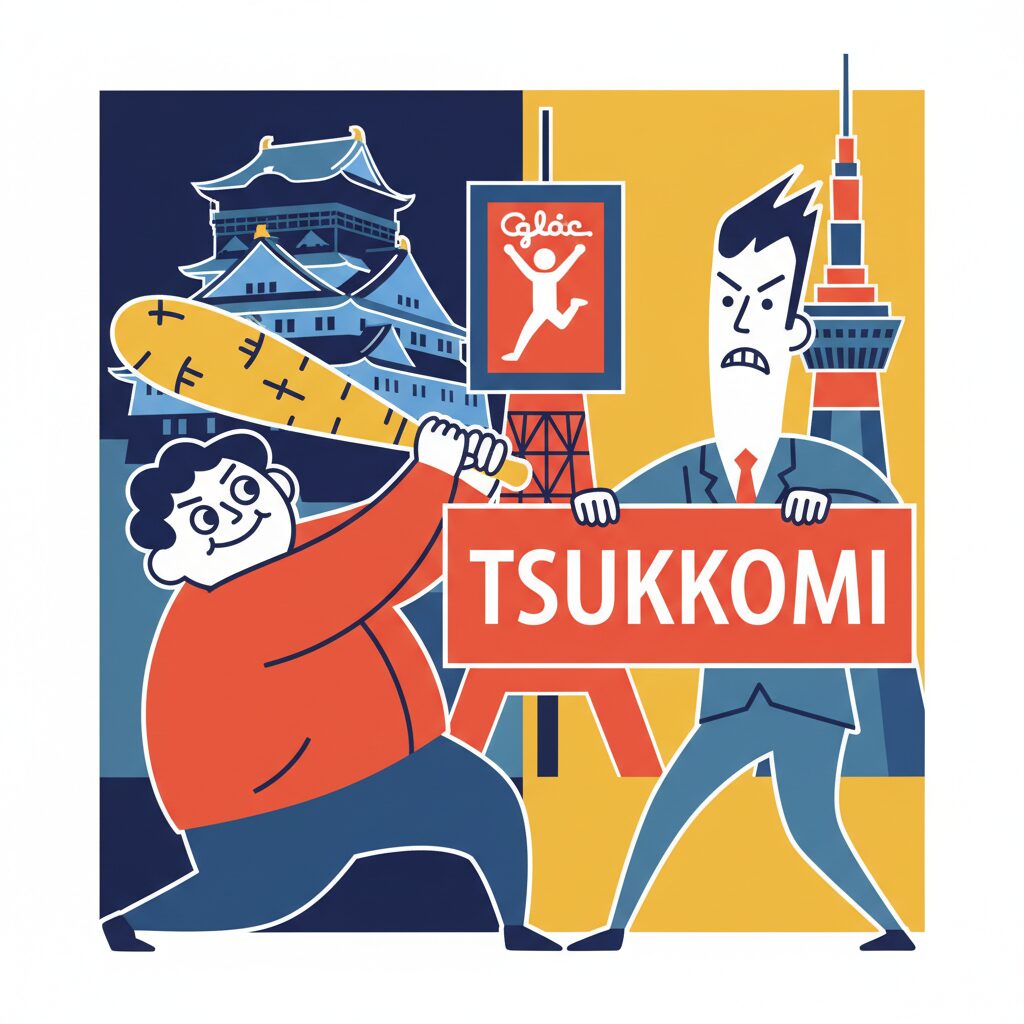
I walked out into the rain, umbrella in hand, completely bewildered. It wasn’t mean-spirited. It was… a performance? A joke for an audience of one? That was my first real lesson: in Osaka, communication isn’t just about exchanging information. It’s a sport. It’s a dance. And more often than not, it’s a two-person comedy routine known as Manzai, played out on the streets, in shops, and over dinner tables. The core of this dance is the dynamic duo of ‘boke’ and ‘tsukkomi’. Understanding this isn’t just a fun cultural tidbit; it’s a survival guide to the social rhythm of this city. It’s the key to unlocking what people mean when they say Osaka is “friendly.”
To further appreciate Osaka’s rich cultural tapestry, one might delve into its revered konamon social ritual, where a home-cooked street food tradition reflects the city’s warm, improvisational spirit.
The Unspoken Rules of the Comedy Game
In most places, a conversation is a straightforward back-and-forth. Information is exchanged, feelings are shared, and then you move on. In Osaka, however, a conversation often serves as an invitation to play a game. The purpose isn’t simply to communicate but to create a shared moment of laughter. This game revolves around two key roles: the ‘boke‘, the funny man or fool who says something absurd, and the ‘tsukkomi’, the straight man who points out the absurdity with a sharp retort. It functions as a social contract. When someone takes on the ‘boke’, they’re trusting you to play the ‘tsukkomi’. Fulfilling your role signals social awareness and warmth. Ignoring it is like leaving a high-five hanging mid-air. It’s not just awkward; it can come off as a bit cold.
The Anatomy of a Boke
The ‘boke’ drives the interaction. They create the comedic opening. This isn’t about being genuinely clueless; it’s a deliberate act of absurdity. A ‘boke’ intentionally misunderstands, exaggerates wildly, or states the obvious with deadpan seriousness. It’s a verbal curveball tossed into an otherwise normal situation. Consider the old lady at the takoyaki stand who, seeing you hesitate over toppings, asks with a straight face if you want chocolate sauce on it. She knows you don’t. You know you don’t. But she has just delivered a perfect ‘boke’. Or your coworker, staring at a spreadsheet filled with dismal sales numbers, might sigh dramatically and say, “Well, time to pack our bags and move to Hawaii.” It’s a way of acknowledging a shared reality through a lens of the ridiculous. The intent is to disarm, connect, and see if you’re willing to engage.
The Art of the Tsukkomi
The ‘tsukkomi’ is the hero the moment calls for. Their role is to ground the ‘boke’s’ flight of fancy and, in doing so, deliver the punchline. The ‘tsukkomi’s’ reply is quick, sharp, and often mock-indignant. The most iconic ‘tsukkomi’ phrase is, of course, “Nande ya nen!” – which loosely translates to “Why?!” or “What the heck?!” or “You’ve got to be kidding me!” It’s the verbal equivalent of a playful slap on the head. In response to the takoyaki lady’s chocolate sauce offer, a good ‘tsukkomi’ might be, “Why would I want that?!” with a laugh. To the coworker’s Hawaii remark, it’s, “Stop dreaming and get back to work!” The key is the tone. A ‘tsukkomi’ is never truly angry. It’s an exaggerated display of exasperation, a sign of affection. A sharp ‘tsukkomi’ tells the ‘boke’, “I see your joke, I appreciate it, and I’m playing along.” In Osaka, a skilled ‘tsukkomi’ signals intelligence and social grace. Leaving a ‘boke’ unanswered lets the joke fade and allows a bit of social connection to wither.
Osaka vs. The World (and Especially Tokyo)
This conversational style is arguably the most significant cultural divide between Osaka and Tokyo. In Tokyo, communication, especially with strangers, is generally more formal, polite, and transactional. If a Tokyo shopkeeper joked that your 1,000 yen note was counterfeit, it would likely cause real confusion and concern, as it would breach protocol. Conversely, in Osaka, it’s actually a breach of protocol not to engage in this kind of playful banter. This key difference shapes the distinct atmospheres of the two cities. Tokyo feels incredibly efficient and smooth, like a well-oiled machine where everyone knows their role and performs it with quiet precision. Osaka, on the other hand, feels more like a lively, ongoing street festival—chaotic at times, but a chaos grounded in constant human interaction.
The Stranger as a Stage Partner
In Osaka, any interaction can become a scene. The person you ask for directions, the bartender serving your drink, the person next to you at a ramen counter—they are all potential ‘boke’ or ‘tsukkomi’ partners. I once asked a man for directions to a train station, and he confidently pointed in the completely wrong way. As I began to thank him, his friend smacked him on the arm and shouted, “He’s lying to you! He just wants you to get lost so he can steal your wallet!” Both burst out laughing. Then, the first man gave me the correct directions, complete with a hand-drawn map on a napkin. The initial misdirection wasn’t meant to be unhelpful; it was the setup. The friend’s ‘tsukkomi’ was the punchline. The genuine help that followed was the resolution. What could have been a simple request turned into a memorable, three-act play. This is why many foreigners find Osaka so welcoming. People aren’t just polite; they actively invite you into their social world, even if only for a moment.
When Foreigners Get It Wrong
For those unfamiliar with this style, it can be tricky to navigate. The most frequent mistake is taking a ‘boke’ literally. When your landlord jokes that the key deposit is a non-refundable gift to him for being so handsome, he doesn’t actually mean it. A serious, literal response like, “But the contract says it’s refundable,” instantly kills the mood. He knows what the contract states; he’s trying to build a friendly connection. Another common error is ignoring the ‘boke’ entirely. A flat, unresponsive reply signals disinterest, which can come across as aloof or even rude in a culture that values this kind of give-and-take. Perhaps the most difficult mistake is attempting a ‘tsukkomi’ with the wrong tone. Shouting “Nande ya nen!” with real anger won’t be funny; it will be alarming. The skill lies in the performance—you need to sound annoyed while smiling with your eyes.
A Practical Guide to Playing Along
You don’t have to be a world-class comedian to thrive in Osaka. You just need to learn the basic steps of the dance. It’s more about social sensitivity than linguistic fluency. The good news is that Osakans are generally very forgiving and encouraging when they see a foreigner attempting to join in.
Level 1: Recognizing the Game
Your first and most important task is simply to develop your ‘boke’ radar. Listen for absurdity, exaggeration, and playful lies. Look for the twinkle in the eye that signals, “This is a setup.” When the woman at the vegetable stand tries to sell you a single onion for the price of an entire bag, pause. Is she serious? Or is she testing you? In Osaka, nine times out of ten, she’s inviting you to play. Recognizing this invitation is half the battle. This awareness alone will save you from countless moments of confusion and misunderstanding. You’ll stop seeing these remarks as odd or rude and start seeing them for what they really are: friendly openings.
Level 2: The Passive Participant
Once you spot a ‘boke’, you don’t have to reply with a sharp ‘tsukkomi’. You can simply be a supportive audience member. The easiest and safest response is to laugh. A genuine, hearty laugh acknowledges the joke and validates the ‘boke’s’ effort. You’ve completed the circuit. You can also add a simple, playful phrase. If the cashier at the supermarket says, “That will be ten million yen,” you don’t need to deliver a perfect “Nande ya nen!” A simple, “Wow, that’s expensive!” paired with a big smile works just as well. Or a puzzled “Eh?!” with a head tilt. These small gestures show you understand the game is on and that you’re happy to play. It’s a low-risk, high-reward approach for daily interactions.
Level 3: The Active Player
For those feeling bolder, you can try your hand at a real ‘tsukkomi’. The classic “Nande ya nen!” is your go-to phrase, but make sure you’ve heard it enough to catch the rhythm and tone. It’s quick and punchy. You can also try simple counter-jokes. When your Osaka friend says, “I’m so popular, I have too many dates this weekend,” you can respond, “You mean dates with your video games?” The key is to keep it light and fast. Think of the ‘tsukkomi’ as a verbal jab, not a knockout punch. In Manzai comedy, performers often use a large paper fan called a ‘harisen’ to smack their partner. It makes a loud noise but doesn’t hurt. That’s the feeling you want: sharp, loud, but affectionate and harmless.
Reading the Room is Everything
Of course, this style of comedy isn’t suited for every situation. You wouldn’t ‘boke’ your way through a serious performance review with your boss, nor deliver a ‘tsukkomi’ during a solemn ceremony. The playfulness is reserved for informal settings: the izakaya, the local shopping street, the office break room. The beauty of Osaka is how extensive those informal spaces are. The line between formal and informal is much blurrier here. But as with any social skill, context is crucial. Watch how others interact. If the mood is light and people are joking, the stage is set. If it’s serious and focused, keep your inner comedian on standby.
Why It Matters: Humor as the Heartbeat of Osaka
This may all seem like a lot of effort for a simple conversation, but ‘boke’ and ‘tsukkomi’ represent more than just a style of communication. They embody the city’s spirit. Osaka has always been a city of merchants rather than samurai or bureaucrats. In business, cultivating relationships, thinking quickly, and having sharp wit were essential survival skills. You needed to charm and disarm both customers and rivals. This history instilled a certain pragmatism and irreverence into the local character. Humor became the great equalizer, a way to break down barriers of status and formality and get to the heart of true human connection.
This is the genuine reason people call Osaka “friendly.” Tokyo’s friendliness is a polite, non-intrusive respect for your personal space. Osaka’s friendliness is an active, engaging, and participatory invitation to share a laugh. It assumes you have a sense of humor and are willing to use it. It may feel intrusive if you’re not accustomed to it, but once you learn the rules, you realize it’s a deep sign of acceptance. When an Osakan throws a ‘boke’ your way, they’re paying you a compliment. They treat you not as a distant foreigner, but as a potential co-star in the comedy of everyday life.
Living here means learning the rhythm of this banter. It’s in the way the butcher teases you about buying too much meat, and how you’re expected to tease him back about his prices. It’s in the self-deprecating jokes coworkers use to lighten a stressful day. It’s in the shared laughter with a total stranger over something utterly ridiculous. Embracing the ‘boke’ and mastering the ‘tsukkomi’ isn’t about becoming Japanese. It’s about becoming an Osakan. It’s about understanding that sometimes, the shortest distance between two people isn’t a straight line, but a punchline.