When I first moved to Osaka, I was on a mission to understand the city’s pulse, its rhythm, the quiet currents that flow beneath the neon glare of Dotonbori and the business-like hustle of Umeda. I walked everywhere, a curious ghost in a bustling machine, and I started noticing a pattern. Tucked into side streets, nestled at the entrances of sleepy shotengai shopping arcades, and sometimes standing defiantly on busy corners, were these little hand-written signs, often accompanied by faded plastic food models: 「モーニングセット」— Mōningu Setto. Morning Set. For a mere 400 or 500 yen, they promised coffee, thick toast, and a boiled egg. My British sensibilities, trained on quick cups of tea and maybe a biscuit if I was lucky, pegged it as just a cheap breakfast deal. A loss leader, perhaps. A way to get people in the door. I was wrong. It took me weeks of observation, of peeking through cloudy glass panes into dimly lit interiors, to realize I wasn’t looking at a meal deal. I was looking at the heart of neighborhood Osaka. This isn’t about grabbing a quick bite. This is a ritual. It’s a social contract, a daily check-in, a quiet declaration that community still matters more than convenience. The Morning Set isn’t something you consume; it’s something you participate in. It’s the city’s gentle, communal exhale before the day’s loud inhale begins. And the stage for this daily play is the venerable kissaten, the traditional Japanese coffee shop that acts as a neighborhood’s living room.
The communal spirit that defines Osaka in the early hours carries through to the night, where a skilled master bartender creates an equally engaging local atmosphere.
More Than a Meal: The Unspoken Contract of the Morning Set
To understand the Morning Set, you need to decode its economics, which focus less on profit and more on people. It’s a beautifully simple, deeply human exchange that feels worlds apart from the cold efficiency of a chain cafe. The unspoken rules and rhythms define the entire experience, transforming a basic breakfast into a cornerstone of daily life.
What You Get vs. What You’re Really Paying For
Let’s start by breaking down the tangible offer. You walk in, find a seat, and order your coffee. For the price of that single cup, or perhaps a hundred yen more, a tray arrives. On it is a steaming cup of dark, siphon-brewed coffee, strong enough to wake the dead. Next to it, a slice of toast so thick it’s practically a bread mattress—what the Japanese call atsugiri toast—golden brown and spread with butter or jam. Then there’s the humble boiled egg, quietly waiting in a small dish, sometimes accompanied by a tiny portion of salad drizzled with bright orange dressing or a small pot of yogurt. It’s a complete, comforting, and entirely unpretentious meal. From a purely financial perspective, it hardly makes sense for the shop owner. The profit margin on the food must be razor-thin, if it exists at all. So what’s the catch?
There is no catch. You’ve just encountered one of Osaka’s core business philosophies: relationships over revenue. The Morning Set isn’t a product; it’s a membership fee. The shop owner, the “Master,” isn’t selling you toast and eggs—they’re offering you a reason to start your day with them, to make their establishment the first stop in your daily routine. By providing this incredible value, they secure a loyal customer base. They ensure their seats are filled with familiar faces each morning, creating an atmosphere of stability and community. In return, what are you, the customer, really paying for? You’re not just buying coffee. You’re renting a space. You’re purchasing an hour of peace, a refuge from the demands of home and the pressures of work. You’re paying for a sense of place, a feeling of belonging to a small, quiet corner of a vast city. The toast and egg are simply a welcoming gift, a delicious pretext for the real transaction.
The ‘My Seat’ Phenomenon
Spend enough time in any given kissaten during the morning hours—which feel less like a ‘rush’ and more like a ‘gentle flow’—and you’ll notice the regulars. There’s the old man in the corner by the window, carefully folding his newspaper. There’s a group of three elderly women at the central table, their conversation a quiet, continuous murmur. They’re the living furniture of the place, almost always occupying the same seats. Every. Single. Day. This is the ‘My Seat’ phenomenon, an unspoken rule of territorial comfort.
This isn’t about entitlement; it’s about routine and recognition. The Master knows their order, knows how they like their coffee, and knows that at 8:15 AM, Mr. Tanaka will need his spot by the window. As a newcomer, you learn to read the room, gravitating toward the empty, unclaimed spaces. This transforms the kissaten into what sociologists call a “third place”—a vital anchor of community life beyond the primary domains of home and work. In a city as vast and potentially anonymous as Osaka, these third places are essential. They provide a social safety net, a casual support system where your absence wouldn’t go unnoticed. If Mrs. Sato misses her morning coffee for two days in a row, someone will check on her. This simply never happens at a Starbucks. The Osaka kissaten morning is a quiet testament to the city’s deeply rooted neighborhood culture. Unlike the transient, functional nature of Tokyo’s cafes, where people often exist as isolated islands of productivity, here you’re part of an ecosystem. Your steady presence shapes the character of the place, making you a thread in the local tapestry.
The Anatomy of an Osaka Kissaten: A Time Capsule with a Purpose
The physical setting of a kissaten is just as essential to the Morning Set ritual as the food itself. These establishments are not created to be Instagrammable or trendy; instead, they are intended for comfort, longevity, and as a refuge from the sensory overload of modern urban life. They act as time capsules, where every element, from the furniture to the person behind the counter, serves a meaningful purpose.
The Decor: Velvet, Smoke, and Showa-Era Nostalgia
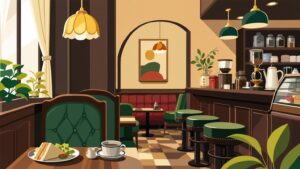
Entering a classic Osaka kissaten is like stepping back in time. The style is distinctly mid-to-late Showa Era (approximately 1950s-1980s). The lighting is low, emitting a warm, amber glow. Chairs are often covered in aged velvet or dark vinyl, incredibly comfortable and shaped by the countless regulars over the years. Walls are lined with dark, polished wood paneling. You might notice ornate light fixtures, bits of stained glass, or shelves filled with vintage manga and porcelain knickknacks. The space carries a certain seriousness, a sense of accumulated history.
And then there’s the aroma. It’s a rich, complex blend: the deep, earthy fragrance of siphon-brewed coffee, a trace of caramelizing sugar, and often, the faint, persistent ghost of cigarette smoke. Although many modern cafes in Japan have gone non-smoking, many traditional kissaten remain strongholds of this fading habit. For some, this can be off-putting. But to truly understand the kissaten, one must see it as a product of its era, a place where morning coffee and the morning cigarette were inseparable companions. This entire ambiance is a conscious rejection of the bright, sterile, minimalist style that dominates contemporary café culture. It’s a sanctuary—a womb-like refuge shielding you from the noise and bustle of the street outside. It conveys, “Slow down. You are safe here. The world can wait.”
The Master: The Heartbeat of the Place
At the heart of this world is the owner, the “Master.” Often an older man or woman who has run the shop for decades, this person serves as the quiet conductor of the morning ritual. They are not an overly enthusiastic barista asking for your name to jot on a cup. The Master embodies quiet authority and keen observation. They move with economy and grace, polishing glasses, preparing the siphon, and plating toast with practiced, unhurried skill.
The relationship between the Master and the regulars is a subtle art of Japanese communication. Built on years of shared mornings, it requires few words. A slight nod of recognition as a regular walks in. A quiet “itsumo no” (the usual) suffices as an order. The Master knows one guest prefers their toast lightly browned, another black coffee, and a third will linger for exactly forty-five minutes before leaving for work. They are the keeper of neighborhood secrets and silent witness to daily dramas and small victories. This dynamic reflects Osaka’s approach to business and relationships: deeply personal, founded on loyalty (joren), trust, and the comfort of predictability—a sharp contrast to the efficient but impersonal transactional culture typical of other major cities.
Osaka vs. Tokyo: Breakfast as a Cultural Barometer
How a city begins its day reveals much about its priorities. The Morning Set culture sharply contrasts the differences between Osaka and Tokyo, serving as a daily, edible illustration of two distinct urban living philosophies that emphasize what each city values most: communal rhythm versus individual efficiency.
Efficiency vs. Community
In Tokyo, mornings often feel like a race against time. The breakfast culture favors speed and convenience. Commuters flood massive train stations, quickly grabbing an onigiri from a convenience store or a coffee and pastry from a sleek, modern cafe chain. The priority is to refuel swiftly and move on to the next destination. Cafes function as pit stops—practical spaces designed for rapid turnover and solitary work on laptops. Their purpose is mostly logistical.
Osaka’s Morning Set culture stands in stark contrast. It represents a deliberate, scheduled pause—an act of defiance against the tyranny of the clock. People don’t just find time for it; they intentionally make time for it. It is woven into the rhythm of their morning. The value lies not in quick entry and exit but in savoring the quality of time spent lingering. The emphasis is on the communal experience, even if it simply means quietly sharing a room with others. This reflects a core Osakan belief: life should be lived, not rushed through. There’s a prevailing sense that human connection, however subtle, is essential for a good day.
The Sound of the City
The ambient noise in a morning cafe offers another cultural insight. A typical Tokyo cafe’s soundscape is one of focused individualism—with the soft tapping of laptop keys, occasional hushed business calls, and the espresso machine’s whirl. Though people share the space, they remain largely in their own worlds. The atmosphere is one of polite, productive isolation.
An Osaka kissaten in the morning, however, sounds entirely different. The primary sound is the gentle rustle of turning newspaper pages. You’ll hear the low, comfortable murmur of conversation at the regulars’ table—a sound refined over countless shared mornings. There’s the delicate clink of porcelain cups on saucers and the soft scraping of knives spreading butter on toast. It’s a cozy, domestic soundscape—a community comfortable and present with each other. This auditory contrast reflects broader city stereotypes: Tokyo as polished, formal, and reserved; Osaka as grounded, relational, and unpretentious.
What Foreigners Often Misunderstand
Newcomers often mistake a kissaten Morning Set for a Western cafe’s brunch special. They see the low price and think, “What a bargain!” They might rush in, order, eat quickly, and leave, feeling they’ve outsmarted the system. This completely misses the point. The Morning Set is not a mere discount—it’s a social invitation. By rushing, you inadvertently decline that invitation.
The unspoken expectation is that you will linger. The Master isn’t eager to clear your table hastily. Indeed, high turnover is contrary to the business model. The value lies in maintaining a stable, predictable clientele who occupy the space and help create a calm, established atmosphere. To “eat and run” is seen as slightly rude—not because of any explicit rule, but because it disrupts the rhythm. It’s treating a living room like a drive-thru. The true value is in embracing the pace, sinking into the velvet chair, and letting yourself become part of the morning’s quiet, unfolding scene.
Finding Your Morning Ritual: A Practical Guide for Residents

Incorporating the Morning Set ritual into your daily routine is one of the most fulfilling ways to truly connect with authentic Osaka. It’s about discovering your favorite spot, your usual seat, and gradually becoming one of the familiar faces. This ritual allows you to put down roots and feel like a genuine resident rather than just a fleeting visitor.
How to Spot a Good Kissaten
Forget relying on Yelp or Google Maps ratings. The best kissaten are often those that remain under the digital radar. Your greatest tools are your eyes and intuition. Look for key signs. Is there a simple, perhaps slightly worn, sign in the window that says 「モーニング」 or 「コーヒー」? Are there incredibly realistic yet somehow old-fashioned plastic food models of the Morning Set displayed? These are strong indicators.
The most important sign is the clientele. Peek through the window. Do you notice older locals? Grandfathers reading the sports section, grandmothers chatting over coffee? If so, you’ve probably found a treasure. These establishments have served the community for decades, thriving on loyalty rather than trends. Don’t be discouraged if the entrance looks a bit dim or dated, or if it’s tucked away in a narrow alley in a residential area. These hidden gems often provide the most authentic and welcoming experience, offering a true taste of local life.
The Unspoken Etiquette
Once you’ve picked your spot, keep a few subtle etiquette rules in mind. First and foremost, relax. Don’t expect immediate service. The Master works at a deliberate, unhurried pace, which is part of the charm. When you order, the coffee is the centerpiece. You request a “Hot” (hot coffee) or “Ice” (iced coffee), and the Morning Set comes as the accompaniment. You might hear “Toast de ii?” (Is toast okay?), confirming you want the set.
Be attentive. If the place has many regulars, try to sense the unspoken seating arrangement. Avoid taking a seat that clearly belongs to a regular. Find a quiet spot and settle in. It’s perfectly fine—in fact, encouraged—to keep to yourself. Bring a book, or simply observe the gentle rhythms of the morning. You’re not expected to engage in small talk. Your quiet, respectful presence adds to the atmosphere. Finally, when it’s time to go, you’ll almost always pay at the cash register near the entrance as you leave. Collect your things, approach the counter, and the Master will give you the total. This system runs on a simple, old-fashioned trust. A soft “gochisosama deshita” (thank you for the meal) as you head out is the perfect way to conclude a perfect Osaka morning.