Tokyo is a city of glass and steel. Tokyo reflects the sky. Tokyo is quiet, efficient, and deeply anonymous. You can live in Tokyo for a decade and never know the name of the person who sells you your morning coffee. But Osaka is different. Osaka is a city of rust and neon. Osaka absorbs the noise. Osaka shouts, Osaka laughs, Osaka demands your attention. If you are a foreigner moving to this wild, vibrant metropolis, you must understand one fundamental truth. The soul of Osaka does not live in its towering skyscrapers. The soul of Osaka does not live in its modern department stores. The soul of Osaka lives under the long, arched roofs of the covered markets. The soul of Osaka lives in the Osaka shotengai shopping street.
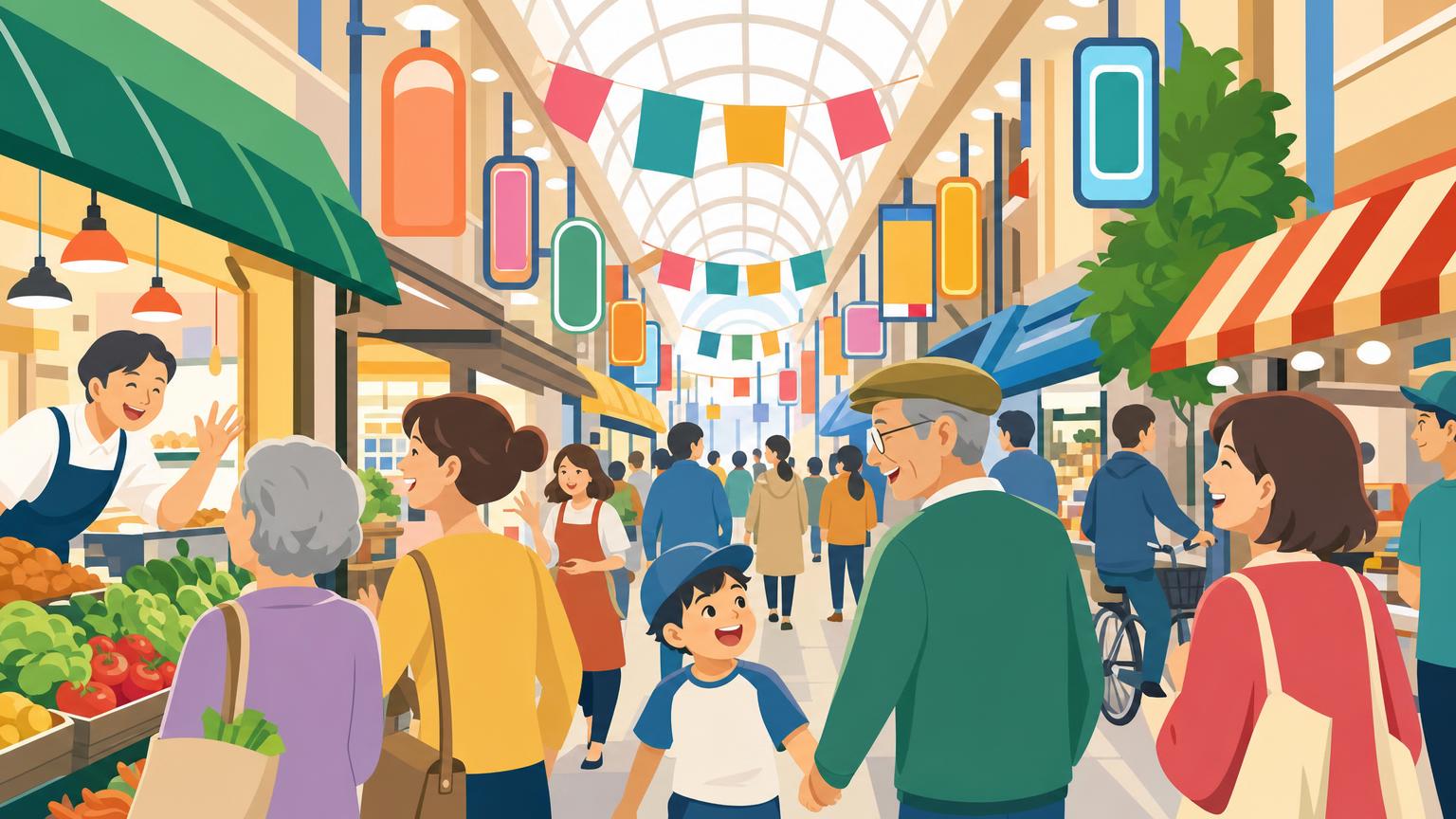
You step out of the station. You feel the heavy, humid air of the Kansai summer. You walk toward the entrance of the arcade. A massive, fading sign welcomes you. The moment you step under that roof, the atmosphere shifts. The light changes. The fluorescent bulbs hum overhead. The smell of rich, savory dashi broth drifts from a corner noodle stand. The sweet, heavy scent of roasting green tea pours out of a decades-old shop. You hear the sharp, melodic chime of bicycle bells. You hear the distinct, rough, and warmly melodic sounds of Kansai-ben, the local dialect. You are no longer just in a city. You are in a living room. You are in the communal dining room of the neighborhood.
This article is not a travel guide. This is a manual for survival and understanding. This is for the expat staring out the window of their new apartment, wondering why the local grocery store feels so chaotic. This is for the digital nomad trying to decipher the unspoken rules of the standing bar. This is for anyone who wants to peel back the neon layers of Dotonbori and understand the raw, beating heart of everyday Osaka life. We are going to explore the community feel of Osaka’s shotengai versus the commercial focus of arcades in other cities. We are going to examine the local shopping arcade dynamics. We are going to look at the people, the mindset, the unspoken rules, and the everyday behavior that makes living here an entirely unique experience.
Before we dive into the deep, winding corridors of the shotengai, let us ground ourselves. Here is a look at where these vibrant arteries run through the heart of the city.
What Does “Shotengai” Mean in Japanese?
To truly understand Osaka, you need to understand the word itself: shotengai. Sho means commerce or merchant. Ten means shop or store. Gai means street. Together, it means a street of merchant shops. However, the literal translation misses the cultural depth, historical importance, and emotional meaning embedded in the term. In many Japanese cities, a shotengai is merely a relic of days gone by—a place where old businesses gradually vanish, replaced by empty storefronts and a quiet melancholy. In Tokyo, major shopping arcades have often become hollow, losing their independent spirit to national chains, fast-food franchises, and sterile pharmacies. They have turned into outdoor malls. They are places for simple transactions. You enter, buy your item, and leave. There is no interaction. No conversation. Only commerce.
Osaka, however, rejects this sterile future. Here, the shotengai remains the neighborhood’s lifeblood. Historically, Osaka was known as the nation’s kitchen—a merchant city. While Tokyo was founded by samurai and bureaucrats, governed by strict hierarchies and formal rules, Osaka was built by traders, wholesalers, and market vendors. In a merchant city, your relationship with customers is everything. Trust is nurtured over decades. Conversations serve as the currency of connection. The shotengai physically embodies this merchant mindset. It is a covered, pedestrian-only street, typically near a railway station, lined with independent, family-run businesses. It functions as an ecosystem.
The roof is essential. It protects the community from heavy summer rains and shields shoppers from the scorching August sun. The roof creates a transitional indoor-outdoor space that blurs the line between public street and private business. As you walk through an Osaka shotengai, you’ll notice that shops don’t keep their goods hidden behind doors. Products spill onto the pavement—crates of daikon radishes, racks of discounted clothes, tables covered in handmade ceramics. The boundary between street and shop is completely porous. This serves as an invitation—a physical expression of Osaka’s personality: open, somewhat messy, intensely practical, and entirely unpretentious.
Foreigners often misinterpret this messiness. When new expats arrive in Osaka from Europe or North America, they often anticipate the hyper-organized, minimalist aesthetic dominating Japan’s international image. They expect Zen gardens, silent train rides, and immaculate, sparsely decorated boutiques. But when they enter a local Osaka shotengai, they experience a sensory overload. Handwritten cardboard signs shout about discounts. Elderly women ride heavy mamachari bicycles with striking precision through the crowds. Vendors loudly call out greetings. It feels chaotic, overwhelming. Yet what the newcomer initially misses is the deep, intricate social fabric holding everything together. The vendor shouting about cheap apples isn’t merely making noise; he is performing for the neighborhood, signaling vitality. The old woman on the bicycle isn’t reckless; she’s navigating a shared space according to a complex, unspoken local traffic rhythm. The chaos is a community in motion.
Tenjinbashisuji vs. Shinsaibashi: Which Osaka Shopping Street is Better?
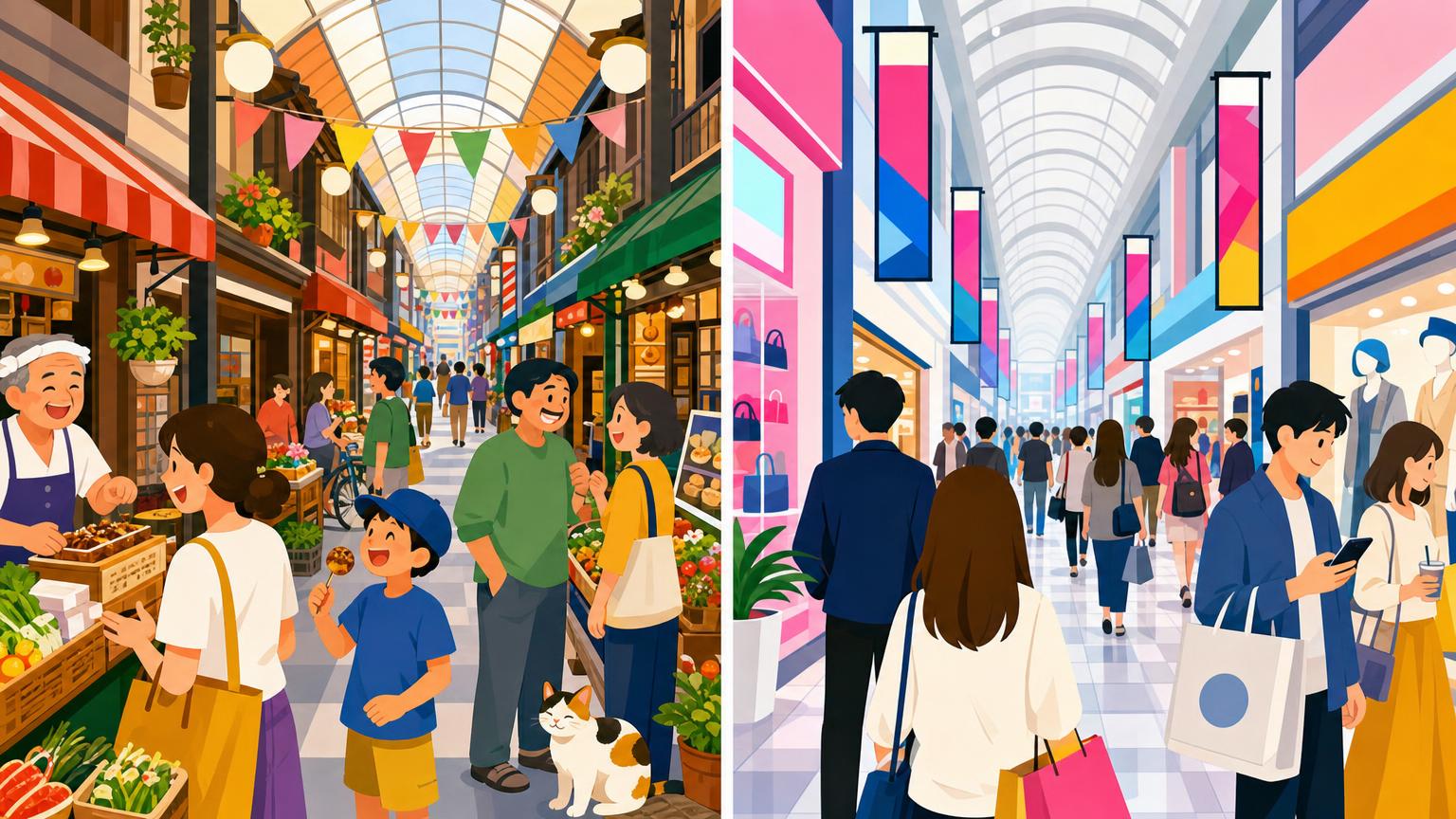
To grasp the dual essence of living in this city, you need to focus on its two giants—the titans of retail architecture: Tenjinbashisuji versus Shinsaibashi. This is the central debate, the dichotomy defining the Osaka experience. One embodies the deep, residential, and unwavering local life; the other showcases the dazzling, commercial, high-speed international side of the city. As a resident, you’ll use both—you’ll need both—but understanding their differences is key to comprehending how Osaka functions.
Many tourists ask which one is superior, but this is the wrong question. It’s like asking if a kitchen is better than a living room—they serve completely different purposes and cater to distinct moods. To truly live here, you must learn to navigate the unique rhythms of each corridor.
Tenjinbashisuji: The Longest Shotengai for Local Vibes
Let’s begin with the heart: Tenjinbashisuji. Stretching over two and a half kilometers, it’s the longest covered shopping arcade in Japan, spanning multiple subway stations from around Tenjimashisuji 6-chome in the north down to the Minami-morimachi area. This isn’t a tourist hotspot, though tourists do visit; it’s a functional, living, residential artery.
Walking down Tenjinbashisuji, you move through the daily lives of thousands of residents. The focus is practical: butchers carving meat on wooden blocks; greengrocers arranging perfectly round cabbages; tiny, dimly lit shops selling specialized teas; hardware stores stacked with brooms, buckets, and obscure gardening tools. The pace here is different—rhythmic—the tempo of a Tuesday morning or a Thursday afternoon.
Tenjinbashisuji’s real charm is its raw authenticity. Shoppers don’t dress up here. You’ll see the famed Osaka obachan—older women of the city—sporting their signature bold prints, often leopard or tiger patterns, paired with sturdy walking shoes and a fearless attitude. They don’t follow global fashion; they care about comfort, bargains, and community. Stand near a vegetable stall long enough, and you’ll witness the art of Osaka interaction—blunt and funny.
In Tokyo, transactions are silent: scan, price, pay, bow, leave. In Osaka, especially here, every exchange is an opportunity for banter. Vendors might toss in an extra mandarin if you smile, complain about the humidity, or tease you for buying too much tofu. It can be intimidating for foreigners—the Kansai dialect is fast and rough—but it’s also warmly inclusive. A clumsy Japanese greeting won’t be met with distant smiles, but with loud encouragement and inclusion in the joke. This is community—imperfect, noisy, but always present.
Shinsaibashi-suji: The Hub for Trendy Clothing and Souvenirs
Now take the subway south to Shinsaibashi station and step into the Shinsaibashi-suji arcade. The contrast is immediate, striking, and spectacular. If Tenjinbashisuji is the neighborhood kitchen, Shinsaibashi-suji is the city’s glittering showroom—the place where commercial muscle flexes.
The roof is higher; the lights are brighter; air conditioning blasts from open doors of international fast-fashion stores, upscale cosmetic boutiques, and sprawling duty-free shops. Floors gleam; crowds are dense and energetic. You won’t find grandmas buying daikon here, but rather crowds of domestic and international shoppers hunting for the latest trends, carrying huge bags, and pausing for photos beneath neon signs.
For residents, Shinsaibashi is a resource—a place to find trendy clothing, buy gifts, or experience the city’s global scale. It’s not a place to relax. Interactions are transactional, with staff speaking polite, standardized Tokyo-style Japanese, mixed with English, Mandarin, and Korean. The local warmth and gritty merchant banter are buried beneath corporate polish.
Yet even amid its high-speed commerce, Shinsaibashi has a distinctly Osaka character. It’s loud and unapologetic, not elegant or understated like Tokyo’s Ginza or Omotesando. It embraces spectacle: huge digital billboards flash nonstop, promoters shout through megaphones handing out flyers. It’s a relentless river of consumption. As an expat, you’ll learn to navigate this river—discovering side streets to avoid crowds, using underground passages. Shinsaibashi is magnificent for what it is, but it’s not where you seek the community’s soul—it’s where you feel the city’s economic pulse.
Best Osaka Shotengai for Authentic Street Food and Restaurants
Food in Osaka is more than mere sustenance; it is a passion. The city’s unofficial motto, kuidaore, roughly means to eat oneself into ruin. Yet, it’s not simply about consuming calories; it’s about the social atmosphere surrounding the meal. Restaurants here are designed to encourage interaction, and this is especially clear in the dining-oriented shotengai.
Choosing the right place to eat involves understanding the local geography. The best meals are seldom found in the polished, quiet dining rooms of major hotels. Instead, they are discovered in the noisy, cramped, steam-filled corridors of the arcades.
Dotonbori Shopping Arcade
Dotonbori is well-known—perhaps even overly familiar. Just a short walk from Namba station, it is the iconic image of Osaka: the giant mechanical crab, the neon Glico running man, and the vast, glowing signs reflecting on the dark canal waters. For tourists, Dotonbori is a must-see. But how do locals perceive it?
Living in Osaka means having a complicated relationship with Dotonbori. On a quiet Tuesday morning, when crowds thin out, you can stroll through the covered sections and witness delivery trucks unloading large quantities of flour, cabbage, and octopus. You glimpse the workings behind the neon lights, realizing that despite its flashy appearance, this is still a functional district.
The food here is bold. Takoyaki stands line the street, with cooks moving swiftly and skillfully, flipping spherical batter cakes with metal picks. The air is thick with the sweet aroma of okonomiyaki sauce. Restaurants here are large, loud, and geared toward high volume. Locals might avoid the main street on busy Saturday nights unless they have visitors, as the lines are long and the noise overwhelming. Yet, they still hold it in respect—for its sheer chaotic energy. Dotonbori represents the commercial peak of Osaka’s food culture: a carnival that is fun, delicious, and theatrical. To experience the everyday dining culture, you must look beyond.
Janjan Yokocho (Shinsekai)
Take the train south to Dobutsuen-mae station and walk toward the Shinsekai district. Shinsekai, meaning New World, was named over a century ago when it was designed as a futuristic entertainment area. Today, it is a wonderfully retro, slightly gritty, deeply nostalgic neighborhood, with Janjan Yokocho at its core.
Janjan Yokocho is not a wide, grand arcade; it is a narrow, cramped, richly atmospheric alleyway. It smells of fried oil, cheap beer, and old tobacco smoke. This is undeniably the home of kushikatsu—deep-fried skewers of meat and vegetables. More importantly, it is the heartland of the standing bar, or tachinomi.
To truly grasp the down-to-earth nature of Osaka’s people, spend an evening at a tachinomi in Janjan Yokocho. There are no seats; you stand shoulder to shoulder with construction workers, office clerks, retirees, and students. Personal space does not exist here. Standing next to an older gentleman with a glass of shochu, he will strike up a conversation. It doesn’t matter if your Japanese isn’t perfect or where you’re from—he will ask what you’re eating, offer you a cigarette, and laugh warmly at your attempts to pronounce menu items.
Here, the city’s communal spirit thrives. There is no hierarchy in a standing bar; the layout forces connection. You can’t hide in a private booth—you are part of the crowd. The well-known kushikatsu rule forbids double dipping in the communal sauce tin. It’s a hygiene rule, yes, but also a social contract: you share this space, this sauce, this moment. Janjan Yokocho is loud, affordable, and utterly unpretentious. It provides the perfect antidote to the sanitized, commercial dining experiences found elsewhere in urban life.
Kuromon Ichiba Market
A short walk from Nippombashi station brings you to Kuromon Ichiba Market. Often called a market rather than a strict shotengai, it operates within the same architectural and cultural framework. It is a covered street historically dedicated to supplying the city’s professional chefs with the freshest seafood, finest meats, and highest-quality produce.
Kuromon Ichiba offers an interesting example of how local arcades evolve. Over the past decade, it has shifted. What was once a purely functional, somewhat quiet morning market for chefs has turned into a bustling street food hotspot. Stalls that once sold whole tuna now sell small, pricey skewers of fatty tuna belly aimed at tourists eating on the go.
For long-term foreign residents, opinions about Kuromon vary. Some lament the gentrification, missing the days when inexpensive everyday vegetables could be bought without navigating crowds of tourists enjoying grilled scallops. They contend that the market’s commercial focus has diluted its community spirit. Others appreciate the adaptation, seeing merchants finding ways to survive and prosper in a changing global economy. Whatever your view, Kuromon remains a vital part of the city. The food quality is undeniable, and its energy is electric. It teaches you that Osaka is not a museum piece—it is pragmatic. If selling grilled crab legs to tourists helps pay the rent and sustain family businesses for another generation, Osaka merchants will embrace change without hesitation.
Deep and Local: Shotengai Off the Beaten Path
If you truly want to integrate and understand what daily life in Osaka is really like once the neon lights go off and the tourists have left, you must venture beyond the city center. You need to explore the residential neighborhoods. This is where the authentic, uncompromising local shotengai culture remains alive in its purest form.
Karahori Shopping Street
Get off at Matsuyamachi station, located a short distance east of the central Namba area. Walk uphill, and you will discover the Karahori Shopping Street. Karahori is a rare survivor. Much of central Osaka was destroyed during the World War II air raids, but the Karahori area mostly escaped the devastation. As a result, the streets here curve and twist in organic, unpredictable ways. The architecture preserves the charm of the early Showa period.
Unlike other shotengai, Karahori is not flat; it ascends and descends a hill, creating a distinctive visual landscape. What makes Karahori especially captivating for foreign residents is the seamless fusion of old and new. Here, a sixty-year-old tofu shop run by a stoic man who starts grinding soybeans at three in the morning sits beside a stylish, meticulously designed specialty coffee stand run by a tattooed young barista.
Karahori demonstrates that local shopping arcades don’t have to disappear or succumb to mass commercialism. They can evolve. Young creatives in Osaka are moving into these older neighborhoods, renovating rundown traditional row houses called nagaya, and opening independent boutiques, curry shops, and design studios. They aren’t pushing out the older residents; they are integrating with them. Walking through Karahori, you feel the strong sense of community. The young barista buys his lunch from the old bento shop. The elderly dry-goods merchant sweeps the street in front of the modern bakery. Living near Karahori means engaging with this daily rhythm. It involves learning your neighbors’ names and realizing that the city is a tapestry woven from multiple generations living side by side.
Senbayashi Shopping Street
For the ultimate, rawest expression of Osaka housewife culture, take the Keihan Line to Senbayashi station. The Senbayashi Shopping Street is a legendary local landmark. It is neither stylish nor trendy. It is fiercely and unapologetically practical.
This is the domain of the famous Osaka obachan. The street is crowded, noisy, and bursting with energy. Shops compete fiercely on price. Banners advertise incredibly cheap vegetables, discounted socks, and bulk household goods. The soundscape is a cacophony of recorded announcements blaring from speakers, live merchants shouting specials, and the constant chatter of women exchanging neighborhood gossip.
For a foreigner, visiting Senbayashi offers a masterclass in understanding the true culture of the city. There are no English menus here. You won’t find craft beer. Instead, you’ll encounter the raw mechanics of daily survival in a working-class Japanese neighborhood. You’ll learn how to navigate through the crowd. You’ll discover that when an older woman with a shopping cart approaches, you step aside. You’ll realize that the true wealth of Osaka isn’t measured in bank accounts, but in the fierce, joyful resilience of its people. The community is close-knit and watchful. If you become a regular at a shop in Senbayashi, you’re no longer just a customer—you become part of the local ecosystem. They’ll ask about your health and your family back home. They might scold you if you look too thin. This level of intrusion might surprise Western sensibilities, where privacy is highly valued. But in Osaka, this intrusion is a form of care. It’s the highest compliment. It means you are truly seen.
Niche Shopping: Where to Find Kitchenware, Ceramics, and Clothing
Living in a new country means you have to gather essentials. You need plates. You need pans. You need clothing suited to the climate. How you obtain these items in Osaka reveals a lot about the city’s personality. You could visit a vast, impersonal department store, or you could explore the specialized shotengai, where the history of craftsmanship is etched into the streets.
Sennichimae Doguyasuji Shopping Street
Just southeast of Namba station is a compact yet vibrant arcade called Sennichimae Doguyasuji. This is the kitchenware street, frequented by professionals. When a new ramen shop opens, the owner comes here to purchase enormous boiling pots. When a top sushi chef needs a knife capable of slicing fish with microscopic precision, they come here.
Doguyasuji is also open to the public, and for someone settling into a new apartment, it’s a treasure chest. You pass shops filled with thousands of ceramic bowls—beautiful, handcrafted pieces in deep indigo, earthy greens, and crisp whites. You see stacks of wooden bento boxes, racks of delicate chopsticks, and huge cast-iron takoyaki grills.
The commercial environment here is captivating. The Doguyasuji merchants are experts who have little patience for ignorance but greatly respect genuine curiosity. If you enter a knife shop and point at a random blade, they will sell it to you. But if you inquire about the steel, its sharpening, or show a willingness to learn, their attitude shifts completely. The gruff façade softens. They’ll spend half an hour explaining the blade’s metallurgy, demonstrate the correct angle on the whetstone, and carefully wrap the knife in protective paper. This embodies the Osaka artisan spirit: practical, unpretentious, yet deeply dedicated to quality. They’re not selling a brand; they’re offering a tool that, if respected, will last a lifetime.
Shinsaibashi & Amerikamura Area
When it comes to fashion and clothing, the vibe changes once again. We’ve looked at the main Shinsaibashi-suji arcade, the bright commercial core. Just west, near Yotsubashi station, lies Amerikamura, or Amemura. Although not a traditional covered shotengai, it serves as an outdoor, chaotic, youth-driven counterpart.
Amemura is the hub of vintage clothing, streetwear, and alternative culture in Osaka. The streets form a maze of small boutiques, record shops, and cafés. The energy here is rebellious. Whereas Tokyo’s youth fashion hubs like Harajuku often favor the polished, curated, and avant-garde, Osaka’s Amemura embraces the rugged, loud, and deeply personal. You’ll find large stores stocked with imported American vintage clothes from the ’80s and ’90s, alongside local designers hand-printing t-shirts.
For residents, exploring Amemura’s clothing shops becomes an exercise in self-expression. The staff here don’t follow traditional Japanese politeness; they’re cool and casual. They’ll compliment your sneakers and ask about your music tastes. The interaction is less about formal customer service and more about shared appreciation of style. This reflects a broader truth about Osaka: the city treasures individuality and expression far more than rigid conformity. You can wear bright colors and mismatched patterns, and the city won’t judge you—it will likely celebrate you.
Practical Tips for Exploring Osaka’s Covered Markets
If you plan to live in this city and navigate its covered arteries daily, practical skills are essential. The shotengai follows its own physics, with its unique flow, rules of engagement, and economy.
How to Get Around
In Osaka, the most important vehicle is not the car but the bicycle, specifically the mamachari—a heavy, sturdy city bike equipped with baskets both front and back. The shotengai is the natural domain of the mamachari. As a pedestrian, you must stay highly aware of your surroundings since the bicycles move silently, weaving through dense crowds with impressive speed and precision.
The golden rule for walking in a local shotengai is to hold your line—avoid making sudden, unpredictable lateral movements across the street. Walk with intention. If you pause to browse clothing or ceramics, step fully out of the main flow of traffic. Locals have a mental map of the street and anticipate movement; if you behave predictably, bicycles will flow around you like water around a stone. But if you dart back and forth, you disrupt the entire ecosystem.
Additionally, pay attention to the time of day. At 10:00 AM on a Tuesday, a shotengai is a place for slow, methodical grocery shopping. By 6:00 PM on a Friday, it transforms into a high-speed commuter highway, filled with thousands rushing from train stations to their homes. You must adjust your pace to match the environment and flow with the city.
Cash vs. Card Etiquette
Japan is rapidly moving toward digitization. In Tokyo’s major malls and commercial hubs like Shinsaibashi street, credit cards and digital transit passes are common—you can tap your phone and walk away. But in Osaka’s deep local shotengai, cash still rules.
When buying a single skewer of chicken yakitori from a small window in Tenjinbashisuji, you don’t hand over a credit card—you give coins. The physical exchange of cash is part of the transaction’s rhythm, allowing a brief moment of eye contact and a nod of thanks.
However, this is gradually changing. Many small vendors now accept QR code payments like PayPay. Still, etiquette remains the same: transactions must be swift. Don’t stand at the front of a busy takoyaki stall fumbling for five minutes to open an app while a line of hungry locals grows behind you. Have your cash ready or your app open before stepping up to the counter. Respect both the merchant’s time and the people waiting around you.
Living in Osaka is a constant process of learning these subtle rhythms. It’s about understanding that the city is not merely a backdrop for your life but an active participant. The shotengai is the stage where this daily drama unfolds. It’s where you realize the true beauty of the city lies not in pristine silence, but in the noisy, messy, joyful, and profoundly human interactions of everyday survival. It’s where you discover that beneath the rough exterior, the loud Kansai dialect, the neon, and the rust, Osaka holds the biggest, warmest heart in all of Japan—you just need to know which street to walk down to find it.