I remember my first real business meeting in Osaka. I came armed with a pristine PowerPoint deck, a rehearsed, formal Japanese greeting, and the buttoned-up demeanor I’d been told was essential for success in Japan. My Tokyo colleagues had prepped me for a long, delicate dance of pleasantries and indirect communication. Five minutes in, the company president, a man in his late sixties with a warm, booming laugh, leaned forward, pushed my carefully prepared documents aside, and asked with a twinkle in his eye, “So, what’s the bottom line? And how can you make it a better deal for us?” The air didn’t feel tense or aggressive. It felt… real. The carefully constructed wall of corporate formality I’d built just crumbled, replaced by an honest-to-goodness conversation. That’s when I realized I wasn’t just in a different city; I was in a different mindset. This wasn’t Tokyo. This was Osaka, the city built not by samurai and shoguns, but by merchants, the ‘Akindo,’ and their spirit is the invisible ink on every contract and the rhythm of every conversation.
For anyone thinking about living in Osaka, working here, or just trying to understand why this city buzzes with a unique, electrifying energy, you have to look past the neon lights of Dōtonbori and into the heart of its people. The key isn’t in a guidebook; it’s in the unwritten rules of the Akindo, a pragmatic, human-centric, and fiercely shrewd way of seeing the world that shapes everything from billion-yen deals to how you buy your vegetables at the local market. It’s the DNA of the city, a living history that defines what makes Osaka so fundamentally different from the rest of Japan. To get a feel for the epicenter of this commercial energy, just look at the area around the Shinsaibashi-suji shopping arcade, a place where business and daily life have been colliding for centuries.
For anyone seeking to uncover even more of Osaka’s authentic character, exploring Osaka’s candid communication style reveals how local bluntness transforms every conversation.
The Kitchen of the Nation: Where the Akindo Spirit Was Born
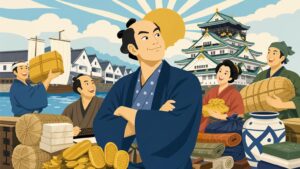
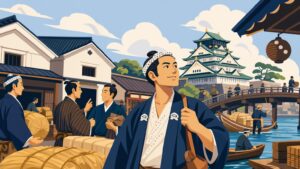
To understand Osaka, you need to rewind the clock. During the Edo Period, while Tokyo (then Edo) served as the rigid political capital of the samurai government, Osaka was known as ‘Tenka no Daidokoro’ – The Nation’s Kitchen. It was the commercial center and the warehouse of Japan, where rice, the currency of the time, was collected, stored, and traded. The city’s heroes weren’t stoic warriors; they were shrewd, hard-working merchants who built fortunes through their ingenuity, relationships, and negotiation skills. This history is not just a museum exhibit; it forms the foundation of Osaka’s identity.
This fundamental difference in origin stories lies at the heart of the Osaka vs Tokyo debate. Tokyo’s culture emerged from a top-down, hierarchical samurai society where formality, procedure, and saving face were paramount. The rules were set by the powerful, and success often depended on one’s status and place in the social hierarchy. Osaka, by contrast, developed a culture from the ground up. Success relied on what you could accomplish, how cleverly you worked, and how well you connected with others on a personal level. Status was earned through commercial achievement rather than inherited by birthright. This nurtured a strong pragmatism and a healthy skepticism of unnecessary formality. An Akindo didn’t have time for vague pleasantries when a deal needed to be struck. This historical context is essential for understanding why a businessperson from Osaka today might appear impatient with bureaucratic red tape that a Tokyo counterpart regards as standard procedure.
It’s Not Rude, It’s Rational: The Osaka Communication Style
One of the earliest culture shocks for foreigners living in Osaka—especially those coming from the more reserved atmosphere of Tokyo—is the communication style. People are straightforward. They say exactly what they think. They interrupt with jokes. To those unfamiliar, it can seem loud, chaotic, and sometimes even a bit brusque. This is perhaps the biggest misconception about Osaka residents. It’s rarely about rudeness; it’s about being efficient and genuine.
In the Akindo mindset, ambiguity is viewed as a waste of time, and time is the most precious resource. A clear ‘no’ is preferable to a vague ‘maybe’ that drags on for weeks. A direct question receives a direct answer, enabling both parties to understand their position and move forward. This approach cuts through the layers of ‘tatemae’ (public face) and ‘honne’ (true feelings) that can make communication elsewhere in Japan so challenging to interpret. In Osaka, you’re much more likely to encounter ‘honne’ right from the outset, and it’s a mark of respect. It means they see you as a serious partner worthy of honest conversation.
Getting to the ‘Nambo?’
The quintessential Osaka question is “De, nambo nan?” – “So, how much is it?” This isn’t just about money. ‘Nambo’ represents a mindset. It embodies the drive to cut through the fluff and get to the heart of the matter. In a business meeting, while a Tokyo-based team might spend an hour on formal introductions and background, the Osaka team is eager to reach the ‘nambo’ of the situation: What’s the real value proposition? What’s the price? What are the key deliverables? What’s the timeline? This can be surprising if you’re unprepared, but it’s incredibly efficient.
This mindset permeates daily life in Osaka. You’ll notice it in the shotengai (shopping arcades) where shopkeepers and customers engage in lively, rapid-fire exchanges about products and prices. It’s a culture that prizes transparency and despises waste—whether it’s wasted time in a meeting or wasted money on a subpar product. For anyone working here, learning to embrace this directness is essential. Don’t confuse it with a lack of respect; rather, see it as an invitation to engage in a productive, straightforward discussion.
Humor as a Business Lubricant
The flip side of this directness is a deep appreciation for humor. In Osaka, a shared laugh is worth more than a stack of business cards. Humor, especially a self-deprecating joke or a quick-witted ‘tsukkomi’ (a sharp retort, like a comedy straight man), is the ultimate icebreaker. It’s a tool used to disarm, build rapport, and gauge the personality of a potential partner. If you can laugh together, you can probably do business together.
This sharply contrasts with the often somber and serious atmosphere of a Tokyo boardroom. In Osaka, cracking a joke during negotiations isn’t unprofessional; it’s strategic. It shows confidence, approachability, and a willingness to be human. It signals that you value the relationship as much as the deal. Foreigners are often surprised when a serious discussion about quarterly earnings is suddenly interrupted by laughter, but this is the Akindo spirit in action. Business is serious, but the people conducting it don’t have to be. A strong relationship, built on mutual trust and a few good jokes, is considered the best foundation for a successful long-term partnership.
The Art of the Deal: Negotiation, Osaka Style
If business is a game, then Osakans are its true masters. The negotiation style here is a fluid, dynamic dance that contrasts sharply with the more rigid, process-driven methods you might encounter elsewhere. It’s less about sticking to a script and more about intuitively reading the other person to achieve a mutually beneficial outcome.
The Philosophy of ‘Ne-giri’ (Price Cutting)
The practice of haggling, or ‘ne-giri,’ is deeply embedded in Osaka’s commercial culture. While bargaining may not be possible in a department store, the essence of ne-giri thrives, often in more subtle ways. It’s not merely about lowering the price; it’s a form of interaction. The initial price is usually just a starting point—the real discussion begins once you push back slightly.
In a B2B setting, this isn’t about lowballing every offer. Rather, it’s a creative negotiation over the terms of the deal. A client might say, “Your price is a little high.” In Tokyo, that could signal a polite refusal. In Osaka, it’s often an invitation: “Convince me. What additional value can you provide? Can we amend the payment terms? Can you include training?” It’s a collaborative effort to shape the agreement. Demonstrating flexibility and willingness to engage in this exchange is highly regarded. Refusing to negotiate and holding rigidly to your initial offer may come across as arrogant or lazy. The dance of ne-giri is about showing that you’re committed enough to earn the deal.
‘Kosupa’ is King: The Obsession with Value
To truly grasp the Osaka mindset, you need to understand ‘kosupa,’ a contraction of ‘cost performance.’ It reflects a near-religious commitment to getting the absolute best value for your money. This is not about being cheap. A cheap product that breaks easily is poor kosupa. An expensive product that lasts for years and works flawlessly exemplifies great kosupa. Osakans are willing to pay a premium, but only if the value is clearly evident.
This dedication influences every facet of daily life and business. Lunch spots are chosen based on which offers the tastiest food at a fair price. Corporate purchasing decisions consider not only the sticker price but the long-term return on investment. When selling a product or service in Osaka, relying on prestige or brand name alone won’t win. You must emphasize value. Your pitch must convincingly address: “Why is this the smartest, most efficient, and most value-packed choice I can make?” This practical, results-driven approach makes Osaka an appealing place to live for those who prioritize substance over style.
Human Connections Over Corporate Structures
In a city established by merchants, relationships mean everything. While a prestigious company name might open doors in Tokyo, in Osaka, a personal introduction from a trusted contact often carries much more weight. The Akindo spirit places great importance on the individual and the strength of their connections.
Who You Know, Not Just What You Do
Business in Osaka operates through a network of intertwined personal relationships. Trust is built between people, not anonymous corporations. This means meetings aren’t solely for conducting business; they’re opportunities to get to know the person across the table. Where did they grow up? What are their interests? What challenges do they face? Investing time in building this personal connection isn’t a waste; it’s the very purpose.
This can be difficult for those accustomed to a more transactional, efficiency-focused business style. The process may feel slower initially. You might have numerous meetings that seem more like casual conversations than tough negotiations. But this is the phase of investment. Once an Osaka businessperson decides they trust and like you personally, things can progress remarkably fast. Deals are finalized with a handshake and shared loyalty, with the paperwork following afterward. This stands in stark contrast to Tokyo’s approach, where the paperwork often forms the foundation of the relationship.
The ‘Naniwa-bushi’ Spirit: Emotion and Loyalty
There’s an old-fashioned term you might hear, ‘Naniwa-bushi,’ which describes a distinct Osakan mix of human-focused emotion, sentimentality, and fierce loyalty. It complements the sharp Akindo mind with heart. It means that once you’re inside the inner circle, your Osaka partners will stand by you through thick and thin. They will fight for you, defend you, and go beyond what’s required not just because a contract demands it, but due to the personal bond you share.
This loyalty is reciprocal. It’s earned by showing your own dedication and dependability. I once witnessed a supplier work through the night to resolve a problem for my company, not because they were contractually bound to do so, but because our boss had helped their son secure an internship years earlier. That’s Naniwa-bushi. It’s a business culture where human debts are remembered and repaid, where logic and emotion are intertwined rather than opposed. This profound sense of community and mutual support is a powerful, if often unseen, element that makes living and working in Osaka feel so authentic.
Living and Working with the Akindo Mindset: A Practical Guide
So how do you take all this and put it into practice? Whether you’re navigating the corporate world or your everyday life, embracing the Akindo spirit can enrich your experience in Osaka and lead to greater success. It’s about being practical, personable, and always focusing on value.
Navigating Your First Business Meeting
When you enter that meeting, leave the rigid script behind. Expect direct questions, and be ready with straightforward, honest answers. Don’t hesitate to let your personality shine. Share a joke if it feels appropriate. The aim is to connect as a person first and a company representative second. Know your numbers thoroughly and be prepared to clearly and concisely explain your value proposition. Why is your solution the best ‘kosupa’? Be open to flexibility and view the initial proposal as the beginning of a discussion, not the conclusion. Show that you’re a smart, reasonable person who’s enjoyable to work with, and you’ll be halfway to sealing the deal.
Beyond the Office: Daily Life Lessons
The Akindo mindset goes beyond the boardroom. You’ll experience it everywhere. When you talk to the owner of the local fruit stand, they’ll tell you exactly which melons are best today and which to avoid. They’re not just selling; they’re cultivating a relationship built on trust and good value. You’ll notice it in the long lines for a new takoyaki stand that offers a slightly larger portion for the same price. This is ‘kosupa’ in action. Adopting this mindset in your own life can be empowering. Ask questions. Look for the best value, not just the lowest price. Engage with people. A simple “Mokari makka?” (“Making a profit?”) – a classic Osaka greeting – can spark a friendly conversation. This is the heartbeat of daily life in Osaka. It’s a city that rewards curiosity, celebrates authenticity, and always remembers that, at the end of the day, business and life are all about people.