Living in Osaka is an exercise in sensory saturation. Your day begins with the rumbling of the Midosuji line, a human river flowing beneath the city. Your lunch is punctuated by the sizzle of okonomiyaki on a hot plate and the boisterous laughter of the shop owner. Your evening is a blaze of neon reflecting off the Dotonbori canal, a symphony of competing J-pop tracks, vendors’ calls, and the cheerful chaos of a million people determined to have a good time. Osaka is loud, it is relentless, and it is gloriously, unapologetically alive. And that’s precisely why the quietest place in the region is one of our most essential destinations. I’m talking about Mount Kōya, or Koyasan, the sacred home of Shingon Buddhism, just a short train ride away but a world apart. For many foreigners, a trip to Koyasan is a bucket-list item, a chance to see a postcard-perfect version of ancient Japan. But for those of us who call Osaka home, it’s something more. It’s not an escape from our city; it’s a pilgrimage to its hidden heart. To understand why the pragmatic, money-minded, and boisterous people of Osaka feel such a profound connection to this silent, sacred mountain is to understand the soul of the city itself. It’s a journey that reveals the unspoken balance that makes life in this vibrant metropolis not just possible, but meaningful.
While Koyasan offers the serene escape that balances the daily intensity of Osaka, its allure is matched by the city’s vibrant culinary traditions evident in the local kuidaore culture, which celebrates Osaka’s passionate indulgence in food and life.
The Nankai Line Express: A Portal Out of Urban Chaos
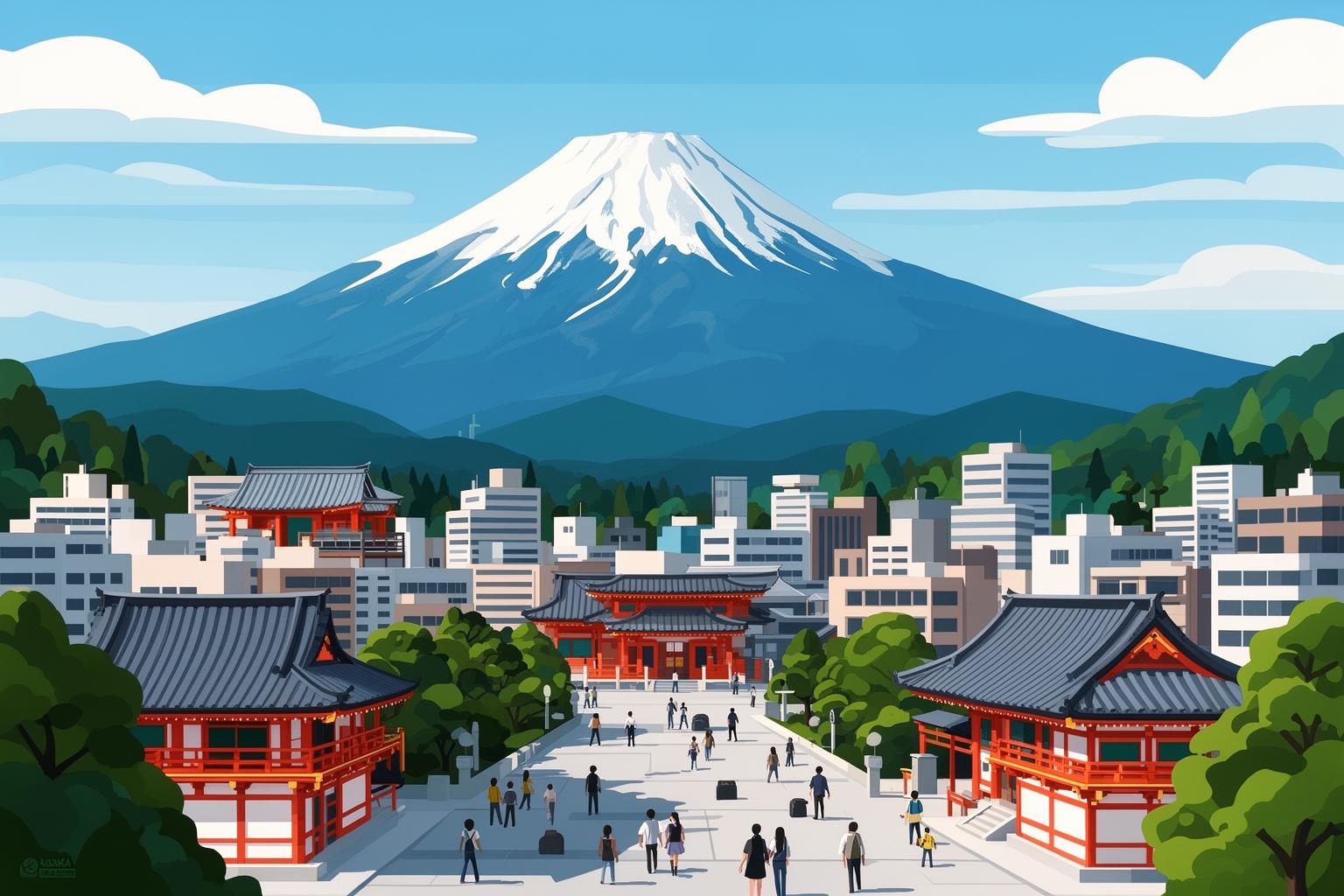
The pilgrimage doesn’t start at a temple gate but amid the chaotic, sprawling Namba Station. Located in the heart of Osaka’s Minami district, Namba serves as the city’s hub—a center of commerce, entertainment, and constant activity. Here, amid crowds bustling toward department stores and izakayas, you’ll find the dedicated platforms for the Nankai Koya Line. The train itself is unremarkable, resembling any other commuter express. Yet stepping aboard feels like passing through a portal. Your fellow passengers represent a broad cross-section of Osaka life: groups of impeccably dressed older women chatting animatedly, their speech colored by the distinctive, melodic Kansai dialect; young couples clad in trendy outdoor gear; families with energetic children; and solo travelers—salarymen and office ladies—faces marked by the week’s stresses.
As the train pulls away, a transformation occurs. The concrete canyons of Osaka give way to the cozy suburbs of Sakai, and then, gradually, the landscape ascends. Buildings thin out, replaced by terraced fields and dense bamboo groves. The train meanders up the forested mountainside, and with each bend, the carriage’s atmosphere changes. Loud conversations soften to murmurs. The children cease their bouncing and gaze out at the steep drops. The salaryman loosens his tie and closes his eyes, not from fatigue but in quiet anticipation. This journey itself becomes a form of meditation—an unhurried decompression, a physical and spiritual ascent preparing you for the profound change in surroundings. This accessibility is central to the Osaka mindset. In Tokyo, a spiritual retreat might feel like a major undertaking, a carefully arranged event requiring Shinkansen tickets and a detailed itinerary. For Osaka residents, Koyasan is practically in the backyard. The journey feels local, familiar. It reinforces the belief that spirituality isn’t an abstract notion to be chased on rare occasions; it’s a seamless part of life, a necessary form of upkeep as accessible as a trip to the supermarket. It’s pragmatic, efficient, and deeply embedded in the fabric of our weekly and monthly rhythms.
Shukubo (Temple Lodging): Beyond Hospitality, It’s Practical Spirituality
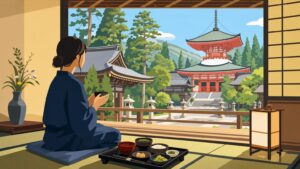
Upon arriving in Koyasan, you don’t check into a hotel; instead, you stay in a shukubo, or temple lodging. This is where the tourist experience diverges sharply from how people in Osaka perceive the trip. A first-time visitor might be struck by the austerity. The rooms are simple, featuring tatami mats and sliding paper screens. The corridors can feel drafty, and bathroom facilities are shared. This is not the polished, aesthetic experience of a high-end Kyoto ryokan. It is something much more straightforward. This simplicity resonates deeply with the Osaka spirit. People from Osaka are known for being no-nonsense. They prioritize substance over style, favoring a good deal over fancy presentation. The shukubo experience is, in many respects, a spiritual exchange. You give up modern comforts like a heated room and a soft bed in return for something far more precious: a moment of true peace and a glimpse into monastic discipline.
The highlight of the shukubo experience is the food, shojin ryori. This traditional Buddhist vegetarian cuisine, for the Osaka palate accustomed to bold, rich flavors like takoyaki, kushikatsu, and countless street foods, can come as a surprise. The dishes are subtle, delicate, and grounded in the principle of balance. There is no garlic or onion, no strong spices. Instead, you find tofu prepared in a dozen inventive ways, seasonal mountain vegetables, and gentle broths. One can almost hear a typical Osaka resident’s good-natured grumble: “It’s healthy, I guess, but I’d prefer a beer and some gyoza.” Yet, they eat it; they engage with the meal. They understand the agreement. They’ve accepted the terms of this spiritual contract. You set aside your cravings and attachment to worldly flavors, and in exchange, you gain a sense of lightness and purity. It’s a cleansing, not only for the body but for the soul as well. Another non-negotiable part of the experience is the morning prayer service. Rising before dawn to the sound of a gong, quietly walking down a cold wooden hallway to kneel on a tatami mat and listen to monks chanting sutras—this forms the heart of the experience. It isn’t a show for tourists; you are a participant in a ritual practiced daily for over a thousand years. For an Osaka person, whose life is ruled by train schedules and business deadlines, this different form of discipline is deeply restorative. It serves as a reminder that there are older, deeper rhythms in life. It provides a practical reset, a way to realign your internal clock away from the city’s relentless pace.
Okunoin Cemetery: Where Commerce and the Cosmos Meet
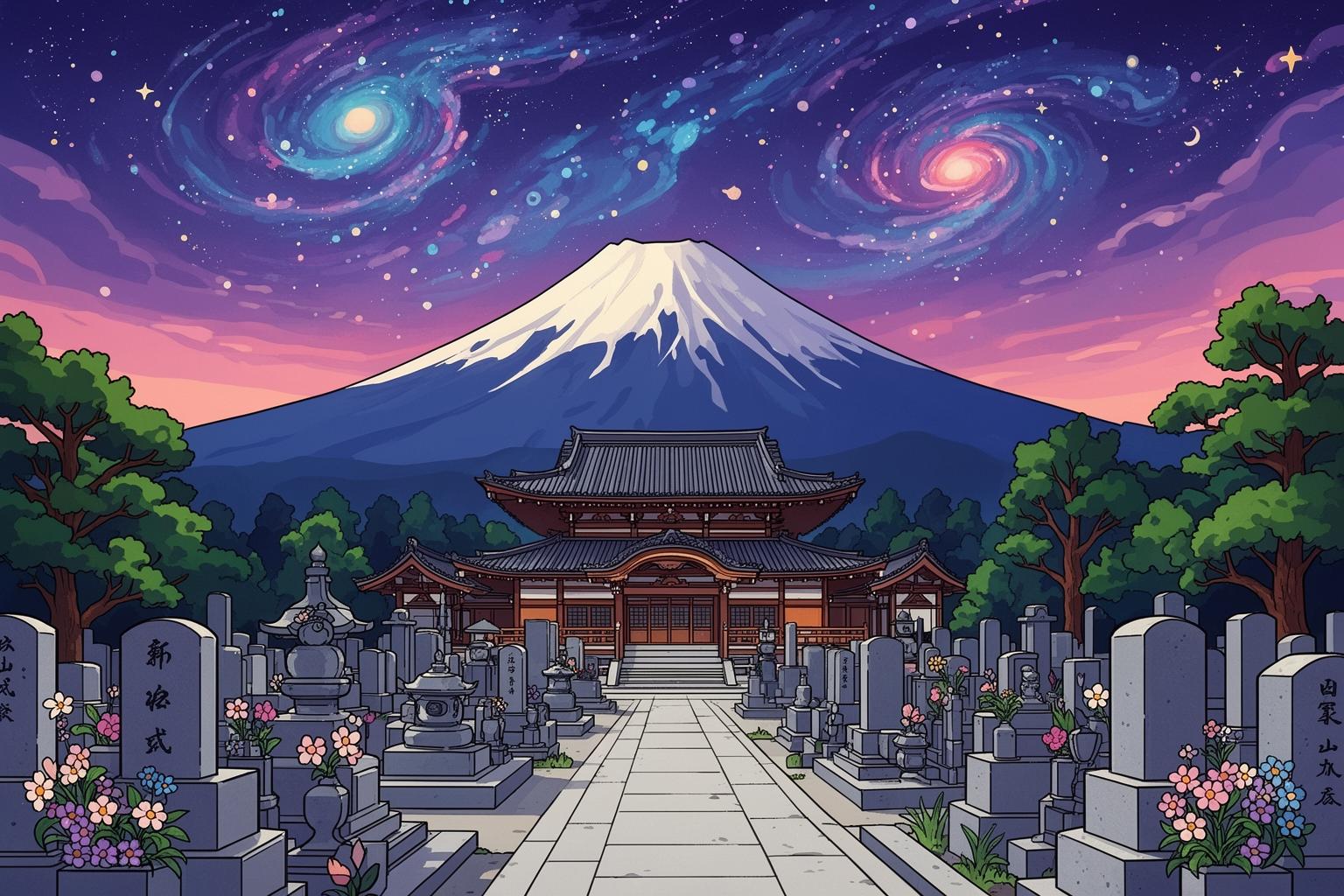
Nowhere is the unique bond between Osaka and Koyasan more evident than in Okunoin, Japan’s largest cemetery. Walking the two-kilometer path to the mausoleum of Kobo Daishi, the founder of Shingon Buddhism, feels like stepping back in time. The trail is lined with ancient, moss-covered stupas and the graves of some of Japan’s most notable historical figures, including samurai lords and feudal warlords. The air is thick with the scent of cedar and incense, and a deep, reverent silence lingers among the towering trees. Yet, upon closer inspection, something disrupts this historical reverie. Nestled among the tombs of ancient warriors are corporate memorials. There’s a monument from a major coffee company, featuring a giant coffee cup to honor its employees, and one from a pest control company dedicated to the souls of the termites and insects it has exterminated. Memorials from aerospace companies, sake brewers, and confectionery makers are also present.
For visitors, especially those from the West or Tokyo, this blend can be confusing, even unsettling. It seems to merge the sacred with the profane. However, for anyone seeking to grasp the Osaka mindset, this is the Rosetta Stone. In Tokyo, business culture often feels more secular and separated from personal or spiritual life. In Osaka, a city built by merchants, commerce has never been solely about profit. It has always been a deeply human—and therefore spiritual—undertaking. An Osaka business owner recognizes that their company is more than just a balance sheet; it is a community of people—employees, suppliers, customers. Honoring the dead, even the insect dead, is a way of acknowledging the interconnectedness of all things. It is a form of spiritual accounting, a method of maintaining harmony with the cosmos. This is pragmatic spirituality at its finest. Why wouldn’t a company reliant on the world’s resources wish to be in good standing with the spirits of that world? This perspective challenges the common stereotype of Osaka as a place where money reigns supreme. In reality, here, money and spirit are not opposites but parts of the same holistic system. Business success is regarded as a blessing that carries with it the responsibility to uphold spiritual balance. Okunoin embodies this belief system physically—a place where a company’s annual report and the eternal cycle of life and death are intertwined in the same ongoing dialogue.
The Silence That Amplifies the Osaka Soul
The most powerful aspect of a trip to Koyasan is the silence. It’s not an empty silence, but a living one, filled with the whisper of wind through the cedar trees, the call of a distant bird, and the crunch of gravel beneath your feet. After the constant noise of Osaka, this quiet can feel overwhelming. It compels you to listen not to the outside world, but to the inner world. This is something foreigners, and even other Japanese, often misunderstand about the Osaka personality. Our well-known love for talking, joking, and lively communication is frequently seen as a sign of extroversion, or perhaps superficiality. But it is also a kind of performance. Living and working in Osaka means being constantly involved in a social dance, using humor and frankness to build relationships and navigate a crowded, competitive environment. It is a vital skill, but also exhausting.
The silence of Koyasan offers the antidote. It serves as the backstage space where the Osaka individual can finally shed the persona. Whether in the quiet of a temple room, gazing out at a perfectly raked Zen garden, or in the misty depths of Okunoin at dawn, the internal monologue can at last be heard. This is not an escape from the self, but a profound exploration of it. The energy that drives Osaka’s relentless pace needs a source, and for many, that source is renewed here. The trip acts as spiritual maintenance, like recharging a battery. You ascend the mountain depleted by the continuous demands of social and economic life, and you descend reenergized with a calm, centered strength. This is why so many people working in Osaka’s demanding service industries—the restaurant owners, shopkeepers, and sales representatives—make regular pilgrimages. They recognize that their greatest professional asset, their boundless energy and infectious cheerfulness, is not limitless. It must be nurtured. Koyasan is the place where that energy is cultivated.
Coming Home: The Descent and Re-entry into Reality
The journey down the mountain is just as meaningful as the climb up. As the cable car and train descend, the world slowly comes back into view. The silence fades into the squeal of the train’s wheels, the chatter of fellow passengers, and finally, the roar of Namba Station. Stepping off the train feels like plunging into a rushing river. The sensory overload hits immediately: flashing lights, the cacophony of announcements and advertisements, and the dense crowd. Yet something has shifted. It’s no longer merely noise. After a weekend in Koyasan, you see the city differently. The chaos feels less chaotic and more like a vibrant, intricate ecosystem. The obachan loudly haggling over fish prices at Kuromon Market isn’t just making noise; she’s engaging in a time-honored commercial dance, full of energy and life. The jam-packed subway isn’t an irritation; it’s a shared human experience, a testament to the city’s magnetic draw.
A trip to Koyasan doesn’t teach you to love quiet and disdain noise. It reveals that they are two halves of the same whole. They are the inhale and exhale of life in Osaka. The city’s boundless energy isn’t rootless or superficial; it’s grounded in a deep, accessible, and pragmatic spirituality. Daily life here constantly swings between these two extremes. The person telling raucous jokes at a standing bar in Kyobashi on a Friday night might be the same one sitting in silent meditation at a temple on Sunday morning. To truly understand Osaka is to grasp this duality. It’s to see that behind the city’s loud, commercial exterior lies a quiet, contemplative soul, and that one cannot exist without the other. This sacred mountain is not a relic of a forgotten past; it lives and breathes as part of the modern Osaka experience—the silent partner that makes our magnificent, noisy city possible.