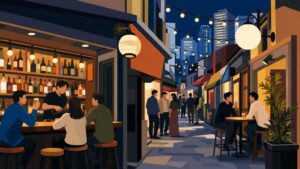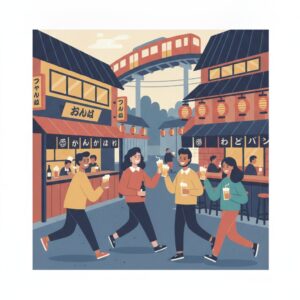
Step off the train at Tenma Station, and the air itself changes. It’s thick with the scent of grilled meat, sweet soy sauce, and the faint, celebratory aroma of spilled beer. The sound hits you next—a layered composition of clattering plates, booming laughter, and the sizzle of hot oil from a hundred different kitchens packed into a labyrinth of covered arcades and impossibly narrow alleyways. This isn’t the polite, orderly hum of a Tokyo neighborhood. This is the raw, beating heart of Osaka’s nightlife. This is the home of `hashigo-zake`.
For the uninitiated, `hashigo-zake` translates to “ladder drinking,” the Japanese art of bar hopping. But in Osaka, and especially in Tenma, it’s not just an activity; it’s a philosophy. It’s a dance of social interaction, a masterclass in economic efficiency, and a full-throated rejection of a quiet, predictable evening. It’s a core sample of the Osaka mindset. Forget what you think you know about Japanese drinking culture—the formal seating, the hushed reverence, the meticulous planning. Tenma operates on a different frequency, a beautiful, organized chaos that can feel intimidating from the outside. But once you understand the rhythm, you don’t just have a fun night out; you understand Osaka. You learn to see the city not as a collection of landmarks, but as a living network of fleeting, authentic connections, all powered by cheap drinks and phenomenal food.
For those eager to delve deeper into Osaka’s vibrant nightlife, this guide to mastering bar hopping offers an authentic look at Tenma’s unique hashigo-zake culture.
The Tenma Mindset: Organized Chaos and the Art of the Quick Exit
Your first walk through the Tenma `shotengai`, or shopping arcade, is an overwhelming sensory experience. Bare light bulbs hang above counters piled with glistening sashimi. Smoke from a charcoal grill billows out of a tiny doorway, briefly obscuring the salarymen packed shoulder-to-shoulder inside a standing bar, or `tachinomi`. Menus are handwritten on cardboard, taped to walls, often featuring items you’ve never encountered before. There’s no host to greet you, no quiet table waiting. There’s just the flow—the constant, churning movement of people.
This atmosphere directly reflects the Osaka mindset. While a night out in Tokyo might involve reservations weeks in advance for a specific, curated experience, the Tenma approach is pure improvisation. You don’t have a plan; you have a starting point. You dive into the chaos and trust your instincts. Does that spot look lively? Does the food on someone’s plate look amazing? Go. Squeeze in. That’s step one.
Step two is the true art: knowing when to leave. The core principle of `hashigo-zake` is constant motion. You’re not there to settle in for the night. You’re there for the highlight reel. The unspoken rule is simple: one or two drinks, one or two signature dishes, and you’re out. This isn’t rudeness; it’s social grace. The bars are tiny, often fitting fewer than ten people. Lingering over an empty glass takes a spot from someone else waiting to join the fun. It also violates the Osakan obsession with efficiency. Why waste time and stomach space in one place when dozens of other incredible experiences are just meters away?
This behavior reveals a deeply rooted pragmatism. An Osakan local is always calculating, not coldly, but wisely. They seek the peak experience from each bar—the crispiest tempura, the freshest tuna, the coldest beer—and then move on before the novelty fades. It’s a sequence of brief, perfect moments strung together to create a brilliant night. It’s the opposite of committing to a single, expensive, and potentially mediocre three-hour dinner. It’s about freedom, flexibility, and the thrill of the next discovery.
More Than Just Drinking: Communication as Currency
Many foreigners visit Osaka and quickly describe it as “friendly.” While this is true, it doesn’t tell the whole story. The friendliness in Osaka isn’t about passive, polite smiles. It’s an active, engaging, and sometimes intrusive kind of social curiosity, with Tenma serving as its natural environment.
The layout of the bars encourages this interaction. In a `tachinomi`, you’re literally pressed shoulder-to-shoulder with strangers. There are no private booths or comfortable distances. Your personal space merges into a shared, communal atmosphere. This closeness creates a unique social contract—silence isn’t just uncomfortable; it’s a missed chance.
This is where the real charm unfolds. The person beside you might lean in and say, “You’ve got to try the `doteyaki` (beef sinew stewed in miso). It’s the best here.” The bar owner (`taisho`) could shout a question from behind the counter: “Where are you from? Do you like sake?” Suddenly, you’re not merely a customer; you become part of a temporary, twenty-minute community. In Tokyo, you might spend the whole night only speaking with your own group. In Tenma, it’s seen as a small failure if you don’t leave with a good story from a stranger, a tip for your next stop, or at least a shared laugh over a spilled drink.
What foreigners often miss is that this isn’t about making deep, lasting friendships. It’s a type of social currency—the performance of being human together. The conversations are light, humorous, and straightforward. Osaka locals, descended from generations of merchants, excel at quick social readings. They size you up, find a connection, share a moment, and then let you continue on your way. It’s a transactional kind of friendliness, but the trade is simply a good time shared. No strings attached. That’s why mastering `hashigo-zake` takes more than just tolerance for alcohol; it demands a willingness to let your guard down and engage.
The “Kosupa” Kingdom: Why Tenma is the Epicenter of Value

To truly understand the essence of Osaka, you need to grasp one key word: `kosupa`. This term, a contraction of “cost performance,” is essentially the city’s unofficial creed. `Kosupa` doesn’t mean being cheap. Being cheap implies buying something low-quality at a low price. Instead, `kosupa` is about maximizing value, quality, and satisfaction for the money you spend. It’s the skill of being a smart consumer, and Tenma stands as its grand cathedral.
`Hashigo-zake` represents the ultimate form of `kosupa`. Rather than spending 5,000 yen on a single meal, the Tenma enthusiast divides that budget into five or six distinct, high-quality experiences. You begin at a fishmonger’s `tachinomi`, where for 500 yen you get a thick slice of premium tuna sashimi that would cost triple elsewhere. Why is it so affordable? Because you’re standing at a simple counter inside their shop, cutting out the overhead of a fancy restaurant and delivering pure value. That’s `kosupa`.
Then, you slip into an alley to find a `kushikatsu` (deep-fried skewer) spot. A beer costs 350 yen. Skewers of lotus root, pork, and quail eggs are 120 yen each. With a drink and three skewers, you spend less than 800 yen before moving on. Your third stop could be a tiny Spanish-themed bar for wine and olives, followed by a specialized sake bar for a tasting flight. Each stop offers a burst of flavor and experience for a minimal cost.
This approach reflects Osaka’s history as a merchant city. It wasn’t the capital of samurai or emperors; it was the capital of commerce. People here think in terms of bargains, value, and making the most of every transaction. This mindset applies to business, and certainly to pleasure. The joy of `hashigo-zake` in Tenma lies not only in the food’s taste but in the quiet satisfaction of knowing you’ve mastered the system. You’ve enjoyed a richer, more varied, and more exciting night than someone who paid twice as much for a traditional sit-down dinner. You’ve reached the pinnacle of `kosupa`.
Navigating the Labyrinth: A Practical Guide for the Foreign Resident
Understanding the culture is one thing; truly living it is another. For a non-Japanese resident, Tenma can seem impenetrable. However, with the right mindset, you can transition from a nervous observer to an active participant. It’s all about learning the unwritten rules of the game.
Reading the Room: When to Enter, When to Leave
First, learn to identify the right kind of place. Look for the red lanterns (`akachochin`) that indicate an izakaya. Peek inside. Is it filled with locals having a good time? Is the `taisho` actively engaging with customers? Does the menu look like a chaotic jumble of handwritten Japanese? These are all positive signs. Be cautious of spots with glossy, multi-language menus and overly polished interiors; they may cater to tourists and lack the authentic `kosupa` and atmosphere.
To enter, simply slide the door open and catch the owner’s eye. A simple nod and a questioning look or a quiet “`Ii desu ka?`” (Is it okay?) is all that’s needed. If there’s room, they’ll signal you in. If it’s full, you’ll receive a polite wave-off. Don’t take it personally. Just move on to the next door. Confidence and keeping a low profile are key.
The exit is just as important. After finishing your last bite and sip, don’t linger. Signal for the bill with “`O-kaikei onegaishimasu`.” Most small places are cash-only, so be prepared. Pay promptly, say a hearty “`Gochisosama deshita!`” (Thank you for the meal!), and quietly slip back out into the night. Your entire visit might last only 25 minutes—and that’s a success.
The Language of the Bar: Essential Phrases and Unspoken Rules
Fluent Japanese isn’t necessary, but a few key phrases unlock the experience. “`Toriaezu biiru`” (Beer for now) is the classic opener—a low-commitment way to get started while you browse the menu. “`Osusume wa?`” (What do you recommend?) is the ultimate sign of trust. It allows the owner to offer their best dish and often opens the door to conversation.
Beyond words, there are etiquette rules. Don’t take up more counter space than necessary. Keep your bag at your feet. When eating `kushikatsu`, remember the cardinal rule: no double-dipping into the communal sauce container. Your first dip is your only dip. While the atmosphere is lively, it isn’t a frat party. The goal is to be social and cheerful, not loud or disruptive. Watch how the regulars behave and follow their lead. It’s a rhythm you pick up by feel, not by reading a manual.
The Solo Hopper’s Advantage
Although going with a friend is enjoyable, the ultimate `hashigo-zake` experience is solo. This may seem intimidating, but it’s the secret to true immersion. As a solo patron, you’re far more approachable. You’re a blank slate, an intriguing puzzle for regulars and the owner alike. You’re also more likely to find a single open spot at a crowded counter.
Going solo forces you to be present, to notice the little details of the bar, to listen to the cadence of Osaka-ben around you. It lowers the barrier to spontaneous conversation. It sends a clear message: “I’m here for the experience.” For a foreign resident wanting to get under the city’s skin, a solo night of `hashigo-zake` in Tenma is a rite of passage. It’s where you stop being a visitor and start feeling like you belong.
Tenma vs. The World: What It Tells Us About Osaka
Ultimately, a night in Tenma serves as an immersive lesson in what sets Osaka apart. The city openly displays its true nature, prioritizing a good bargain and hearty laughter over polished appearances and strict formality. The chaotic, intertwined streets of the bar district symbolize the city’s social fabric—disorderly, somewhat overwhelming, yet deeply connected and bursting with human vitality.
Visitors from Tokyo might perceive Tenma as nothing more than noise and disorder. They could mistake the locals’ straightforwardness for rudeness or view the fixation on `kosupa` as vulgar. However, they miss the essence. Tenma isn’t a show; it isn’t trying to be anything other than what it truly is: a place where working people come to eat, drink, and connect as efficiently and joyfully as possible.
This is the true Osaka—a city defined by its inhabitants rather than its power structures. It’s the sharp wit of merchants, the precise timing of comedians, and the practical approach of chefs. To master the art of `hashigo-zake` is to grasp the city’s native language of spontaneity and value. It means realizing that the best experiences in life aren’t always found in the most elegant spots, but in the small, fleeting, deeply human moments experienced when you embrace getting a little lost in the chaos. It’s the art of living in the present, one ladder rung and one small bar at a time.