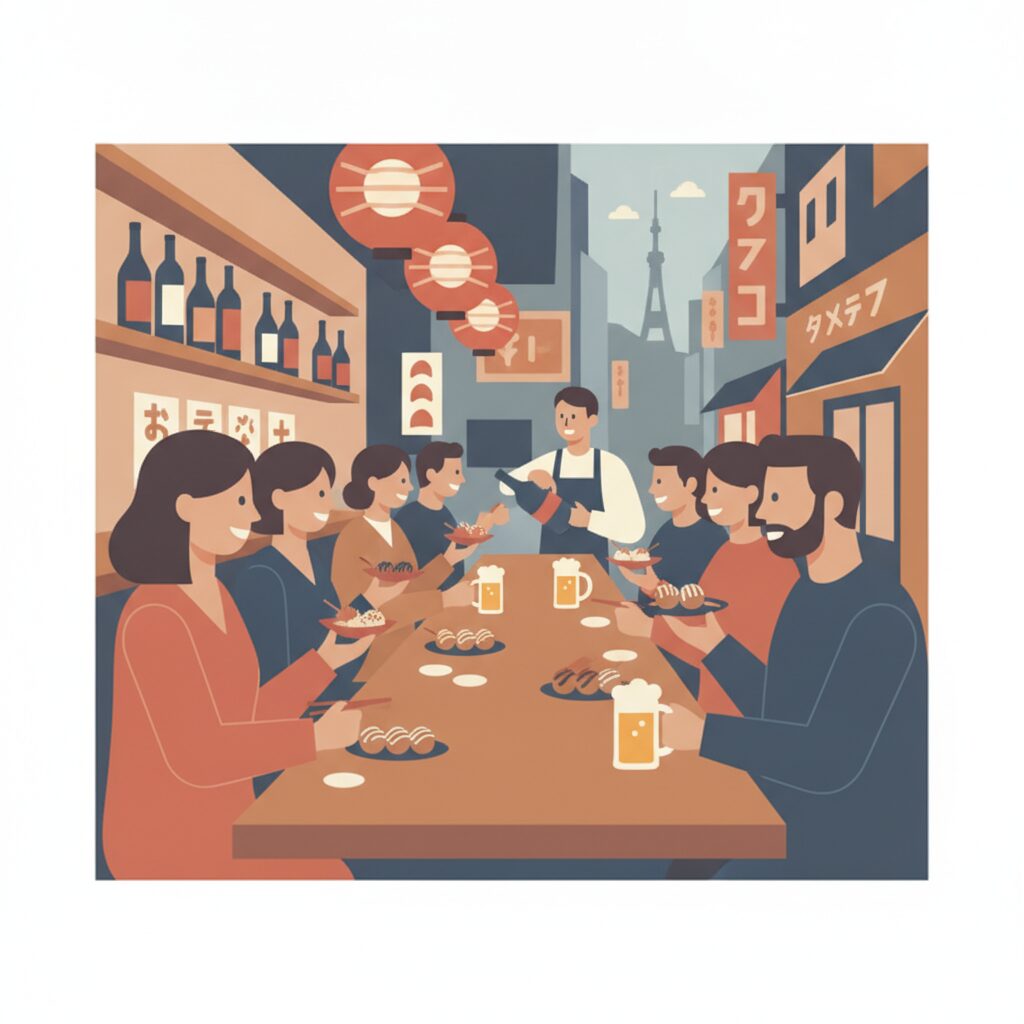
The air is thick, a humid mix of sizzling oil, simmering dashi, and cheap beer. It’s seven in the evening in Tenma, and the standing bar, the tachinomi, is hitting its stride. There are no chairs, just a worn wooden counter packed with salarymen loosening their ties, young couples sharing a plate of fried chicken, and old-timers nursing cups of sake. Elbows touch. Voices overlap. A loud laugh erupts from the corner, followed by a sharp, playful retort from the bar owner. This isn’t the quiet, reserved Japan you see in postcards. This is Osaka. And if you really want to understand what makes this city tick, you don’t need to go to a castle or a temple. You need to find a space at a counter like this and learn to listen.
For many foreigners, the social landscape of Japan can feel like a series of politely closed doors. Friendships are often built slowly, through structured settings like work or school. But Osaka plays by a different set of rules. Here, the social fabric is woven in real-time, in the chaotic, vibrant, and incredibly open spaces of its standing bars. The question isn’t just what to order, but how to belong. How do you break into that circle of laughter? What are the codes of communication that turn a stranger into a friend for the night? The answer lies in understanding a communication style that’s as fundamental to Osaka as takoyaki and the Hanshin Tigers.
In this vibrant counter scene, every shared laugh and clink of glass embodies a pragmatic Shimatsu mindset that redefines everyday connections in Osaka.
The Counter is a Community, Not Just a Bar
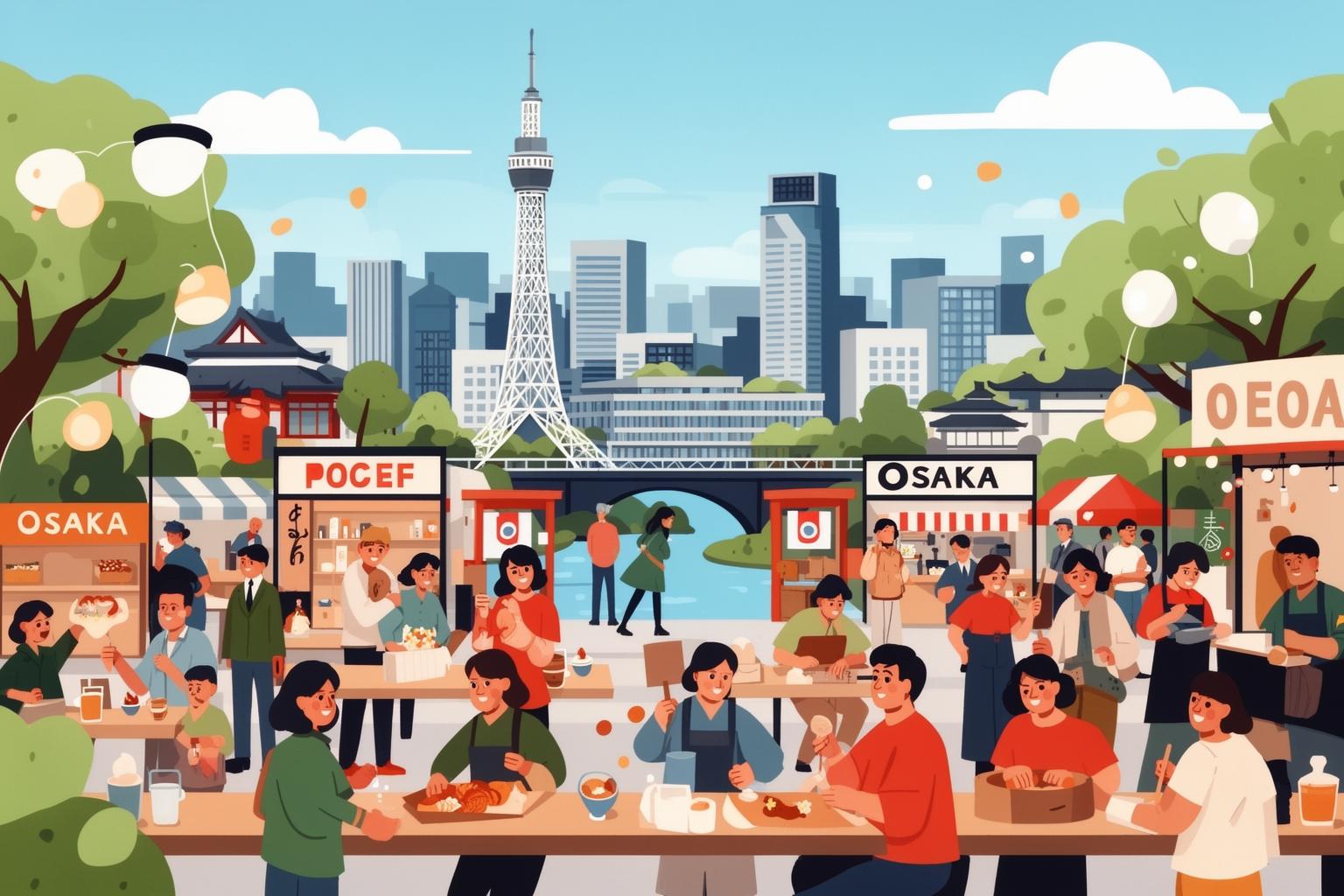
First, you need to appreciate the architecture of the interaction. Why stand? Because it removes barriers. In a typical bar with tables and chairs, you create your own private island. You’re with your group, and the rest of the room might as well be on another planet. A tachinomi deliberately breaks that pattern. Standing places everyone on the same level, both literally and figuratively. You’re shoulder-to-shoulder, sharing a communal space. The U-shaped counter, a common design, isn’t just about efficiency; it’s a stage. It compels you to notice everyone else. You can catch someone’s eye across the way, see what they’re eating, and hear their conversation with the taisho, the master of the bar.
The counter itself is the ultimate equalizer. It doesn’t matter if you’re a company president or a part-time worker; here, you’re simply another customer enjoying a beer and a plate of doteyaki (beef sinew stew). This physical closeness encourages a psychological closeness. It grants you implicit permission to engage. The space is designed for flow—people come and go, squeezing in wherever they can. This constant, fluid motion ensures the social energy never stagnates. It’s a living, breathing organism, and for a brief time, you become a part of it. This isn’t just a place to drink; it’s a transient, pop-up neighborhood forming every single night.
Tokyo’s Planned Connections vs. Osaka’s Spontaneous Collisions
To truly understand what’s happening at that counter, you need to compare it with Tokyo. Life in Tokyo, despite its vibrant energy, often feels socially structured and scheduled. You meet people through formal introductions—friends of friends, colleagues from work, members of your hobby group. Socializing is something you plan, mark on your calendar, and travel across the city for. The idea of spontaneously engaging in a deep conversation with a complete stranger in a bar is, while not impossible, definitely uncommon. It can be seen as intrusive or even odd. The default mode is polite, respectful distance.
Osaka completely reverses that dynamic. Here, the best social interactions tend to be unplanned. The city’s spirit is tied to its past as a merchant town, where quick, direct, and pragmatic communication was essential for business. That heritage shapes a social style that prioritizes immediacy and authenticity over formal protocol. An Osakan might spot a stranger and think, “That person looks interesting, I’ll talk to them.” A Tokyoite might see the same person and think, “I shouldn’t disturb them.”
This is the core difference you sense in a tachinomi. The atmosphere buzzes with potential connections. The person next to you might ask what you’re drinking. The woman across the counter might offer you a piece of her tempura. The bar master might loudly inquire where you’re from, instantly making you the focus of conversation for the next five minutes. It’s a culture of inclusion by default. You’re assumed to be part of the conversation until you prove otherwise, whereas in many other places, you’re assumed to be an outsider until formally invited in. This can feel surprising at first, but once you embrace it, it’s incredibly freeing.
The Unspoken Language of Manzai: Boke and Tsukkomi in the Wild
So, conversations are happening all around you. But how do they actually work? The rhythm, the cadence, and the incredible speed of it can be bewildering. To understand it, you need to grasp the core of Osakan humor and communication: the dynamic between boke and tsukkomi. These terms come from manzai, Japanese stand-up comedy, but in Osaka, they form the foundation of everyday dialogue.
What is Boke and Tsukkomi?
Think of it as a conversational dance. The boke (pronounced bo-keh) plays the funny fool, the one who makes a slightly silly, absurd, or exaggerated statement. They set up the joke. The tsukkomi (tsoo-ko-mi) is the straight man, responding with a quick, sharp, and often witty comeback pointing out the absurdity. The tsukkomi delivers the punchline — a verbal jab, a playful smack on the head.
For example:
Boke: (Staring at a massive plate of food) “I think I’ll just have this as a light appetizer.” Tsukkomi: “Nande ya nen!” (Why the hell! / No way!) “That’s enough to feed a family!”
This isn’t an argument. It’s a performance. The tsukkomi isn’t intended to be mean or dismissive. It shows engagement. It says, “I’m listening so intently to your nonsense that I can instantly call you out.” It’s a form of conversational closeness.
Recognizing it at the Bar
Once you know what to listen for, you’ll notice it everywhere in an Osaka tachinomi. It’s constant. The bar master slides a drink to a regular.
Regular (Boke): “Master, you remembered! I’m so happy I could cry.” (Said deadpan, without emotion.) Master (Tsukkomi): “Just drink it before it gets warm, you drama queen.”
Someone accidentally bumps into another person.
Person 1 (Boke): “Whoa, sorry! My magnificent presence is just too much for this small space.” Person 2 (Tsukkomi): “Yeah, right. Your beer belly is the only magnificent thing here. Move it over!”
They both laugh and the tension disappears. It’s a social lubricant, a way to handle minor conflicts, show affection, and build rapport at lightning speed. It’s the driving force of Osakan conversation.
A Common Misunderstanding for Foreigners
Here’s the biggest challenge for outsiders. Without knowing the boke/tsukkomi structure, the tsukkomi can come across as extremely rude. It’s direct, sharp, and seemingly critical. A foreigner might make a simple comment and get a tsukkomi back, leaving them confused and feeling insulted. You might say, “Wow, Osaka is so lively!” and an Osakan might respond with a grin, “Atarimaeやん!” (Obviously!) “Where did you think you were, the countryside?”
They aren’t dismissing your observation. They’re confirming it in the local dialect. They’re treating you like an insider, someone who can take part in the playful banter. Getting a tsukkomi is actually a compliment. It shows you’re accepted into the conversational game. The worst response to a comment is polite nodding and silence. That’s the real sign you’re an outsider.
Your Entry Ticket: How to Join the Conversation
Knowing the rules of the game is one thing; actually playing it is another. So how can you, as a foreigner who might not be fluent in Japanese, much less familiar with the nuances of Osaka-ben, join in on the fun? It’s easier than you might expect. The key is to be attentive and open-minded.
The Power of Observation
Your easiest entry point is through the food. The counter offers a buffet of conversation starters. Spot someone eating something that looks delicious? That’s your chance. A simple, “Sumimasen, sore, oishisou desu ne. Nan desu ka?” (Excuse me, that looks tasty. What is it?) works wonders. In most cases, this will not only get you an answer but will spark a full conversation. They might even offer you a taste. They’ll ask where you’re from. They’ll suggest what you should try next. Food is a universal language, and in Osaka, it’s the main dialect.
Engaging the Master (Taisho)
The bar owner is the heart of the community. They know the regulars, set the atmosphere, and are often your best ally. Don’t hesitate to engage them. Ask for their recommendation (osusume). Compliment the food. A simple “Meccha umai!” (This is crazy delicious!) said to the taisho can catch your neighbors’ attention and act as an invitation for them to join the conversation. The taisho might even use your presence to initiate a chat among other customers, serving as a social connector.
The Art of the Shared Experience
You don’t have to be a comedian to participate. Just being present and responding to the shared atmosphere is enough. If a loud group arrives, a shared glance and smile with your neighbor is a form of communication. If the baseball game on the tiny TV gets exciting, a cheer or groan shared with others connects you. Even a playful, self-deprecating remark can work. Trying a dish and making a face if it’s oddly or unexpectedly spicy can create a great boke moment, inviting a friendly tsukkomi from someone nearby. It’s about being open and showing a little of your true personality. Osakans value authenticity over polished politeness.
The Beautiful Impermanence of Tachinomi Friendships
There’s one last aspect of the tachinomi experience that can be puzzling for Westerners. You might have a wonderful, hour-long conversation with someone—sharing stories, laughing, and buying each other a drink. You sense a genuine connection. Then suddenly, they say, “Ja, osaki ni” (Well, I’m heading out), give a quick nod, and disappear into the night. No exchanging phone numbers, no promises to meet again. The connection existed for that moment, in that place, and that’s all it needed to be.
Here for a Good Time, Not a Long Time
This isn’t a rejection. It reflects the Japanese concept of ichi-go ichi-e, often translated as “one time, one meeting.” It conveys the idea that every encounter is unique and will never happen in the same way again, so it should be treasured for what it is. The tachinomi friendship is the ultimate expression of this—a temporary bond, formed in the heat of the moment, with no expectation of the future. This removes all social pressure. You don’t need to worry about whether to follow up or if you made a good enough impression for a second meeting. You simply enjoy the interaction for its own sake.
Why This Works in Osaka
This philosophy aligns perfectly with Osaka’s pragmatic and efficient mindset. It is a social interaction that delivers maximum human connection with minimal long-term obligation. It allows people from all walks of life to connect authentically, unwind, and feel a sense of community before returning to their separate lives. It’s a beautiful, fleeting, and deeply human experience. It teaches you to appreciate the present moment—a lesson increasingly difficult to learn in a world fixated on networking and maintaining digital connections.
So, the next time you find yourself in Osaka, push aside the curtain of a crowded standing bar. Find a small spot at the counter and just listen. Listen for the rhythm of the boke and the sharp, affectionate sting of the tsukkomi. Don’t hesitate to ask your neighbor what they’re eating. Don’t be surprised if you receive a playful jab in return. And don’t feel sad when your new best friend for the evening disappears without a proper goodbye. You haven’t just had a drink—you’ve taken part in a ritual. You’ve felt the true pulse of the city and, in that moment, understood what it really means to be in Osaka.