It happens on a Tuesday. Or maybe a Thursday. You’re settling into your new life in a quiet residential corner of Osaka, getting the hang of the intricate trash separation schedule and the melodic chime of the sweet potato truck. Then comes a knock at the door. It’s not a delivery. It’s your neighbor, an older woman with a kind, crinkly smile, holding out a well-worn plastic clipboard. A cascade of papers is clipped to it, and a thin, slightly faded red string is tied to the top. She says something that sounds like “Kairanban, onegaishimasu,” and looks at you expectantly. You take it, thank her, and close the door, a sense of deep, profound confusion washing over you. What is this thing? Is it a petition? A bill? A neighborhood census? Welcome, my friend, to one of the most authentically Japanese, and deeply local, experiences you can have: the Kairanban, Osaka’s analog social network. In a city that boasts futuristic skyscrapers and a dizzying web of underground shopping malls, this humble paper-and-plastic contraption is your real key to understanding the rhythm of daily life. It’s a relic, a ritual, and your official induction into the neighborhood. Before we unravel the mysteries of this paper-based community feed, let’s get our bearings on the city itself.
Experience another facet of Osaka’s vibrant local culture by delving into the nuances of daily commutes as outlined in the mamachari rulebook, which perfectly complements your initiation into this multifaceted metropolis.
What Exactly Is This Clipboard of Mystery?
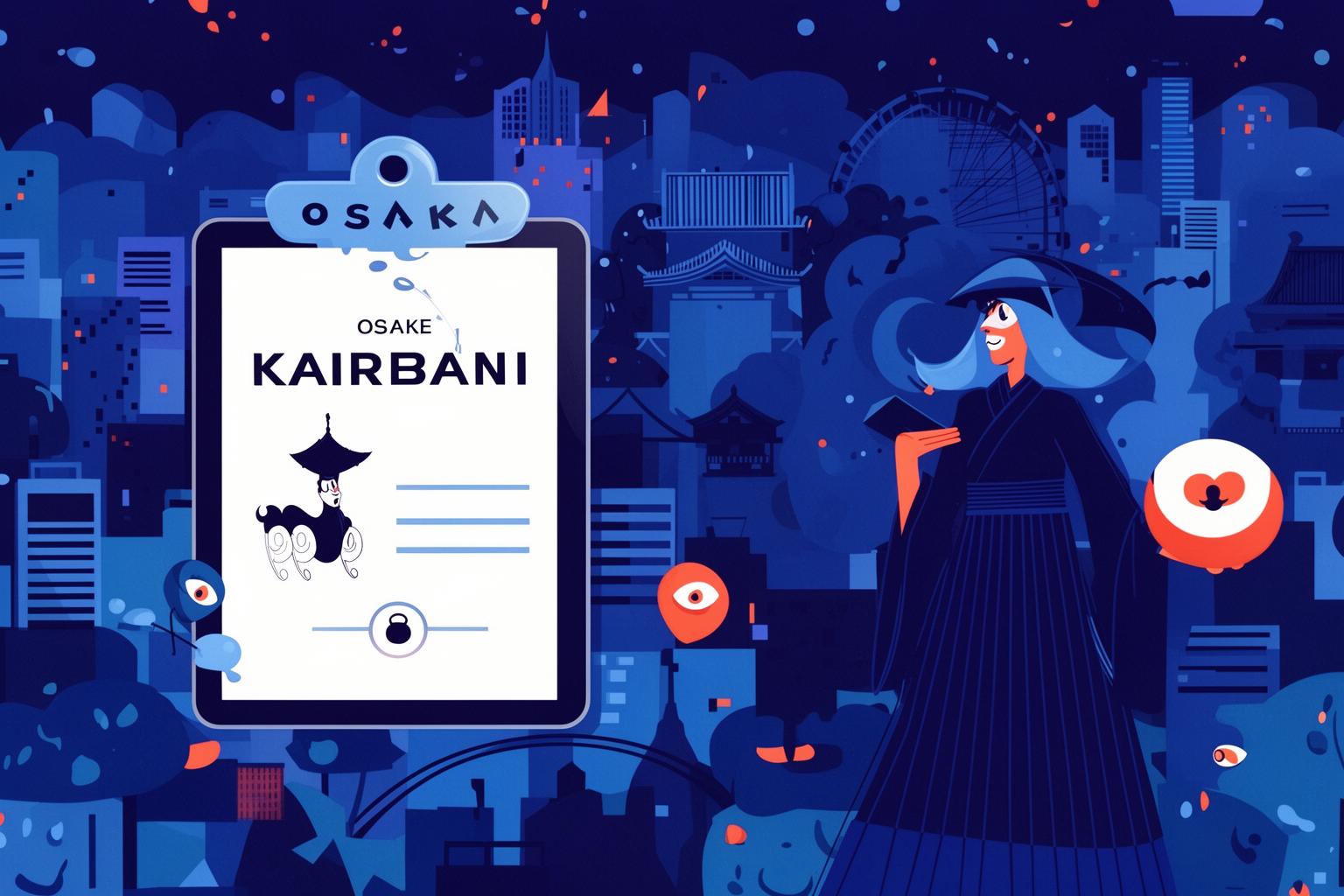
Think of the Kairanban, or “circulating board,” as your neighborhood’s private, physical newsletter. It serves as the official communication channel for your local chonaikai or jichikai, the neighborhood association acting as a micro-government for your immediate block or community. While Tokyo and other Japanese cities have similar systems, in Osaka—with its history rooted in close-knit merchant communities and distinctive local districts—the Kairanban feels less like a bureaucratic routine and more like the living heartbeat of the neighborhood. It acts as the glue that binds the block, a tangible link passed from hand to hand, house to house. It is an institution that stubbornly resists the digital age, for reasons that reveal much about the local mindset.
The Anatomy of a Kairanban
Let’s examine the object itself. It’s almost always a standard A4-sized clipboard—the type you’d find in any stationery store. The color may vary, but the sense of official-yet-ordinary business is consistent. Attached to the front is the most important document: the circulation list. This is a grid, a roster of every household on your designated route. It lists names, and sometimes addresses, in a specific, fixed order. This is the sacred path the Kairanban must follow. Your name will appear on it, likely written in katakana if you are a foreigner, neatly placed between Tanaka-san and Suzuki-san. Beside each name is a small box, waiting for a seal of acknowledgment. This list serves as the Kairanban’s map and memory, showing where it has been and where it must go next.
A Tour Through the Paper Trail
Below the circulation list is a stack of documents—a cross-section of community life. The contents might appear random at first, but they fit into several distinct categories. This is where you’ll find the real core of local information, the kind of details that never make it into guidebooks or expat forums. It connects you directly to the ward office, the police box, and the community elders who coordinate local festivals.
Official City Business
A large portion of the flyers come directly from your local ward office, or kuyakusho. This is the government’s way of ensuring essential information reaches every household. You’ll see brightly colored pamphlets outlining changes to the garbage collection schedule, a famously complex system that varies by ward. There will be public health notices about seasonal flu shots, free health check-ups for residents of certain ages, or warnings about mosquito-borne diseases in the summer. You might receive announcements about road construction blocking nearby streets or details on how to apply for various municipal subsidies. While sometimes dry, this information is crucial for the smooth running of your daily life.
Neighborhood Association News
This part forms the heart and soul of the Kairanban. These documents are generated by your own chonaikai. They announce the dates for the annual neighborhood summer festival, the natsu matsuri, along with calls for volunteers to help run food stalls. You’ll find schedules for the local shrine’s New Year’s events. Importantly, you will be informed of the mandatory neighborhood cleaning day, or chiiki seiso, when residents are expected to spend an hour on a Sunday morning sweeping leaves, pulling weeds, and tidying shared public spaces. Flyers for disaster preparedness drills are also included, reminding everyone of the local evacuation point and what to do in the event of an earthquake or typhoon. These notices invite you to participate, be visible, and become part of the community fabric.
Safety and Security
The local police box, or koban, also uses the Kairanban as a direct communication channel. These notices are generally printed on simple, no-frills paper and convey a serious tone. They may alert residents about recent incidents such as bicycle thefts or purse snatchings in the area. They often provide detailed information about common scams targeting the elderly, including the notorious “It’s me” phone scams. The local fire department contributes flyers about fire safety, especially during dry winter months, reminding everyone to check smoke detectors and use space heaters carefully. This information serves a dual role: keeping you informed and subtly reinforcing the idea that community safety is a shared responsibility.
The Unspoken Rules of the Kairanban Ritual
Handling the Kairanban isn’t merely about reading the papers. It’s a performance, a subtle social dance governed by a clear set of unwritten rules. How you manage the clipboard sends a message to your neighbors. Doing it properly reflects your consideration and respect for local customs. Mishandling it can gently mark you as an outsider who doesn’t quite understand. The main principle is simple: be prompt and avoid causing inconvenience to others. This perfectly embodies the Japanese concept of avoiding meiwaku, or disturbing others.
The Handoff: Speed and Etiquette
The cardinal rule of the Kairanban is: do not be the bottleneck. In Osaka, a city that thrives on efficiency and pragmatism, holding onto the clipboard for several days is a serious neighborhood faux pas. The information is, in theory, time-sensitive, and your delay holds up the entire chain. Ideally, you should pass it on within a few hours, or at the latest, the same day you receive it. The process is a well-oiled machine. First, you receive it from your neighbor. Second, you immediately find your name on the circulation list and either stamp your hanko (personal seal) or sign your name in the box beside it. This step is crucial—it serves as your digital receipt, proof that you have seen it and are transferring responsibility for its onward journey. A simple signature in English is perfectly acceptable if you don’t have a hanko. Third, you quickly scan through the documents. If a flyer is particularly relevant—like the cleaning day schedule—you might take a photo with your phone. It’s rare to remove any documents unless explicitly allowed. Fourth, you check the name right below yours on the list. That’s your next recipient. You walk the clipboard over, knock on their door, and when they answer, you say simply, “Kairanban desu.” They will thank you, and the cycle continues.
To Read or Not to Read? That Is the Question
Here’s a candid secret that even your Japanese neighbors may not openly admit: not everyone reads every single word of the Kairanban. Life is busy. For many, stamping and passing it on is a semi-automatic routine, a matter of muscle memory. They might skim it to catch major announcements but don’t scrutinize every detail, like the fine print in the ward office’s new recycling pamphlet. However, for foreigners, this can be risky. Your Japanese neighbors have a lifetime of cultural context—they can often intuit what’s important and what’s not. You don’t. Ignoring the contents entirely risks missing a critical notice—such as an alert that your building’s water will be shut off for maintenance next Wednesday from 1 to 4 PM. This is where technology becomes your greatest ally. Don’t hesitate to use the Google Translate app’s camera feature. Spread the documents out on your table and let your phone work. The translation won’t be perfect, but it will be good enough to catch keywords like dates, times, locations, and topics such as “cleaning,” “festival,” or “construction.” Making this small effort is the difference between being an informed resident and the confused foreigner continually surprised by neighborhood events.
The Kairanban and the Osaka Mindset
So why does this paper-based system continue to exist in one of the world’s most technologically advanced countries? The answer reveals something profound about the Japanese, and specifically the Osakan, character. It’s a deliberate choice that values community cohesion over digital convenience, reflecting a distinct set of social priorities.
Community Over Convenience: Why This Still Exists
The Kairanban serves as the main communication tool of the neighborhood association, which forms the foundation of local Japanese society. In Osaka, a city shaped by merchants where your standing among neighbors directly influenced your success, these local bonds are crucial. The Kairanban strengthens this. The system is based on shared responsibility: the city does not just clean the streets; residents take part in cleaning their own. Safety isn’t solely the police’s duty; everyone is expected to stay alert. The Kairanban coordinates these communal responsibilities. It is also deeply inclusive. In a nation facing rapid aging, the Kairanban ensures that elderly residents who may not use smartphones or computers remain informed. It guarantees that information reaches every household, regardless of technological skill. This stands in contrast to some parts of Tokyo, where the high density and anonymity of high-rise living can make the chonaikai feel more distant and bureaucratic. In many Osaka neighborhoods, especially the older, low-rise areas, the chonaikai remains a tangible presence, and the Kairanban is its approachable, if somewhat insistent, messenger.
The Analog Heart in a Digital City
There is a practical mindset here that is distinctly Osaka. The system, despite its analog nature, works well. It is extremely low-cost, reliable, and achieves its purpose. Why shift to a complex digital system that might exclude some residents and require ongoing upkeep when the traditional method still functions smoothly? Osakans are known for being down-to-earth and straightforward; they prioritize effective outcomes over flashy appearances. Moreover, the physical act of passing the clipboard from one individual to the next fosters a small but meaningful social connection. It offers a chance to see a neighbor’s face and exchange a quick greeting. In a world where people can live for years without speaking to the person next door, these brief, required interactions serve as the bonds that hold a neighborhood together. Each hanko stamp on the circulation sheet is a silent affirmation: “I am here. You are here. We are in this together.”
Navigating Your First Kairanban Encounter
Alright, theory is useful, but let’s focus on the practical side. You’re standing at your door, clipboard in hand. What’s next? Don’t worry. This is a manageable—and even rewarding—part of your life in Osaka. Here’s your step-by-step guide to becoming a Kairanban expert.
The Practical “How-To” Guide
First, the knock. When you hear it, take a deep breath. It’s probably no trouble, just community business. Open the door with a calm and friendly expression. Your neighbor will offer the clipboard, likely with both hands, accompanied by a simple phrase. Just accept it, also with both hands if possible, and say, “Arigatou gozaimasu” (Thank you). That’s it. Transaction complete. Next, the stamp. Bring the clipboard inside and set it on a table. Find your name on the circulation sheet. If you have a hanko, stamp it firmly in the designated box. If not, a clear signature is perfectly fine. No one cares about your penmanship. Now, the scan. Spread out the papers. Take out your smartphone and open your translation app. Methodically review each document. You’re not seeking a detailed literary translation but key information: dates, times, locations, and tasks. Is there a gathering? A fee? A day you’re expected to attend and help? Take photos of anything important. Finally, the pass. Look at the circulation sheet to find the next name and household on the list, usually your immediate neighbor. Take the clipboard, head over, and knock. When they answer, hold it out and say, “Kairanban desu.” They will accept it, thank you, and you can walk away feeling the satisfaction of completing a classic Japanese neighborhood task.
What If I’m Not Home?
This often causes worry for newcomers. What if you’re at work when your neighbor drops by? What if you’re away? The system has built-in solutions. Usually, your neighbor will slip the clipboard into a plastic bag (to protect it) and hang it on your doorknob or leave it in your mailbox. When you return, you’ll find it waiting. It’s then your responsibility to handle it promptly. If you know you’ll be gone for more than a few days, a considerate gesture is to inform your neighbors on either side. You can tell the person who gives it to you, “I’ll be away, so could you please pass it directly to the next person?” This small act of foresight is much appreciated and shows you understand the importance of keeping the chain moving.
I Don’t Understand! Can I Just… Not?
When overwhelmed by a new language and culture, it’s tempting to simply opt out, viewing Kairanban as just one more chore. Technically, membership in a chonaikai is voluntary, and you might find a way to be removed from the list. However, this would be a serious mistake. Opting out sends a clear, and probably unintended, message: “I’m not interested in being part of this community.” Participating in the Kairanban is one of the easiest yet most rewarding ways to build goodwill with your neighbors. It shows respect for their way of life. Moreover, you’d be cutting yourself off from an essential source of information. The Kairanban informs you about the local summer festival where your kids can enjoy games and shaved ice. It’s how you discover the neighborhood mochi-pounding event at New Year’s. It’s your official invitation to local life. By engaging with it, you open the door to a richer, more connected experience of living in Osaka.
The Kairanban as a Window into Osaka Life
The modest Kairanban is far more than just a clipboard holding papers. It is a cultural artifact, a living testament to social history that reveals the city in a way no museum or travel program ever could. It embodies the unspoken social contract that shapes neighborhood life in Osaka. It narrates the story of a community that embraces shared responsibility, cares for its most vulnerable members, and draws strength from local connections. Each time the clipboard moves from one hand to another, it strengthens the invisible bonds that unite a street. It is a quiet, rhythmic, and profoundly human ritual. For any foreigner who truly wants to understand what it means to live here, to go beyond being just a resident and become part of the community, the journey begins with that knock on the door. So when it arrives, don’t hesitate. Welcome it. Stamp it, scan it, and pass it along. You’re not merely shuffling papers; you’re engaging in the authentic, everyday life of Osaka.