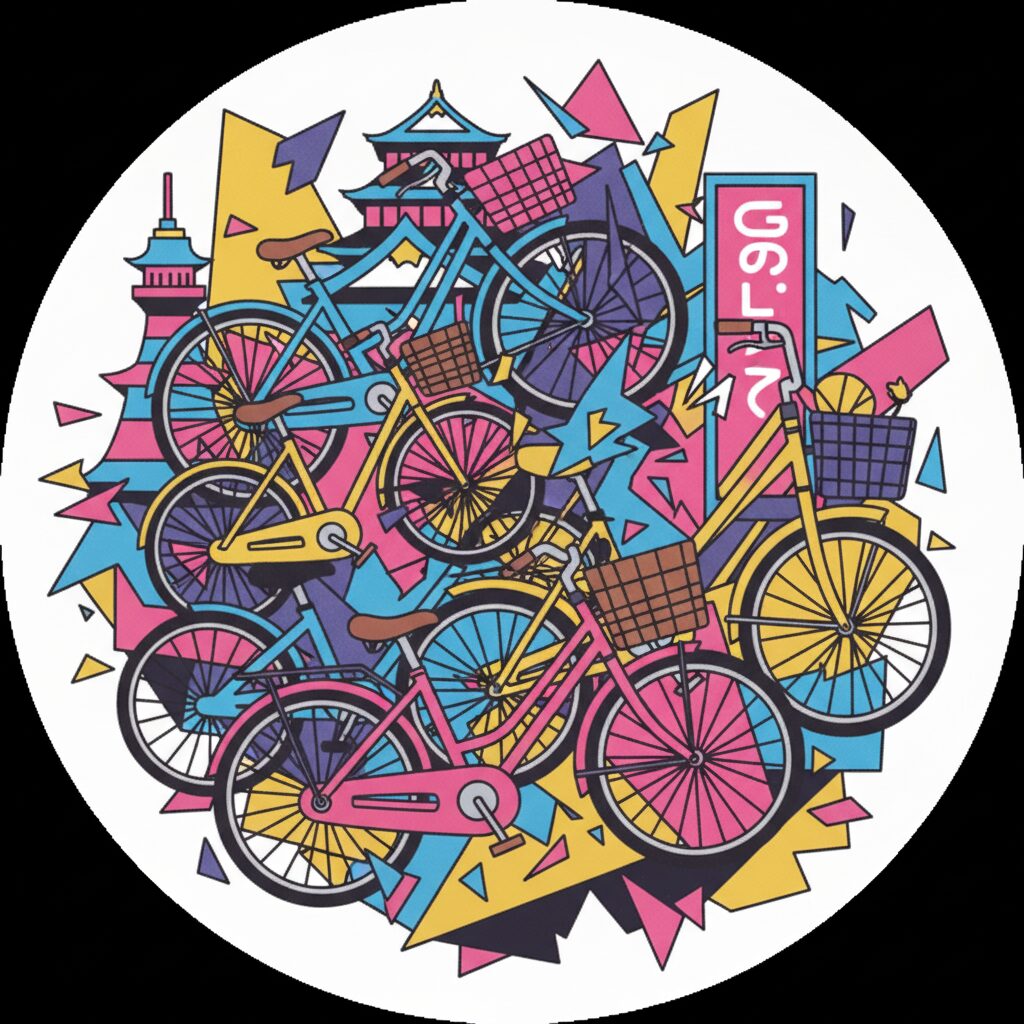
The first thing that hits you isn’t the neon of Dotonbori or the scale of Osaka Castle. It’s the bikes. They’re everywhere. A silent, shimmering river of steel flowing down sidewalks, chained to every conceivable pole, and piled in mountainous heaps outside train stations. Your first thought might be, “Wow, what a green city.” Your second, as a cyclist comes within a millimeter of your elbow at full speed on a crowded pavement, is probably, “Are there any rules here at all?” Welcome to Osaka, where the bicycle isn’t just a mode of transport; it’s a way of life, a cultural identifier, and your first, most chaotic lesson in how this city really ticks. Forget what you learned about Japan’s legendary order and civic precision. On two wheels, Osaka operates on a different frequency, a rhythm of controlled chaos that feels both bewildering and, once you understand it, beautifully efficient. This isn’t just about getting from A to B. This is about navigating the unspoken social contract of a city that values practicality above all else. Before we dive into the deep end, take a look at the epicenter of this beautiful mess: the area around Osaka Station. This is ground zero for bicycle density, a perfect microcosm of the city’s two-wheeled soul.
Mastering the city’s intricate flow involves understanding the local quirks and unspoken protocols—for example, Osaka’s unspoken bicycle rules and parking etiquette reveal how chaos becomes order.
The Unwritten Code of the Concrete Jungle
To grasp Osaka’s bicycle culture, you need to disregard the official rulebook. Yes, laws do exist. You’re supposed to ride on the left side of the road. Riding on sidewalks is prohibited unless a sign allows it. A front light is required at night. These rules are like a “suggested serving size” on a chip bag—they’re technically correct but generally ignored in practice. The true law of the land is an unwritten blend of pragmatism, situational awareness, and a collective mindset best described as “ah, ee yan” (ah, it’s fine/go for it).
This isn’t chaos; it’s a different sort of order. An Osakan confronted with a narrow, crowded road and speeding cars alongside a wide, empty sidewalk won’t blindly follow the official rule to stay on the road. Osaka logic sees that as inefficient and somewhat foolish. The sidewalk becomes the clear choice. Then the unwritten social contract kicks in: if you ride on the sidewalk, you go slowly, weave around pedestrians skillfully, and accept being the lowest priority. You yield to everyone. It’s a fluid, fast-paced negotiation for space happening thousands of times per minute citywide. Nobody gets angry because everyone understands the unspoken rules. Each person is simply trying to get where they’re going in the most sensible way possible. This pragmatism is the heartbeat of Osaka, a city shaped by merchants who valued results over strict rules.
The Mamachari: Osaka’s Urban Workhorse
Talking about Osaka’s bikes means paying tribute to the queen of the streets: the mamachari (mom’s chariot). This isn’t a sleek road bike or a rugged mountain bike. The mamachari is the two-wheeled equivalent of a minivan—a magnificent beast of burden made for pure utility. It’s heavy, with a low step-through frame, a huge front basket, a sturdy rear rack, an integrated lock, and a kickstand capable of supporting the load of a small elephant. Many have elaborate front and rear child seats, sometimes with rain covers resembling tiny space capsules. These bikes underpin neighborhood life, hauling groceries, ferrying kids to daycare, transporting futons, and serving as the mobile command centers of the city’s famously forthright middle-aged women, the Osaka Obachan. Watching one pilot a mamachari laden with a week’s shopping and a grandchild, while chatting on her phone (illegal, but common) and skillfully weaving through a bustling shopping arcade, is witnessing a master in action. The mamachari isn’t a pastime; it’s a vital tool and a symbol of the relentless, practical efficiency that defines domestic life in Osaka.
Sidewalk Surfing and Bell Etiquette
The most surprising thing for newcomers is the sidewalk situation. In Osaka, sidewalks are open territory. Though technically banned in many spots, the rule is so widely ignored that it’s effectively defunct. The flow feels natural. A salaryman on a cross bike zips by, followed by a grandmother moving at a leisurely pace, then a student listening to music—all sharing a two-meter-wide pavement stretch. Awareness is key. Osakans develop a sixth sense, anticipating pedestrian and cyclist movements without making eye contact. The bicycle bell, widely used in other countries, is a last resort here. Ringing it is seen as slightly aggressive, an impatient poke. It’s far more common to hear a soft “sumimasen” (excuse me) or for cyclists to simply slow down and slip through a gap. The system relies on a shared, unspoken agreement: since we’re all bending the rules together, let’s be considerate about it.
Parking Wars: The Daily Gamble for a Spot
If riding a bike is like a fluid dance, parking it becomes a ruthless game of Tetris blended with musical chairs. The overwhelming number of bicycles means that official parking, whether free or paid, is persistently inadequate. This scarcity fosters a creative, often illegal, parking culture that reshapes the urban landscape.
The Sea of Silver: Station Parking Lots
Approach any major train station—Umeda, Namba, Tennoji—and you’ll encounter the “sea of silver.” This local term describes the vast, sprawling expanses of parked bicycles that encircle transportation hubs. They occupy every designated space and then overflow, forming unofficial parking zones. They are locked to guardrails, signposts, fences, and to each other. It’s a stunning sight of organized chaos. Navigating these areas on foot demands careful maneuvering. Finding a spot for your own bike after 8 a.m. is nearly impossible. Here, the difference between the cautious and the bold becomes clear. The cautious pay a hundred yen for a cramped, multi-story municipal lot. The bold seek out semi-legal gray areas—spots not explicitly forbidden but risky—and hope for the best. This daily gamble is an integral part of the Osaka cycling experience.
The Green Ticket of Doom: Navigating Impound Lots
Sometimes, your risk doesn’t pay off. You return to your spot to find your bike gone, replaced by a chalk mark on the ground and a laminated notice zip-tied to the nearest railing. This is the dreaded green ticket, your official invite to the municipal bicycle impound lot. It’s a rite of passage for long-term Osaka residents. The process is a lesson in Japanese bureaucracy. First, you call the number on the notice to find out which of the city’s several inconveniently located impound lots holds your bike. Then you face the journey of shame, often involving a train ride and a long walk to an industrial area beneath a highway overpass. Upon arrival at a massive fenced-in yard filled with thousands of seized bicycles, you present your ID and key to your bike lock, pay the fine (usually around 2,500 yen, cash only), and are then allowed to search for your bike among the masses. The experience is frustrating, time-consuming, and a strong deterrent. You quickly learn which areas are actively patrolled by the city’s bike removal trucks and which are relatively safe. This local knowledge, passed from neighbor to neighbor, is invaluable.
Osaka vs. Tokyo: A Tale of Two Cycling Cities
Osaka’s distinctive character is most evident when comparing its bike culture to that of Tokyo. If Osaka represents a free-flowing jazz improvisation, Tokyo embodies a precisely conducted symphony. In Tokyo, there is stricter adherence to rules: people are more likely to use designated bike lanes, pay for parking diligently, and generally avoid riding on crowded sidewalks. Enforcement feels more rigorous, and social pressure to comply is strongly felt. You see far fewer overloaded mamacharis and more sleek, single-speed commuter bikes.
In Osaka, the boundaries are more fluid. The interaction between cyclists, pedestrians, and cars is a continual, dynamic negotiation. There’s a rawness, a shared hustle that’s absent in Tokyo. An Osakan cyclist will make eye contact with a driver at an intersection and reach a silent, instantaneous understanding about who proceeds first. In Tokyo, the traffic light usually dictates the decision. This isn’t to suggest Tokyo is “better,” just different. Tokyo’s system relies on everyone obeying written rules, while Osaka’s works because everyone understands the unwritten ones. This contrast mirrors the essence of each city: Tokyo as the orderly, meticulous capital, and Osaka as the pragmatic, adaptable merchant city.
So, How Do You Survive (and Thrive)?
Navigating this system as a foreigner can feel intimidating, but it’s certainly not impossible. The key is to observe, adapt, and let go of any preconceived notions about how things should work.
Blend In, Don’t Fight It
The biggest mistake you can make is insisting on strictly following the official rules. If you only ride on the road, you may find yourself in dangerous situations on narrow streets. If you refuse to park in gray areas, you might spend half your day searching for a legal spot. The key is to go with the flow. Watch what the locals do. Ride defensively. Expect that a pedestrian could step out in front of you at any moment, or that another bike may pull out from a side street without warning. Develop a 360-degree awareness. It’s not about being aggressive, but about staying alert and predictable within an unpredictable flow.
Your First Bike: A Practical Guide
Getting a bike is simple. You can buy a new mamachari for a surprisingly low price at a home center like Cainz or a discount store like Don Quijote. Alternatively, second-hand bike shops sell reconditioned models for even less. Whatever you choose, registering the bike is the most crucial step.
Registration is Non-Negotiable
This is the one rule you absolutely must follow. When you buy a bike, you need to complete the bouhan touroku (crime prevention registration). It costs a few hundred yen and links the bike’s serial number to your name and address. The sticker on your bike frame is essential. Police conduct random checks, and if you’re riding an unregistered bike (or one registered to someone else), you’ll face a long and unpleasant conversation to prove you didn’t steal it. This is the one piece of official protocol that holds the entire chaotic system together. It’s the state’s way of saying, “You can bend the traffic laws, but theft is off-limits.”
Lights, Locks, and a Little Prayer
While bike theft isn’t rampant, it does happen. A flimsy built-in lock isn’t enough. Invest in a sturdy secondary lock, especially if you plan to park near a train station or in nightlife areas. Also, get a bright front light. Many locals ride in the dark without one, but the police can and do stop riders for not having one, and it’s a simple safety measure worth the small cost. After that, a little prayer every time you park in a questionable spot doesn’t hurt.
Beyond the Chaos: Why the System (Mostly) Works
At first glance, Osaka’s bike culture might appear anarchic—messy, risky, and far removed from the Japan depicted in travel brochures. However, after living here, you begin to recognize the underlying logic. It’s a system created by and for its users, reflecting the city’s spirit: impatient, efficient, somewhat rough around the edges, yet ultimately functional and cooperative in its own unique way. It resembles a ballet of near-misses that somehow avoids collisions. This chaos functions because of a foundation of mutual trust and a shared purpose. It’s a community in motion, a city that’s adapted the rules to match its own distinct rhythm. Understanding the bicycles’ chaos is the first step toward grasping the heart of Osaka itself. So, get a bike, register it, and join the flow—just keep your head on a swivel.