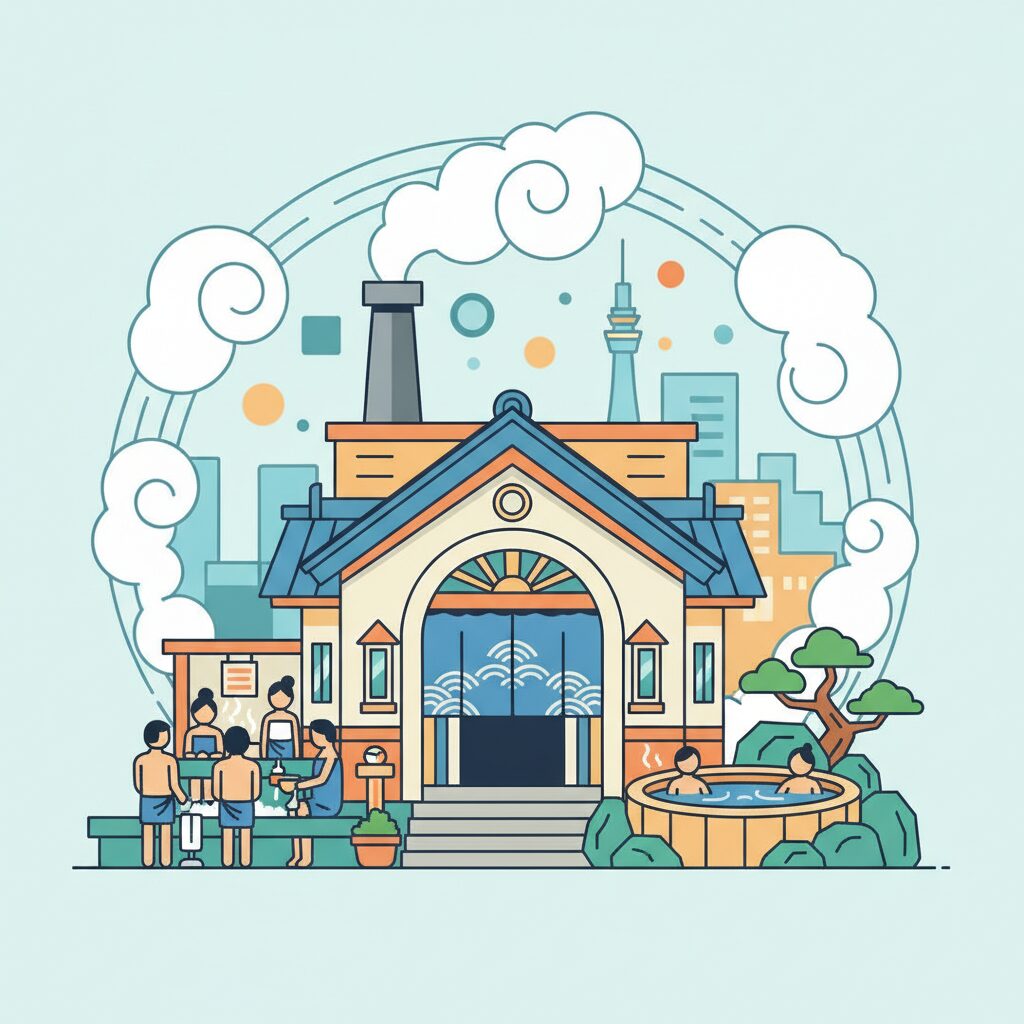
Step off the train in one of Osaka’s older, sleepier neighborhoods, the kind of place where the rumble of the Loop Line fades into the clatter of a local shopping arcade. You’ll smell it before you see it. A faint, clean scent of steam and soap, maybe a hint of hinoki wood, hanging in the humid air. Follow that scent and you’ll find the local ‘sentō’, the public bathhouse. For many foreigners, the image is one of quaint, slightly intimidating tradition, a place you might visit once for the ‘authentic experience.’ But to truly understand Osaka, you have to realize that for entire communities, the sentō isn’t an experience. It’s the epicenter of daily life. It’s the neighborhood’s living room, its news station, and its social safety net, all rolled into one steamy, tile-walled institution. This isn’t about tourism or nostalgia; it’s about a deeply ingrained social rhythm that defies the cold anonymity of modern city living. It’s where the city’s famous warmth isn’t just a cliché; it’s a tangible, steaming reality. Forget the polite, reserved interactions you might find elsewhere. Here, in the raw vulnerability of the bath, you find the unfiltered, unvarnished soul of working-class Osaka, a city built not on grand monuments, but on the million tiny, daily connections forged between its people.
The sentō may be the neighborhood’s communal living room, but exploring the nuanced world of tachinomi culture also unveils the intimate, everyday social rituals that knit Osaka together.
Beyond the Hot Water: The Unspoken Social Contract
Let’s be clear. People in Osaka don’t visit the sentō merely to get clean. Nowadays, almost every apartment, no matter how compact, includes its own unit bath. The continued presence of the neighborhood sentō isn’t due to a lack of private facilities; rather, it represents a deliberate choice to engage in a public ritual. This choice feels fundamentally different from how public spaces are often regarded in, for instance, Tokyo. In Tokyo, a sentō might serve as a trendy, retro spot for a solitary soak and quiet reflection. In Osaka, silence arouses suspicion. The sentō is a place filled with noise, conversation, and life. It’s a communal performance, and attending is your entry to the event.
The unspoken agreement is straightforward: you are here to be among others. The moment you slide open the door and hand a few hundred yen to the elderly woman at the ‘bandai’—the raised platform overseeing both the men’s and women’s sections—you’ve accepted this. You cease to be an anonymous resident in a concrete apartment building; you become Tanaka-san from down the street, the night-shift worker, or the young family with the newborn. This social aspect is why the sentō endures. It offers something a private bathroom simply cannot: casual, regular, low-pressure human connection. It serves as the antidote to the loneliness that afflicts so many modern megacities. In a world dominated by curated online personas and planned gatherings, the sentō provides a space for spontaneous, genuine interaction. It’s a commitment to seeing and being seen by your neighbors, a daily affirmation that you belong to a community, not just exist as an individual drifting through the city.
The Neighborhood’s Living Room: Where Generations Collide
Nowhere else does the social hierarchy of the outside world dissolve so completely. In the steam-filled bathhouse, everyone is equal. The local factory owner, the retiree living on a pension, the young student, and the tattooed day laborer—they all sit on the same small plastic stools, scrubbing from identical yellow washbowls. This radical leveling is the sentō’s magic. It is perhaps the last truly multi-generational, class-agnostic space in urban Japan. Grandfathers soak beside teenagers, their conversations drifting from the Hanshin Tigers’ latest game to the rising price of vegetables. It’s a living library of local knowledge, passed down not through books, but through casual, off-the-cuff remarks.
This is where you witness the famous Osaka ‘osekkai’ in its natural setting. ‘Osekkai’ is often translated as being nosy or meddlesome, but that misses the point. It’s an expression of communal responsibility, a belief that your neighbor’s business is, to some degree, your business. A young mother might find herself receiving a torrent of unsolicited—but genuinely helpful—advice from a group of grandmothers on how to soothe a fussy baby. A newcomer may be gently but firmly corrected on their washing technique. This isn’t about being critical; it’s about initiation. It’s the community’s way of saying, “We see you, you’re one of us now, and this is how we do things here.” It’s a form of intimacy that can feel jarring to those used to the polite distance of other cultures, or even other Japanese cities. But in Osaka, this direct engagement is a sign of care. The alternative—being ignored—would be the true insult.
The Human Information Network
Before social media, there was the sentō. It functions as a hyper-local, analog news network. Who’s sick? Whose daughter is getting married? Which local shop is closing down? You hear it all here first. The information flows freely in the changing room, over the clatter of lockers and the hum of old-fashioned fans. People check in on each other. If an elderly regular doesn’t show up for a few days, someone will notice. Someone will knock on their door. This informal welfare check system is a vital, life-saving function of the sentō in neighborhoods with aging populations. It provides a safety net no government program could ever replicate, built on the simple power of daily observation and mutual concern. It’s a powerful reminder that a strong community isn’t built on grand gestures, but on the accumulated weight of countless small, everyday interactions.
The Architecture of Communication: Design and Flow
The physical layout of a traditional sentō is intentional; it serves as a masterclass in designing spaces for social interaction. Every feature, from the entrance to the tubs, is crafted to break down barriers and encourage communication. Grasping this design is essential to appreciating the sentō’s social significance.
The Gateway: Bandai and Datsuijo
You enter the ‘datsuijo’, or changing room. At its forefront sits the ‘bandai’, the sentō owner’s throne. From here, they greet regulars by name, manage payments, sell soap and cold drinks, and function as the community’s switchboard operator. They are both gatekeepers and keepers of memory. The changing room itself is an open, shared space with no private cubicles. You undress and prepare alongside your neighbors, and this shared vulnerability is the initial step in shedding outside identities. After the bath, conversations continue here as people lounge on benches, watch sumo on the old television, and cool off with a bottle of fruit milk—creating a relaxed, post-soak social club ambiance.
The Stage: The Washing Area
Inside the bathing area, rows of low faucets and mirrors await. You sit on a small stool, a posture that is both humbling and inherently communal. Everyone is at eye level; you cannot hide behind a shower curtain. Your personal space is limited only by the length of your shower hose. This closeness naturally invites conversation—you might ask to borrow a bucket or comment on the water’s temperature. These brief exchanges form the foundation of sentō society. The acoustics of the tiled room enhance every sound—the splash of water, the scrubbing of towels, the booming laughter of elderly men recounting familiar tales. It’s a symphony of communal life.
The Heart: The Communal Tubs
Lastly, the tubs, or ‘furo’. Often, there are several, each offering a different temperature or feature—a jet bath, an herbal bath, or the notorious ‘denki-buro’ (electric bath) that sends a low-voltage current through the water. Here, side by side in the hot water, the deepest conversations unfold. The shared heat seems to dissolve inhibitions. Business deals are negotiated, family troubles confided, and philosophies debated. It’s a place of profound intimacy where physical closeness fosters emotional connection. Through this repeated ritual, strangers become something much more like family.
Reading the Air: Sentō Etiquette and Osakan Directness
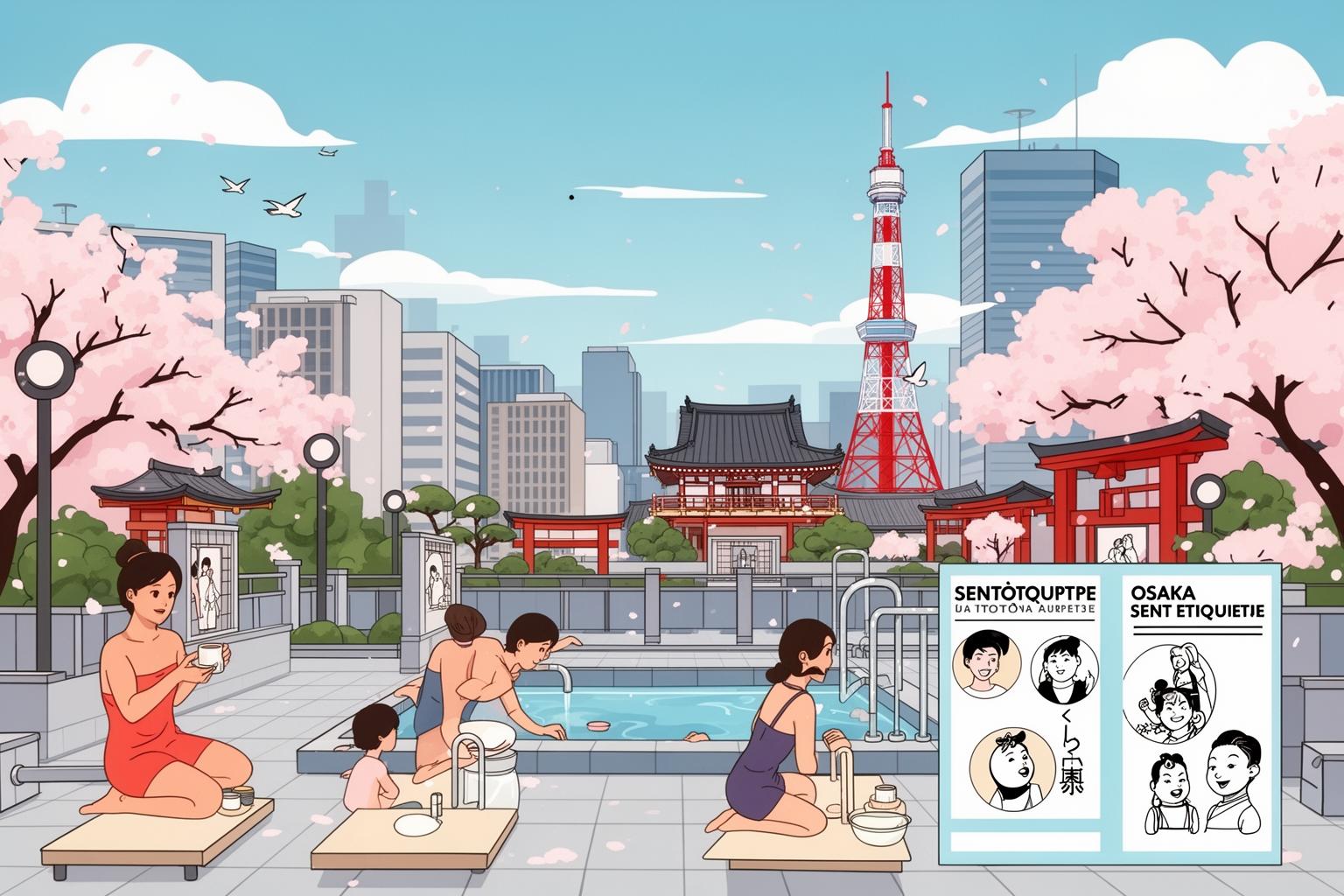
For a foreigner, the sentō can appear to be a minefield of unspoken rules. However, these rules are less about strict ceremony and more about practical respect for a shared resource. In Osaka, if you make a mistake, you’ll likely be corrected immediately. This contrasts sharply with Tokyo, where a social misstep might only earn you a cold, silent glare. The Osakan style is much more direct and, in many ways, more helpful.
The most important rule is to wash thoroughly before entering the main tubs. This is not just about hygiene; it is the essential expression of respect. The tubs are meant for soaking and relaxing, not for washing. A foreigner who jumps straight into the tub is the ultimate sentō faux pas. In Osaka, an older man won’t hesitate to shout, “Oi, 兄ちゃん (niichan)! Wash first!” This isn’t aggressive but instructional and practical. The community is protecting its shared water and teaching you how to be part of it. The message is delivered plainly because the reasoning is simple: clean body, clean water, happy everyone. End of story.
Other rules are more subtle. Don’t let your small towel touch the bathwater. Don’t splash. Be considerate of your neighbor’s space at the washing stations. You learn these things by observing, listening, and soaking in the room’s rhythm. Regulars often have unofficial ‘assigned’ spots—their favorite faucet or preferred locker. While no one will force you to move, yielding to a regular is a sign of respect and acknowledgment of the social order. Mastering this etiquette signals that you are not just a tourist but a participant who understands and respects the local culture. When you get it right, the reward is acceptance into one of the city’s most genuine and welcoming social circles.
A Fading Tradition? The Sentō’s Future in a Modernizing Osaka
It would be misleading to depict the sentō as a timeless, unchanging institution. The truth is that they are disappearing. Across Japan, including Osaka, hundreds close every year. The owners are aging without successors. The old wooden buildings are costly to maintain. Younger generations, accustomed to private baths and digital communities, don’t always feel the same connection to the neighborhood bathhouse. With each sentō that shuts down, a unique social ecosystem disappears. The smokestack grows cold, the ‘noren’ curtain is taken down, and the neighborhood loses its heart.
The loss is more than merely nostalgic; it signifies a fundamental shift in how people connect. When a sentō closes, the elderly lose a primary reason to leave home and a place for both physical and social wellness. Casual check-ins stop. The information network goes dark. The community becomes slightly more fragmented and more anonymous. In its place, you might find the rise of the ‘super sentō’—large, modern complexes with restaurants, massage chairs, and several novelty baths. These are excellent establishments, but they serve a different role. They are a destination, an occasional indulgence, not a daily ritual. You go with your own friends or family, not to make new ones. The deep, messy, intergenerational community of the old sentō cannot be duplicated there.
Still, the spirit of the sentō endures. It remains in the DNA of Osaka, in the city’s preference for face-to-face interaction, its love of shared experiences, and its fundamentally communal nature. Stepping into one of the remaining neighborhood sentō is like entering a living museum of Osakan identity. It’s a reminder that a city is more than its buildings and economy; it’s the web of relationships that bind its people together. In the warm, steamy air of the bathhouse, surrounded by echoes of a thousand conversations, you can feel that web—strong and resilient—holding the neighborhood together, one bath at a time.