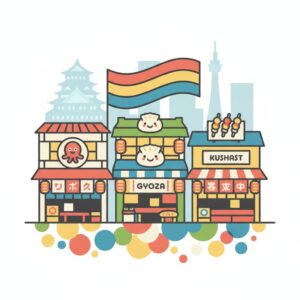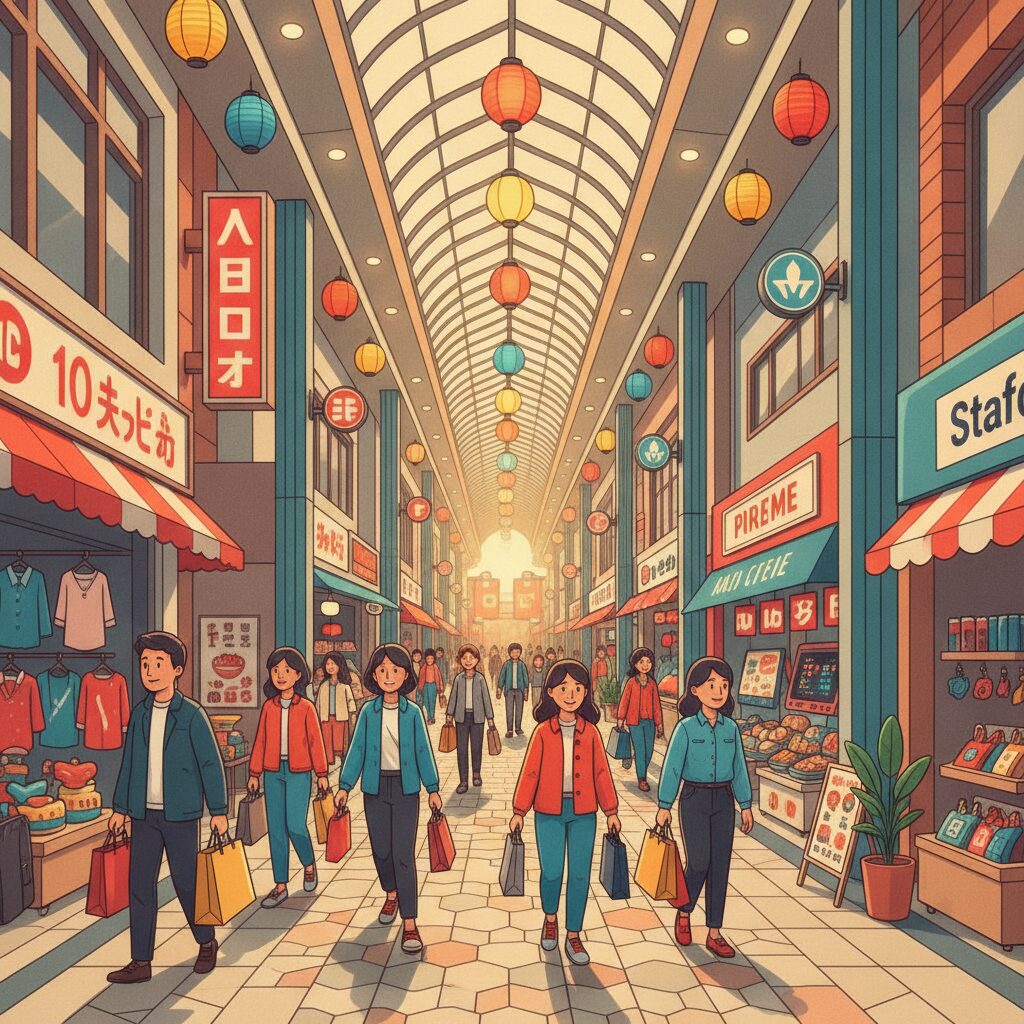
The first time you walk into a real, residential shotengai, one of Osaka’s covered shopping arcades, it feels like a glitch in the matrix of modern Japan. You leave a quiet side street, all neat apartment blocks and polished vending machines, and suddenly you’re in another world. The air gets thick with the smell of grilled eel, sweet soy sauce, and the sharp tang of pickled daikon. The sound is a wall of vendors shouting today’s deals, the tinny echo of enka music from a tiny CD shop, and the constant, rhythmic rumble of bicycles weaving through the crowd. It’s a sensory assault, a far cry from the serene, climate-controlled perfection of a department store basement or the sterile aisles of a chain supermarket. Your first instinct might be to see it as just a charming, old-fashioned place to buy groceries. But that’s like saying a pub is just a place to buy a drink. You’d be missing the entire point. These arcades are not just commercial corridors; they are the vibrant, beating hearts of Osaka’s neighborhoods. They are the city’s living rooms, its social networks, and the best place to understand what makes an Osakan tick. Forget the tourist traps like Dotonbori; the real soul of the city is found here, under these weathered plastic roofs, between the fishmonger and the futon shop. This is where the unspoken rules of Osaka life play out every single day, in a rhythm that feels completely different from the precise, measured pace of Tokyo.
For readers eager to dive deeper into the everyday pulse of Osaka’s local life, exploring the shotengai daily hub reveals how these bustling corridors have become the city’s intimate social and cultural meeting spots.
The Unspoken Rhythm of the Arcade
Life in the shotengai follows a unique, unwritten rhythm. It’s a subtle dance of cues and mutual understandings that can seem puzzling at first. You don’t learn it by reading signs but through observation, making small errors, and eventually getting it right. It’s a language without words, built on decades of close-knit living and commerce.
Greetings, Grunts, and “Maido!”
In Tokyo, you’re welcomed with a crisp, almost robotic “Irasshaimase!” (Welcome!). It’s polite, professional, and entirely impersonal. But in an Osaka shotengai, greetings take on a very different character. You might hear a hearty “Maido!” which literally means “every time” but conveys “Thanks for your continued business!” This greeting is reserved for regulars, a verbal nod of recognition. It might also be a simple “Oideyasu” (Come on in), a gentler, more Kyoto-style invitation. Or, and this is important, it could be nothing more than a slight nod, a grunt of acknowledgment, or a brief glance from the shop owner as they continue gutting a fish. Foreigners might mistake this for rudeness. It’s not. It reflects a different kind of relationship. The shopkeeper isn’t performing customer service; they’re a craftsperson, a busy merchant. Their focus is on the product. The absence of a formal greeting means they see you not as just another customer, but as a fellow person sharing the space. The transaction is understood as mutually beneficial, not one based on service and supplication. The real welcome arrives once you’ve become a familiar face, when the greeting evolves from a grunt to a warm “Maido, niichan!” (Thanks, buddy!).
The Bicycle Ballet
The organized chaos of Osaka is perhaps best seen in the shotengai’s bicycle traffic. People of all ages—from grandmothers carrying baskets full of leeks to students rushing to class—navigate the busy pedestrian area on their trusty mamachari bikes. There are no dedicated bike lanes, no stop signs. Yet it somehow works. The key lies in a constant, low-level negotiation of space. A gentle bell ring isn’t a demand to move aside; it’s a polite announcement: “Excuse me, just passing on your left.” Pedestrians respond with subtle shifts, a half-step aside, without interrupting their conversations. It’s a fluid, instinctive dance. Trying to impose strict rules here would create gridlock. Instead, Osakans depend on a shared, practical understanding. The goal is to reach your destination without causing trouble. This defines the Osaka mindset: a pragmatic approach valuing flow and efficiency over rigid formality. In Tokyo, cycling through crowded pedestrian zones might draw a stern look. In Osaka, it’s simply part of the scene, an essential piece of the neighborhood’s transit landscape.
Haggle as a Handshake
Let’s be clear: you don’t haggle over a 100-yen coffee can. But for other items—especially fresh produce near closing time or goods without a fixed price—the listed amount often serves as a starting point for negotiation. Asking, “Chotto makete kureru?” (Can you give me a little discount?) isn’t considered cheap. It’s a form of interaction. A game, a performance. The vendor might laugh and refuse, sigh and knock off 50 yen, or throw in an extra onion as a compromise. The act of asking matters most. It shows you’re not a passive buyer but an active participant in the exchange. This tradition comes from Osaka’s rich history as a merchant city, where business thrived on relationships and sharp negotiation. In Tokyo’s more hierarchical society, questioning a price can feel like challenging the establishment itself. In Osaka, it’s simply how business is done. It’s a sign of respect for the vendor’s role—and yours. The discount is secondary; the true reward is the interaction, the brief moment of connection.
It’s Not a Market, It’s a Network
To regard the shotengai as just a collection of shops is to overlook its most essential role. It functions as the neighborhood’s central nervous system—a place where information is exchanged, reputations are formed, and community is built through daily interactions. It runs on a currency of familiarity and trust that no point card or loyalty app can ever replicate.
The Obachan Intelligence Agency
The real power holders of the shotengai are the obachan—the middle-aged and elderly women who roam these arcades every day. They are the custodians of neighborhood knowledge, living databases of local information. They know which butcher has the best pork for tonkatsu today. They know the new doctor who just opened a clinic is the tofu maker’s son. They know you’re the new foreigner who moved into the apartment above the bakery because they saw you struggling with your recycling. If you need to find something, don’t wander aimlessly—ask an obachan. She won’t just direct you; she’ll likely walk with you, sharing the entire history of the shop you seek and offering unsolicited yet surprisingly accurate advice on your life choices. This is often what people mean when they say, “Osaka people are friendly.” It’s not a vague, superficial kindness. It’s a practical, deeply rooted sense of community responsibility. Information is shared freely, and helping neighbors is just what you do. It’s a social safety net woven from everyday conversations and casual gossip.
Your Face is Your Point Card
Across much of Japan, loyalty is recorded with plastic cards and QR codes. In the shotengai, your face serves as your loyalty card. During your first visits to a fruit stand, you’re merely a customer. But after a few weeks of buying mikan oranges from the same gruff man, something changes. He begins nodding when you approach. He starts setting aside the best-looking bunch for you. One day, while bagging your apples, he’ll toss in an extra one that’s slightly bruised but perfectly good. This moment marks your elevation—you are no longer simply a customer; you are a regular. This form of recognition is fundamental to shotengai life. It’s a human-to-human connection that goes beyond commerce. It feels profoundly rewarding in a way no accumulation of digital points ever can. It reminds you that your presence matters, that you belong to this specific place. It’s the opposite of the anonymous consumerism that dominates much of modern urban life.
The Power of a Little “Omake”
That extra apple has a name: omake. You’ll hear this word often in Osaka. It means “a little extra” or “a bonus,” but its cultural importance is vast. Omake isn’t a discount or an entitlement. It’s a gift, a gesture of goodwill from seller to buyer. It’s the croquette shop owner adding an extra potato croquette because you bought ten. It’s the pickle vendor giving you a scoop of a new variety to try. Omake embodies the relationship you’ve built. It says, “I see you. I appreciate your business. Come back again.” It strengthens the bond between merchant and customer, turning a simple transaction into a reciprocal exchange of loyalty. It serves as a powerful social glue and a core element of the warm, generous spirit Osakans take pride in.
The Arcade as the Osaka-Tokyo Divide
The shotengai offers perhaps the clearest example of the cultural divide between Osaka and Tokyo. It serves as a living museum showcasing the values and attitudes that make Japan’s second-largest city distinct from its capital. As you walk through an arcade, you can see, hear, and feel these differences in real time.
Glorious, Functional Chaos
Even a busy shopping street in Tokyo often maintains a sense of deliberate order. Everything is visually pleasing, clean, and neatly arranged. In contrast, an Osaka shotengai flourishes in a kind of glorious, functional chaos. Vegetables spill out onto the walkway, handwritten signs with exclamation marks shout about today’s deals, and the soundscape is a blend of competing vendors, pachinko parlors, and background music. To an outsider, it may feel messy or overwhelming. But to Osakans, this is not disorder; it’s energy. It’s life. The sensory overload is part of the charm. The emphasis is on utility and vibrancy, not flawless presentation. A shop doesn’t need to look beautiful; it needs to offer good products at a fair price. This practicality lies at the core of Osaka’s identity.
The Beauty of “Good Enough”
This functional-first approach extends to the goods themselves. In Tokyo, perfection is often prized—the perfectly shaped strawberry, the impeccably wrapped gift. In Osaka, the motto is often “kore de eeyan”—“this is good enough.” A slightly imperfect croquette that tastes fantastic is preferred over a perfectly round one that’s mediocre. The fishmonger sells parts of tuna that aren’t pretty enough for a high-end sushi restaurant but are ideal for grilling at home—and at a great price. This doesn’t reflect low standards; rather, it shows a deep appreciation for substance over form. It’s a no-frills attitude that celebrates the delicious, the practical, and the authentic. This philosophy liberates you from the tyranny of aesthetics, allowing you to enjoy things as they are.
Straight Talk, Not Small Talk
One of the biggest culture shocks for foreigners—and even for Japanese from other regions—is the straightforwardness of communication in Osaka. The shotengai is where this is most apparent. A butcher, hearing what you plan to cook, might bluntly say, “No, don’t use that cut of meat. It’ll be too tough. Use this one instead. It’s cheaper and better.” In Tokyo, such direct advice might be seen as intrusive or rude. The focus there is on tatemae, the polished facade of politeness and subtlety. In Osaka, this is simply good customer service. The butcher’s aim is for you to prepare a delicious meal and return again. His honesty is a mark of respect—for you and for his craft. He’s not interested in polite pretenses; he wants a good outcome. This frankness can be mistaken for brusqueness, but it stems from sincerity and a desire for efficiency. In the fast-moving, straightforward world of the shotengai, there’s no room for ambiguity.
Your Shotengai Survival Guide
Embracing your local shotengai is one of the quickest ways to truly feel at home in Osaka. It’s about more than mere convenience; it’s about connecting deeply with the heart of your neighborhood. This involves a small adjustment in your shopping habits and mindset, but the benefits are substantial.
Building Your Local Roster
Don’t attempt to explore the entire arcade all at once. Begin with a small step. The aim is to create your personal list of favorite vendors. Find your tofu seller. Find your vegetable vendor. Find your fishmonger. Start by regularly visiting the same one or two shops. Make eye contact. Offer a clear “Konnichiwa.” Even if your Japanese is limited, your effort will be appreciated. Before long, you’ll graduate from being just another face to becoming a regular. This is the crucial step. Once you establish your roster, grocery shopping transforms from a chore into a series of friendly encounters with familiar faces.
Mastering the Daily Ebb and Flow
Shotengai follow a distinct daily rhythm. The morning, around 10 AM, is the best time for the freshest produce and fish. This is when professionals and dedicated home cooks do their shopping. At lunchtime, the arcade buzzes as office workers and students pick up bento boxes and fried snacks. Late afternoon, between 3 PM and 5 PM, is when housewives come to stock up for dinner. By 6 or 7 PM, many fresh food stalls begin to close, often offering significant discounts on leftover stock. Unlike the 24-hour supermarkets, the shotengai runs on a human schedule. Understanding this ebb and flow is essential for grabbing the best items and feeling connected to the neighborhood’s rhythm.
Why Your Wallet Needs Paper
While much of Japan is gradually adopting cashless payments, many small, family-run stalls in the shotengai still operate strictly on cash. Trying to use a credit card at a tiny pickle stand will likely result in a polite but firm shake of the head. Always carry enough yen, preferably in smaller bills and coins. This isn’t due to being outdated. Their business model is focused on speed, simplicity, and low expenses. Cash transactions are immediate and personal. They keep queues moving and avoid transaction fees. Carrying cash is part of engaging in the shotengai’s traditional, face-to-face economy.
Living in Osaka, you’ll quickly come to see the shotengai as more than just a place. It’s a gauge of the city’s spirit, a stage for daily stories, and a classroom for unwritten social norms. It’s lively, a bit chaotic, and unapologetically human. It’s where commerce and community remain intertwined in a way that feels both timeless and vibrant. Mastering the arcade’s rhythm won’t just simplify your day-to-day life; it will offer you a true understanding of this complex, practical, and wonderfully straightforward city. It’s the moment you stop asking your fishmonger for suggestions and he starts asking how your week has been. That’s when you know you’re not just living in Osaka—you’re becoming part of it.