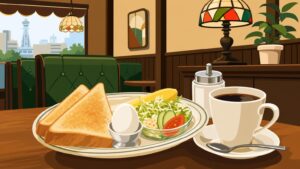
The first time it happened, I was genuinely confused. I was in a small, slightly smoky coffee shop—a kissaten—tucked into a covered shopping arcade somewhere deep in Higashiosaka. The air was thick with the smell of dark-roast coffee and newspaper ink. I ordered a “blend coffee,” a simple 450-yen transaction. A few minutes later, the master, a man who looked like he’d been wiping down the same formica countertop since the 1970s, placed my coffee down. Next to it, he set a small plate. On it sat a slice of impossibly thick, golden-brown toast, a perfectly hard-boiled egg still warm in its shell, and a tiny mound of cabbage salad. I hadn’t ordered them. I looked at the plate, then at him. He just gave me a slight nod, his attention already on the horse races playing on the small TV in the corner. I figured there was a mistake, a language barrier flub on my part. When I went to pay, ready to explain I only wanted the coffee, the bill was exactly 450 yen. “The food,” I started, pointing back at my empty plate, “how much?” He just smiled faintly. “Sābisu,” he said. Service. Free. That was my introduction to Morning Service, or as it’s known everywhere, simply “Morning.” It’s not just a breakfast special; it’s a cultural institution, a daily ritual, and one of the clearest windows into the pragmatic, value-obsessed, and surprisingly communal soul of Osaka.
Osaka’s quiet morning service offers just a taste of its rich communal culture, while exploring the dynamic realm of standing bar etiquette reveals another vibrant facet of local life.
What Exactly is ‘Morning Service’? The Art of the Deal
Let’s address the mechanics first, as their elegant simplicity is the essence of the concept. Morning Service is a system, typically active from opening until around 11 AM, where purchasing a single drink grants you a complimentary or heavily discounted breakfast set. The usual price of the drink, commonly coffee or tea, ranges from 400 to 550 yen. With that purchase, you automatically receive the “service” portion. The classic Morning set consists of three items: a thick slice of white toast called atsugiri toast (厚切りトースト), a hard-boiled egg, or yude tamago (ゆで卵), and your coffee. That’s all—you pay for the coffee, and the rest simply appears. It seems like a magic trick, but it’s really just good business.
Many establishments offer slight variations. Some may list an “A Set” (the basic toast and egg, free) and a “B Set” (perhaps adding a small salad and a piece of fruit for an extra 100 yen). The core idea is the value offered. The term “service” itself is a piece of wasei-eigo, Japanese-made English, which doesn’t mean customer service in the American sense. Instead, it signifies “a bonus,” “on the house,” or “something extra just for you.” It’s like a linguistic wink and nod. This isn’t about spoiling you; it’s about presenting such an obvious, logical deal that refusing it would be foolish. It’s a cultural handshake based on mutual understanding: you came for your morning caffeine, and we’re making it worthwhile by including breakfast. It’s a simple, unspoken agreement.
The Osaka Mindset on Display: It’s All About ‘Kosupa’
To grasp Morning Service, you need to understand the near-sacred Osaka idea of kosupa. It’s a shortened form of “cost performance,” but that phrase feels too clinical. It doesn’t convey the deep, emotional significance the concept holds here. Kosupa goes beyond simply finding something cheap—that’s just being frugal. Kosupa is about achieving the highest value for your money. It’s an art, a challenge, and a source of pride. Spending extra on something that could have been obtained cheaper, or for the same price with added benefits, isn’t merely a financial loss; it’s a strategic misstep. Morning Service is the grand sanctuary of kosupa.
The Gospel of Cost Performance
Osaka was founded by merchants and served as Japan’s commercial hub for centuries, where rice was traded, and fortunes were built. That heritage, the shōnin no machi (商人の町) or “merchant town” ethos, runs deep. In Tokyo, status may be displayed through luxury brands, upscale real estate, or exclusive dining experiences. In Osaka, status is often shown through shrewdness. It’s about finding the best takoyaki for 500 yen, bargaining for a lower price on a used bicycle, or knowing which kissaten offers not only a boiled egg but also a small cup of yogurt with your morning coffee. Morning Service is the daily celebration of this mindset. Why pay 300 yen for a coffee at a chain and another 300 yen for a pastry elsewhere when you can enter a local spot and get it all for 450 yen? It’s not just about saving 150 yen; it’s about the victory. It’s about starting your day with a small, concrete win—a confirmation that you understand how the city operates. You’re a savvy player, a connoisseur of value. This sharply contrasts with Tokyo’s morning rush, often a fast, efficient, solitary transaction at a convenience store or a stylish, branded café. Tokyo prioritizes time efficiency and image, while Osaka values resource efficiency and a good deal.
A Ritual of Rationality
The entire practice is rooted in a strong, pragmatic logic. Making breakfast at home means buying bread, eggs, and coffee, taking time and effort. Eating out involves buying two separate items. Morning Service offers a third option—a highly rational solution that optimizes both money and time. You get your caffeine, nourishment, and a place to sit and prepare mentally for the day, all for the price of a single drink. For many Osakans, especially older residents and the self-employed, it’s not a luxury; it’s the default. It’s the most sensible way to start the day. This practicality defines Osaka’s character. Outsiders may sometimes see it as blunt or overly money-focused, but insiders view it as a form of honesty. There’s no pretense—it’s a straightforward calculation of value, and Morning Service is the answer every time.
Beyond the Toast: The Kissaten as a Neighborhood Living Room
If the deal is what gets you through the door, the atmosphere is what makes you stay. Morning Service is rarely found in the sterile, cookie-cutter settings of global coffee chains. Its true home is the classic Japanese kissaten, the independent coffee house. These establishments are relics of the Showa era (1926-1989), often adorned with dark wood paneling, worn velvet banquettes, and the warm glow of Tiffany-style lamps. They feel less like businesses and more like someone’s slightly outdated, but very cozy, living room.
The Third Place Before Starbucks Made it Cool
Long before sociologists coined the phrase “third place” to describe community hubs beyond home and work, the kissaten was already refining this concept. The morning hours unfold like a quiet ballet of neighborhood life. In one corner, a group of elderly men, the local jīsans, pore over horse racing forms in their newspapers, speaking in soft, gravelly Kansai-ben. At another table, a pair of housewives, their shopping trolleys parked beside them, dissect local gossip over their toast. A salaryman might sit alone, not scrolling on a laptop, but simply staring into his coffee cup, gathering his thoughts before heading to the office. The soundtrack isn’t a curated indie-pop playlist; it’s the drone of the morning news on the television mounted in the corner and the clink of ceramic on saucer. This is a space for coexistence rather than interaction. It offers a sense of shared solitude, a quiet hum of community that is deeply comforting. It’s a place to belong to the neighborhood without the pressure to perform.
The ‘Master’ and the ‘Jōren’: A Symbiotic Relationship
At the heart of every great kissaten is the master or mama-san, its proprietor. They are more than just a barista; they are the anchor of this small world. The master knows who takes their coffee black, who prefers their toast extra-browned, and who is having a tough time and needs to be left alone. A relationship with the master builds over hundreds of mornings, a slow accumulation of quiet nods and brief pleasantries. Becoming a jōren, a regular, at a kissaten is an important step toward feeling rooted in an Osaka neighborhood. It means you have a place. The master’s role is to provide a steady, reliable environment, and the jōren’s role is to provide consistent, dependable business that keeps the lights on. It’s a beautifully symbiotic relationship that sharply contrasts with the anonymous, high-turnover service model of chain cafes. You don’t become a jōren at Starbucks. You are always simply a customer. At a kissaten, after enough time, you become part of the furniture, and in Osaka, that is a high compliment.
How to Navigate the World of Osaka Morning Service
For someone new, the world of Morning can feel somewhat elusive. The best spots rarely appear online, and from the outside, they often seem modest or even slightly daunting. But figuring it out is part of the fun.
Finding Your Spot: From Gritty Shotengai to Quiet Suburbs
Forget the shiny commercial areas of Umeda or Namba. The true essence of Morning Service lies within the city’s extensive network of shotengai (covered shopping arcades) and the quiet residential streets near local train stations. Places like the renowned Tenjinbashisuji Shotengai are a treasure trove, with dozens of kissaten vying for the morning crowd. However, you’ll find them everywhere—from the working-class neighborhoods to the east to the quieter suburbs in the south. The best way to discover one is on foot. Watch for key signs: a simple, hand-painted 「モーニング」 sign, a plastic food model of coffee and toast displayed in the window, or a few elderly men reading newspapers inside. These are marks of authenticity.
Reading the Signs and Menus
Once inside, the system is generally straightforward. Menus are often simple, handwritten sheets taped to the wall or placed on a small stand on the table. Look for the phrase モーニングサービス (mōningu sābisu). You’ll frequently encounter options like A セット (A Set), B セット (B Set), and so forth. If you recognize a few key words, you’re good to go: トースト (tōsuto – toast), ゆで卵 (yude tamago – boiled egg), and コーヒー (kōhī – coffee). Often, simply ordering a coffee before 11 AM triggers the service automatically. Don’t hesitate to point and say “Kore, kudasai” (“This, please”). The master has heard it all before.
The Unspoken Etiquette
The rules are simple and mostly unspoken. The Morning Service business depends on a steady turnover of customers, not long stays. It’s fine to read a newspaper or book, but lingering for three hours with just a 450-yen coffee is considered rude. Respect the flow of the place. An hour is sufficient. In these older, independent cafés, paying in cash is often the easiest and most appreciated. When leaving, a simple “Gochisousama deshita” (“Thank you for the meal”) to the master is a small but meaningful gesture. It shows that the experience was more than a transaction; it was an act of hospitality.
The ‘Morning’ Arms Race: When a Free Egg Isn’t Enough
Because it’s Osaka, a simple, good deal is never enough—it has to be the best deal. This creates a phenomenon I call the Morning Service Arms Race. In neighborhoods dense with kissaten, a friendly yet fierce competition unfolds. If the corner shop offers toast and an egg, the one across the street adds a small salad. The shop down the block responds with a piece of melon. This escalation can reach remarkable heights. It’s not uncommon to find Morning Service sets that include a small bowl of udon noodles, a savory chawanmushi egg custard, or a plate of spaghetti napolitan, all for the price of a single coffee. This isn’t merely a loss-leader marketing tactic—it’s a display of merchant pride. It’s a way for a master to say, “My place offers more. We take better care of our people.” It’s a competition of generosity, a race to provide the most outrageous kosupa. Discovering these super-charged Morning spots feels like uncovering a city secret, a testament to Osaka’s endless drive to outdo, out-value, and out-welcome everyone else.
What This Teaches You About Living in Osaka
Participating in the daily ritual of Morning Service does more than just fill your stomach inexpensively. It reshapes your perspective on Osaka. It shows you that in this city, value is essential, but value goes beyond price alone. It encompasses the entire experience: the quality, the quantity, the atmosphere, and the human connection. You realize that community isn’t built on grand gestures but on the quiet, steady foundation of daily routines. Sitting in a kissaten, you observe the network of relationships that bind a neighborhood together, with the master at its heart. You begin to understand that the well-known Osaka pragmatism isn’t coldness; rather, it reflects a desire for straightforward, honest interaction. No frills, no pretense—just a good cup of coffee and a complimentary piece of toast. When you move to Osaka, one of the most important things you can do is find your Morning spot. The moment the master begins pouring your coffee before you’ve even ordered, the moment you receive a silent nod of recognition as you enter—that’s when you stop merely living in Osaka and start truly belonging to it. It’s a simple breakfast, yes, but it’s also a key to the city.