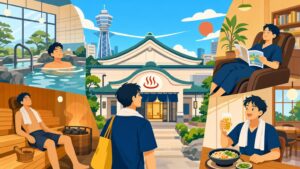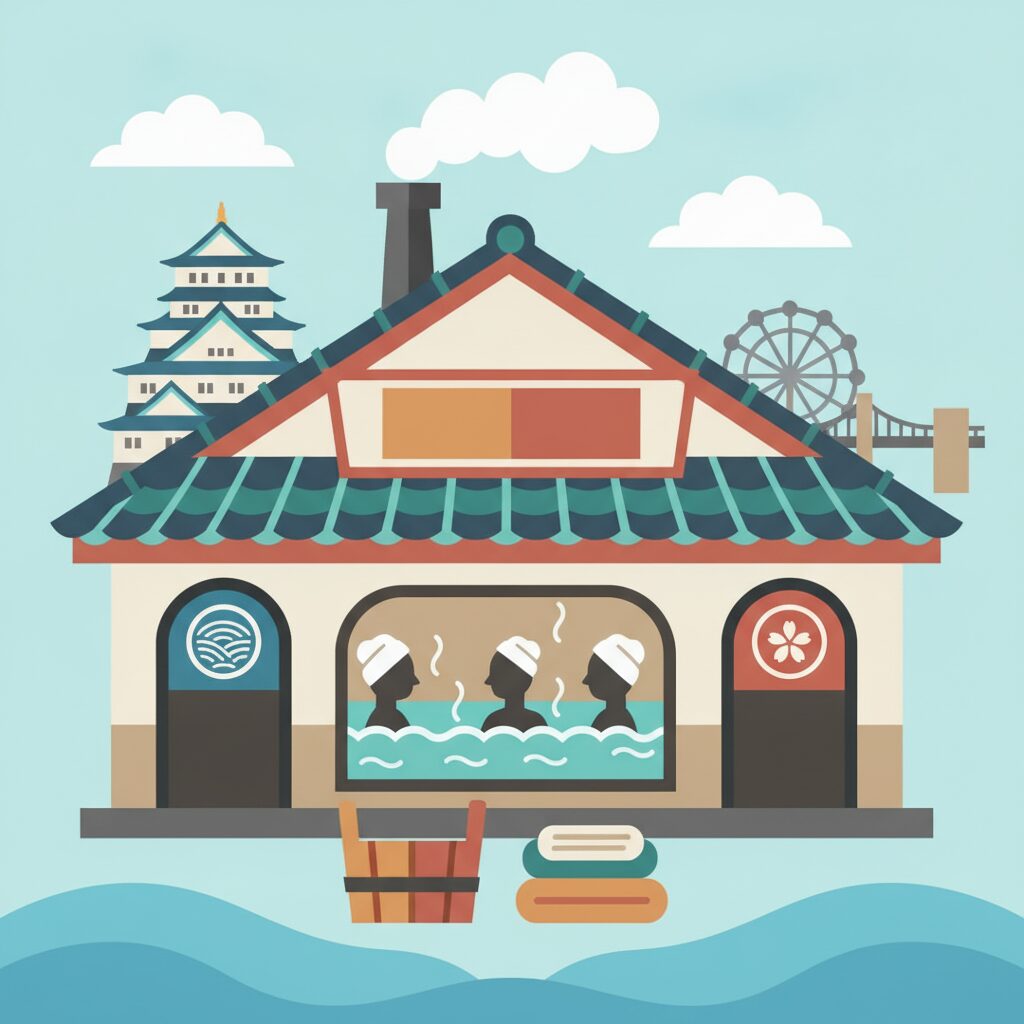
You’ve just moved into your new apartment in Osaka. It’s compact, it’s clean, and it has a perfectly functional unit bath. You’ve got hot water on demand. So why, your neighbor asks, haven’t you been down to the local sento yet? You see it every day on your way to the station—the old-fashioned tile roof, the tall chimney, the short curtain flapping over the entrance with the ゆ symbol for hot water. You politely explain that your apartment has a shower. Your neighbor gives you a look. It’s not a look of judgment, but one of genuine confusion, as if you’d just said you don’t need to eat because you have a refrigerator. It’s in that moment you realize you’re missing a fundamental piece of the Osaka puzzle. You think a sento is about getting clean. In Osaka, you’re only about ten percent right. A sento isn’t a utility; it’s a vital, living organ of the neighborhood. It’s the city’s communal living room, a place where the unvarnished, unfiltered rhythm of daily life plays out in steam and hot water. Forget what you think you know about Japanese bathing etiquette from tourist guides. To understand Osaka, you need to understand its public baths.
Embracing the local sento not only deepens your connection to Osaka’s vibrant community but also lets you discover a refreshing cultural ritual, as detailed in making your neighborhood sento your weekly Osaka sanctuary.
The Community Hub Disguised as a Bathhouse
Decades ago, when modern plumbing was considered a luxury, the sento was a necessity. Today, nearly every home has its own bath. Logic would suggest that the public bathhouse should have become obsolete like the payphone, a relic of a bygone era. And in many parts of Japan, that has happened, with hundreds closing each year. However, in Osaka, especially in the dense, older neighborhoods often referred to as shitamachi, the sento endures with remarkable resilience. This isn’t merely nostalgia for a Showa-era aesthetic. It’s because the sento’s main role has shifted from hygiene to social infrastructure. It has survived by offering something your private, sterile unit bath never can: human connection. An Osaka sento is less a place to wash your body and more a place to cleanse your mind of the day’s stresses, catch up on neighborhood news, and reaffirm your place in the local community. It serves as a low-cost, low-commitment third space—not home, not work—that functions as a social safety net and information exchange. It’s where the elderly, who might otherwise be isolated, find guaranteed daily contact. It’s where parents can bring their kids for a bit of lively chaos that isn’t confined within their own thin apartment walls. The persistence of the sento in Osaka is a testament to the city’s deeply rooted communal spirit, a preference for shared experience over private convenience.
The Unspoken Rules of Naked Communication
The concept of hadaka no tsukiai, or “naked communion,” can be found throughout Japan. The idea is that once clothes are removed, so too are the markers of social status, title, and wealth, enabling a more honest and open form of communication. But Osaka takes this idea and amplifies it. A Tokyo sento might be a place for quiet, personal reflection—you soak, you think, you leave. In Osaka, silence can feel suspicious. The atmosphere is thick not only with steam but also with the ongoing buzz of everyday conversation. People don’t come here to be alone with their thoughts; they come to share them. You’ll overhear grandmothers debating the best way to pickle radishes, middle-aged men analyzing last night’s Hanshin Tigers game with precise scrutiny, and parents exchanging tips on which local supermarket has the cheapest eggs. It’s a raw, live stream of the neighborhood’s collective consciousness. This is where the stereotype of the friendly, talkative Osakan is born and maintained. It’s not about randomly approaching strangers; it’s a participation in a long-standing communal ritual. You’re in their space, sharing their hot water, and thus, you become part of the conversation, even if you remain a silent observer.
Reading the Room, Osaka Style
Navigating this social scene for the first time can be daunting. The key is to realize that participation is optional, but awareness is crucial. You don’t have to initiate a conversation, but be ready for one to come to you. The regulars, the joren, have their routines down to an art. There’s the old man who claims the corner jet bath as his personal throne every evening at exactly 7 PM. There’s the group of women who hold court in the sauna, their voices bouncing off the cedar walls. The social dynamics are fluid and unspoken. A simple nod or a brief remark on the water’s temperature—ee yu desu na (“nice hot water, isn’t it?”)—often signals your openness to interaction. The true ruler of this realm is the attendant perched on the raised platform called a bandai, situated between the men’s and women’s entrances. From here, they see and hear everything. They act as the neighborhood’s unofficial concierge, therapist, and news anchor, keeping a mental record of everyone’s lives while collecting the 500-yen entrance fee and selling soap. To grasp the heartbeat of an Osaka neighborhood, you don’t visit city hall; you go to the sento bandai.
It’s Not a Spa, It’s a Living Room
A common error among foreigners is to confuse the neighborhood sento with a tourist-focused onsen (hot spring) or a contemporary, chic spa. This misunderstanding only sets the stage for disappointment. An Osaka sento is, first and foremost, a functional, utilitarian space. The tiles may be cracked, the paint peeling, and the lockers temperamental. The decor often features faded advertisements for local noodle shops and real estate agents stuck on the walls. There are no infinity pools or aromatherapy treatments here. This lack of refinement is not a defect; it’s the very essence. A sento extends the feeling of home, and home is seldom perfect. It is comfortable, familiar, and well-used. The main appeal isn’t any special mineral composition in the water, which is usually just heated tap water, but the range of baths available: the electrifying sensation of the denki buro (electric bath), the strong jets of the jacuzzi, and the soothing heat of the sauna followed by the intense shock of the mizu buro (cold plunge pool). It’s about the simple, visceral joy of a really, really large bathtub—a luxury few city apartments can provide.
The Post-Bath Ritual: The True Highlight
Many would argue that the most significant part of the sento experience unfolds after bathing. The datsuijo, or changing room, is where genuine community bonding occurs. Here, conversations from the bath continue, accompanied by the hum of vintage hair dryers and the clatter of glass bottles. It’s common to see people, wrapped in towels, relaxing on vinyl benches, watching the evening news or a baseball game on a small TV. This is the sento’s second act. Visitors purchase a bottle of cold milk—coffee milk being a post-sento favorite—or a beer from the old-fashioned vending machine and simply hang out. There’s no hurry to leave. This communal cooldown serves as an essential transition between the public sphere and private life. It’s a moment of shared relaxation. In this setting, you witness the genuine fabric of Osaka’s social life. People from all backgrounds, young and old, blue-collar and white-collar, are united by the simple ritual of bathing. It’s a powerful equalizer, nurturing a sense of shared identity that is increasingly rare in modern urban living.
Sento as a Barometer of Osaka’s Character
If you want to grasp the core philosophies that shape Osaka, spend a few evenings at a local sento. The entire experience serves as a microcosm of the city’s mindset. It reflects the values that people here cherish, often standing in stark contrast to those of other Japanese cities, especially Tokyo.
Practicality Over Polish
Osaka is a city built by merchants, with a deeply embedded culture of pragmatism and a keen sense for value, or kosupa (cost performance). People are willing to pay for quality, but have little tolerance for empty pretension. The sento perfectly embodies this principle. For about 500 yen—less than the cost of a fancy coffee—you gain access to multiple large baths, a sauna, and a valuable social space. It’s an incredible bargain. The emphasis is on the substance of the experience, not superficial aesthetics. This preference for function over form can be seen throughout Osaka, from its no-frills yet delicious food stalls to its straightforward, unembellished communication style. The sento isn’t aiming to be a luxury experience; it strives to be an essential and affordable part of daily life. And in this, it excels remarkably.
The Blurring of Public and Private
One of the biggest cultural adjustments for foreigners in Japan is navigating the clear separation between public and private life. In Tokyo, for example, public spaces tend to be marked by quiet, formal reserve. People usually keep to themselves. Osaka operates on a different wavelength. The boundary between your personal space and the public sphere is much more fluid. The sento is the ultimate example of this. You are, quite literally, sharing a very intimate space with your neighbors. This ease with communal living nurtures a distinct social contract. There’s an unspoken understanding that everyone is in this together. This attitude extends beyond the sento into the streets, shops, and local eateries. It’s why shopkeepers are more likely to start a conversation, and why people feel more at ease interacting with strangers. It’s not a show of friendliness; it’s the natural outcome of a culture that values the collective over the individual.
Your Place in the Steam
So, how do you, as a foreigner, fit into this scene? The first step is to release your inhibitions. No one is staring at you. And if they are, it’s with mild curiosity rather than judgment. The basic rules are straightforward: wash yourself thoroughly at the shower station before entering any of the baths, keep your small towel from touching the bathwater, and avoid being overly loud. Beyond that, the best advice is simply to be present. You don’t need to be the life of the party. You can sit quietly in the corner of the hot bath and just listen. The rhythm of conversations, the topics shared, and the easy laughter—these are the insights that will give you a far deeper understanding of Osaka life than any textbook or documentary. If you feel bold, a simple nod or a quiet konbanwa (good evening) to someone entering the bath is a great way to start. The sento is a forgiving place. It’s designed for relaxation, not social anxiety. Your presence alone shows respect for a local institution, and that is usually enough for acceptance. By stepping through that curtain, you are no longer just an observer of Osaka life; you become a participant. You are part of the neighborhood. So next time you pass that old bathhouse with the tall chimney, don’t just see it as a place to get clean. See it for what it really is: an invitation. It’s an open door to the warm, steaming, and wonderfully unfiltered heart of Osaka.