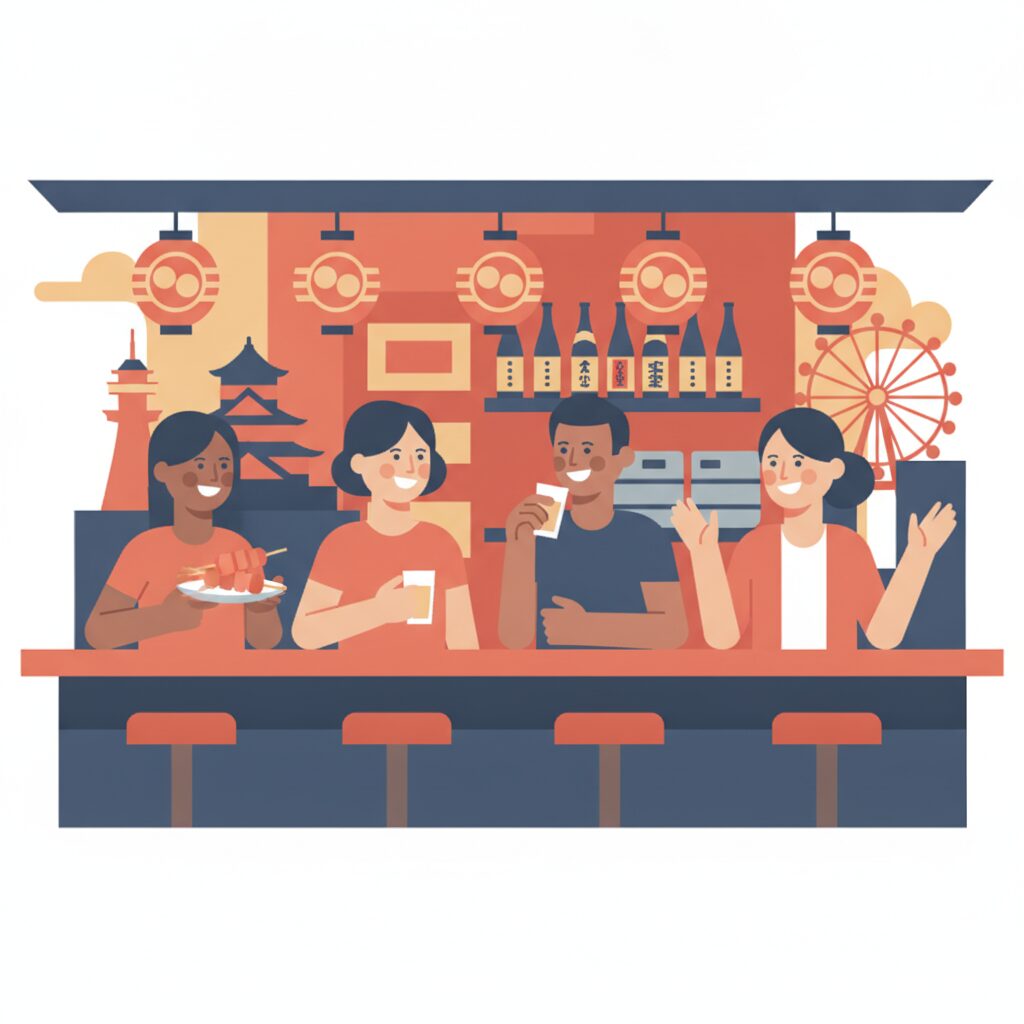
My first encounter with a proper Osaka tachinomi was in the sprawling, chaotic maze of streets around Kyobashi Station. I saw a place with no door, just a plastic curtain, overflowing with people packed shoulder-to-shoulder under the raw glare of fluorescent lights. There were no chairs. No tables, really, just a long, worn wooden counter. Everyone was standing, laughing, shouting over the sizzle of a grill and the clatter of plates. It looked less like a bar and more like a private party I’d accidentally stumbled upon. My British sensibilities screamed, “This is too crowded, too loud, there’s no personal space!” But my curiosity won. I squeezed into a tiny gap at the counter, and within five minutes, the man next to me, a construction worker still in his dusty uniform, had poured me a bit of his sake and was asking me, in booming Osakan dialect, what I thought of the Hanshin Tigers baseball team. This wasn’t just a place to get a cheap drink. This was a social engine, a community hub disguised as a bar. And understanding the tachinomi—the standing bar—is fundamental to understanding the very heartbeat of daily life in Osaka. It’s where the city’s famous friendliness isn’t just a cliché; it’s the unwritten house rule.
The energetic spirit of Osaka’s tachinomi scene is mirrored in its inventive humor, as illustrated by Osaka’s comedy code insights.
The Art of Standing Still: Demystifying Tachinomi Etiquette
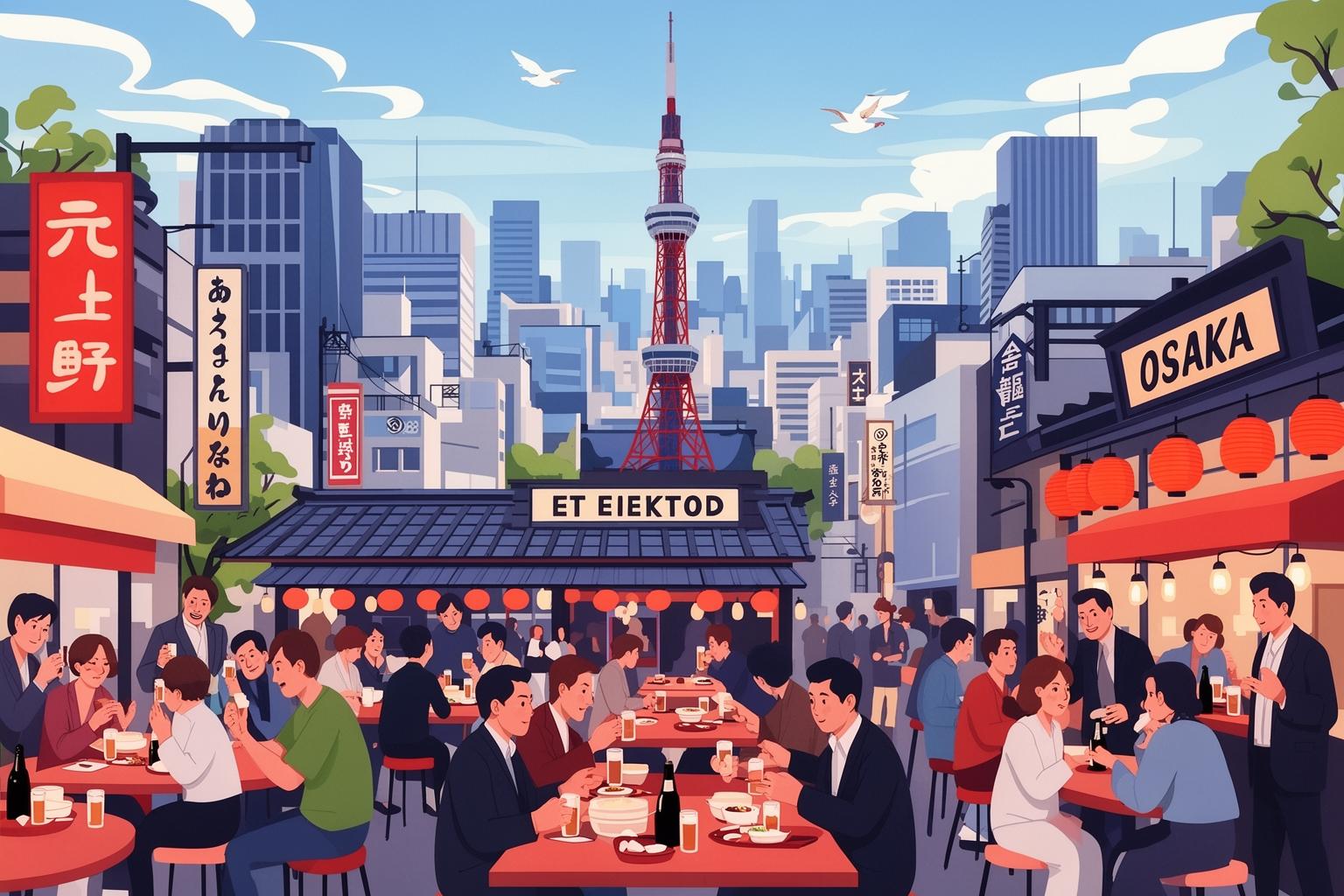
First things first: the seemingly chaotic nature of a tachinomi actually follows a distinct rhythm. The biggest obstacle for newcomers isn’t the language; it’s the fear of making a mistake. But the charm of the tachinomi lies in its notable absence of strict rules. This stands in stark contrast to the quiet, solemn temples or the formal, procedure-heavy traditions typically associated with Japan. Here, the main guideline is to be mindful of the shared space. You’re in a very small area with many people. Keep your bag at your feet, avoid spreading your arms too wide, and watch your elbows. It’s a physical expression of communal living.
Ordering is generally quick and simple. Many places use a “cash on delivery” system. You place your order with the staff behind the counter, they bring your drink and food, and you pay immediately. Often, you’ll be given a small tray or a spot on the counter to hold your money, and change is made as you go. This system is remarkably efficient. It removes the hassle of splitting bills and lets people come and go freely. You can stop by for one quick drink costing 300 yen or linger for several hours. There’s no pressure, no minimum charge, no table to reserve. You are a temporary participant in a flowing river of people.
The atmosphere is deliberately minimal. You won’t find elaborate decorations, mood lighting, or curated playlists. The focus is on three things: affordable drinks, good, simple food (called ‘ate’), and conversation. The minimalist setup acts as a great equalizer. Without physical barriers like tables and booths, social barriers fade as well. You’re literally close enough to touch the person next to you, making it almost impossible not to interact. This intentional design is a key part of what defines Osaka. It values human connection over aesthetics or comfort. It’s a philosophy that says, “We don’t need fancy furniture to enjoy ourselves. We just need each other.”
The Social Catalyst: Why Strangers Talk in Osaka Bars
If you’ve spent any time in Tokyo, you’ll know that starting a conversation with a random stranger in a bar is… rare. People usually stick to their own groups, and solo drinkers often come for quiet reflection. An Osaka tachinomi operates on a completely different social wavelength. Here, chatting with strangers isn’t just accepted; it’s practically expected. The question is, why?
Part of it stems from the city’s merchant history. Osaka was Japan’s commercial hub for centuries, a place where communication, negotiation, and quickly building rapport were crucial for survival. This heritage fostered a culture of directness and openness that remains today. People aren’t afraid to speak honestly or ask straightforward questions. In a tachinomi, this translates into genuine curiosity. “Where are you from?” “What do you do?” “Do you like Osaka?” These aren’t mere polite phrases; they are invitations to share a part of your story. Osakans enjoy a good narrative, and a foreigner in a local standing bar is an intriguing one.
Economic accessibility also plays a significant role. A beer might cost 300 yen, a plate of grilled skewers 200 yen. These low prices make the tachinomi a daily habit for many, not just an occasional indulgence. It becomes a ‘third place’—a space that’s neither home nor work—where people from all walks of life can relax. You might see a salaryman in a sharp suit standing next to a student, beside a shop owner, next to a retiree. Social status stays at the nonexistent door. This blend of people, all enjoying the same simple pleasures, creates fertile ground for spontaneous conversation. Everyone’s there for the same reason, and that shared context is an instant icebreaker. The standing format itself is key. It’s fluid. You can easily turn to the person beside you or join a conversation happening a couple of seats down the counter. The whole bar becomes a single, amoeba-like social entity.
A Tale of Two Cities: The Standing Bar in Osaka vs. Tokyo
While Tokyo certainly has its share of standing bars, the experience can be vastly different. Many Tokyo tachinomi, especially in business districts like Shimbashi or Shinjuku, are designed for speed and efficiency. They serve as quick stops for busy ‘salarymen’ to grab a drink and a bite before catching the last train home. The atmosphere often emphasizes solo drinking or quiet conversation with a single colleague. The energy tends to be more subdued and transactional. You enter, drink, and leave. While functional, these bars often lack the lively, communal spirit found in their Osakan counterparts.
In Osaka, a tachinomi is a destination in its own right. It’s a social event. The purpose isn’t just to refuel; it’s to connect. I once spent an evening in a Tenma tachinomi where a debate about the best way to make takoyaki broke out among a group of elderly men. Within minutes, the entire bar was joining in, shouting suggestions, laughing, and sharing family recipes. I was even asked for my “international perspective.” This kind of spontaneous, bar-wide engagement is the magic of the Osaka tachinomi. It’s a performance, a discussion forum, and a comedy club all rolled into one.
This contrast reflects a fundamental difference in city cultures. Tokyo is often marked by a greater sense of public anonymity and reserved politeness. It’s a city of millions where you can easily spend a whole day without speaking to a stranger. Osaka, by contrast, feels more like a network of interconnected villages. There’s an underlying assumption of familiarity. People are more inclined to engage, offer unsolicited help, or start a conversation simply because you share the same space. The tachinomi perfectly embodies this mindset: a place where shared space explicitly means a shared social experience.
From Gritty to Gourmet: The Diverse World of Osaka Tachinomi
Not all tachinomi are the same, and their diversity reveals much about the city’s food and drink culture. The classic image is a gritty, smoke-filled spot beneath the train tracks, and these places are iconic. Visit neighborhoods like Kyobashi, Tenma, or Shinsekai, and you’ll find them. They are strongholds of tradition, often run by the same family for generations. The menus are straightforward—stewed beef tendon (‘doteyaki’), kushikatsu, and inexpensive beer or shochu. These venues embody the spirit of old Osaka, unapologetically lively and warmly welcoming. They offer a glimpse into the city’s working-class origins.
However, the tachinomi concept has evolved. In central districts such as Umeda, Namba, or Kitashinchi, a newer style of standing bar has emerged. There are ‘Italian Tachinomi’ serving small pasta dishes and fine wine. You’ll also find ‘Sake Tachinomi’ with carefully curated selections of artisanal brews from across Japan, where the owner eagerly shares the story behind each bottle. There are craft beer bars and even places specializing in high-end sashimi, sliced fresh to order.
This evolution is significant. It demonstrates that the standing bar concept is not solely about affordability; it’s about adaptability and focus. By eliminating the cost and space needed for seating, these establishments can invest more in the quality of their offerings. This approach is distinctly Osakan and pragmatic: prioritize what matters most. For patrons, it means sampling top-quality food and drink without the expense or formality of a full sit-down meal. It’s a culture of accessible excellence, enabling people to cultivate refined tastes on a reasonable budget. The key social aspect endures, whether you’re enjoying 300-yen sake or a 1,000-yen craft IPA. The format goes beyond the menu.
The Tachinomi as a Window into the Osakan Soul
So, what does all this reveal about living in Osaka? It shows that this city prioritizes substance over style, and community over privacy. The tachinomi is a small reflection of the city’s character. It’s straightforward, efficient, unpretentious, and profoundly human. It demonstrates that in Osaka, social barriers are challenges to be broken down, not honored. Your age, job title, or nationality mean far less than your willingness to share a laugh with the person beside you.
Foreigners often come with the stereotype of Japan as a place of reserved, indirect communication. Osaka, especially through the tachinomi, happily shatters that assumption. Living here means adapting to a different social rhythm. People will strike up conversations on the train. The lady at the corner shop will ask about your day. And if you step into a tachinomi, you will probably leave with a new friend or at least a memorable story.
This isn’t to say Osaka is without its complexities, but its public culture embraces participation. The tachinomi serves as a training ground. It teaches openness, sharing your space, and finding joy in the simple, fleeting connections of daily life. It reminds you that a city is more than its buildings and landmarks; it’s the sum of countless small interactions between its people. And in Osaka, many of the best moments happen while standing at a modest wooden counter, sharing a drink with a stranger who soon won’t be one. It’s the city’s living room, and everyone is welcome.