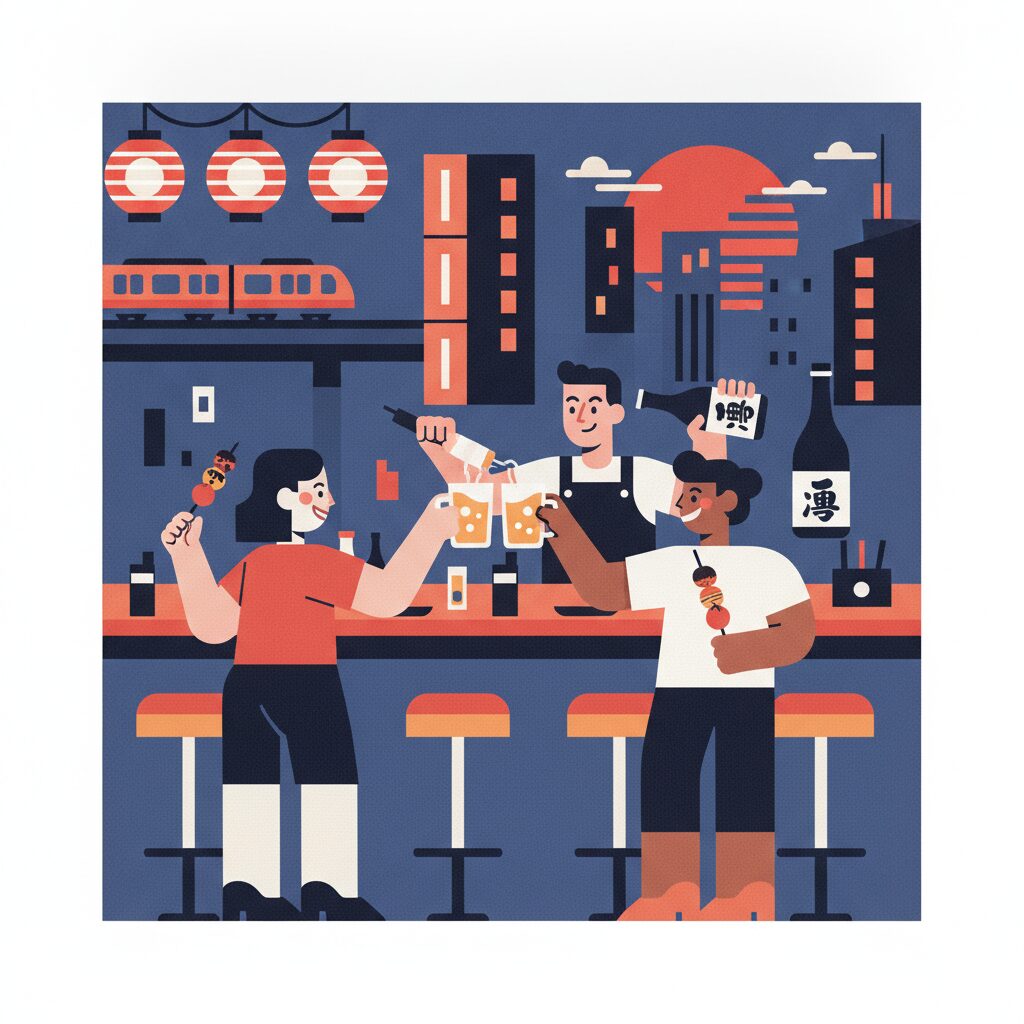
You see them everywhere, once you know what to look for. Tucked into the arteries of a covered shotengai, nestled on a quiet corner in a residential neighborhood, or standing bold under the rumble of an elevated train line. From the outside, it looks like any other neighborhood liquor shop, a `sakaya`. Walls of sake bottles, coolers humming with beer and chuhai, shelves packed with snacks. But listen closely. Past the sliding door, you hear it—the low murmur of conversation, the sharp clink of glasses, a sudden burst of laughter. Step inside, and the scene unfolds. In a small, cleared-out space, often no bigger than a walk-in closet, a handful of people are standing shoulder-to-shoulder around a makeshift counter, drinking. This isn’t a bar. This isn’t just a store. This is `kaku-uchi`, and it’s one of the most undiluted, authentic expressions of Osaka’s soul you’ll ever find. It’s a concept that often confuses outsiders. Is it a pre-drink spot? A place for alcoholics? A private club? The truth is, it’s a uniquely Osakan third space, a social pressure valve built on a foundation of commerce, community, and pure, unadorned pragmatism. To understand kaku-uchi is to understand the city’s rhythm, its priorities, and the unwritten rules that govern daily life far from the tourist trails.
For an even broader look at Osaka’s raw urban charm, delving into Osaka’s kairanban culture reveals another vibrant facet of the city’s social fabric.
The Unspoken Code of the Counter
Walking into a kaku-uchi for the first time feels like crashing a party you weren’t invited to. The regulars, the `joren-san`, seem to communicate on a silent, shared wavelength. But the system is ruthlessly straightforward, ruled by an unwritten code of efficiency. There’s no host, no menu, no music. The first rule is that you’re a retail customer before you’re a drinker. You head to the cooler and grab a beer. You browse the shelves and pick up a can of mackerel in miso or a small bag of dried squid. You bring your choices to the shopkeeper, the `taisho`, who rings you up as if you were buying groceries. Once paid, you gain access to the drinking area.
This is where the second set of rules comes into play. Many kaku-uchi use a cash-on-the-counter system. You’ll notice a small woven bamboo tray, a `zaru`, on the counter. You place a 1,000 yen bill in it, and as you order, the taisho deducts the cost. It’s a system built on trust and speed. No fumbling for wallets with each round. It keeps the pace flowing. And flow is everything. A kaku-uchi is not somewhere to linger. It’s a pit stop. The average visit lasts twenty, maybe thirty minutes. Enough time for a large bottle of Kirin and a quick chat. It’s a punctuation mark in the day—a pause after a hard day’s work, a brief stop before heading home. This embodies a core Osaka mindset: get in, get it done, get out. No wasted time, no unnecessary ceremony. The space itself reflects this. It’s cramped. You’ll be elbow-to-elbow with a stranger. There’s an unspoken agreement to minimize your footprint, not spread your belongings, and be mindful of the shared, limited space. A slight nod of the head acts as both greeting and apology for the inevitable bump. It’s an intimate dance of communal living in miniature.
Why Kaku-uchi is Pure Osaka Soul
To truly grasp kaku-uchi, you need to understand that Osaka was founded by merchants. This is `shonin no machi`, the city of traders, and that commercial spirit permeates everything. Kaku-uchi is the ultimate creation of merchants. For the shop owner, it’s brilliant—you sell your own stock at retail price without any overhead costs for a kitchen, extra staff, or fancy decor. You both move product and cultivate customer loyalty at the same time. For the customer, it represents the peak of `kosupa`, or cost performance—a concept deeply valued in Osaka. You drink at store prices, not bar prices. There’s no cover charge, no service fee. It’s the most economically efficient way to have a drink and share a moment of social connection.
This contrasts sharply with Tokyo. While Tokyo has its share of `tachinomi`, or standing bars, they often feel like a deliberate stylistic choice. They’re designed to be standing bars, typically with a curated menu, a distinct brand identity, and a younger, trendier crowd. They represent a concept. An Osaka kaku-uchi is quite the opposite. It lacks a concept. It’s a liquor store that, through pure practicality, created a space for drinking. The function—selling and consuming alcohol—shaped the form, not vice versa. You won’t find craft cocktails or artisanal cheese plates here. Instead, you’ll find cans of Asahi Super Dry, single-serving sake, and shelves lined with instant ramen. The charm of a kaku-uchi lies not in its design but in its authenticity. It is what it is and makes no apologies for it. This pragmatism extends to its social role. It acts as a great equalizer. A construction worker in dusty clothes can stand beside a bank employee in a crisp suit, both enjoying the same beer and commiserating over the Hanshin Tigers’ latest loss. Titles and social status are checked at the door. Within the tight space of the kaku-uchi, you’re simply another person grabbing a quick drink. This mirrors Osaka’s generally flatter, less formal social hierarchy compared to Tokyo’s more stratified environment.
Navigating Your First Kaku-uchi Experience
Finding a kaku-uchi means you need to recalibrate your senses. You’re not searching for a stylish facade or a welcoming sign. Instead, you’re looking for a functioning liquor store. Watch for the tell-tale markers: stacks of empty beer crates outside, a faded `noren` curtain hanging over the entrance, a warm yellow light spilling from a doorway that feels busier than a typical shop. Places like Kyobashi, Tenma, and the hidden streets of Nishinari are rich territory, where these establishments are embedded in the community’s fabric.
Your first visit might feel intimidating. The regulars may give you a brief, curious glance. The taisho could appear gruff, busy organizing shelves or managing a delivery. The key is to move with quiet confidence. Walk in, offer a slight nod, and head straight to the coolers. Don’t hesitate. Choose a familiar beer—Kirin, Asahi, Sapporo. For a snack, start with something simple and sealed, like a can of tuna or a bag of persimmon seed crackers. Bring it to the counter. The transaction serves as your initiation. A simple “Okanjo, onegaishimasu” (The bill, please) or just placing the items on the counter will do. Once paid, find an open spot at the drinking counter. Pour your beer. Take a sip. You’re in.
The food is a vital part of the experience, precisely because of its simplicity. Don’t expect a culinary revelation. The menu is the store itself. The pleasure comes from the straightforward, perfect pairing of a cold drink with a salty, savory snack requiring no preparation. Canned mackerel simmered in soy sauce, smoked oil sardines, canned yakitori, a block of cold tofu with a splash of soy sauce from a shared bottle on the counter. It’s honest, unpretentious sustenance. This embodies the Osaka mindset: why complicate things? Why build a full kitchen when a perfectly good can of food already exists? It’s a celebration of the ready-made, a tribute to efficient satisfaction.
The Language of the Standing Counter
Eavesdropping in a kaku-uchi is like an accelerated lesson in raw, unfiltered Osaka-ben. The language flows faster, is more musical, and much more direct than standard Japanese. You’ll frequently hear the repeated phrase “Maido!”—a merchant’s greeting meaning something along the lines of “Thanks, as always, for your business!” Conversations unfold as a rapid-fire volley of jokes and friendly jabs, a style of verbal sparring that is central to Osaka communication. It’s not aggressive; rather, it signals closeness. People skip small talk about the weather and jump straight into the heart of matters—complaining about work, celebrating minor victories, or dissecting a baseball game.
As a foreigner, you stand out, and that can be your greatest advantage. While in a quiet Tokyo bar your presence might be politely overlooked, in an Osaka kaku-uchi, it often sparks interaction. Don’t be surprised if the person beside you, after a few minutes of silent observation, turns and asks, “Doko kara kitan?” (Where’d you come from?). This isn’t an interrogation but genuine, straightforward curiosity emblematic of the local spirit. Osaka locals enjoy the unexpected and breaking the daily routine, and a foreigner trying to grasp their world is prime conversation material. Your best approach is to remain open and modest. A smile, a simple answer, and an attempt to ask a question back—even in broken Japanese—can open the floodgates. You’ll learn more about the real concerns and joys of the city’s working people in twenty minutes here than in a year of polite, formal exchanges.
What Kaku-uchi Teaches You About Living in Osaka
Ultimately, a kaku-uchi is more than simply a spot to drink. It serves as a living classroom for grasping the essence of Osaka. It teaches the significance of community—not in some lofty, abstract way, but through the everyday reality of sharing cramped spaces. It’s about learning to read the atmosphere, to make yourself small when necessary, and to offer a bit of your counter space to a newcomer. This practical lesson in coexistence applies equally to life on Osaka’s packed trains and busy streets.
It ingrains a deep, enduring respect for value—distinct from cheapness. Osakans are famously discerning consumers, and a kaku-uchi thrives because it delivers an unbeatable balance of price, quality, and social reward. This mindset influences how people shop, eat, and live in the city. It’s about maximizing every yen and every minute. Perhaps most importantly, kaku-uchi champions authenticity over aesthetics. In a world increasingly polished, curated, and filtered for public display, the kaku-uchi remains unapologetically genuine. The harsh fluorescent lights, hand-scrawled prices, and worn-out counters are all marks of pride. They represent a place comfortable in its own identity, valuing substance over style. For anyone seeking to truly understand what life in Osaka is like—beyond tourist spots and official stories—the answer awaits. It’s standing in a liquor store corner, under buzzing lights, with a cold beer in one hand and a can of fish in the other.