The first time you walk into a Super Tamade, your senses get a shock. It’s not like the other Japanese supermarkets. There are no serene wood-paneled walls, no gentle instrumental music, no politely curated pyramids of perfect fruit. Instead, you’re hit by a wall of fluorescent yellow. Blinding, unapologetic, pachinko-parlor yellow. Flashing neon lights that would feel more at home in Dotonbori line the ceilings, casting a strange glow on everything. The music isn’t a calming melody; it’s a relentlessly upbeat, slightly tinny jingle that burrows into your brain and stays there for days. Signs aren’t printed in elegant fonts; they’re scrawled in thick, black marker, screaming prices that seem impossibly low. A pack of tofu for 19 yen. A bento box for 250 yen. A single croquette for a price that feels like a rounding error. Your first thought, as a foreigner accustomed to the quiet order of most Japanese retail, might be one of deep suspicion. Is this place real? Is this food safe? And why is everything so… loud? But if you stick around, push your cart through the crowded aisles, and watch the people around you, you’ll realize you haven’t just walked into a grocery store. You’ve walked into the heart of Osaka. This isn’t just where Osaka shops. This is a living, breathing expression of how Osaka thinks.
Beyond the sensory overload and bright chaos of Super Tamade, Osaka’s dynamic sense of humor—evident in its signature boke and tsukkomi interactions—offers yet another glimpse into the city’s unapologetically vibrant soul.
The Merchant’s DNA: The Philosophy of an Osaka Supermarket
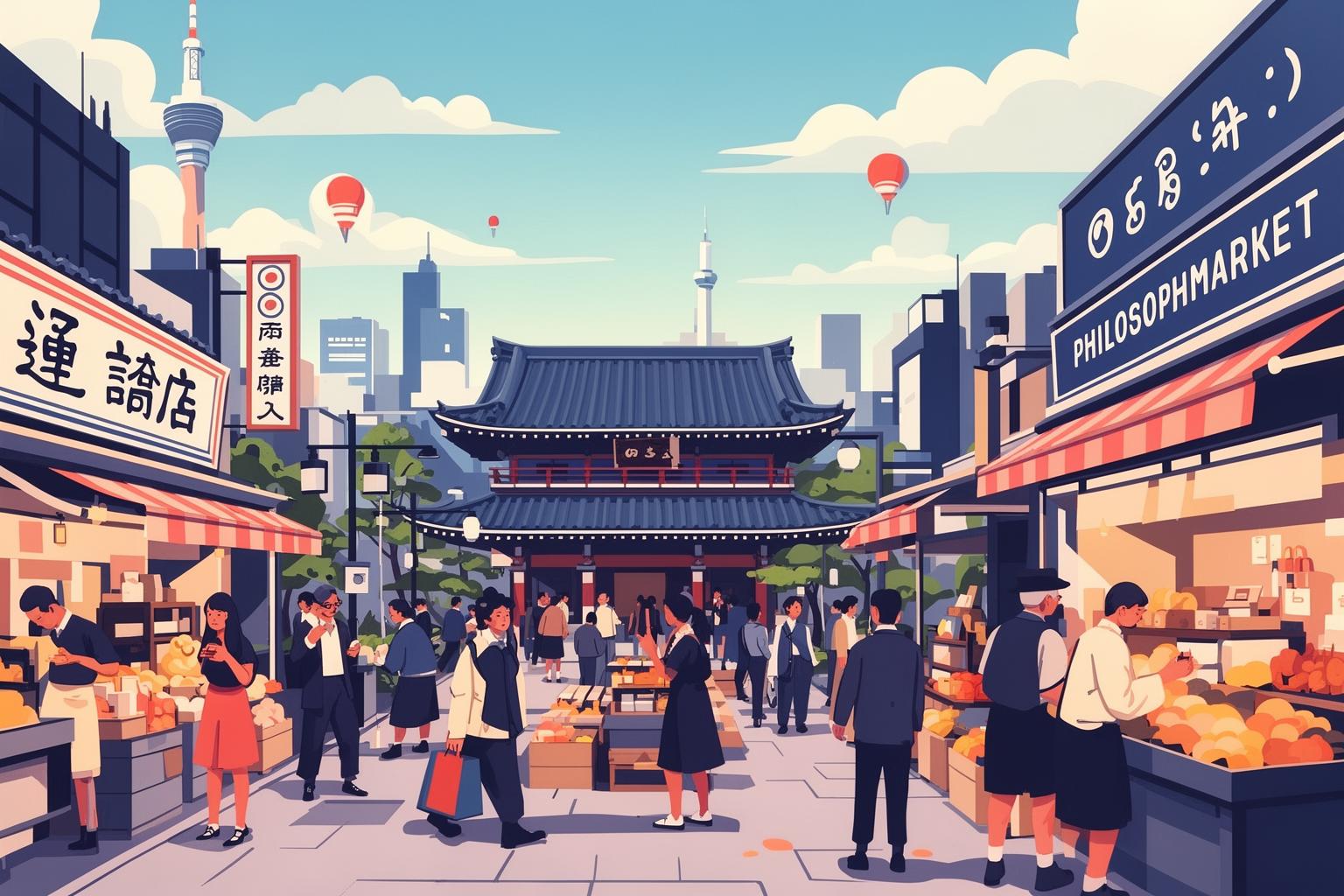
To truly understand a place like Tamade, you need to grasp the history of Osaka. This city has always been known as Akindo no Machi, the City of Merchants. For centuries, it stood as Japan’s commercial center—a hub where goods were exchanged, fortunes were built, and the idea of value was honed to perfection. It earned the nickname Tenka no Daidokoro, the Nation’s Kitchen, because rice and other essential goods from across the country passed through here. This history is not just something found in books; it’s ingrained in the local mindset. While a Tokyoite might pay extra for elegant packaging or a prestigious brand, an Osakan is culturally conditioned to look beyond the wrapping and ask, “What’s the real value here?”
This leads us to the key term in the Osaka dialect related to shopping: kosupa. It’s short for “cost performance,” but that phrase feels too clinical. Kosupa embodies a philosophy, a challenge, and a deep sense of personal pride. Achieving good kosupa doesn’t mean you’re cheap; it means you’re savvy. You’ve outsmarted the system and gotten the best possible return on your hard-earned yen. When an Osakan scores a kilogram of chicken thighs at an unbelievably low price, the reaction isn’t just relief—it’s triumph. They’ll eagerly share their victory with neighbors, wearing it as a mark of honor.
Super Tamade is the shrine of kosupa. The chaotic decor, the flashing lights, the handwritten signs—all deliberately crafted to send one clear message: we have eliminated all unnecessary expenses to offer you the absolute lowest price. There’s no pretense here. You’re not paying for a “shopping experience” in the modern marketing sense. You’re paying for the food, and nothing more. The bold yellow and red color scheme isn’t a design mistake; it’s a statement. It shouts “BARGAIN” in a way that no minimalist, beige-walled store ever could. The store communicates: “We invest in price cuts, not in interior designers.” And the people of Osaka hear this message loud and clear—and they love it.
An Orchestra of Chaos: Navigating the Aisles
Shopping at Tamade is a full-sensory experience. It’s an onslaught on your senses that, once familiar, settles into an almost comforting rhythm. You quickly learn to navigate the beautiful chaos.
The Sights
Your eyes dart constantly, with no calm, logical flow. Instead, you face towering heaps of products. Onions aren’t lined up neatly; they’re piled in a giant bin you have to dig through. Cabbage heads stack high on tables, each one varying in size and shape. The famous 1-yen sales are quite the spectacle. Of course, there’s a catch—you usually need to spend 1,000 yen first to qualify for a single 1-yen item. But the psychology behind it is brilliant. It transforms a regular shopping trip into a treasure hunt. Shoppers often rearrange their entire list just to hit the 1,000 yen mark and claim their prize, whether it’s a can of coffee or a packet of instant noodles. The signs, often laminated and reused, focus purely on function. Big, bold numbers convey everything. There are no flowery descriptions or brand stories. The price is the narrative.
The Sounds
Underneath the constant jingle, the store has its own distinct soundtrack. There’s the rhythmic beep-beep-beep of cash registers working at a pace that feels twice as fast as anywhere else. A booming staff voice echoes over the PA, announcing fresh fried chicken in the prepared foods section—“Ima dekitate no chikin wa ikaga deshou ka!” (How about some freshly made chicken!). Then there are the shoppers themselves. The musical cadence of the Osaka dialect rings out everywhere. Friends bump into one another and ask, “Hona,なんぼやった?” (So, how much was it?), holding up their purchases. A constant, low-level murmur of bargaining and comparison fills the air. It’s a communal environment, not a silent hall of consumption.
The Smells and The Main Event: Souzai
The air carries a complex blend of scents. Near the entrance, you smell the earthy aroma of root vegetables. Deeper inside, the salty ocean scent of fresh fish takes over. But the true heart of Tamade, especially in the evening, is the prepared foods corner, the souzai section. This is where the magic happens. The aroma of frying oil, sweet soy sauce, and steaming rice is intoxicating. Here, you’ll find an incredible variety of bento boxes, fried cutlets (katsu), tempura, grilled fish, and salads, all at prices that defy logic. As evening deepens, the real event begins. A staff member appears with sheets of discount stickers—20% off, 30% off, and finally, the prized 半額 (hangaku), 50% off. A quiet, respectful crowd gathers, circling like hawks. There’s no pushing or shoving, but an intense, unspoken competition. The moment a sticker is placed, a hand shoots out to grab the prize. Scoring a 50% off tonkatsu bento for under 200 yen feels like hitting the jackpot.
The Cast of Characters: A Shopper’s Theater
This daily drama features an outstanding cast, with the undeniable star being the Osaka obachan (a familiar term for a middle-aged or older woman). She is far from a passive consumer—she is a logistics expert, a quality control specialist, and a master strategist. Arriving with her foldable shopping cart, her eyes scan for deals like a predator. She picks up a daikon radish, weighs it in her hand, gives it a firm tap, and inspects it from every angle before determining if its kosupa is acceptable. She knows exactly which day eggs go on sale and the precise time when bread is marked down. As the keeper of the household budget, she wields her power with precision and pride.
Foreign residents often mistake this straightforwardness for rudeness, but it is not—it’s efficiency. Both shoppers and staff are focused. The cashiers at Tamade exemplify speed, with less of the deep, formal bowing common in Tokyo department stores. The interaction is brief, transactional, and direct. They scan your items quickly, state the total, take your money, and have you on your way in seconds. There is a shared, unspoken understanding: everyone is here to be efficient and save money. Time isn’t wasted on unnecessary formalities. This is a form of respect for everyone’s time and purpose. There is warmth in this approach, but it’s a pragmatic warmth, grounded in a shared community goal.
The Foreigner’s Dilemma: Decoding “Cheap”

For many newcomers to Japan, particularly those from Western countries, there is a deeply rooted belief: if something is this cheap, it must be defective. Is it nearing its expiration? Is it of low quality? This is one of the biggest misconceptions about Osaka’s food culture. The key to understanding it lies in Japan’s sophisticated system for food dating and Osaka’s expertise in using it.
Food packaging typically shows two important dates. The first is the 消費期限 (shouhi kigen), or “use-by” date, which applies to highly perishable items like raw meat, fresh bento boxes, or sandwiches. These must be consumed by the listed date. The second, more common date is the 賞味期限 (shoumi kigen), or “best-before” date, seen on products like yogurt, eggs, snacks, and canned goods. This indicates the date until which the item maintains its optimal flavor and quality. It is not an expiration date—these foods remain safe and edible long afterward.
Supermarkets such as Tamade excel in logistics, operating under a high-volume, low-margin strategy. They have well-developed systems to track products approaching their shoumi kigen and quickly move them by drastically reducing the price. This practice is not about selling inferior food but about avoiding waste of good food. It embodies the Japanese concept of mottainai (a feeling of regret over waste), transformed into an ingenious business approach. From my perspective as someone from China, this resonates strongly, reflecting the spirit of a lively wet market where freshness and smart consumption matter, and nothing good is discarded. An Osakan doesn’t view a carton of milk a day past its shoumi kigen sold at half price as a risk, but as a perfectly fine product, a great bargain, and a smart way to fight food waste. It’s a shift from interpreting price as a quality marker to seeing it as a sign of a clever system.
A City of Specialists: The Supermarket Ecosystem
While Tamade may be the most well-known, it isn’t the only option. The savvy shopper in Osaka doesn’t show loyalty to a single store; rather, they are loyal to finding the best deals. This dynamic creates a lively supermarket ecosystem, where many people practice hashigo (laddering), visiting multiple stores in one shopping trip to gather the ideal, most cost-effective assortment of groceries.
Your journey may begin at Gyomu Super (“Business Supermarket”). Originally catering to restaurants, it is now open to the public and reigns supreme for frozen goods and bulk purchases. You visit here for a huge bag of frozen gyoza, a liter of soy sauce, or a large block of cheese. The prices are incredibly low because of the volume you buy.
Next, you may stop at a mid-range, everyday supermarket such as Mandai or Life. These are the “typical” stores—cleaner, more organized, and offering a broader range of brands than Tamade. Prices are fair, and this is where you might pick up your weekly staples, meat, and household necessities.
But you reserve a special visit for Super Tamade. You go to Tamade for the excitement. You go for the loss leaders—astonishingly cheap eggs, milk, or tofu meant to draw you in. You go for the 1-yen sale. And you go for the souzai section when you don’t feel like cooking. It’s not your all-in-one store; it’s your strategic advantage in the battle for kosupa.
This behavior uncovers a fundamental aspect of life in Osaka. Living here means having a strategy. It’s about being an active participant, not a passive consumer. You don’t simply go to “the supermarket.” You have a plan. You understand the strengths and weaknesses of each store, using that insight to your benefit. It’s a deliberate and thoughtful approach to living.
Why It All Matters: The Supermarket as a Cultural Guide
Ultimately, you can gain more insight into Osaka’s soul from spending an hour at Super Tamade than from a week of touring temples and castles. The city’s true essence isn’t solely found in its famous landmarks; it lies in the ordinary, daily routines of its people.
The supermarket unveils a culture that is deeply pragmatic, unpretentious, and theatrical. It’s a place where substance triumphs over style, every single time. It reflects a community that values cleverness, resourcefulness, and a collective passion for a good bargain. It captures the difference between Osaka and Tokyo better than any travel guide. While Tokyo may emphasize harmony, order, and refined presentation, Osaka thrives on lively, friendly, and functional chaos. There is a straightforwardness and honesty here that might seem rough around the edges but is truly just free of pretense.
So, if you’re new to Osaka or trying to understand it, my advice is simple. Forget what you think you know about Japanese supermarkets. Take a deep breath, step into the neon yellow glow, and let the chaos envelop you. Watch the obachan examine the cabbages. Listen to the cashier’s rapid-fire greeting. Grab a 250-yen bento for dinner. In this noisy, dazzling, and utterly unique jungle of bargains, you’ll discover the truest expression of this city’s incredible spirit. You’ll realize that in Osaka, scoring a great deal on groceries isn’t just about saving money—it’s about engaging with the life of the city itself.