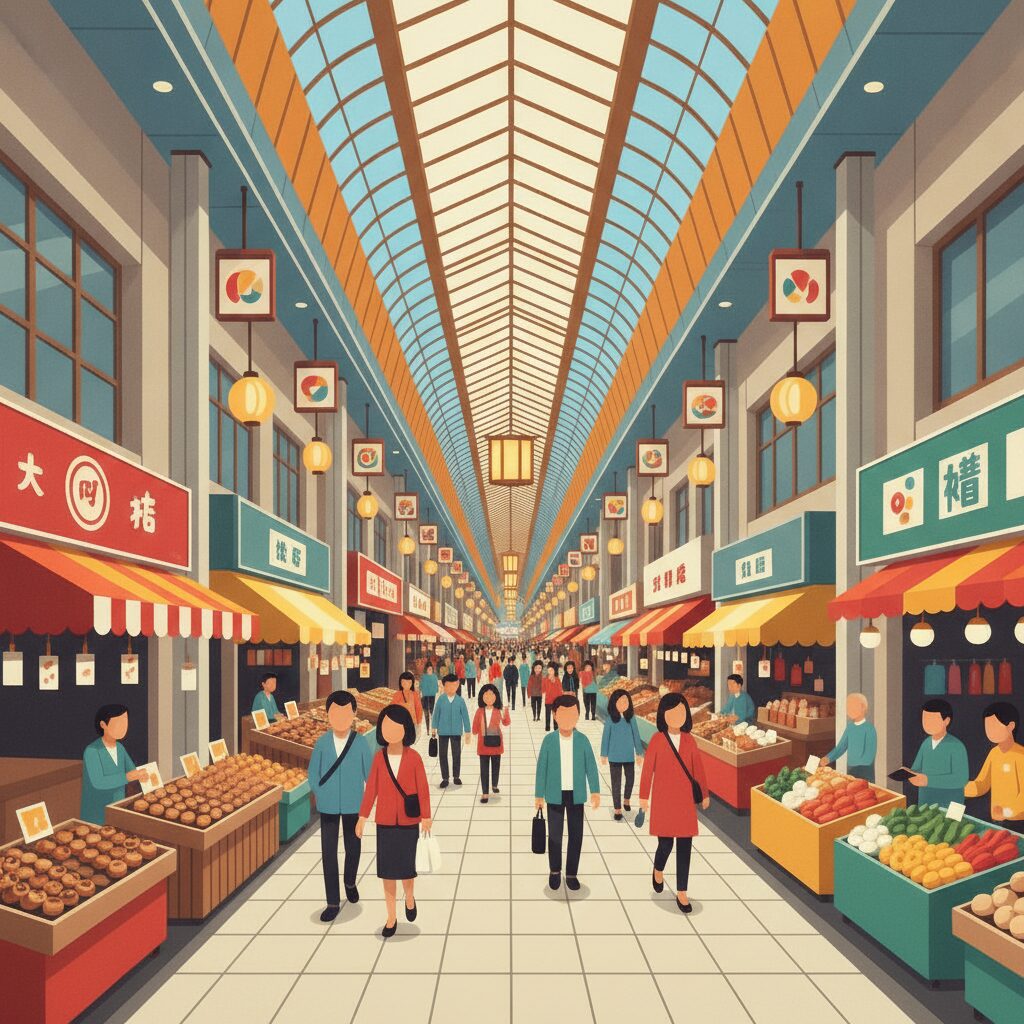
Forget the glossy brochures. Forget the sleek, silent efficiency you might associate with Japan. To understand Osaka, you first need to understand its arteries. They aren’t highways or subway lines. They’re the shotengai, the covered shopping arcades that pulse with a messy, vibrant, and profoundly human energy. Living next to one isn’t just a matter of convenience; it’s a full-immersion baptism into the city’s soul. In Tokyo, your neighborhood might be defined by a train station and the nearest high-rise. Here, it’s defined by the sizzle of a takoyaki stand, the hypnotic chant of the vegetable seller, and the clatter of a thousand bicycles parked at jaunty angles. This isn’t just a place to buy your groceries. It’s the community’s living room, its kitchen, and its main stage, all rolled into one. Choosing to live on its doorstep is choosing to live your life in public, set to a soundtrack of commerce, conversation, and the constant, rhythmic hum of a city that never truly sleeps. It’s a world away from the curated perfection of a Tokyo department store. This is life, unedited and unapologetic.
Amid this relentless urban pulse, some locals unwind with an Osaka sentō digital detox that perfectly balances the lively shotengai experience.
The Unspoken Social Contract of the Arcade
Living in a shotengai means you’re inherently part of an unspoken agreement. The rules are straightforward but essential. This space isn’t anonymous or purely transactional; it’s a network of relationships, and you’re expected to find your place within it.
More Than Just a Transaction
In Tokyo, a store clerk’s “Irasshaimase!” is a sharp, professional greeting. It’s polite, efficient, and clearly separates customer from staff. In an Osaka shotengai, you’ll hear a robust “Maido!” or “Maido, maido!” This is more than just “welcome.” It loosely means “thank you for your continued patronage” or “thanks, as always.” It assumes a relationship. It conveys, “I know you. You were here last week. You’ll be back next week.” The first time, it seems like a simple greeting. By the tenth time, you realize it’s recognition of your role in the community. You’ve moved beyond being just a customer; you’re now a regular. This status brings a different kind of interaction. The butcher pauses to tell you the pork from Kagoshima is especially good today. The fishmonger directs you away from pricey tuna to a fresher, cheaper cut of mackerel, suggesting it’s perfect for grilling. They’re not merely selling goods; they’re sharing their expert advice. This level of service comes from familiarity, not corporate training. It’s the foundation of Osaka commerce: trust built through countless small exchanges.
The Art of the Chat: Your Daily Language Lesson
This relationship-driven commerce requires your active engagement. You can’t just point, pay, and leave. You’re expected to participate in the ritual of conversation. It often begins with the classic Osaka business greeting, “Mokarimakka?” (Making money?). The usual response is a wry smile and “Bochi bochi denna” (So-so, getting by). This isn’t a sincere question about finances; it’s a verbal handshake, a way to maintain social bonds. For a foreigner, this can be both a gift and a challenge. If you’re learning Japanese, it’s an unparalleled, consistent practice ground. You’ll be gently corrected on pronunciation, asked where you’re from, and quizzed about what you’re cooking for dinner. But if you’re introverted or weary after a long day, this obligatory small talk can feel draining. Being a silent observer isn’t an option. Inaction is noticed. Staying quiet or distant isn’t read as polite reserve, as it might be elsewhere in Japan; it can be seen as cold or aloof. The famed “friendliness” of Osaka isn’t passive—it’s an invitation to engage. They’re friendly with the expectation you’ll be friendly in return. They offer a hand, and you’re expected to shake it.
The Rhythm of the Day: Perks of Proximity
Once you adjust to the social demands, the practical advantages of arcade life become unmistakable. Your daily routine aligns with the rhythms of the shops, offering a convenience that surpasses what a 24-hour convenience store can provide.
The Freshest Food, The Best Advice
Living next to a shotengai transforms your entire approach to food. The idea of a big, weekly supermarket trip becomes outdated. Why buy a sad, plastic-wrapped pack of vegetables when you can purchase exactly two perfect tomatoes, still warm from the sun, from the elderly woman at the fruit stand? Your day begins with the aroma of baking bread from the corner bakery, a scent that signals 7 AM more reliably than an alarm clock. Lunchtime arrives with the sizzle and sweet soy sauce fragrance from the yakitori stall. By late afternoon, the croquette stands are bustling, offering an affordable, delicious snack beloved by every local. This isn’t just about freshness; it’s about specialization. You don’t buy tofu from a supermarket; you buy it from the tofu maker, who offers five different kinds and patiently explains which is best for Agedashi and which suits Miso soup. You get your tea from a tea expert who can speak at length about harvest seasons. This rich well of knowledge is freely offered, part of the experience. It turns a simple errand into a moment of learning and connection.
An Ecosystem of Everyday Life
The shotengai is a complete, self-sustaining community. It’s an ecosystem that meets nearly every need. That unusual battery for your old camera? The dusty electronics shop has it. Need a specific type of screw? The cluttered hardware store owner will find it in minutes. Need a hemline adjusted? The tiny alterations shop, run by a woman who’s been sewing for sixty years, will fix it while you wait. Nestled among butchers and bakers are small clinics, traditional barbershops, cramped bookstores, and quiet kissaten coffee shops where elderly men read newspapers for hours. This dense network of specialized, small businesses creates a strong sense of place. You’re not just living in a random apartment block; you are part of a village, a self-contained unit where human-scale problems have human-scale solutions. It’s a tangible connection to a past when communities provided for themselves, a sharp contrast to the anonymous, car-dependent sprawl of many modern cities.
The Noise and the Neighbors: The Pitfalls of Proximity
Naturally, living in the midst of the action comes with its costs. Despite all its charm and convenience, the shotengai can overwhelm the senses, and the close-knit community has a side that can feel intrusive.
There’s No “Off” Switch
The arcade’s life extends beyond business hours. The day begins early, before 6 AM, with the rumble of delivery trucks and the metallic screech of shutters being raised. Then come the greetings called out across the alley, morning announcements played over a tinny PA system, and the endless repetition of the arcade’s theme song. It never stops. On weekends, the background noise intensifies into a full-blown roar of crowds, festival music, and vendors hawking their goods through megaphones. If you cherish silence and solitude, this is your personal hell. The sensory overload is not just auditory. It’s also olfactory. The enticing aroma of grilled eel is delightful for five minutes, but less so when it has permanently infused your curtains. You live in a constant stew of smells: frying oil, sweet red bean paste, fresh fish, and the faint incense scent from the tiny shrine nestled between two shops. It is unrelenting, and there is no refuge.
The Goldfish Bowl Effect
The very community that provides support and advice also ensures constant, unavoidable scrutiny. There is no anonymity. The woman at the vegetable stand will notice if you look tired. The butcher will ask why you’re purchasing chicken again when you just bought some on Tuesday. If a new person visits your apartment, the entire arcade will know by noon. This is the “goldfish bowl” effect. Your life is on display, and your routines are well known. This can offer a sense of security—your neighbors will definitely notice if something is wrong. But for a foreigner accustomed to urban anonymity, it can feel suffocating. It challenges the Western idea of privacy. Here, privacy can be equated with secrecy, and secrecy often breeds mistrust. This relates to the Japanese cultural concept of uchi-soto (inside/outside). As a resident, you occupy a gray area. To become part of the uchi (the in-group), you must fulfill your role as a good neighbor: you shop, you chat, you engage. If you keep to yourself, you remain soto (an outsider), and your actions, or lack of them, will be noticed and discussed. It’s a communal pressure that can feel deeply uncomfortable until you learn how to navigate it.
Shotengai Mindset: The Soul of Osaka Commerce
To live by a shotengai is to absorb the essence of the Osaka mindset through osmosis. The arcade embodies the city’s commercial spirit: practical, straightforward, and fiercely independent.
Pragmatism over Polish
Contrast a typical Osaka shotengai with a stylish Tokyo shopping area like Ginza or Omotesando. Tokyo focuses on presentation, branding, and flawless aesthetics. The experience there is carefully curated and refined. An Osaka shotengai is its exact opposite. It prioritizes substance over style. Shops often appear cluttered, signs are hand-painted, and the lighting serves only a practical purpose. This isn’t a sign of failure; it reflects a different set of values. The Osaka merchant, the akindo, cares about one thing: offering a good product at a fair price. The extras don’t matter. This pragmatism is part of the city’s character. Osaka residents are known for their directness. They will honestly tell you if they think you’re making a mistake or getting a bad deal. This can be surprising for those used to Tokyo’s more indirect, nuanced communication style, but it stems from practicality, not ill will. Why waste time on pleasantries when you can get straight to the point? The shotengai teaches you to value not the shiny exterior, but the quality within.
A Living Museum vs. A Modern Mall
Many shotengai feel like stepping back into the Showa Period (1926-1989). This isn’t a contrived retro theme; it’s the result of continuity. That rice cracker shop isn’t designed to look old; it has been run by the same family in the same location for seventy years. This commitment to tradition and stability is a core part of the arcade’s charm. It stands in stark contrast to the hyper-modern, ever-changing environment of a shopping mall, where stores are replaced every few years based on market trends. Living here means embracing a different pace of life. It means carrying cash because the old tobacconist doesn’t accept credit cards. It means knowing the butcher closes precisely at 5 PM, no exceptions. It’s a trade-off. You give up some modern convenience for something far rarer: a sense of permanence and authenticity. In a world that values disruption and novelty, the shotengai is a resilient, beautiful link to the past, reminding you that not everything needs reinventing.
Is Arcade Living Right For You?
Choosing a home next to a shotengai is less about a real estate choice and more about embracing a lifestyle. It offers an invitation to experience Osaka in its most raw, intimate, and unfiltered form. However, it’s not suitable for everyone.
Who Thrives Here
You’ll thrive in the arcade environment if you’re an extrovert or someone who deeply desires genuine community. It’s perfect for language learners eager to be pushed out of their comfort zones daily. Food lovers looking to build connections with those who produce their meals will find paradise here. If you prioritize character over conformity and are willing to sacrifice some polish for a great deal of soul, you will feel at home. This lifestyle suits those who want to experience the city’s pulse firsthand, not just watch from afar.
Who Might Struggle
Conversely, living near a shotengai may be difficult if you are a private person who values anonymity. If you are sensitive to noise, odors, and constant close human contact, this environment can quickly feel overwhelming. People who prefer the convenience of online shopping, one-stop supermarkets, and predictable chain stores often get frustrated by the irregular hours and cash-only policies. If the thought of daily, spontaneous social interactions with neighbors fills you with anxiety, you might want to look elsewhere. Life by a shotengai demands a certain surrender—a readiness to embrace the messy, vibrant, and demanding nature of arcade living as your own.