The descent from the rugged ridges of Mount Kongo is always a quiet, meditative experience. For hours, you hear nothing but the crunch of hiking boots on loose gravel, the wind shifting through ancient cedar trees, and the occasional call of a mountain bird. But the moment you step off the local train back into the heart of Osaka, that serene silence shatters. The transition from the isolated wild to the relentless, neon-drenched urban sprawl is jarring. Yet, as an outdoor enthusiast who calls this city home, I find a strange parallel between navigating a narrow mountain pass and navigating the chaotic, joyous alleys of Osaka at night. Both require spatial awareness. Both require respect for the environment. And both demand a clear understanding of unwritten rules. When the sun goes down, the true spirit of Osaka does not hide in high-end cocktail lounges or quiet, private dining rooms. It spills out onto the pavement. It lives and breathes in the tachinomi.
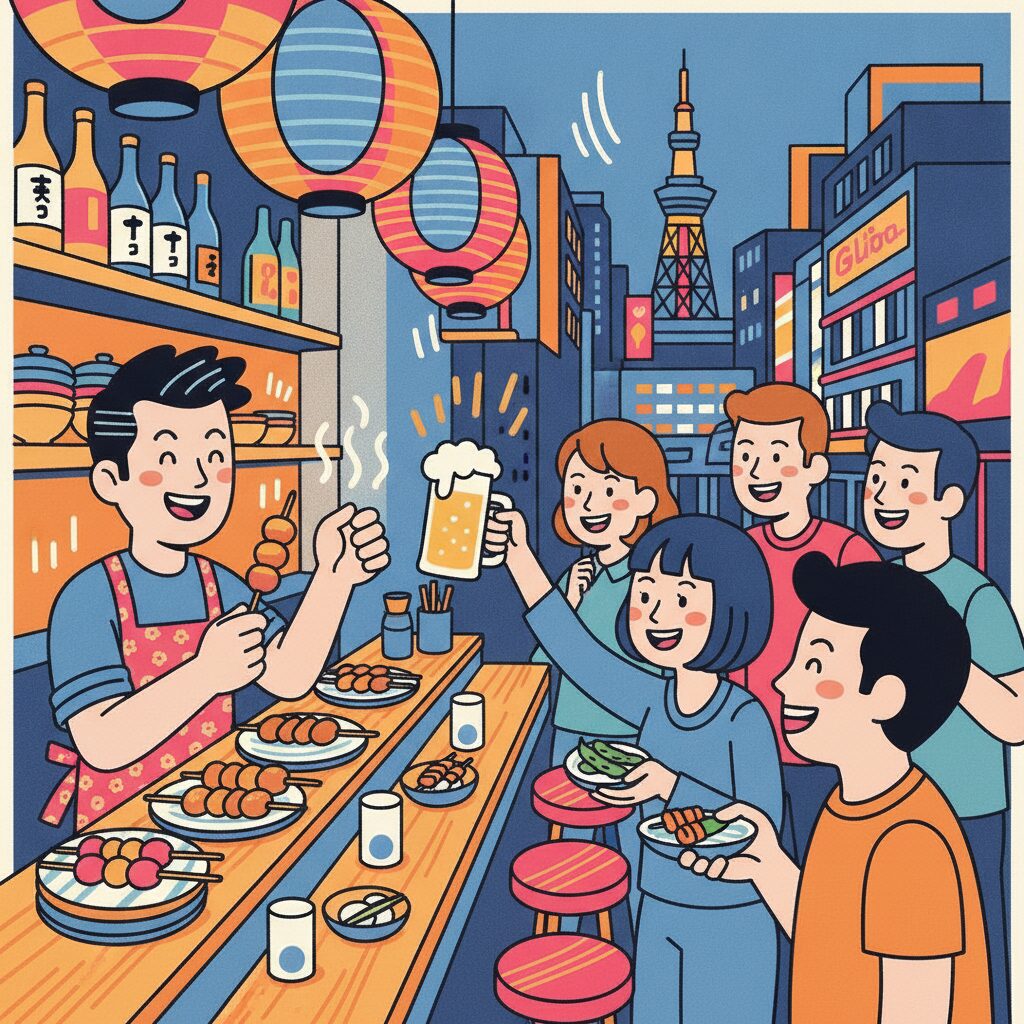
A tachinomi, quite literally a “standing drink” establishment, is exactly what it sounds like. It is a bar without chairs. For many foreign residents, expats, and newcomers trying to piece together the reality of daily life in Osaka, these tiny, crowded bars look like impenetrable fortresses of local culture. They are loud. They are impossibly cramped. The menus are often handwritten on greasy slips of paper taped to the walls, heavily relying on local slang. It is easy to walk right past them, opting instead for the safety of a familiar chain restaurant with a digital ordering tablet. But to ignore the tachinomi is to ignore the beating heart of Osaka. This is where the city drops its professional facade. This is where construction workers, corporate executives, artists, and neighborhood grandmothers stand shoulder-to-shoulder, sharing cheap plates of braised beef tendon and oversized mugs of draft beer. Understanding how to walk into one of these bars, how to order, and how to interact with the people inside is the ultimate crash course in Kansai culture. If you can master the standing bar, you can master life in Osaka.
Why Osaka is Japan’s Ultimate Tachinomi Destination
Tokyo has standing bars. Fukuoka has standing bars. However, the culture of tachinomi in Osaka feels fundamentally different from anywhere else in Japan. To understand why, one must consider the historical and psychological foundation of the city. Tokyo historically is a city of samurai and bureaucrats, built on strict hierarchy, decorum, and the preservation of public harmony through respectful distance. In Tokyo, polite society requires giving people privacy—you pretend not to hear the conversation next to you and keep your eyes forward.
In contrast, Osaka is a city of merchants. For centuries, it has been known as the kitchen of the nation, driven by the “Akindo” (merchant) spirit. In a merchant city, distance is bad for business. Everyone is a potential customer, partner, or at least a captive audience for a good joke. The culture here values warmth, humor, and direct communication over rigid formality. This mindset permeates every inch of a local standing bar.
The layout of a tachinomi physically reflects this Osaka philosophy. There are no private booths or physical barriers to hide behind. You are drawn into the immediate orbit of strangers. In a city proud of “Kuidaore”—the concept of eating and drinking until financial ruin—the standing bar serves as daily training ground. The tachinomi is not just a place to consume alcohol; it is a vital social equalizer. Men in tailored business suits stand next to mechanics in paint-splattered overalls. Because no one sits, everyone shares the same physical and social level. The pretension of the outside world is checked at the door. If you live in Osaka and want to know how locals really think and feel about current events, local politics, or the latest baseball game, you do not read the newspaper. You stand at the counter and listen.
Step-by-Step Tachinomi Etiquette: How to Drink Like a Local
Stepping into a standing bar for the first time is like merging onto a high-speed highway. The pace is swift, the rhythm already set, and hesitation can cause a traffic jam. However, the evening follows a very clear and logical sequence. Master this sequence, and you’ll seamlessly blend in, transforming from a bewildered outsider to a respected regular.
Entering and Finding Your Space
You approach the entrance, often just a pair of heavy plastic vinyl curtains designed to block the winter wind and trap the smell of deep-fried food inside. You pull the curtains aside and are immediately hit by a wave of noise. A blast of heat, cigarette smoke, and loud Kansai dialect washes over you. Looking in, the bar appears completely packed. Not just busy, but stuffed to the breaking point. Your first instinct might be to turn away and leave. Resist that urge.
In Osaka, “full” is a relative term. Creating space out of thin air is a local superpower. Stand at the entrance and catch the eye of the master behind the counter or a floor staff member. Hold up the number of fingers matching your party size. If you’re alone, just raise one finger and nod slightly. This simple first interaction is key. The master will survey the room, shout an order, and suddenly, the crowd will part. Patrons will shift their plates slightly to the left or turn their shoulders. A tiny, seemingly impossible gap will open at the corner of the wooden counter.
Walk straight to that opening. Offer a quick, polite nod to those you’re squeezing past. A simple “sumimasen” (excuse me) suffices. Slide into your spot—you’ve officially entered the circle.
The Golden Rule: Always Order a Drink First
You’re now at the counter. The menu taped to the wall is a confusing collection of kanji characters you might not fully recognize. You may be hungry and tempted to figure out which meat skewer to try first. Stop. Focus on the bartender. You must order a drink immediately.
This is the golden rule of the Japanese standing bar. Tachinomi bars operate on high volume and fast service. The staff needs to confirm you as an active, paying customer the moment you claim your spot at the counter. Asking for a food menu or pausing for several minutes to decide disrupts the flow of service.
The easiest and most universally accepted way to start is by saying “Toriaezu nama,” which roughly means, “For now, a draft beer.” This phrase is the magic password in the Japanese drinking world. The master nods, grabs a large glass mug, pulls the tap, and slams a cold beer in front of you within ten seconds. If you don’t drink beer, a highball (whiskey and soda) or a lemon sour (shochu, soda, and lemon) works just as well.
Having a drink in your hand immediately serves two purposes. First, it respects the master’s time and workflow. Second, it instantly makes you look at ease. Standing empty-handed in a crowded bar makes you appear like a lost tourist, while holding a cold beer signals you belong. Once your drink is in front of you, the pressure is off—you can now relax, sip your beverage, and slowly work your way through the food menu.
Navigating the Payment Systems (Cash on Delivery vs. Pay at the End)
Payment in a tachinomi can be a source of anxiety for newcomers, largely because these bars often reject modern conveniences. While much of Japan is shifting toward smartphone payments and credit cards, traditional Osaka standing bars remain staunchly cash-based. There are usually two payment methods, and it’s important to recognize which one is in use right away.
The first, iconic among older Osaka establishments, is the “Cash on Delivery” (COD) system. When you take your place at the counter, you’ll notice a small plastic bowl, woven tray, or shallow wooden dish placed right in front of you. This little container acts as your personal bank account for the duration of your visit. You put a few thousand-yen bills and some coins from your wallet into it.
When your draft beer arrives, the bartender doesn’t give you a bill. Instead, they reach into your bowl, take out five hundred yen, and drop a fifty-yen coin back as change. When your plate of grilled chicken skin comes, the bartender dips into the bowl again. This is a very tactile, honest transaction. You watch your physical cash decrease as your food intake rises. When you’re ready to leave, whatever money remains in the bowl goes back into your pocket. If the bowl empties, you either add more money or head home. This system is brilliant because it eliminates the need for complex bill calculations at closing, speeding up turnover.
The second method is the standard “Pay at the End” system. If there’s no bowl, the staff keeps a running tally of your orders on a slip of paper under your plate or via a digital point-of-sale device. When you finish, simply cross your index fingers to form an “X” and say “Oaiso” (check, please), or just gesture to the bartender.
Regardless of the system, keep your credit cards out of sight. Bring cash—specifically thousand-yen bills and one-hundred-yen coins. Flashing a ten-thousand-yen note to pay for a four-hundred-yen drink is considered bad manners. It forces the bartender to empty their cash register for change, slowing the entire operation.
Unwritten Rules of the Standing Bar
The physical environment of a tachinomi is a fragile ecosystem that requires everyone’s cooperation to maintain balance. Just as hikers follow specific etiquette when passing each other on steep mountain trails to prevent accidents, standing bars have spatial and temporal rules to ensure everyone enjoys themselves without encroaching on others.
Respecting the Shared Space and Managing Luggage
In Osaka, space is an incredibly precious resource. After a weekend hike in the Rokko mountains, I often carry a heavy, rough canvas backpack. Bringing it into a tachinomi calls for careful planning. You cannot place your bag on the counter—it is sacred territory reserved solely for food, drinks, and sometimes an elbow resting. Nor can you leave your bag on the floor behind you, as the aisles barely allow sideways passage; a stray backpack creates a tripping hazard for staff juggling hot soup trays and glass bottles.
Take a look around you. Beneath the edge of the wooden counter, there are usually small metal hooks. Hang your bag there. If you have a jacket, there may be hangers on the wall behind you, but be careful that it doesn’t drape over the person next to you. If hooks are absent, look for a small folding basket near the wall to place your belongings. Keep your footprint as minimal as possible. Tuck in your elbows while eating. Avoid spreading your phone, wallet, and keys all over the counter—claim only the space you absolutely need. When someone tries to squeeze past you toward the back, naturally shift forward, press your stomach against the counter, and let them by. It’s a subtle, ongoing dance of spatial awareness.
The “Chotto Ippai” Philosophy: Don’t Overstay Your Welcome
Japanese drinking culture has a specific phrase: “Chotto ippai,” meaning “just a quick drink.” This is the guiding principle of the tachinomi.
A standing bar is not a lounge, nor is it a venue to celebrate major anniversaries or engage in lengthy philosophical debates with friends. It’s a pit stop—a place to move quickly from workday stress to evening relaxation. You come in, have one or two drinks, eat a few skewers or a small bowl of potato salad, and then leave.
Lingering is strongly discouraged. Profit margins on a 300-yen glass of shochu are razor-thin. The bar’s survival depends on high volume and rapid turnover. If you’ve finished your drink and food but are just standing around staring at your phone, you’re costing the bar money by occupying space that a paying customer could use. The unspoken rule is to limit your visit to about 45 minutes, or an hour at most. Once your glass is empty, pay your bill and head out. If you want to drink more, embrace the true Osaka style: walk down the street to another standing bar. Bar hopping, or “hashigo-zake” (ladder drinking), is the correct way to spend an evening here.
Tap Water Taboos and Tipping Culture
Certain behaviors immediately mark you as an outsider who doesn’t respect the local system. One of the biggest offenses is asking for free tap water without ordering anything.
In a typical Japanese restaurant, receiving a glass of ice water, called “ohiya,” is standard and free. But in a tachinomi, the rules differ. You occupy a highly contested space in a place that sells cheap alcohol. Asking for free tap water without ordering a paying drink is essentially taking up space for free and is viewed as very rude. If you’re the designated driver or don’t drink alcohol, you must order a non-alcoholic beverage that costs money—like oolong tea, ginger ale, or cola—and pay around 300 yen. This is your “rent” for standing at the counter. Once you have a paid drink, it’s perfectly acceptable to ask for a small glass of water on the side to stay hydrated.
Finally, one rule that applies to all of Japan applies even more strongly here: do not tip. Tipping doesn’t exist in Osaka. No matter how excellent the service was or how cheap the bill felt, leaving change on the counter will only cause confusion. The bartender will assume you forgot your change and might leave their post to chase you down the street to return a fifty-yen coin. The best way to show appreciation in a tachinomi is to eat quickly, drink with enthusiasm, say a loud “Gochisousama deshita” (thank you for the meal) when leaving, and come back again next week.
Osaka-Specific Vibes: Interacting with the Locals
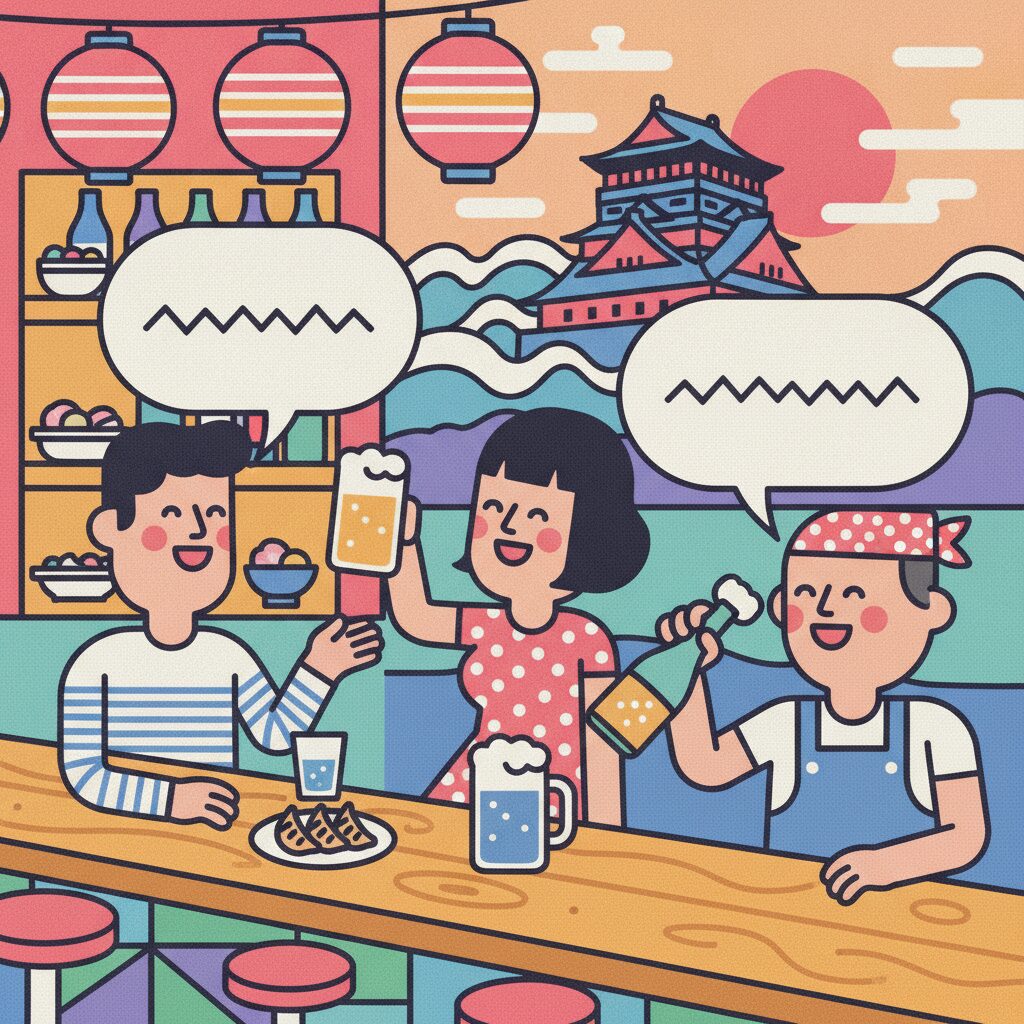
If you follow the basic rules—tuck your elbows in, order quickly, pay in cash, and don’t linger too long—you’ll survive the tachinomi experience. But to truly appreciate it, you need to understand the people of Osaka.
As a foreigner living in this city, you stand out. At a standing bar in Tokyo, locals might likely ignore you, assuming that interacting could make you uncomfortable or that the language barrier would be too difficult. They politely act as if you aren’t there. In Osaka, ignoring someone is seen as cold. Here, acknowledging your presence is the highest form of respect.
Don’t be surprised if the older gentleman beside you, a local “Ochan” with a face flushed from hot sake, suddenly turns to you and starts chatting. He might speak in a thick, rapid Kansai dialect and ask very direct questions: “Where are you from? What do you do for work? How much is your rent? Are you married?” In many Western cultures, this kind of questioning from a stranger would be intrusive and rude. In Osaka, it’s the greatest sign of friendliness. They’re not trying to pry; they’re trying to connect. They’re genuinely curious how someone from another country ended up standing next to them in a smoky Tenma alley.
Embrace this interaction. Fluency in Japanese isn’t necessary. A few words, a smile, and willingness to engage will go a long way. Locals appreciate it when you try their dialect. Instead of the usual Japanese “Arigatou” for thank you, say a localized “Ookini.” Watch their faces light up.
Often, this friendly exchange leads to unexpected generosity. Sharing food is deeply rooted here. It’s common for older women, the famed “Obachan” of Osaka, to carry hard candies (Ame-chan) in their purses and press them into strangers’ hands. In tachinomi bars, this spirit turns into shared dishes. The man beside you might order a huge plate of fried garlic, realize he can’t finish it, and push half your way. He might wave down the bartender and point to your empty glass, indicating he’s buying your next beer.
When this happens, accept graciously. Don’t refuse out of politeness. Rejecting food or drink in an Osaka bar can dampen the cheerful atmosphere. Accept the beer, raise your glass, say “Kanpai” (cheers), and take a long sip. If you want to return the favor, order a small, inexpensive dish like edamame or pickled cucumbers and share it with them. But usually, nothing is expected in return. They simply want to make sure the person beside them is enjoying themselves. This lively, boundary-crossing warmth defines daily life in Osaka. It’s a city that embraces you physically—whether you want it or not.
Quick Checklist: Essential Dos and Don’ts for Tachinomi Beginners
Navigating your first few standing bars can be daunting. Keep this practical checklist in mind before you step past the vinyl curtains.
- Do bring plenty of small cash: Thousand-yen bills and one-hundred-yen coins are essential at the bar. Keep the large ten-thousand-yen notes and credit cards stashed away.
- Do order a drink right away: Say “Toriaezu nama” (draft beer for now) as soon as you find your spot. Establish yourself as a paying customer before checking out the food.
- Do control your physical presence: Hang your bags on hooks under the counter. Keep your elbows tucked in. Make room for people passing by.
- Do join the local conversation: If someone talks to you, smile and engage. Expect direct, personal questions. Accept offered food or drinks with thanks.
- Do leave when you’re done: Follow the “chotto ippai” spirit. Eat, drink, and free up space for the next weary worker.
- Don’t put luggage on the counter: The counter is only for food and drinks. Placing a dirty bag on the eating surface is a serious breach of etiquette.
- Don’t order only free tap water: If you occupy space at the counter, you must order a paying drink. If you don’t drink alcohol, order soda or tea.
- Don’t stay too long: Don’t pull out a laptop. Don’t spend hours chatting over empty glasses.
- Don’t leave a tip: Tipping is not customary and may confuse or distress the staff.
Conclusion: Step Up to the Counter with Confidence
Living in Osaka means letting go of rigid expectations about how a city should function and embracing the messy, loud, and deeply human reality of how this unique city thrives. The tachinomi perfectly captures this reality in a microcosm. Yes, the unwritten rules around space, the order of requests, and cash payments can feel intimidating at first. It’s easy to feel like an outsider peering through smoky glass.
Yet, the charm of Osaka lies in its welcoming nature. The standing bar isn’t an exclusive club; it’s a public haven for the soul. The moment you step inside, follow basic respect, and order your first beer, you stop being a tourist or a puzzled expat. You become part of the nightly rhythm of the city.
So next time you’re walking home from the station and hear the clatter of plates and the roar of laughter beneath a glowing red lantern, don’t just pass by. Check your pockets for a few thousand yen. Part the curtains, raise one finger to the master, slide onto the counter, order your drink, and let the warmth of Osaka envelop you. The city is ready to speak with you.