
You have polished your Japanese. You have memorized the intricate rules of corporate etiquette. You know exactly how many degrees to bow when exchanging business cards with a new client. Yet, stepping into a corporate environment in the heart of Osaka can feel like walking onto a completely different stage. The air is charged with a different kind of electricity. Conversations fly across the room at breakneck speeds. Laughter erupts continuously from the sales department. A senior manager might playfully slap a subordinate on the shoulder while delivering critical feedback. For many foreign professionals, this sudden exposure to the vibrant, unapologetic culture of the Kansai workplace is deeply disorienting. Standard textbooks simply do not prepare you for the realities of the merchant city. The rigid, silent harmony often associated with Japanese corporate life feels distinctly absent here. In its place, you find a dynamic ecosystem driven by humor, blunt pragmatism, and fiercely guarded personal relationships.
For those of us coming from other parts of East Asia, where strict Confucian principles often dictate corporate structures, this local dynamic can feel deeply counterintuitive. We are trained to read the air. We are taught to protect the face of our superiors at all costs. We measure our words with microscopic precision to avoid any semblance of conflict. Yet, in the commercial hubs of Kansai, maintaining extreme professional distance is often viewed with suspicion. You are expected to bring your human self to the desk. True harmony in this region is not the absence of friction. True harmony is the ability to argue passionately about a project, correct a superior’s mathematical error without hesitation, and then go out for skewers and beer an hour later as if nothing happened. The transition requires a massive psychological shift.
This article is your roadmap to mastering that shift. It is not about tourist destinations or popular street food. It is about decoding the everyday reality of making a living in this bustling metropolis. We will explore how local colleagues think, speak, and collaborate. We will dissect the nuances of regional communication styles. We will analyze the tension between maintaining formal respect and engaging in casual, rapid-fire banter. We will uncover why traditional rules of corporate hierarchy are sometimes bent, though never entirely broken, in the relentless pursuit of good business. By understanding the underlying psychology of the local workforce, you can transition from being an outsider to an integrated, highly respected member of the team. This is your guide to surviving and thriving amid the unique energy of Japan’s most animated commercial engine.
Understanding Osaka’s Unique Business Culture
The Importance of Building Personal Relationships
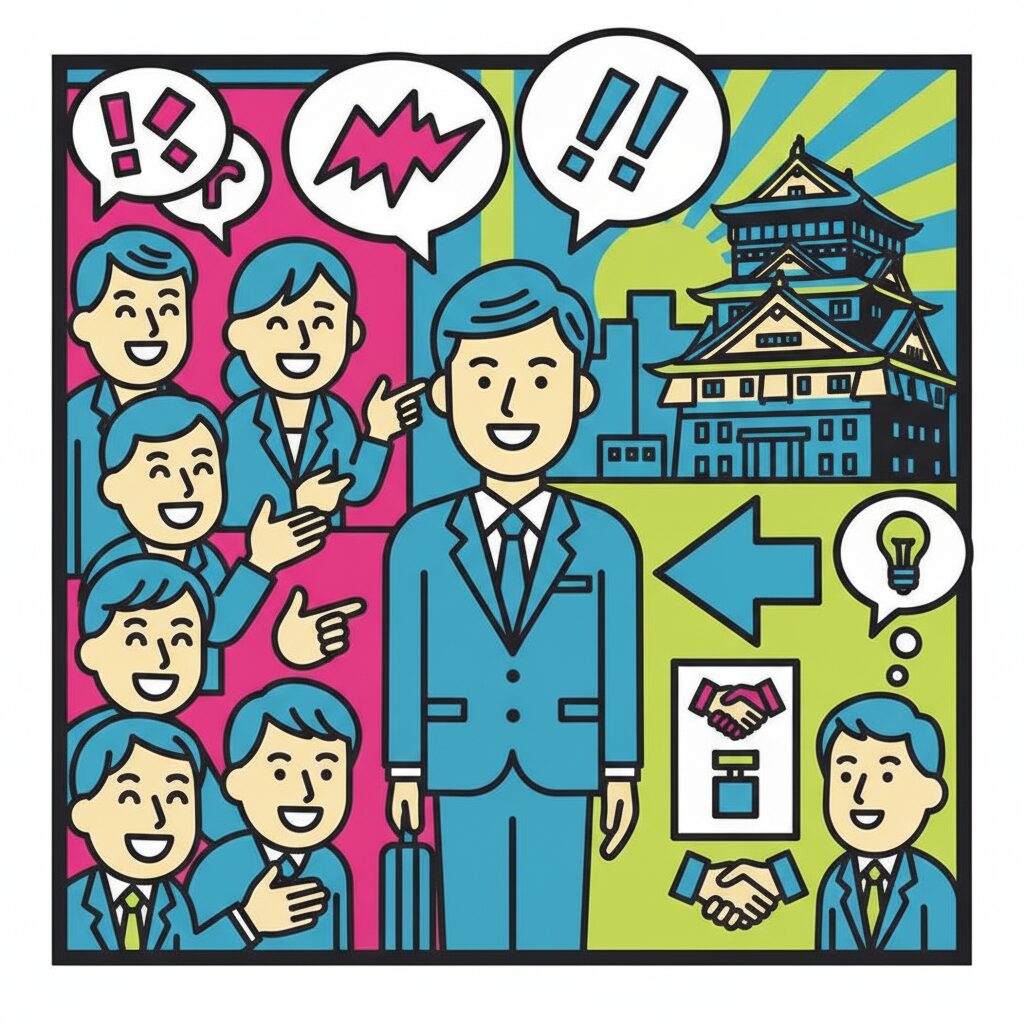
To grasp the corporate mindset in this region, you first need to understand its long, rich history. For centuries, this city functioned as Japan’s commercial kitchen. It was a merchant town governed not by the rigid codes of the samurai, but by the practical, everyday demands of trade. This historical background deeply influences the modern office environment. In many traditional corporate settings, authority is derived solely from rank, with titles demanding instant, unquestioned compliance. However, in the merchant city, trust is the most valuable currency. Your colleagues want to see who you are beyond your job title. They continually assess your character, reliability, and warmth as a person.
Building relationships here requires genuine openness. It involves stepping away from the heavy shield of professional formality. When local colleagues ask seemingly personal questions about your weekend plans, family life, or favorite local foods, they are not violating professional boundaries. Instead, they are extending a hand. They aim to establish a foundation of human connection before moving on to purely transactional business matters. For foreign professionals accustomed to strict separation between work and personal life, this approach can feel unexpectedly intrusive and necessitates a shift in personal boundaries.
Yet, resisting this integration can unintentionally convey aloofness or arrogance. Embracing these personal questions is crucial. Showing genuine interest in their lives builds a strong base of loyalty. When deadlines tighten and pressure rises, it is this personal bond that will support you. A local manager will go to great lengths to assist a colleague they truly like and understand. They will not extend the same effort for someone who remains distant and formal. Investing time in building human connections is the smartest business strategy you can employ in this region.
Humor and Banter in the Workplace
Humor is far from a distraction in the local corporate culture; it is a vital, finely honed tool for social ease. It helps relieve tension during high-stakes negotiations, softens the impact of critical feedback, and fosters camaraderie across strict hierarchical boundaries. The comedic interaction often follows a traditional duo format deeply embedded in regional culture. One person takes the role of the fool, making an absurd remark or obvious mistake, while the other plays the straight man, quickly highlighting the absurdity with a sharp, witty comeback. This dynamic unfolds regularly in serious meeting rooms and casual break areas alike.
Understanding this conversational flow is essential. A manager might purposefully propose an absurd budget suggestion, waiting for a junior employee to correct them in an exaggerated tone. If a colleague makes a self-deprecating joke or teases you lightly about a minor error, responding with stiff formality disrupts the flow. It creates an awkward silence that kills collaborative energy. You don’t need to become a professional comedian to thrive here; you simply need to read the room effectively.
Recognizing when a comment is a joke and responding with a warm smile or lighthearted acknowledgment shows you resonate with the local cultural vibe. It signals that you’re not a rigid professional operating by rote but a flexible, adaptable person. Engaging in light, contextual banter is often seen as a mark of high emotional intelligence in this region. It demonstrates you can handle intense work pressure without losing your humanity. Embrace the laughter—it is a sign of acceptance.
Osaka vs. Tokyo: Key Differences in Corporate Communication
The contrast between the capital city and the merchant city is striking and immediately apparent. In the capital, business communication is marked by extreme caution and measured silence. People carefully “read the air,” relying heavily on subtle non-verbal cues to sense consensus. Direct confrontation is avoided at all costs. Decision-making proceeds deliberately, with strict adherence to formal procedures. The main goal is to preserve surface harmony, even if it means concealing the truth or delaying necessary action. It is a culture focused on careful maintenance.
Communication in the Kansai region operates on a completely different wavelength. The pace is much quicker, and the language is unapologetically direct. If a proposal is flawed, a local manager is likely to point it out immediately using blunt terms that might shock someone trained in conventional corporate Japanese. They do not soften rejections with layers of polite apologies. This directness should never be mistaken for hostility or personal dislike. It represents pure merchant pragmatism. Time is money, and avoiding critical issues is seen as wasteful and disrespectful.
For foreign workers, this bluntness is a significant strategic advantage. You spend far less time guessing your boss’s true meaning. Expectations are clearly laid out. You know exactly where you stand and what must be improved. In return, you are expected to communicate your own challenges, obstacles, and disagreements with equal transparency. Concealing problems to save face is considered a serious breach of trust. Learning to deliver and accept blunt truths is the foundation of efficiency in the local market.
Navigating Osaka-ben (Kansai Dialect) in the Office
Common Osaka-ben Phrases You Will Hear at Work
Osaka’s local dialect is everywhere throughout the city. Even in very formal business environments, regional expressions naturally slip into daily corporate conversations. Developing a strong passive understanding of this linguistic landscape is essential to keep up with the rapid pace of meetings and informal instructions. The dialect functions almost like its own operating system, with unique vocabulary and rhythmic timing. One of the most frequently used words is Akan, which simply means no, impossible, or useless. When a senior colleague glances at a spreadsheet and mutters Akan, it signals that the current approach is failing. It’s a quick, decisive rejection that leaves no room for doubt.
Another key phrase often heard in office corridors is Maido. Traditionally employed as a warm greeting among local merchants, it roughly translates to thank you for your continued patronage. Salespeople might say it when closing a call, or it could be casually expressed when acknowledging a favor from a coworker. It carries a warmth rarely found in standard Japanese greetings. When asked how a tough project is progressing, a common culturally appropriate response is Bochi-bochi, meaning so-so or slowly but surely. This reflects a humble, grounded attitude toward success, avoiding arrogance while recognizing steady, dependable progress.
You will also frequently encounter the word Shoumonai, which means boring, trivial, or useless. When an idea is labeled Shoumonai in a brainstorming session, it’s more than just a dismissal of the data—it’s a cultural critique indicating the concept lacks cleverness, usefulness, or practical value. Understanding the strong emotional nuances of these regional words gives you a significant strategic edge. It helps you detect subtle emotional undertones in conversations that typical language textbooks overlook, allowing you to hear the rhythm behind the words.
Should Foreign Professionals Speak Osaka-ben?
Many foreign professionals feel a strong urge to adopt the local dialect, seeing it as a fast, clever shortcut to deep cultural integration. However, this temptation must be approached with great caution. The dialect is highly nuanced, relying on precise intonation, exact rhythmic timing, and appropriate context. Poor usage or using it in unsuitable professional settings can come across as mocking, overly familiar, or simply strange. It can quickly undermine the professional respect you’ve spent months building.
The safest and most effective strategy is to aim for complete passive fluency. Train your ear to fully understand what’s being said, but default to standard Japanese when speaking. This creates a comfortable, balanced dynamic where your local colleagues feel free to express themselves naturally in their dialect, while your consistent use of standard Japanese maintains a firm baseline of professional respect. You become a steady, reliable presence amid the regional energy.
Dropping a well-chosen regional word now and then during casual lunches or after-hours drinks can be charming and show your cultural awareness. But in serious meetings, formal presentations, and high-stakes negotiations, stick firmly to the language you know well. Let your colleagues speak as locals while you remain the highly adaptable, universally understood professional. This boundary protects your authority while honoring their culture.
Balancing Standard Japanese (Keigo) with Local Flavor
Mastering the complex interplay between formal honorifics and regional casualness is an art form. Standard honorific language, or Keigo, is crucial for showing respect to superiors, important clients, and senior colleagues. Yet overly rigid, mechanical adherence to textbook Keigo can create an unnatural, cold distance in workplaces that value warmth and approachability. The goal is to find the perfect subtle balance, projecting competence and respect without becoming stiff or unapproachable.
Watch your senior colleagues closely. Notice how they easily switch between formal, complex language when addressing clients and a much softer, colloquial tone when speaking with internal team members. This seamless shift in language style is key. You can strike the same balance by mastering polite standard Japanese while adopting the physical and conversational rhythms of the region. This is where the magic lies—you align your energy with the room without sacrificing professional language.
Engage in active listening: nod enthusiastically and offer verbal affirmations that match the speaker’s high energy. You can speak in perfectly structured, impeccably polite Japanese while delivering it with the genuine warmth, sustained eye contact, and slightly faster pace characteristic of the Kansai region. This subtle approach shows profound respect for the hierarchical structure while demonstrating your appreciation of local spirit. It is the ultimate expression of cultural fluency.
Practical Communication Strategies for Foreign Workers
Clarifying Instructions and Overcoming the Language Barrier
The rapid delivery of complex instructions in a thick regional accent can overwhelm even advanced Japanese speakers. Misunderstandings are almost inevitable during the initial months. The most common mistake many foreign professionals make is pretending to understand in order to save face. In a culture intensely driven by merchant pragmatism and efficiency, hiding a lack of understanding is viewed as a serious professional offense. It inevitably leads to errors, wastes valuable time, and permanently damages trust.
Accept the blunt directness of the environment. If an instruction is unclear, pause the conversation immediately. Request specific clarification without hesitation. You can politely express your confusion by stating that you want to ensure complete accuracy for the success of the project. Local managers generally appreciate this proactive approach. They far prefer a brief, honest interruption to correct course rather than a major, costly failure later on. They respect the intention to get things right the first time.
Use visual aids whenever you can. Draw diagrams on whiteboards. Confirm complex, multi-step instructions with a concise email immediately after the meeting ends. Don’t let the internal fear of seeming inadequate stop you from achieving the clarity you need to perform your tasks effectively. Your colleagues will judge you by the quality of your final output, not by how many clarifying questions you asked at the start. Prioritize clarity over pride.
Participating in Meetings and Group Discussions
Meetings in the capital city often follow a strict, highly predetermined order. People speak strictly by seniority. The final decision is usually quietly made behind closed doors before the meeting starts. In the vibrant commercial hub of Kansai, meetings tend to be much more fluid, noticeably louder, and genuinely collaborative. Ideas are debated openly and passionately. Junior members are sometimes actively encouraged to challenge the project’s underlying assumptions. The atmosphere can feel chaotic and intimidating to outsiders.
To succeed in this dynamic environment, you must overcome the instinct to stay silently observant until invited to speak. You need to find the inner courage to interject. The rhythmic flow of regional conversation naturally allows for brief pauses. You must learn to spot these fleeting gaps and insert your thoughts clearly, loudly, and confidently. Don’t be intimidated by the volume or the passionate, rapid delivery of your colleagues. They are fiercely debating the topic, not attacking you personally.
Bring solid data to the discussion. Bring sound logic to the table. But present your ideas with visible energy and conviction. A brilliant idea delivered quietly will be lost in the noise. Your ability to participate actively and passionately in this lively exchange signals a deep commitment to the team’s shared goals. It proves you are not just a passive observer but a driving force within the company.
The Role of After-Hours Socializing (Nomikai) in Kansai
After-hours drinking sessions, known as Nomikai, are a central part of corporate life nationwide. However, the character and purpose of these gatherings vary greatly in this region. While corporate events in other cities may feel like mandatory, rigid extensions of the workday, filled with strict pouring rituals and formal conversation, local gatherings tend to be looser, much louder, and focused intensely on genuine psychological stress relief.
These events are the main and essential venue for shedding professional titles and connecting purely human-to-human. Attendance is rarely strictly mandatory on paper, but highly recommended during your crucial early months of integration. These noisy, smoky tables are where real, lasting relationships form. It’s where you’ll hear honest, unfiltered opinions withheld during formal afternoon meetings. It serves as the safety valve of this merchant city.
You absolutely don’t need to drink alcohol to participate effectively. The goal is to share the collective experience. Join in the loud laughter. Listen carefully to the wild stories. Let your professional guard down a little. You’ll see senior directors deliberately making fools of themselves to get a laugh from new recruits. You’ll hear candid, constructive grumbles about company policy. By actively engaging in these shared moments of vulnerability and humor, you establish yourself not just as a capable employee but as a deeply trusted member of the work family.
Official Support and Consultation Resources in Osaka

Utilizing Seminars for Foreign Workers
Adjusting to an entirely new corporate culture is a complex and often tiring process, but you definitely don’t have to face it alone. The regional government and several public foundations actively support the integration of international talent into the local economy. They understand that the regional culture is distinctive and can be overwhelming. Organizations like the Osaka International House Foundation regularly hold specialized seminars aimed at bridging cultural gaps in the workplace.
These seminars go well beyond basic etiquette lessons. They provide in-depth, analytical insights into the psychological motivations behind local business practices. They create safe, controlled environments to role-play challenging conversations and practice responding to direct feedback. Additionally, they offer valuable networking opportunities with other foreign professionals who encounter the same daily challenges. You are not alone in your confusion, and these programs clearly demonstrate that.
Participating in these formal resources greatly speeds up your learning curve. It visibly reflects your proactive and serious dedication to your professional growth in the region. It broadens your perspective, helping you realize that your personal struggles at work are actually common, manageable patterns experienced by many in the international community. Make sure to take full advantage of this structured support.
Administrative and Labor Consultation Counters
Although most local workplaces provide enriching and supportive environments, it’s crucial to be fully aware of your legal rights and the formal resources available in the event of serious conflicts. Misunderstandings about employment contracts, working hours, or workplace treatment can occur. In these challenging situations, you need objective, authoritative advice. The Osaka Labor Consultation Center offers specialized, dedicated services for workers, including expert support tailored for foreign nationals.
These consultation counters provide strictly confidential, professional guidance on navigating the complex details of Japanese labor laws. They help you determine whether a confusing workplace practice is merely a harmless cultural difference or a serious violation of your legal rights. Knowing that such strong safety nets exist brings significant peace of mind and alleviates the fear of uncertainty.
This knowledge empowers you to advocate for yourself with confidence and professionalism. When you are clear about your legal position, you can handle difficult conversations with calm assurance. By fully understanding both the subtle, unwritten cultural norms of the workplace and the formal legal frameworks of the country, you set yourself up for a secure, successful, and deeply rewarding long-term career in one of Asia’s most dynamic and vibrant commercial hubs.