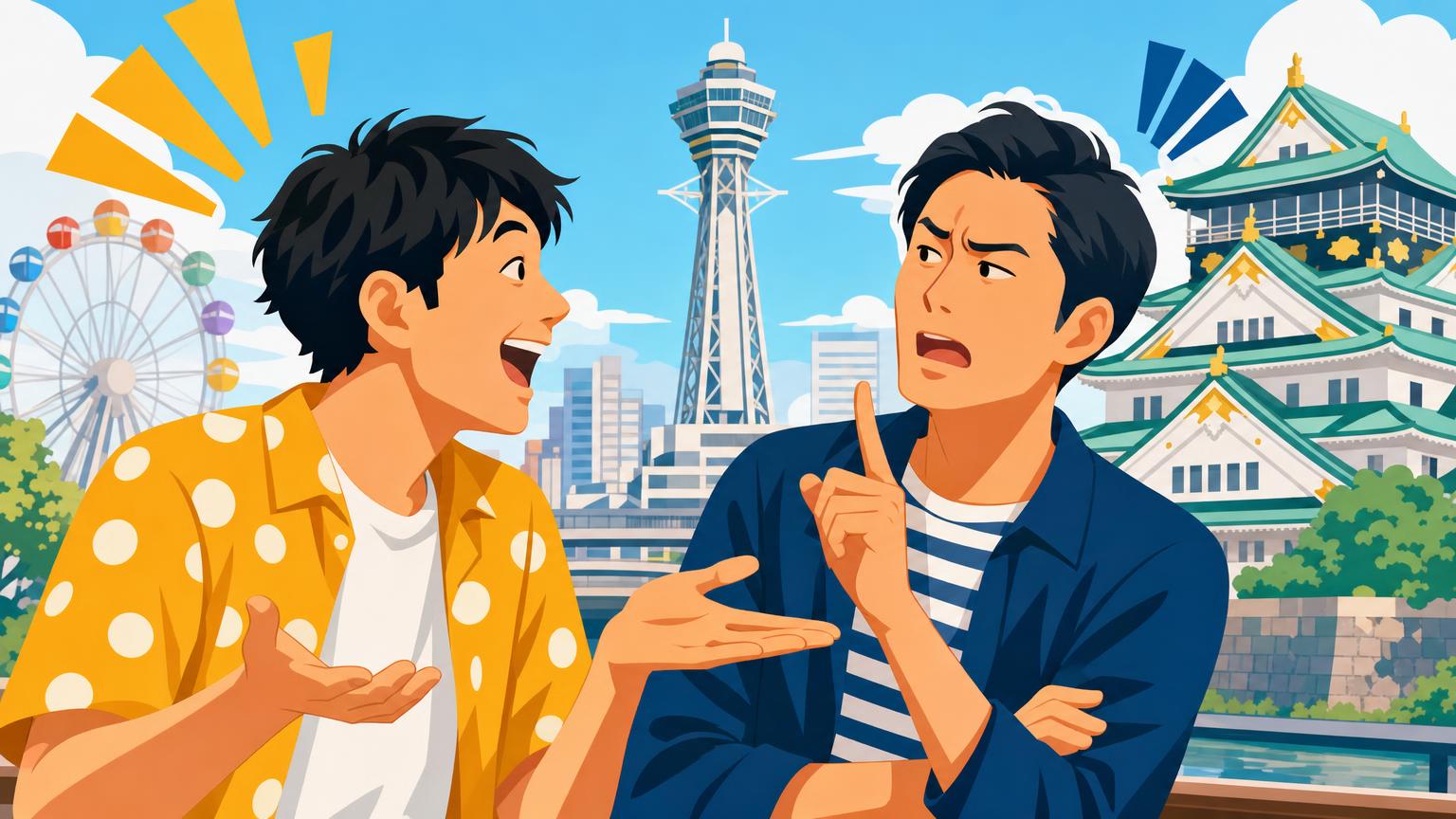
If you live in Osaka and someone says something obviously wrong, unexpectedly dramatic, or slightly ridiculous, the correct response may not be a serious correction. It may be an invitation to play. In Japanese comedy, boke means the person who creates the joke, misunderstanding, exaggeration, or foolish idea. Tsukkomi means the person who reacts, corrects, questions, or brings the conversation back to reality. Together, boke and tsukkomi form one of the most recognizable patterns in manzai, the fast-paced Japanese comedy style strongly associated with Osaka and the wider Kansai region.
In daily life, however, Osaka people do not usually announce, “I am being the boke now.” The roles move quickly. A colleague may make an absurd comment, wait for someone to react, and then laugh when the other person says, “That makes no sense.” A friend may deliberately misunderstand you because the misunderstanding is more entertaining than the original statement. A shopkeeper may tease you, but the teasing may be a way of creating warmth rather than showing hostility.
This is where many foreign residents become confused. Osaka conversation can sound blunt, loud, or even argumentative when the speakers are actually enjoying themselves. At other times, a joke that feels friendly to one person may feel invasive to another. The key is not simply learning two Japanese words. You need to understand the rhythm, the relationship, the setting, and the difference between playful correction and genuine criticism.
The map below points to Namba Grand Kagetsu in Namba, one of Osaka’s best-known comedy theaters. It is included not as a sightseeing recommendation, but as a cultural reference point: the stage tradition helps explain patterns that still appear in ordinary Osaka conversations. The theater’s official site lists its location at 11-6 Namba Sennichimae, Chuo Ward, Osaka.
What Do Boke and Tsukkomi Mean in Japanese Conversation?
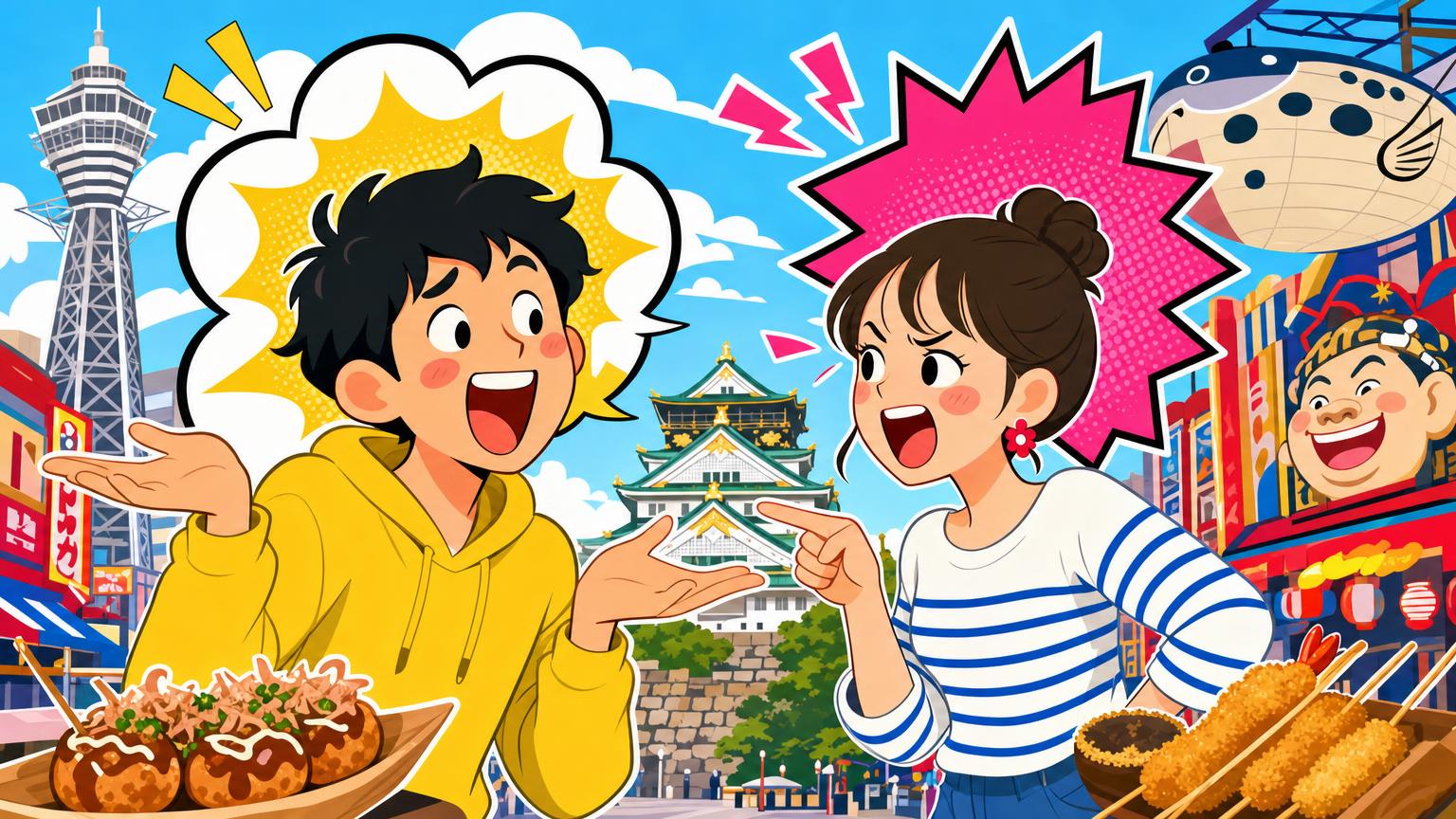
Boke is more than “the stupid one”
The word boke is often translated as “funny man,” “fool,” or “joker.” These translations are useful, but none of them is perfect. A boke is not necessarily unintelligent. The boke creates comic material by saying something strange, misunderstanding a situation, taking a phrase literally, exaggerating a problem, or confidently presenting an idea that everyone else recognizes as ridiculous.
In everyday Osaka conversation, boke can be either intentional or accidental.
An intentional boke might sound like this:
“I walked for ten minutes, so I deserve a medal.”
The speaker knows that walking for ten minutes is not a heroic achievement. The exaggeration gives the other person an opportunity to respond:
“A medal? You took the train for the difficult part.”
That reply is the tsukkomi. The humor comes from the contrast between the exaggerated claim and the realistic response.
An accidental boke occurs when someone says something funny without intending to. A foreign resident might say, “I thought Osaka Station and Umeda Station were completely different cities,” and a local friend might reply, “Yes, they are separated by a very dangerous three-minute walk.” The first speaker was not necessarily trying to make a joke. The local has turned the confusion into a shared comic moment.
Boke can also describe someone who is absent-minded, forgetful, or slow to notice something. In that context, the word may be teasing or critical depending on the tone. This is one reason you should not assume that every use of boke is harmless. A close friend saying “You are such a boke” with a smile is different from a supervisor describing an employee as careless.
Tsukkomi is the reaction that gives the joke shape
The word tsukkomi comes from the idea of “pushing in,” “cutting in,” or entering the exchange with a correction. In a comedy duo, the tsukkomi notices the boke’s mistake and reacts quickly. The response may be a verbal correction, a sharp question, a look of disbelief, or a physical gesture.
Typical tsukkomi phrases include:
- “What are you talking about?”
- “That is not what happened.”
- “No, wait.”
- “You cannot say that seriously.”
- “That is completely wrong.”
- “Why would you do that?”
- “Who told you that?”
The English translations can sound aggressive, especially when written on the page. In Japanese, the same words may sound playful when the voice is light, the timing is quick, and the relationship is comfortable. A tsukkomi response is often less about correcting information than about showing that the speaker has noticed the comic opening.
For foreign residents, the most important point is this: tsukkomi is not automatically an invitation to insult someone back. It is a reaction role. You can perform a gentle tsukkomi by pointing out the contradiction without attacking the person.
For example, if a coworker says, “I am going to save money this month,” while ordering an expensive dessert, you might say:
“That plan is already in trouble.”
This is safer than saying:
“You are irresponsible and have no self-control.”
The first comment focuses on the situation. The second judges the person. Osaka-style teasing often works because the target is the moment, not the person’s entire character.
Manzai and the Osaka Rhythm of Conversation
Manzai is a partnership, not simply Japanese stand-up comedy
Foreign residents often describe manzai as “Japanese stand-up comedy,” but the comparison is incomplete. Western stand-up generally focuses on one performer speaking to an audience. Manzai, by contrast, traditionally centers on two performers whose relationship creates the structure of the joke.
One performer usually takes the boke role, while the other takes the tsukkomi role. They stand or sit close together and exchange lines rapidly. The audience watches not only for the funny statement itself but also for the reaction, interruption, correction, and escalation that follow.
The duo may create a story about shopping, family, work, travel, school, food, or an everyday misunderstanding. The boke pushes the situation in an illogical direction. The tsukkomi tries to restore reality, but the correction itself becomes part of the entertainment. The boke then responds again, and the cycle accelerates.
This creates a distinctive conversational rhythm:
- A normal statement establishes reality.
- The boke introduces a mistake or exaggeration.
- The tsukkomi reacts immediately.
- The boke adds another layer.
- The tsukkomi increases the energy.
- The exchange ends before the idea becomes tiring.
The rhythm matters just as much as the words. A delayed reaction can weaken the joke, while an overly long explanation can make the conversation feel heavy. The tsukkomi’s role is to help the audience understand what was strange and why it was funny.
Osaka’s connection with manzai forms part of a broader Kansai performance culture. Official Osaka tourism materials describe manzai as a comedy style that originated in Osaka and identify the city as a major center for comedy and entertainment. This does not mean that every Osaka resident behaves like a professional comedian. Rather, it means that the local culture has given ordinary conversation a strong vocabulary for teasing, reacting, and creating energy together.
Why Osaka conversation can sound like an argument
A visitor from Tokyo or another region may hear two people from Osaka speaking loudly and assume they are arguing. They may interrupt each other, challenge each other’s statements, and use animated facial expressions. Then, a few seconds later, they may both laugh and continue eating.
Volume alone does not reveal what is happening.
In many Osaka interactions, a quick reaction can signal involvement. If someone responds to every statement with only “I see,” the conversation may feel flat. A stronger response can mean, “I am listening closely enough to play with what you said.” This is not universal, nor is it an excuse to ignore boundaries. However, it helps explain why an Osaka conversation may include more visible correction than one in a more restrained setting.
Tokyo communication is often stereotyped as more polished, indirect, and controlled, while Osaka communication is often stereotyped as more direct and expressive. These stereotypes are too broad to describe every individual. Still, there can be a noticeable difference in conversational temperature. In Osaka, people may become informal sooner, especially in workplaces or neighborhoods where repeated contact creates familiarity.
The contrast is not simply that “Tokyo is cold and Osaka is warm.” Tokyo has many humorous, direct, and generous people, while Osaka has plenty of reserved, private, and formal ones. A more useful distinction is that Osaka often makes the social relationship visible through quick reactions. Someone may tease you to signal that the conversation has moved beyond formal distance.
The hidden question behind a joke
When someone from Osaka makes a boke, the hidden question may be:
“Can we have fun with this situation together?”
When someone offers a tsukkomi, the hidden message may be:
“I heard what you said, and I am willing to respond with energy.”
This is why a silent, literal answer can sometimes create an awkward pause. If someone makes a light joke and you respond with a detailed factual correction, you may be correct but still miss the social purpose of the exchange.
You do not need to become a comedian. A smile, short laugh, or simple reaction may be enough. If you understand the joke but cannot respond quickly in Japanese, try a short phrase such as:
- “That was a good one.”
- “I see what you did there.”
- “Very Osaka.”
- “You are making yourself the boke today.”
- “I do not know how to tsukkomi in Japanese yet.”
The last option can itself become a gentle joke, especially when said with a smile.
The Famous Tsukkomi Gesture and What It Does Not Mean
The light slap is a theatrical signal
Many people first encounter tsukkomi through anime, manga, variety shows, or manzai performances. The tsukkomi may lightly slap the boke on the head, tap their shoulder, or make a sharp hand gesture. In English discussions, this is often called the tsukkomi slap.
On stage, the gesture makes the timing visible. The audience sees the moment when the boke has gone too far and the tsukkomi responds. It is similar to punctuation: the spoken line creates the absurdity, while the gesture marks the end of the comic beat.
In everyday life, you should not imitate the physical slap with people you do not know well. Physical comedy depends on trust, performance, and clear consent. Even among friends, a gesture that seems harmless on television may feel uncomfortable in real life. The safer everyday version is verbal: a hand wave, an exaggerated stare, a pause, or a phrase such as “What are you saying?”
Foreign residents sometimes misinterpret the slap as evidence that Japanese people view hitting as a normal form of communication. That is not a safe conclusion. The stage gesture belongs to a performance tradition. Depending on the performers and audience, it may be mimed, softened, or avoided altogether.
Timing matters more than force
The tsukkomi gesture works because it comes immediately after the boke. If it arrives too late, the audience may not understand which statement it is responding to. If it is too forceful, the mood can shift from playful to uncomfortable.
In everyday conversation, you can create timing without touching anyone. Pause for one beat, look at the speaker, and say:
“Seriously?”
Or:
“That is your solution?”
The pause shows the other person that you noticed the absurdity. The phrase gives the exchange direction, while your facial expression indicates whether you are playing along or criticizing.
Do not confuse tsukkomi with public humiliation
A good tsukkomi usually makes the situation funnier for everyone. A bad one makes one person feel exposed. This distinction matters in Osaka workplaces, schools, share houses, and neighborhood relationships.
Avoid making a person’s accent, body, nationality, income, relationship status, religion, disability, or personal insecurity the subject of a joke. These topics can become especially uncomfortable when the speaker assumes that directness automatically creates closeness.
A useful rule is to make the joke about something temporary and observable:
- The enormous amount of food someone ordered
- The weather changing five times in one day
- A confusing train transfer
- An overly complicated explanation
- A small mistake that everyone can laugh about
Be more cautious with things the person cannot easily change or may already feel sensitive about.
How Boke and Tsukkomi Appear in Daily Osaka Life
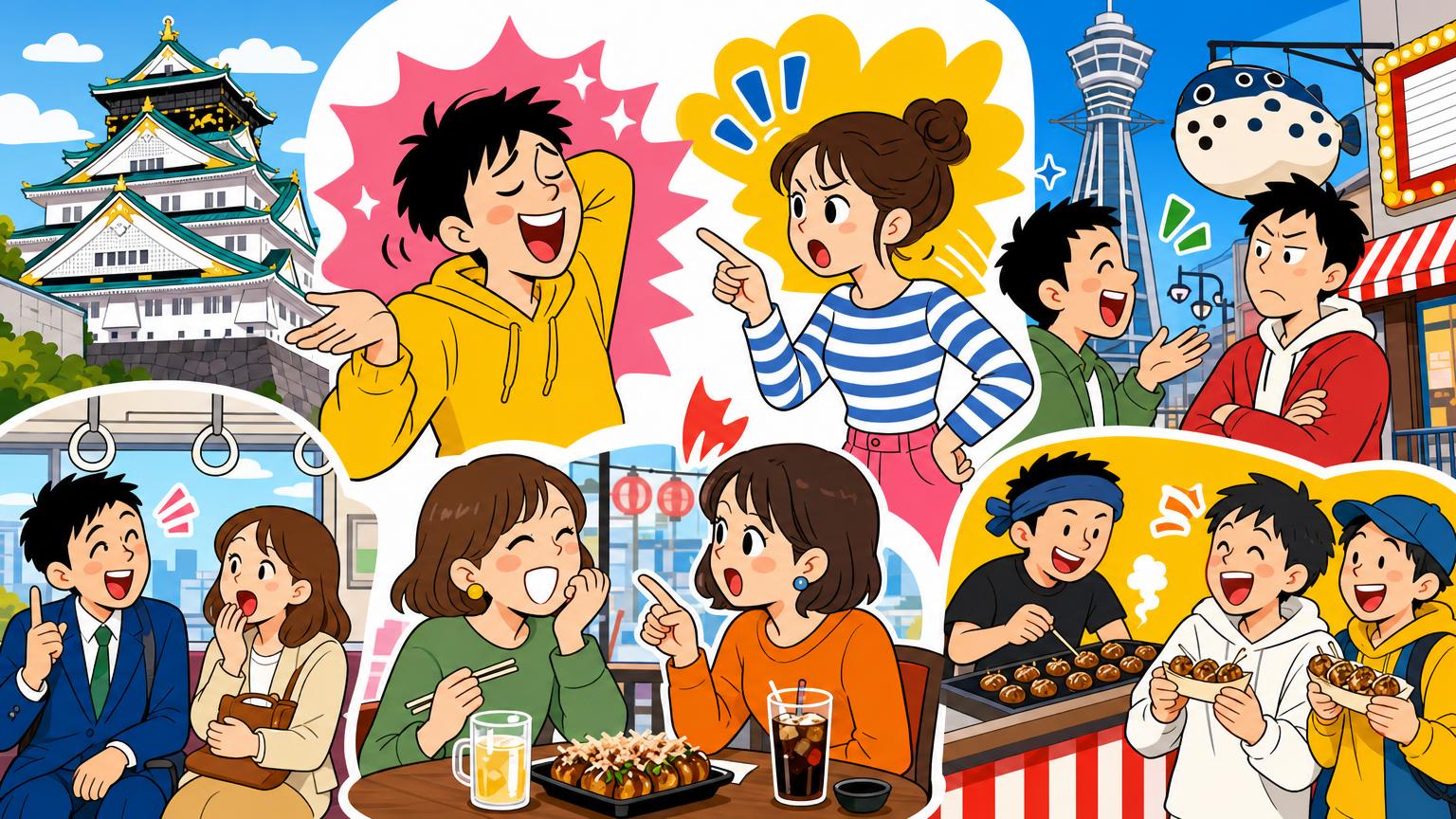
At work
In an Osaka workplace, a meeting may include more informal teasing than a foreign resident expects. Someone might make a dramatic complaint about the printer, say that a deadline is “tomorrow, apparently,” or joke that a colleague has become the office president because they sent one email.
The appropriate response depends on the hierarchy and atmosphere. With a close colleague, you might offer a light tsukkomi:
“You became president without telling us?”
With a manager or senior coworker, a smile and brief response may be better than trying to out-joke them. You could say:
“That sounds serious.”
The humor comes from pretending to take the exaggeration seriously.
Do not assume that an informal Osaka workplace has abandoned hierarchy. People may joke with you while still expecting careful behavior regarding deadlines, greetings, punctuality, and responsibility. A warm conversational style does not eliminate professional rules.
At a part-time job
Restaurants, cafés, retail stores, and other service workplaces can involve frequent, repetitive interactions. A worker may use humor to reduce tension during a busy shift. Customers may also joke with staff, especially in neighborhood businesses.
Foreign residents sometimes respond by becoming either too formal or too familiar. Excessive politeness can make the exchange awkward if the other person is clearly offering a light social opening. Excessive familiarity can be worse, particularly if you imitate a local dialect or joke about customers before you understand the workplace hierarchy.
Start by observing. Notice whether coworkers tease one another equally, whether the manager joins in, and whether jokes stop when a customer becomes uncomfortable. In Osaka, the ability to laugh together may be valued, but the ability to read the room is valued more.
At a neighborhood shop
A local shopkeeper may comment on your shopping choice, appetite, umbrella, or language ability. For example:
“Only one piece of bread? Is that enough for an Osaka person?”
This may not be a literal question. It may be a small performance of familiarity, giving you a chance to respond.
A simple answer could be:
“I am saving room for dinner.”
Or:
“I am still learning how much food Osaka expects.”
If you do not want to joke, you can answer normally. The important point is to recognize that the comment may be relational rather than informational.
Among friends
Close friends may intentionally misunderstand one another. If you say, “I am exhausted,” a friend might reply, “Then you should retire immediately.” If you say, “I studied Japanese for two hours,” they might say, “Congratulations, you are now a professor.”
These responses are not necessarily attempts to dismiss your feelings or effort. They may simply be playful exaggerations. However, context matters. If you are sharing something genuinely painful, the same style can feel cruel. Osaka humor does not cancel emotional sensitivity.
You can make the boundary clear without creating a dramatic confrontation:
“That is funny, but I am actually upset today.”
A good friend should understand the shift. If the person continues making jokes after you have stated the boundary, the problem is no longer a misunderstanding of boke and tsukkomi. It is a failure to respect you.
Why Foreign Residents Often Misread Osaka Humor
Direct language is not always anger
Japanese learners are often taught to avoid disagreeing directly. So when they hear people from Osaka say things like “No,” “That is wrong,” or “What are you doing?” they may assume the relationship has become hostile.
The words matter, but so do the speaker’s pitch, speed, facial expression, and what happens afterward. A serious correction usually slows the interaction and narrows its focus. A playful tsukkomi, by contrast, often keeps the energy moving. The speaker may smile immediately, continue the story, or give the other person another opportunity to respond.
If the person becomes quiet, avoids eye contact, changes the subject abruptly, or repeats the correction in a formal tone, the comment may not be playful. Osaka people can be direct when they are genuinely dissatisfied. Do not use “It is just Osaka humor” to dismiss a real complaint.
Laughing does not always mean agreement
A person may laugh because the situation feels awkward, because they are surprised, or because they do not know how to respond. Foreign residents sometimes assume that laughter means they have permission to continue teasing, but it does not.
Look for reciprocity. Are both people joking? Does the other person joke back? Do they remain engaged? If one person is always the target and never has an opportunity to respond, the exchange may be unequal even if everyone is smiling.
Osaka dialect can intensify the effect
Kansai Japanese, including Osaka speech, often sounds more expressive to learners. Particles, pitch, vocabulary, and sentence endings can make a simple statement feel more dramatic or humorous. A phrase that sounds harsh in textbook Japanese may come across as lighter in a familiar Osaka tone.
This does not mean that every Osaka resident speaks dialect all the time. People adjust their language according to their work, age, neighborhood, education, family background, and audience. Younger residents may mix standard Japanese, Kansai expressions, internet slang, and English. Foreign residents should avoid reducing Osaka speech to a costume.
You can learn a few expressions, but use them carefully. If your pronunciation is exaggerated, locals may appreciate the effort, but they may also feel that you are performing an idea of Osaka rather than speaking naturally. Listening is more important than collecting dialect phrases.
A pause can be meaningful
In an English-speaking conversation, a pause may suggest uncertainty or discomfort. In boke and tsukkomi exchanges, however, a pause can build anticipation. The boke may wait for someone to notice the absurdity, while the tsukkomi may hold a facial expression before responding.
If you answer too quickly and literally, you may interrupt the comic rhythm. If you wait too long, the moment may pass. You do not need perfect Japanese to participate. A brief pause, a smile, and a phrase such as “Wait, what?” can show that you understand the nature of the exchange.
Practical Conversation Etiquette for Living in Osaka
Learn to distinguish among three kinds of correction
Not every correction is a tsukkomi. In daily life, someone may correct you because they want to help, because they are annoyed, or because they are playing with you.
A helpful correction usually provides information:
“The recycling collection is on Thursday, not Wednesday.”
A playful correction adds energy:
“Thursday? You are already living in the future.”
A serious correction often becomes more specific:
“I told you this twice. Please check the schedule.”
When in doubt, respond to the practical information first. Correct the mistake, apologize if necessary, and only then consider whether a joke is appropriate. Humor should not be used to avoid responsibility.
Return the energy, not necessarily the same joke
You do not need to come up with a clever comeback. Reciprocity can be simple. If someone jokes about their own mistake, you can laugh and say:
“At least you noticed.”
If someone exaggerates, you can gently exaggerate in return:
“Then we need an emergency meeting.”
If you are not confident, use a confirming reaction:
“You are joking, right?”
This allows the other person to clarify the tone without forcing you to pretend that you understood everything.
Do not use humor as a substitute for politeness
Osaka’s casual atmosphere can make new residents feel that formal language is unnecessary. It is not. Say hello to your neighbors. Follow apartment rules. Keep your voice down late at night. Pay your bills on time. Apologize directly when you cause a problem.
Someone may joke with you at the supermarket and still become unhappy if you leave garbage in the wrong place. A coworker may call you “funny” and still expect your report by the deadline. Everyday humor is part of social connection, not a substitute for reliability.
Be especially careful with strangers
A local may joke with you first, but that does not automatically mean you should tease them about their appearance, age, or private life. Match the level of intimacy that has already been established.
Safer early topics include food preferences, the weather, train confusion, language mistakes, and shared inconveniences. Riskier topics include salary, marriage, divorce, health, religion, political views, and family problems.
If you are unsure, make yourself the boke. Self-deprecating humor can reduce pressure, as long as it does not become constant or encourage people to treat you badly. For example:
“My Japanese is still in the trial version.”
This creates a light opening without asking the other person to become the target.
Osaka, Tokyo, and the Question of “Friendliness”
Osaka Is Not Simply Friendlier Than Tokyo
Many people ask whether Osaka is a good place to live because Osaka residents are often said to be friendlier than people in Tokyo. However, this comparison needs more nuance.
In Osaka, a stranger or acquaintance may be more likely to comment on an immediate situation. Someone might talk to you while waiting in line, joke about the weather, or ask whether you know where you are going. This can make everyday life feel socially active.
Tokyo may provide more anonymity. For some people, that can feel cold, while for others, it can feel liberating. You can often move through a station, apartment building, or neighborhood without being questioned. Osaka’s more conversational style can feel welcoming, but it may also feel intrusive if you value privacy.
The real question is not which city has nicer people, but which level of social contact suits you. If you enjoy quick interactions and do not mind being drawn into small conversations, Osaka may feel comfortable. If you prefer a clear boundary between public and private life, you may need to communicate that boundary directly.
Osaka Warmth Often Comes Through Involvement
What foreigners describe as “friendliness” in Osaka is often a form of involvement. Someone notices what you are doing and responds to it. They might ask why you chose that dish, comment on your Japanese, or complain with you about a delayed train.
This involvement can be practical. A neighbor may tell you that the garbage schedule has changed. A coworker may warn you that a meeting is more formal than it seems. A restaurant owner may explain how to order. That same person may also tease you about your choice of toppings.
This combination can be confusing because help and humor may come in the same sentence. You do not have to accept every joke in order to appreciate the assistance.
Neighborhood Differences Matter
Osaka is not a single social environment. The atmosphere around Umeda can feel different from that of the shopping streets in Tenma. Namba and Nipponbashi have their own rhythms. Residential areas in Higashiyodogawa, Joto, Sumiyoshi, or Sakai may feel less performative and more routine-based. University districts, business districts, and older shopping arcades all create different expectations.
People also differ by age. Older residents may use more traditional Kansai expressions. Younger residents may rely on internet humor, dry reactions, or a combination of standard Japanese and dialect. A family-run business may invite more conversation than a chain store, while a busy commuter may not want to talk at all.
The best way to understand Osaka is to observe patterns without assuming that every interaction represents the entire city.
Boke and Tsukkomi in Anime, Manga, and Popular Culture
Why the Pattern Feels Familiar to International Fans
Foreign fans often recognize boke and tsukkomi before learning the vocabulary. One character makes an absurd claim, and another immediately shouts, reacts, or physically interrupts. This exchange may appear in school comedies, sports stories, fantasy adventures, workplace dramas, or variety-style scenes.
The pattern is useful in storytelling because it quickly clarifies character roles. The boke reveals imagination, arrogance, innocence, chaos, or social awkwardness, while the tsukkomi reveals practicality, impatience, intelligence, or emotional restraint. Their contrast creates movement.
In a larger group, one character may become the regular boke while another takes on the regular tsukkomi role. However, these roles can switch. The supposedly sensible character may suddenly make an outrageous mistake, while the comic character may offer the most realistic observation in the scene.
This switching is important in real life as well. Someone who often corrects others may deliberately act foolishly with close friends. A quiet coworker may deliver the strongest boke of the day. Do not assign permanent personality types to people based on a single conversation.
Pop Culture Exaggerates Real Behavior
Anime and television often make reactions louder, faster, and more physical than they would be in ordinary conversation. Characters may shout across a room, hit someone with a prop, or repeat the same catchphrase for dramatic effect. These scenes communicate the basic structure, but they are not instructions for treating people.
In real Osaka life, the tsukkomi may respond with a raised eyebrow, a sigh, a short laugh, or a quiet “No, that is not right.” The boke may be a small exaggeration rather than a spectacular misunderstanding.
The emotional principle is more realistic than the volume: one person creates a gap between expectation and reality, and another points it out.
Understanding “Straight Man” Correctly
English explanations often call the tsukkomi the “straight man.” This phrase comes from the traditional English-language description of a comedy duo, but it can be misleading. The tsukkomi is not necessarily serious, morally superior, or emotionally normal. They are performing as well.
A good tsukkomi has comic timing, sound judgment, and a strong sense of what the audience needs to notice. They may be more theatrical than the boke, and their apparent common sense is part of the act.
In everyday Osaka conversation, this means that the person who says, “That makes no sense,” may be enjoying the absurdity just as much as the person who created it.
When Osaka Humor Is Not Welcome
Read the situation before joining in
Humor is less welcome during a serious complaint, an apology, an official procedure, or a conversation involving health, money, immigration, housing, harassment, or legal problems. A joke can make the situation more difficult, especially when the other person needs clear information.
If you are dealing with a ward office, landlord, school administrator, doctor, police officer, or immigration professional, prioritize clarity. The person may be friendly, but the interaction still has a practical purpose.
Humor is also risky when there is a significant power imbalance. A manager joking with a foreign employee may not give that employee an equal freedom to joke back. A teacher may tease a student who cannot safely respond. A landlord may describe a serious rule as “just a joke.” Consider whether you genuinely have a choice about participating.
“It was a joke” is not a complete defense
Osaka’s comedy culture is sometimes used to excuse behavior that would be inappropriate anywhere. If a comment repeatedly embarrasses you, targets your nationality, or continues after you ask someone to stop, you do not have to accept it as cultural education.
You can respond calmly:
“I understand that you are joking, but I do not like that topic.”
Or:
“Please do not joke about my personal information.”
A person who respects you may apologize or change the subject. Someone who insists that you must laugh simply because they are from Osaka is not showing the best side of Osaka culture.
Foreigners can also become the “boke” without agreeing to it
Sometimes a foreign resident is treated as a constant source of amusing language mistakes. One or two jokes may be harmless, but continually correcting, mimicking, or showcasing your Japanese can become tiring and humiliating.
You can set a boundary while keeping the tone light:
“One correction per conversation, please.”
Or more directly:
“I am happy to practice Japanese, but I do not want every sentence to become a joke.”
This is helpful because it separates language practice from entertainment. You can enjoy Osaka humor without giving others unlimited access to your mistakes.
How to Practice Boke and Tsukkomi Without Sounding Forced
Start with reactions
For most foreign residents, tsukkomi is easier to practice than boke. You can start by reacting to contradictions that are already obvious.
If a friend says, “I am on a strict diet,” while ordering a second bowl of rice, you can say:
“Strict for whom?”
If someone says, “I am not late,” while arriving twenty minutes after the agreed time, you can say:
“You are operating on your own time zone.”
Keep your voice warm, and do not overperform. The best everyday tsukkomi often sounds spontaneous.
Use exaggeration carefully
To create a boke, exaggerate a small truth. If the rain is heavy, say:
“I need a boat to get to the station.”
If a meeting is long, say:
“We may finish before the next era begins.”
If a restaurant serves a large portion, say:
“This is lunch for the entire building.”
These statements are clearly unrealistic but still connected to the situation. They give the other person an opportunity to react without requiring knowledge of a private reference.
Let the other person choose the level
After making a boke, do not force the tsukkomi. Give the other person some space. They may laugh, answer literally, or ignore the joke. All three responses are possible.
If they respond seriously, return to the normal conversation. Do not say, “Why did you not understand my joke?” That turns a playful offer into a demand.
Likewise, if someone makes a joke that you do not understand, you can ask:
“Was that a boke?”
This question often gives the speaker a chance to explain without embarrassment.
Do not imitate professional performers
Professional comedians train in timing, audience awareness, voice control, and repetition. Everyday residents are not performing a television routine. If you use a very loud voice, repeated slaps, or dramatic dialect phrases, you may sound as though you are imitating a stereotype.
A small response is usually more natural. A raised eyebrow, short laugh, or brief contradiction can communicate that you understand the local rhythm.
Where the Comedy Tradition Fits into Everyday Osaka
Namba as a cultural reference point
Namba is often associated with Osaka’s entertainment, shopping, food, and nightlife, but its importance in understanding the city extends beyond a simple list of attractions. It is one of the places where commercial entertainment, neighborhood interaction, popular culture, and performance traditions come together.
Namba Grand Kagetsu is operated by Yoshimoto Kogyo and features manzai, rakugo, and Yoshimoto Shinkigeki performances. Its official visitor information describes the theater as an ongoing center of Osaka comedy culture, with daily performances and a long history tied to Yoshimoto’s entertainment business. You do not need to become a regular theatergoer to understand Osaka, but seeing how a professional duo builds a joke can make everyday conversation easier to recognize.
Comedy is also heard outside theaters
The boke-tsukkomi pattern can be found in family kitchens, office break rooms, school clubs, shopping streets, local bars, and group chats. It is not limited to people who consider themselves comedy fans.
A group of coworkers might complain about a broken air conditioner and then turn the complaint into a miniature performance. A parent may exaggerate a child’s minor mistake. Friends may argue over which restaurant to choose while secretly enjoying the argument more than the decision itself.
The goal is not always to create the funniest possible joke. Often, it is simply to keep the conversation from becoming stiff. A quick reaction helps people stay connected through a shared moment.
Everyday humor can make city life less anonymous
Large cities can be tiring because many interactions are functional. You buy something, pay, commute, work, and return home. Osaka’s conversational humor sometimes adds a small social layer to these ordinary activities.
That layer can be enjoyable when it is mutual, but it can also be exhausting when you are expected to perform constantly. For foreign residents, the healthiest approach is not to force yourself to become more outgoing than you are. Instead, learn to recognize when humor is being offered, accept it when you want to, and decline it when necessary.
A Practical Guide to Reading the Room
Signs that a joke is likely friendly
A joke is more likely to be friendly when:
- The speaker also makes jokes about themselves.
- The target can easily respond or change the subject.
- The tone becomes lighter immediately afterward.
- Everyone involved appears to have equal social power.
- The joke concerns a temporary situation rather than a personal vulnerability.
- The speaker stops when someone seems uncomfortable.
These signs are not guarantees, but they can provide useful clues.
Signs that a comment may be serious
Be more cautious when:
- The speaker repeats the correction slowly.
- The topic involves work quality, money, safety, rules, or responsibility.
- The person avoids smiling and keeps the conversation focused.
- The same individual is targeted repeatedly.
- The speaker continues after you ask them to stop.
- Other people become quiet instead of amused.
When you are uncertain, take the practical meaning seriously first. You can always return to the humor later.
A safe response when you are unsure
Try using a neutral reaction:
“Are you joking, or should I take that seriously?”
This is useful in both Japanese and English, especially in the workplace. It gives the other person an opportunity to clarify and keeps you from accidentally laughing at something important or apologizing for something that was only a joke.
You can also say:
“I understand the joke, but I want to confirm the actual information.”
This works well for schedules, apartment rules, workplace instructions, and administrative matters.
What Understanding Osaka Humor Can Teach You About Living Here
Osaka values responsiveness
In Osaka, conversation often rewards the person who responds. You do not need to have a perfect answer; responding simply shows that you are present. A nod, laugh, brief question, or small comment can help keep the relationship moving.
This does not mean you have to talk constantly. Silence is acceptable. The difference is that a completely passive style may be interpreted as distance, especially in a casual group that is making an effort to include you.
Osaka values practical warmth
Warmth in Osaka is often less polished than it may be in a formal service interaction. Someone may help you while sounding impatient. They may complain about your mistake and then show you exactly how to fix it. They may tease you and then bring you food.
If you expect warmth always to sound gentle, you may overlook it. If you assume every blunt comment is hostile, you may become unnecessarily defensive.
At the same time, do not romanticize bluntness. People can be rude in Osaka, just as they can anywhere else. The useful skill is learning to distinguish style from substance.
Osaka relationships may develop through repeated contact
Many everyday relationships are built through small, repeated interactions: seeing the same neighbor, visiting the same shop, working the same shift, greeting the same school parents, or meeting the same people at a community activity.
Humor can serve as a bridge in these relationships. The first joke may feel strange, while the fifth may feel natural. Over time, the same person who once corrected your Japanese may start asking about your weekend or saving a product for you.
Do not expect instant intimacy. Osaka can feel socially open while still requiring time to build trust. Regular presence, reliability, and respectful participation matter more than a single clever joke.
Final Advice for Foreign Residents
If you want to understand Osaka people better, listen for the relationship beneath the words. Ask yourself whether the speaker is sharing information, expressing frustration, inviting play, or testing familiarity. Notice who is allowed to joke, who is expected to react, and whether the exchange remains balanced.
Remember the basic structure:
- Boke creates the absurdity.
- Tsukkomi points it out.
- Manzai turns the exchange into a fast-paced partnership.
- Everyday Osaka conversation borrows the rhythm without always becoming a performance.
You do not need to slap anyone, speak loudly, or imitate a comedian. You need to pay attention to timing, distinguish a playful correction from a genuine complaint, return some energy when you feel comfortable, and set a boundary when you do not.
Osaka is not a city where everyone is constantly joking. It is a city where humor can emerge during ordinary activities: buying lunch, waiting for a train, discussing work, complaining about the weather, or deciding who forgot the key. The humor often works because people are willing to respond to one another rather than leave every statement untouched.
Once you understand that rhythm, conversations that once sounded rude or chaotic may become easier to interpret. You may notice that the person who says, “What are you talking about?” is not always rejecting you. Sometimes, they are giving you a place in the conversation.