If you live in Osaka and avoid animal products, one question appears again and again: is it possible to eat naturally here without turning every meal into a research project?
The honest answer is yes, but not always in the way foreign residents expect.
Osaka is often described as a city of food. That does not mean every restaurant understands veganism, and it certainly does not mean that a dish labelled vegetable is free from fish stock. In ordinary Japanese cooking, bonito flakes, dried sardines, shrimp, oyster sauce, egg, milk, and meat-based seasoning can appear in otherwise vegetable-heavy meals. A bowl may look entirely green and still contain katsuo dashi.
Tennoji’s Shitaderamachi temple quarter offers a different way to think about the problem. Here, plant-based food is not merely a modern dietary preference. It is connected to Buddhist practice, temple institutions, seasonal cooking, restraint, hospitality, and an older Osaka habit of making practical use of what is available.
This does not mean that every restaurant around Shitennoji serves shojin ryori. It does not. Nor does it mean that Tennoji is a vegan district. It is a mixed, busy, ordinary part of Osaka, with supermarkets, school routes, apartment buildings, family restaurants, bars, clinics, convenience stores, and temple streets existing side by side.
That mixture is precisely what makes the area useful for understanding life in Osaka. The temple quarter is not a museum separated from the city. It is a working neighbourhood where old religious geography still shapes the rhythm of streets, businesses, ceremonies, and local expectations.
The practical lesson is simple: if you want authentic Buddhist cuisine, plan ahead. If you want an everyday plant-based routine, learn how to ask about dashi, read labels, shop locally, and recognise the difference between traditional shojin food and a modern vegan restaurant.
The map below centres on WAQOO Shitaderamachi, a temple-lodging-style hotel in the Shitaderamachi area. It is a useful reference point for understanding the quarter, although dinner availability, menus, and booking conditions should always be confirmed directly before you go.
The Spiritual Heart of Osaka: Why Tennoji Matters for Plant-Based Living
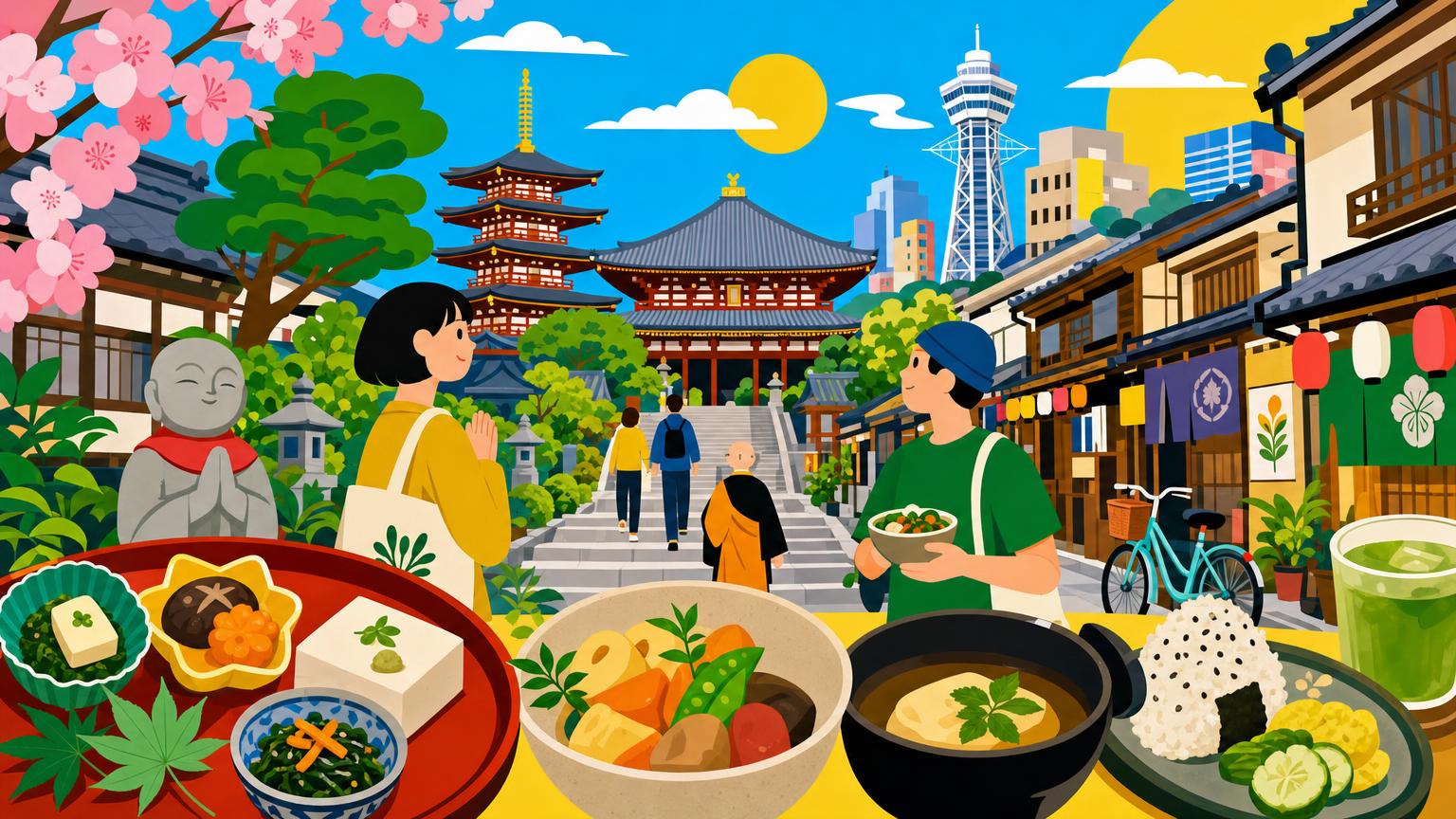
Shitennoji is part of the city’s living structure
Foreign residents sometimes imagine that a major Buddhist temple must be located in a quiet, isolated landscape. Shitennoji is not. It stands within densely urban Osaka, within walking distance of Tennoji Station, Abeno, Shitaderamachi, and the streets leading toward Shinsekai. Commuters pass through the area. Children go to school. Residents shop for groceries. Delivery bicycles travel along roads lined with small temples and ordinary homes.
That combination is significant. Shitennoji is not simply a sightseeing attraction situated inside Osaka. It is one of the historical foundations around which the district developed.
Temple tradition dates Shitennoji’s foundation to 593, when Prince Shotoku established it during the early spread of Buddhism in Japan. The temple is associated with one of Japan’s oldest official Buddhist institutions, and its central layout preserves a form connected to early continental Buddhist architecture. The present buildings have been rebuilt many times following storms, fires, war, and other disasters, but the site’s religious and civic importance has endured.
For daily life, the key point is not simply the date 593. It is continuity. A place can be reconstructed and still remain socially meaningful. In Osaka, historical identity often functions in this practical way. People do not need every building to be original for a neighbourhood to feel old. The temple’s name, annual events, shopfronts, cemetery walls, the route to the station, and the way local people describe the area all carry the past forward.
What Teramachi means in everyday terms
Teramachi means temple town or temple quarter. In Tennoji, the name Shitaderamachi refers to an area where Buddhist temples stand close together. Some are large and well known; others are small, quiet, and easy to overlook behind walls, gates, or narrow entrances.
A foreign resident may initially see this landscape as decorative. Japanese residents often understand it in more functional terms. A temple may be connected to a family grave, a funeral, a memorial service, a local festival, a school, a religious association, or a long-standing relationship between households and clergy. The temple is not necessarily somewhere people visit every week for meditation. It may be a place they approach at particular moments: after a death in the family, on an ancestor’s memorial day, during a ceremony for a child, or for an annual event.
This helps explain why shojin ryori should not be treated as merely Japanese vegan cuisine. The food comes from a religious and institutional context. It has been shaped by training, discipline, hospitality, seasonal awareness, and the practical needs of people who live and work in temples.
In other words, the meal is not only about replacing meat with tofu. It is also about how a meal is prepared, presented, received, and eaten.
Osaka is less formal than its temple history may suggest
Visitors sometimes expect a temple neighbourhood in Osaka to feel solemn from beginning to end. Tennoji is more mixed than that. A quiet cemetery wall may stand beside a busy road. A Buddhist gate may face a convenience store. A traditional restaurant may share the neighbourhood with inexpensive noodle shops and apartment buildings.
This is very Osaka. The city does not always separate the sacred, the commercial, and the ordinary into neat zones. Instead, they overlap. A person may bow at a temple, buy a packaged lunch, complain about the weather, and discuss a small business matter all within the same morning.
That overlap also shapes local communication. Osaka people may sound informal, humorous, or direct even when discussing serious matters. The local style is not always a sign of intimate friendliness. Often, it is a way of reducing distance. A joke, a small complaint, or a teasing comment can make a situation feel less stiff.
Foreigners sometimes misunderstand this as universal openness. It is more accurate to say that Osaka often allows more ordinary social contact than Tokyo does. That does not mean everyone wants a long conversation. It means a shopkeeper, neighbour, or older person may speak more directly, comment on your Japanese, or offer unsolicited advice without considering the exchange rude.
What Shojin Ryori Actually Means in Daily Life
It is not merely a vegan version of a meat dish
Shojin ryori is commonly translated as Buddhist cuisine, temple cuisine, or Zen vegetarian cuisine. The word shojin conveys the idea of devoting oneself to practice or exertion. In Buddhist settings, cooking and eating can be understood as part of one’s training rather than as activities separate from spiritual life.
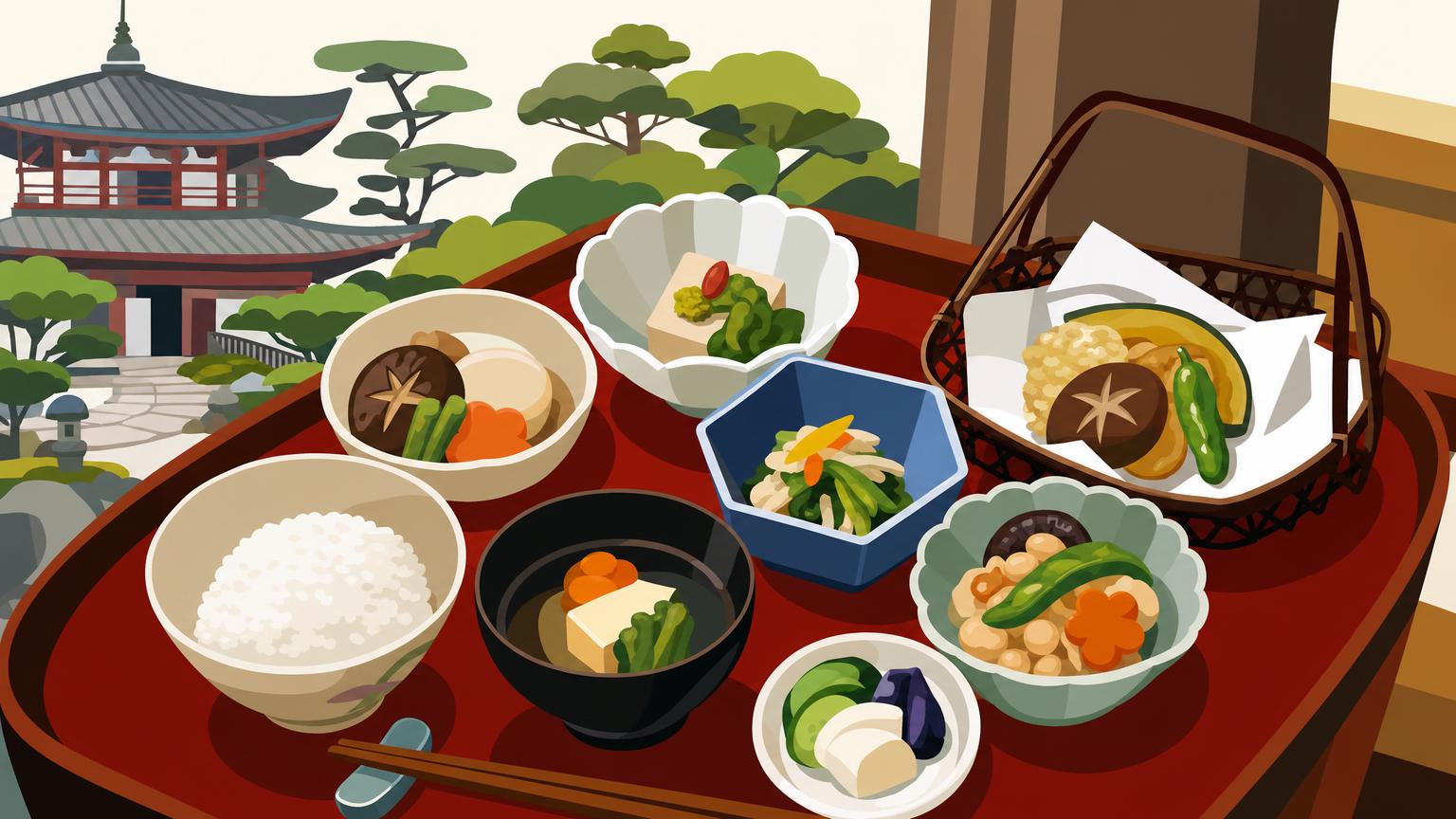
A traditional meal may include tofu, sesame tofu, wheat gluten, konnyaku, seasonal vegetables, mushrooms, seaweed, beans, grains, pickles, and carefully prepared broths. Ingredients are chosen and cooked to bring out their texture and natural flavour instead of being covered by heavy seasoning.
At WAQOO Shitaderamachi, the published explanation of the cuisine describes the use of five colours, five cooking methods, and five flavours. These principles create visual balance, nutritional variety, and a sense of the season. Cooking methods may include raw preparation, simmering, roasting, frying, and steaming. Flavours may include sweet, salty, sour, bitter, and spicy elements.
For someone accustomed to Western vegan food, the result can feel unfamiliar. There may be no obvious centrepiece. Rather than presenting a large portion of protein surrounded by side dishes, the meal may offer many small preparations, with textures and temperatures shifting across the tray.
That does not mean it lacks substance. It reflects a different idea of completeness.
The hidden importance of dashi
For a vegan resident in Japan, the most important practical question is often not whether a dish contains visible meat, but what was used to prepare the broth.
Katsuo dashi is made with bonito, a type of fish. Niboshi dashi commonly uses dried sardines or other small fish. These ingredients may appear in miso soup, noodle soup, simmered vegetables, dipping sauces, curry seasoning, restaurant pickles, and prepared foods.
True shojin ryori avoids animal-derived ingredients and traditionally depends on plant-based sources of umami, particularly konbu kelp, dried shiitake mushrooms, soy products, beans, sesame, and vegetables. WAQOO’s own explanation specifically highlights kelp broth as part of its approach to creating depth without relying on heavy flavouring.
This is why asking vegetarian desu ka is sometimes not enough. In Japan, the word vegetarian may be interpreted in several different ways. One restaurant may understand it to mean no red meat while still using fish stock. Another may remove meat from a dish but leave the original sauce unchanged.
Useful questions include:
- Dashi wa konbu to shiitake desu ka? Is the stock made from kelp and shiitake?
- Katsuo dashi wa haitteimasu ka? Does it contain bonito stock?
- Niku, sakana, tamago, gyuunyuu wa taberaremasen. I cannot eat meat, fish, eggs, or dairy.
- Onaji nabe de tsukutteimasu ka? Is it cooked in the same pot?
If you have a severe allergy or a strict ethical requirement, do not rely on a short phrase alone. Show a written explanation in Japanese, contact the restaurant ahead of time, and ask what can be prepared safely.
The meal is seasonal and deliberately restrained
Shojin food does not try to make every vegetable taste like something else. A carrot may taste simply like a carrot. A mushroom may be presented for its aroma. Sesame tofu can be smooth, springy, and rich without containing dairy.
This restraint is not necessarily minimalism in the modern design sense. It is closer to attentiveness. The cook considers colour, cutting, texture, temperature, and the stage of the season. A vegetable nearing the end of its season may be used because it expresses a passing moment, rather than because it is the most convenient ingredient.
This attitude connects with a broader Japanese habit of noticing seasonal changes in everyday life. People may comment on the first evening when the air turns cool, the appearance of a particular fruit, the arrival of new rice, or the colour of a tree beside a railway line. You do not need to be poetic about it. Seasonal awareness often takes the form of a small observation made while doing something else.
For foreign residents, this is one of the more useful ways to understand Japanese food culture. Seasonality is not confined to expensive kaiseki restaurants. It can be seen in supermarket displays, school lunches, convenience-store sweets, home cooking, and the gifts people bring when visiting someone’s home.
What Osaka People Often Misunderstand About Veganism
A vegetable-heavy meal is not automatically vegan
Osaka has a strong food culture, but much of its everyday cooking is based on fish, meat, eggs, or sauces containing animal products. The city’s famous dishes are not designed around plant-based eating. Even when a menu includes vegetables, the cooking may rely on dashi, mayonnaise, bonito flakes, or animal-derived toppings.
This is not usually a deliberate attempt to exclude vegans. Rather, it reflects how Japanese cooks classify food. A dish may be understood as vegetable-based because its main ingredients are vegetables. The broth may be viewed as a separate technical element rather than as the defining identity of the dish.
That difference in classification can create misunderstandings. A foreign resident says, “No fish.” The restaurant hears, “No pieces of fish.” The customer means no fish-derived stock. Both sides believe they have communicated clearly.
The solution is not to become suspicious of every Japanese meal. It is to be specific.
Shojin ryori is not always available on demand
Another misunderstanding is the assumption that a temple quarter should have many walk-in shojin restaurants. In reality, authentic temple-style dining may be connected to accommodation, ceremonies, group bookings, cultural programmes, or fixed meal services.
WAQOO Shitaderamachi is a useful local example. It describes itself as a shukubo-style hotel rather than a temple directly operated by a particular Buddhist institution. Its cultural experiences include shojin ryori, calligraphy, Buddhist activities, and related practices, but the meal should be treated as a planned experience rather than something a walk-in diner can always order for lunch.
The practical approach is to ask before travelling across the city. Check whether the meal is available to non-guests, whether it is dinner only, whether a stay plan is required, how many days in advance reservations must be made, and whether allergies can be accommodated.
Vegan food and shojin food serve different purposes
A modern vegan restaurant may offer ramen, curry, burgers, Taiwanese food, desserts, or Osaka-style comfort food. Its purpose may be accessibility, enjoyment, environmental concern, health, or animal ethics.
Shojin ryori has a different background. It is connected with Buddhist practice and a disciplined approach to ingredients, preparation, and eating. A shojin meal may be entirely vegan, but not every vegan meal is shojin ryori.
The distinction matters because it changes what you expect. If you want a satisfying quick meal after work, a fully vegan restaurant may be more suitable. If you want to understand how Buddhist food fits into Tennoji’s history, a planned shojin experience is more appropriate.
Neither is more authentic in every situation. They simply meet different needs.
Where Plant-Based Residents Can Eat Around Tennoji
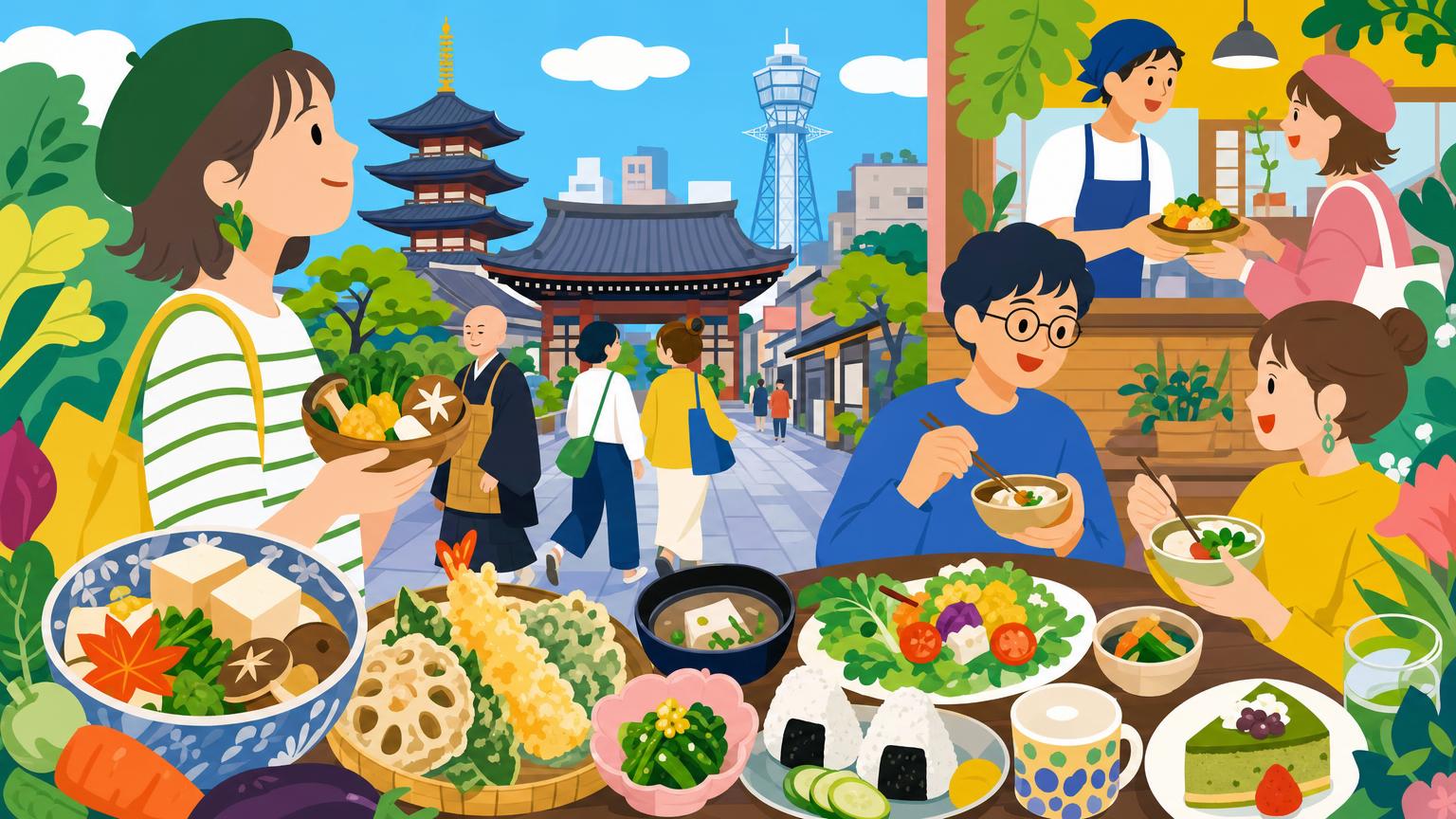
WAQOO Shitaderamachi: the clearest local connection
WAQOO Shitaderamachi is located at 2-5-12 Shitaderamachi, in the temple quarter between Shitennoji-mae Yuhigaoka, Ebisucho, and Tennoji. According to its official access information, it is approximately a seven-minute walk from Shitennoji-mae Yuhigaoka Station, seven minutes from Ebisucho Station, and fifteen minutes from Tennoji Station.
For a foreign resident, its value extends beyond the food. It demonstrates how an urban Osaka business can reinterpret the older shukubo concept for contemporary users. Traditionally, a shukubo was temple lodging, but WAQOO describes its facility as a shukubo-style hotel that works with temples and local cultural institutions rather than serving as the lodging of one particular temple.
Its published sample menu includes seasonal vegetables, sesame tofu, ganmodoki, konnyaku, mushrooms, seaweed, rice, pickles, and other small preparations. The menu varies according to the season and ingredient availability. The hotel also describes the work involved in making its sesame tofu, including prolonged mixing to create a firm, smooth texture.
That detail is revealing. Shojin ryori values ingredients, but it also values time. A familiar ingredient gains meaning through preparation. This reflects the mindset of many Osaka small businesses, where product quality is often expressed through repeated work that customers never see.
Do not arrive expecting a casual café. Contact the facility in advance to confirm its current dining conditions. If you are staying elsewhere, ask whether dinner reservations are available to outside guests. If you are staying at WAQOO, check whether your accommodation plan includes the meal or whether it needs to be added separately.
Japanese tofu and yuba restaurants near the larger Tennoji area
The wider Tennoji and Abeno area includes restaurants specialising in tofu, yuba, vegetable dishes, and traditional Japanese set meals. These may be useful for vegetarians, although their suitability for strict vegans varies.
Tofu itself is vegan, but the sauce poured over it may not be. A yuba dish may come with fish-based dashi. A vegetable kaiseki course may contain egg, dairy, or seafood in one of its smaller preparations. The description healthy Japanese food tells you very little about whether a meal is vegan.
When considering a tofu or yuba restaurant, ask about the ingredients in the full course rather than simply requesting that meat be removed. A course prepared in advance may be difficult to modify, especially when sauces and stocks are made centrally.
For residents who eat dairy or eggs but avoid meat and fish, these restaurants may offer greater flexibility. For strict vegans, a fully plant-based restaurant or a pre-arranged shojin meal is the safer choice.
The broader lesson is useful beyond Tennoji: in Japan, flexibility is often easier when you ask before the restaurant begins cooking. Last-minute changes can be difficult because many dishes are prepared as complete systems rather than assembled from interchangeable components.
Vegan restaurants in the Tennoji–Shinsekai corridor
The area around Tennoji, Dobutsuen-mae, and Shinsekai offers modern plant-based options that are more convenient for everyday eating than a formal temple meal. SAIJIKI’s Tennoji shop is presented as a vegan Taiwanese-style restaurant, while Shinsekai Paprika Shokudo is described by current local food listings as a fully vegan restaurant serving plant-based versions of familiar Osaka-area foods such as kushikatsu and takoyaki.
These restaurants are culturally interesting because they reveal another side of Osaka’s food identity. Osaka people often value recognisable pleasure: a hot snack, a satisfying set meal, a distinctive sauce, or a dish shared casually with friends. A vegan restaurant serving familiar local forms does not reject Osaka culture; it negotiates with it.
This differs from the quieter presentation of shojin ryori. One approach encourages you to notice subtle changes in texture and season. The other may be saying that you can still enjoy this city’s food culture without using animal products.
For a resident, both approaches are important. One helps you understand historical food culture, while the other makes it easier to eat lunch on a busy weekday.
Because independent restaurants may change their opening hours, menus, and locations, verify current details before travelling. Do not depend on an old social-media post, a translated listing, or a review written several years ago.
Cafés, bakeries, and flexible plant-based routines
A sustainable vegan life in Osaka is rarely built solely around restaurant visits. It is built through routines.
You may eat breakfast at home, buy soy milk and fruit at a supermarket, carry nuts or rice crackers during a long workday, use a restaurant app to find a fully vegan meal, and keep one or two dependable dinner options near your station. This may be less glamorous than eating a traditional course, but it is closer to everyday life.
Around Tennoji, department-store food halls, supermarkets, convenience stores, and shopping-centre restaurants provide residents with more options than visitors may realise. The challenge lies in reading labels and understanding production methods. Plain onigiri with umeboshi or kombu may be suitable, but fillings, seasonings, and factory labels still need to be checked. Prepared salads may contain egg-based dressing. Bread may include milk or butter. Even a vegetable sandwich may use mayonnaise.
Learn the Japanese words for the ingredients you avoid:
- Niku means meat.
- Sakana means fish.
- Ebi means shrimp.
- Kani means crab.
- Katsuobushi means dried bonito.
- Nyuuseihin means dairy products.
- Tamago means egg.
- Hachimitsu means honey.
- Gyunyu means cow’s milk.
- Butaniku means pork.
- Toriniku means chicken.
Do not assume that plant-based milk is unsweetened or that a product described as natural is vegan. Japanese packaging is precise, but only if you can read the ingredient panel or use a reliable translation tool.
How Tennoji Feels Different from Tokyo
Tokyo often separates districts by function more clearly
Comparisons between Osaka and Tokyo can become lazy very quickly. Tokyo does not have a single personality, and neither does Osaka. Still, foreign residents often notice a difference in the texture of everyday interaction.
Tokyo can feel more compartmentalised. Offices, residential districts, commercial centres, cultural areas, and transport hubs may seem more sharply divided. The city’s scale encourages people to protect their time and personal space. Interactions can be polished and efficient without becoming personal.
Osaka often feels more compressed and mixed. A large railway station, a temple quarter, a shopping street, a cemetery, an old residential lane, and a modern tower can all sit within a short walk. Tennoji expresses this particularly clearly. The area has large-scale transport and retail, but also small temples, narrow streets, and local businesses that operate according to older rhythms.
For plant-based residents, this mixed geography can be useful. You may find a formal cultural experience, an inexpensive café, a supermarket, a vegan restaurant, and a convenience store within the same broad area. It can also be confusing, as the city does not always make clear what kind of place you are entering.
Osaka speech is often more relational
Osaka people are frequently described as friendly. A better description may be that everyday speech is more relational and more willing to acknowledge the other person.
A shop interaction in Tokyo may remain efficient and neutral. In Osaka, a shopkeeper may comment on the weather, joke about the price, ask where you are from, or tell you that your Japanese is better than expected. The exchange may be brief, but it contains a little more social texture.
This does not mean Osaka people will solve every problem for you, nor does it mean strangers automatically become friends. It means conversation can be used to create a manageable human connection, even in a commercial setting.
Foreign residents sometimes respond too seriously to Osaka humour. A teasing remark may be an invitation to relax rather than an insult. At the same time, not every direct comment is harmless or welcome. You are entitled to set boundaries. The useful skill is learning to distinguish between routine local banter, genuine curiosity, and behaviour that crosses a line.
People may value practical warmth over formal perfection
In Tokyo, visitors often notice polish, controlled language, and consistency. Osaka also values good service, but people may place greater visible value on practical warmth, speed, and a sense that the exchange is not unnecessarily stiff.
This can be seen in the food culture. A small restaurant may use excellent ingredients without offering an elaborate explanation. A family-run shop may look plain but provide generous portions. A staff member may give instructions in simple, direct language rather than in ceremonial English.
Foreign residents should not interpret informality as a lack of professionalism. Nor should they expect every local business to offer multilingual service. Osaka’s practical hospitality may be strongest when both sides accept that communication will be imperfect and work through it together.
Everyday Etiquette in a Temple Quarter
Treat the area as a neighbourhood, not a themed backdrop
When walking through Shitaderamachi, remember that people live and work there. Do not photograph private entrances, cemetery areas, worshippers, children, or ceremonies without permission. Keep your voice low near temple buildings and funeral-related spaces. Avoid blocking narrow pavements while looking at your phone.
A temple gate is not necessarily an invitation to enter every space. Look for signs, opening hours, and boundaries. If people are praying, wait rather than treating the area as a photo opportunity.
This is not about performing reverence perfectly. It is about recognising that the place has users other than you.
Eating in a temple-related setting
If you attend a shojin meal, arrive on time. Fixed courses may be prepared for a specific number of people, and arriving late can disrupt the rhythm of service. If you need to cancel, contact the organiser as early as possible.
Shojin cuisine may be served in small bowls and dishes. If the setting is formal, wait until everyone has been served. Use the provided chopsticks carefully. Do not search through dishes or rearrange food for photographs before the meal begins.
You do not need to imitate monastic behaviour. You can ask questions respectfully. A simple sumimasen before asking for clarification is sufficient. If you do not know how to use a particular dish, watch the staff or ask quietly.
Do not waste food because the portions look small
A large number of small dishes can be deceptive. Take time to eat rather than assuming that each item is merely a tasting sample. Traditional Buddhist food often reflects an ethic of using ingredients carefully, including stems, skins, grains, and seasonal leftovers where appropriate.
The point is not that every temple meal is zero-waste in the modern technical sense. Food systems still involve packaging, transport, refrigeration, and waste. However, shojin cooking generally encourages respect for the ingredients and the labour behind them.
That attitude can be carried into daily life. Buy what you can use. Store vegetables properly. Learn a few simple tofu and mushroom dishes. Freeze rice in portions. Use kombu and shiitake to make stock. Osaka life becomes easier when a special meal is connected to everyday habits rather than treated as a one-time performance.
Making Shojin and Vegan Eating Work as a Resident
Build a small network instead of starting from zero each time
The most effective approach is to maintain a personal list of reliable places and products. Include one formal restaurant, one casual vegan restaurant, one café, one supermarket, and one convenience-store fallback.
Record what you actually learn:
- Whether the restaurant understands “no fish stock.”
- Whether staff can communicate in English or simple Japanese.
- Whether reservations are essential.
- Whether the menu changes weekly or seasonally.
- Whether takeaway is available.
- Whether the restaurant closes unexpectedly.
- Whether the route from the station is easy after dark.
This kind of local knowledge is more valuable than a long list from the internet. Osaka changes quickly at street level. A shop may close, move, change owners, or alter its menu while its name remains visible in old online articles.
Learn to distinguish reservation culture from walk-in culture
A casual Osaka restaurant may welcome you to sit down without a booking. A shojin meal, kaiseki course, temple lodging, or small chef-led restaurant may require advance planning.
Reservations are not necessarily a sign that the restaurant is trying to be exclusive. They may be necessary because the meal depends on seasonal purchasing, hand preparation, limited seating, or a fixed number of staff.
When booking, provide the useful information in one message:
- Date and preferred time.
- Number of diners.
- Vegan, vegetarian, or allergy requirements.
- Whether fish stock is acceptable.
- Whether eggs, dairy, or honey must be excluded.
- Whether the group includes children.
- Whether anyone has a serious allergy.
If you are unsure about the Japanese wording, ask a Japanese-speaking friend, your workplace, your ward’s international association, or the accommodation staff to check the message. Do not assume that a booking form’s vegan checkbox fully explains your requirements.
Use neighbourhood geography to reduce stress
Tennoji Station is a major transport hub, but Shitaderamachi is not simply an extension of a station shopping centre. The streets become quieter and less obvious as you move towards the temples. A route that looks short on a map may involve large crossings, station exits, slopes, or confusing roads.
Shitennoji-mae Yuhigaoka Station is often convenient for the temple quarter. Ebisucho can also be practical, particularly if you are combining the area with Shinsekai or Nipponbashi. Tennoji Station is useful for trains, department stores, and larger retail facilities, but the walk towards Shitaderamachi may take longer than visitors expect. WAQOO’s official access information gives approximately fifteen minutes from Tennoji Station and seven minutes from the two nearer subway stations.
For daily life, your choice of station matters. A restaurant may technically be in Tennoji but feel more connected to Yuhigaoka, Ebisucho, Abeno, or Shinsekai. Learn the local boundaries rather than treating Tennoji as one uniform district.
Shop with seasonality in mind
Plant-based living becomes easier when you know what ordinary Japanese shops do well. Tofu, natto, edamame, mushrooms, beans, seasonal vegetables, rice, noodles, seaweed, pickles, and fruit are widely available. The difficulty is not access to vegetables, but the hidden ingredients and time needed to prepare balanced meals.
A simple home routine might include:
- Rice or brown rice prepared in batches.
- Miso soup made with kombu and shiitake instead of fish stock.
- Tofu or natto for protein.
- Seasonal vegetables from a supermarket or local produce shop.
- Sesame, miso, soy sauce, vinegar, and ginger for flavour.
- Fruit or roasted sweet potato as a simple snack.
This is not a claim that traditional Japanese households have always eaten vegan diets. Most have not. It is a practical adaptation that uses ingredients familiar in Japanese kitchens.
Exploring Shitennoji Without Turning Daily Life into Tourism
Use the temple as a way to read the neighbourhood
Shitennoji is worth visiting for more than its buildings. Walk slowly enough to notice how the temple fits into the surrounding city. Observe where commercial streets give way to residential areas. Notice the different scales of roads, gates, walls, and apartment blocks. Listen to how the traffic changes near the grounds.
The temple’s official history records repeated destruction and rebuilding, including major damage caused by the Muroto Typhoon in 1934 and the Osaka air raids of 1945. Much of the complex was reconstructed after the war, while efforts were made to preserve its historical form.
For a foreign resident, this offers a useful correction to the idea that authenticity means untouched survival. Osaka’s heritage is often a history of rebuilding. A place remains itself through memory, design, ritual, and use, rather than through perfect physical preservation.
Visit on an ordinary day
The best time to understand the district is not necessarily during a major festival. On an ordinary weekday, you can see more of the local rhythm: people arriving for work, residents walking to shops, schoolchildren passing through, temple staff handling practical tasks, and older people visiting familiar places.
The twenty-first and twenty-second days of each month are associated with Shitennoji’s temple fairs, known locally through traditions connected with Kobo Daishi and Prince Shotoku. These events can bring stalls and a different energy to the district. They are valuable, but they are not the only way to understand the area.
If you live nearby, return at different times of day. Morning, late afternoon, and evening reveal different versions of the same streets. This is a more useful habit than trying to visit every attraction in a single trip.
Connect the temple quarter with Tennoji Park and Keitakuen Garden
Tennoji Park and Keitakuen Garden help illustrate another Osaka contrast: dense urban life alongside carefully managed green space. Keitakuen is a strolling pond garden within Tennoji Park, near the station and the city’s major cultural and commercial facilities. Its official information describes the garden as a landscape designed to work with nature through restrained human refinement.
The garden is not shojin ryori, and it should not be forced into a Buddhist interpretation. Its value here is social and urban. Residents use Tennoji’s green spaces for brief pauses, meetings, walks, and a change of pace. A person may spend the morning among temple streets, eat a planned plant-based meal, and then sit beside a pond before returning to a crowded station.
This kind of movement is typical of Osaka. The city often offers relief in small intervals rather than through a complete escape from urban life.
What Foreign Residents Should Expect from Life in Osaka
Osaka is convenient, but convenience has its limits
Osaka makes many everyday tasks easy. Transport is extensive, shopping is diverse, and neighbourhoods are relatively compact. Tennoji connects major railway lines, subway lines, buses, retail facilities, schools, hospitals, temples, parks, and entertainment districts.
However, convenience does not mean that every service is designed with foreign residents in mind. Smaller businesses may not have English menus. A landlord may communicate through Japanese-language documents. A restaurant may understand that you are vegan only after a detailed explanation. A local event may be welcoming without providing translation.
The city often works best when you build relationships with a few people who can help you navigate daily life. This might be a neighbour, co-worker, shop owner, ward office adviser, or another foreign resident who has already dealt with the same problem.
Osaka people may help indirectly
A common misunderstanding among foreigners is expecting help to arrive in a clearly announced, formal way. In Osaka, assistance may be offered indirectly. Someone may complain about a confusing station exit and then walk part of the way with you. A shopkeeper may say that a restaurant cannot prepare your meal, then recommend another place. A neighbour may scold you for putting out rubbish incorrectly, then show you the correct schedule.
The first part may sound harsh, but the useful part can come afterwards.
This style is not unique to Osaka, although the city’s conversational culture can make it more noticeable. Do not judge the entire exchange by the first sentence. Listen for the practical information beneath it.
Humour does not remove hierarchy
Osaka’s casual speech can make social situations feel less formal, but Japanese hierarchy still matters. Age, workplace position, customer status, seniority, and institutional roles continue to influence behaviour.
A friendly conversation with a shopkeeper does not mean you can disregard the shop’s rules. A joke from a colleague does not necessarily mean that the workplace is informal in every respect. A temple may welcome visitors while still requiring respectful behaviour in a religious space.
The safest approach is to be warm without assuming that equality has been established. Observe how local people treat one another. Notice when voices become more formal. Pay attention to who speaks first, who serves, who pays, and who makes decisions.
A Practical Weekly Pattern for Plant-Based Life in Tennoji
A realistic routine might look like this:
On a weekday morning, eat at home and prepare a packed snack, since you cannot be sure whether lunch near the office will be safe. At lunchtime, choose a reliable fully vegan restaurant or a familiar set meal whose ingredients you have already checked. After work, buy tofu, mushrooms, greens, fruit, and rice from a supermarket instead of searching for a restaurant every evening.
One evening each month, try a new restaurant with a friend who can help with communication. On another day, make a kombu-and-shiitake broth and freeze it in small portions. When you have visitors, book a planned shojin meal at least several days in advance, then explain that the meal is part of Tennoji’s living temple-quarter culture, rather than simply a special menu.
At the weekend, walk through Shitaderamachi without following a fixed sightseeing checklist. Visit Shitennoji if you want to understand the area’s historical centre. Sit in Tennoji Park or Keitakuen Garden when you need some quiet. Notice where residents shop, wait, hurry, and pause.
This pattern is more sustainable than trying to eat traditionally every day. It combines modern vegan infrastructure with an older plant-based food culture.
The Main Lesson of Tennoji’s Shojin Food Culture
Tennoji does not provide a simple answer to the question of how to live vegan in Osaka. Instead, it offers a framework for asking better questions.
Where does the food come from? Who prepared it? What is hidden in the broth? Is this a religious meal, a modern ethical business, or an ordinary vegetable dish? Does the restaurant understand the difference between no meat and no animal products? Is the meal designed for walk-in convenience or advance planning? How does the surrounding neighbourhood shape the experience?
These questions take you beyond the familiar image of Osaka as a city that simply loves eating.
Osaka’s food culture is practical, social, and historically layered. People value satisfaction, but that satisfaction may mean a generous portion at a small local restaurant, a carefully prepared seasonal course, a joke shared over lunch, or a familiar meal that can be ordered without explanation. The city is not automatically easy for vegans, but it becomes adaptable when you learn its categories and communicate clearly.
Shitaderamachi reflects the older foundation of that adaptability. Buddhist institutions developed ways to create rich meals without animal ingredients. Cooks used tofu, sesame, mushrooms, seaweed, grains, vegetables, and time. They worked with seasonality and restraint, treating eating as connected to conduct.
Modern Osaka adds another layer. Vegan cooks reinterpret ramen, Taiwanese food, kushikatsu, takoyaki, sweets, and everyday set meals. Residents use supermarkets, convenience stores, delivery apps, and small cafés to build routines that would not have existed in the same form in the temple kitchens of earlier centuries.
The result is not a clear division between old and new. It is a working neighbourhood where the two come together.
For a foreign resident, that may be the most important thing to understand about Osaka. The city’s heritage is rarely sealed away from daily life. It appears in the road you take to the station, the temple wall beside your supermarket, the seasonal vegetables at the market, the direct advice of a neighbour, and the broth you learn to question before taking your first spoonful.