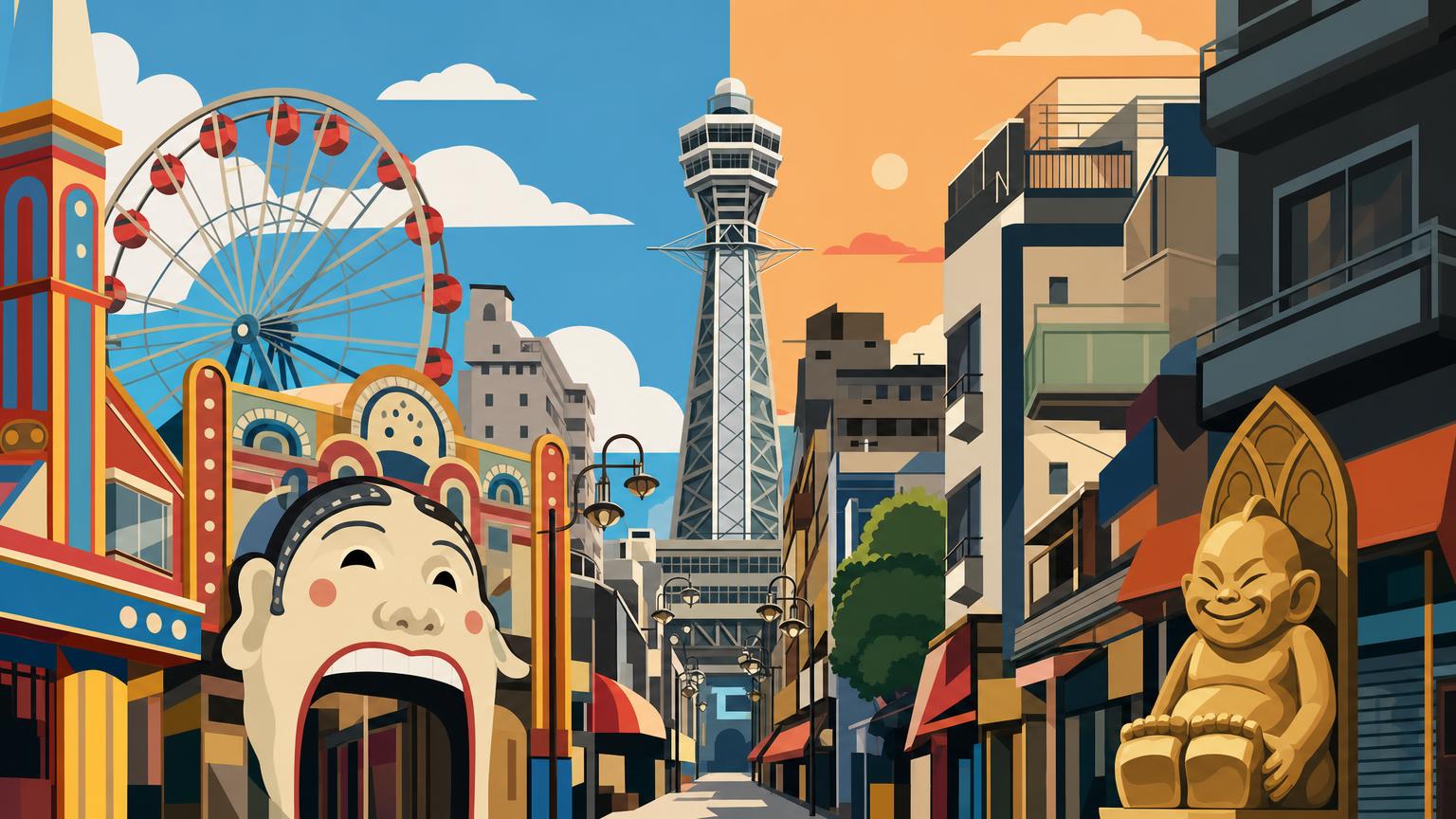
If you are deciding where Osaka begins to feel like a real city rather than a visitor’s version of Japan, Shinsekai is a useful place to look. It is not simply an old-fashioned entertainment district, and it is not merely a cheap food destination beneath Tsutenkaku Tower. It is a meeting point between several Osakas: the Osaka of industrial ambition, the Osaka of post-war survival, the Osaka of loud commercial pleasure, and the Osaka now being reshaped by tourism, short-term accommodation, and rising land interest.
For a foreign resident, Shinsekai can be confusing. One street may be lined with brightly painted kushikatsu restaurants and enormous cartoon signs. The next may contain a quiet apartment entrance, a small Buddhist temple, a welfare office, an elderly man sitting outside a café, or a business that seems to have survived unchanged for decades. It can feel theatrical and completely ordinary at the same time.
That contradiction is the point. Shinsekai shows how Osaka works when different social worlds are allowed to remain close together. It also explains why many foreigners misunderstand the city. Osaka is not simply “friendly” in a soft, universally welcoming sense. It is more direct, more observant, more commercially expressive, and often more tolerant of visible difference than the polished image of Japan suggests. Yet that tolerance has limits, and it does not mean that every outsider automatically understands the local rules.
The map below is included only to establish the area’s position within the wider city. Shinsekai sits between Tennoji and Nishinari, close to major railway lines and within easy reach of Namba, but its social atmosphere changes noticeably from one block to the next.
Shinsekai began as a planned dream of modern Osaka
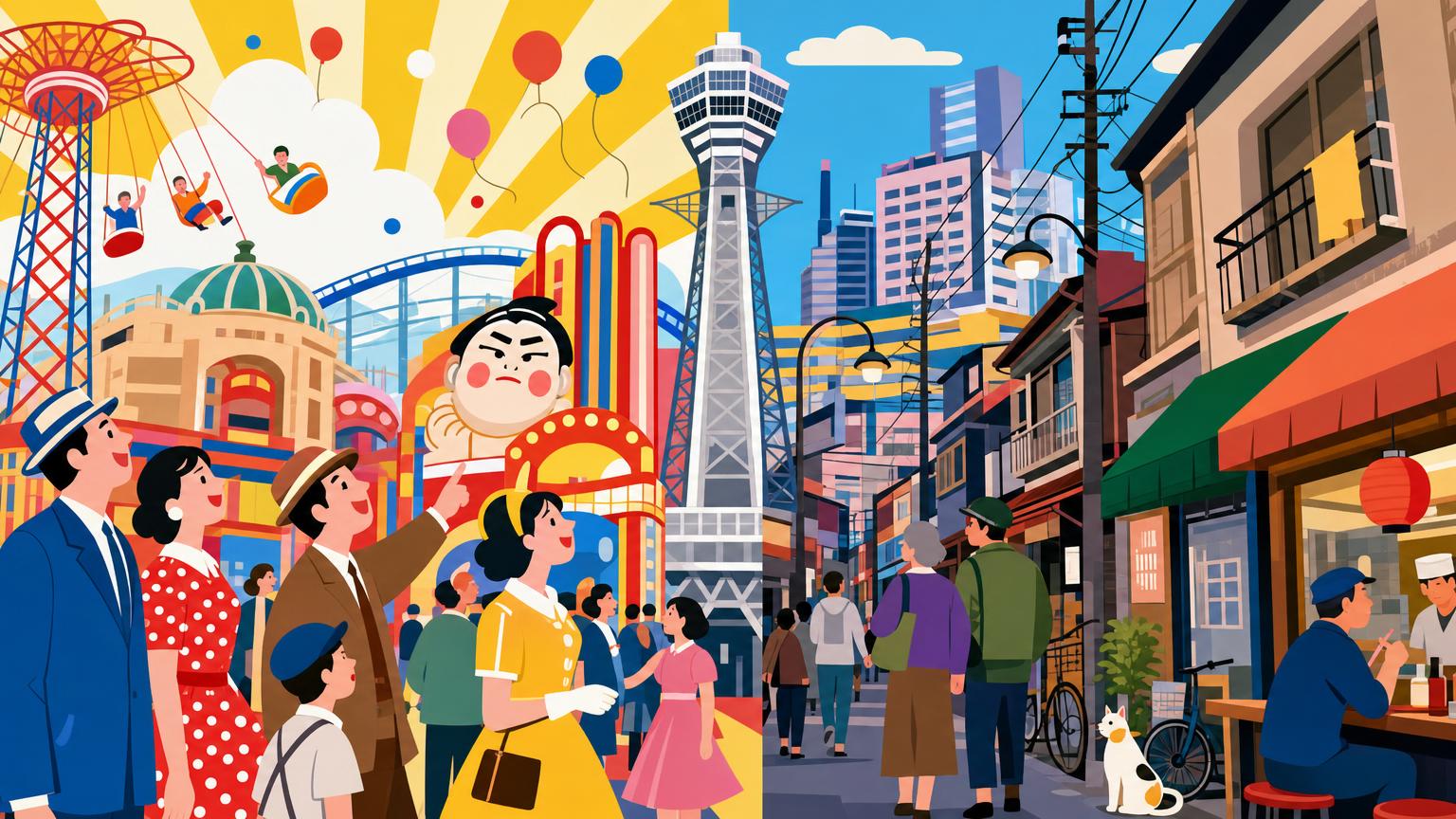
The name Shinsekai means “New World.” Today, that name sounds almost ironic because the area is associated with faded signs, old arcades, inexpensive eateries, and the visual language of the Shōwa period. Historically, however, Shinsekai was intended to represent the future.
Its modern development began after the Fifth National Industrial Exposition, held in Osaka in 1903. When the exposition closed, the site was reorganised as an entertainment and urban development district. The eastern side became connected to Tennoji Park, while the western side developed around an early Tsutenkaku Tower and Luna Park. The original plan drew on international imagery, including Parisian boulevards, an Eiffel Tower-like structure, and the idea of an amusement district partly modelled on attractions overseas.
This history matters because Shinsekai has always been a place where Osaka translated the outside world into a local language. It did not simply copy Paris, New York, or European modernity. Instead, it transformed those references into a distinctly Osaka commercial environment, defined by louder signs, affordable food, theatre, gambling-style entertainment, comic performance, and a strong emphasis on bringing people together physically.
That habit continues today. A foreign visitor may view the district as a retro theme park, while a long-time Osaka resident may see something less decorative: an old entertainment economy that has adapted to new customers without completely changing its social character.
This is one reason Shinsekai feels different from many historic districts in Tokyo. Tokyo often presents its past through carefully maintained fragments: a preserved shopping street, a renovated warehouse, or a shrine approached through an orderly commercial landscape. Shinsekai’s historical layers are less tidy. Its past is visible in patched façades, old business names, improvised signs, narrow entrances, and the continued presence of people whose lives are not designed for visitors’ comfort.
The area’s appeal does not come from being perfectly preserved. Rather, it comes from the fact that preservation, neglect, adaptation, and reinvention are all taking place at once.
Why Shinsekai feels more direct than central Tokyo
Foreigners often wonder why Osaka feels more relaxed or approachable than Tokyo. The answer is not that every Osakan is naturally outgoing; it is more useful to consider the city’s patterns of interaction.
Osaka has a long history as a commercial city. Merchants, traders, entertainers, manufacturers, labourers, migrants, and customers had to negotiate with one another in close quarters. In that environment, communication became practical. People needed to quickly determine whether a customer understood the price, whether a joke had landed, whether a complaint was serious, and whether a stranger could be trusted.
That practical quality may come across as warmth to foreigners, but it can also seem like bluntness. A shopkeeper may comment on your Japanese, your order, your appetite, or your confusion. A neighbour may ask a personal question sooner than someone in Tokyo would. A colleague may use humour to reduce hierarchy, gauge your reaction, or make a difficult conversation easier.
The important point is that Osaka-style openness is often interactive. You are expected to respond. A silent smile may be polite in one setting, but in Osaka it can sometimes leave the exchange unfinished. If someone jokes with you, replying with a small joke may establish trust more effectively than giving a formal answer. If a shopkeeper offers practical advice, acknowledging it clearly matters. If you make a mistake, a brief apology followed by action is often better than a lengthy explanation.
This does not mean foreigners should perform a caricature of Osaka. You do not need to become loud, comic, or artificially familiar. What helps is showing that you are engaged in the conversation rather than hiding behind perfect politeness.
Shinsekai makes this especially visible because many businesses operate at close range. Customers sit at counters, and restaurant staff can see whether you are reading the menu, waiting for service, or unsure how to eat something. A small arcade can place strangers shoulder to shoulder. A local café may have regulars who recognise one another through routine rather than formal introductions.
The social rule is simple but easy to miss: participation matters more than performance. People may not expect you to know every rule, but they often notice whether you are paying attention.
The “retro theme park” is also a working neighbourhood
The most common misunderstanding about Shinsekai is assuming that its retro appearance tells you what the area is for. It does not.
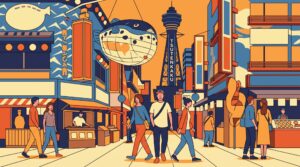
The large signs, pufferfish lanterns, tower imagery, and old-fashioned streetscape have become part of Osaka’s public identity. They attract visitors, create photo opportunities, and support restaurants and accommodation. Yet behind this visible layer are ordinary urban functions: housing, convenience stores, clinics, laundries, schools, religious buildings, small offices, delivery routes, rubbish collection, and local shopping.
A neighbourhood does not stop being a neighbourhood simply because visitors enjoy its atmosphere. In fact, the tension between tourism and daily life is one of the defining features of contemporary Shinsekai.
If you live in Osaka, you will recognise this tension in other districts. A shopping street may be promoted as a cultural destination while local residents use it to buy vegetables. A café may be praised online as hidden and authentic even though its owner is simply trying to run a small business. An alley may appear atmospheric to a visitor but serve as the route residents take to carry groceries, bring children home, or move goods between shops.
The responsibility of a foreign resident is not to avoid older or poorer-looking areas. It is to understand that visual authenticity is not a product waiting to be consumed. It belongs to people whose lives continue after visitors leave.
This is what distinguishes Shinsekai from a purpose-built tourist quarter. The district has certainly become more tourist-oriented, particularly around its central streets. However, the tourist economy has been placed over an existing social landscape rather than built on empty ground. The result is uneven. Some businesses have prospered, and some streets have become more polished. Other places still serve customers who have no interest in the area’s image as “retro Osaka”.
For anyone considering living in Osaka, this is useful information. A neighbourhood can be convenient, affordable, and culturally interesting while still requiring sensitivity. You may enjoy the food and walkability but dislike the noise, visitors, late-night activity, or visible poverty nearby. The question is not simply whether Shinsekai is good or bad, but whether its contradictions suit the kind of daily life you want.
The history behind the rough reputation
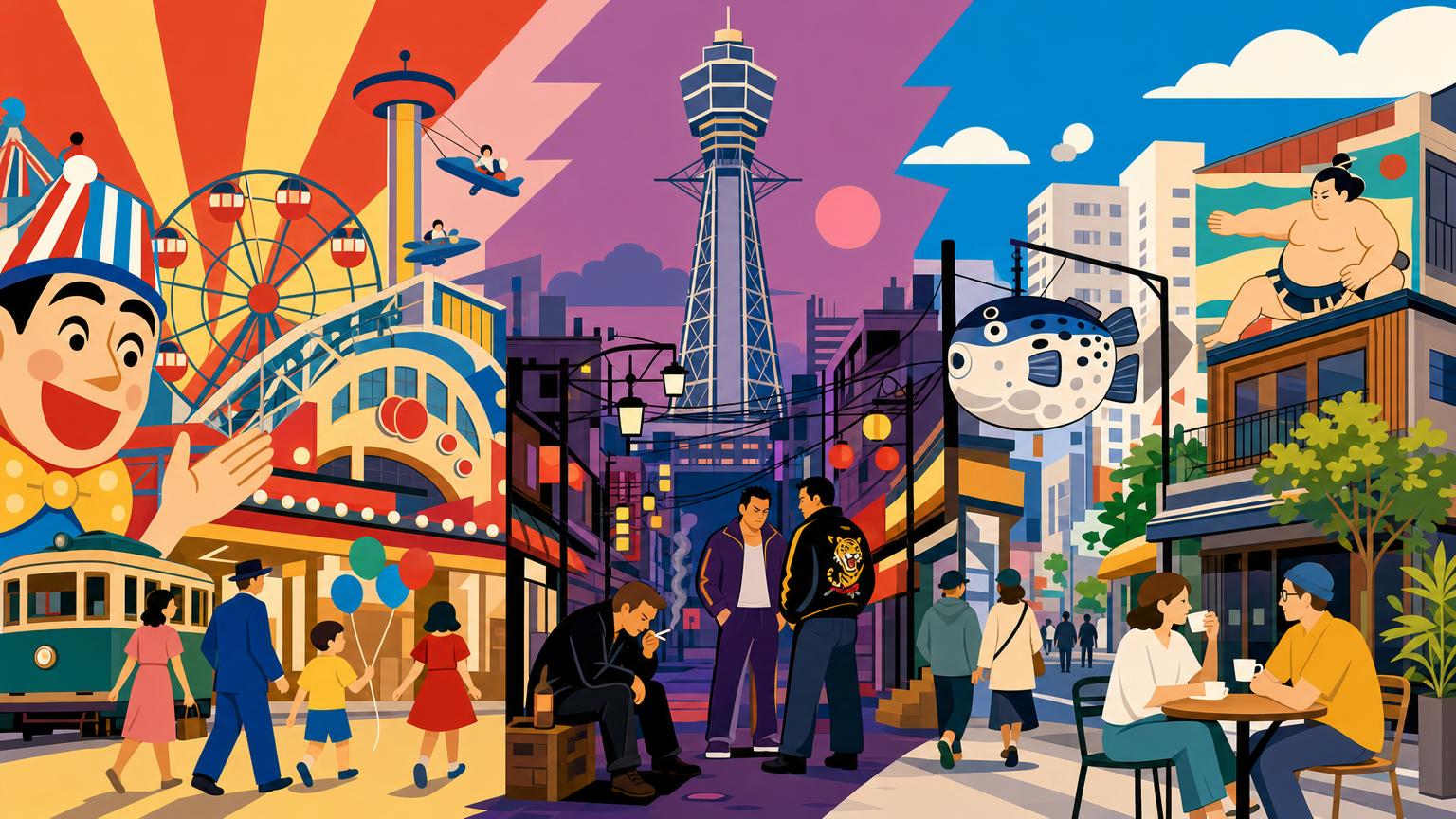
Shinsekai’s gritty reputation did not emerge from nowhere. The area’s fortunes declined after the entertainment boom of the early twentieth century. War damage, economic change, shifting leisure patterns, and the movement of investment toward other parts of the city all affected the district. Nearby Nishinari became closely associated with day labour, homelessness, poverty, and social exclusion.
Those histories are often reduced to a single foreign-language warning: “Is Shinsekai dangerous?” The question is understandable, but it can be too blunt to be useful.
Shinsekai is now a heavily visited and generally safe tourist destination. Basic street awareness is sensible, as it is anywhere. Keep control of your belongings, be cautious around intoxicated people, avoid photographing people without permission, and do not enter unfamiliar private businesses simply because they look interesting. However, most visitors are not entering a zone of constant danger. The greatest risks are usually discomfort, confusion, aggressive solicitation in certain nightlife contexts, or the possibility of behaving disrespectfully toward residents.
The area’s old reputation often reflects class prejudice as much as objective risk. Some people see poverty, homelessness, ageing, or rough clothing and interpret those visible signs as evidence of personal danger. That is not a reliable way to understand a city. An older man sitting alone in a public space may be economically vulnerable without posing any threat. A loud argument may be unpleasant without becoming violent. A neglected building may indicate disinvestment rather than immediate danger.
At the same time, do not replace one stereotype with another. Shinsekai is not a romantic museum of harmless old men and charming poverty. The surrounding area faces real social problems, including isolation, addiction, housing insecurity, and the long-term consequences of labour-market exclusion. Recent reporting has also described redevelopment and new investment in Nishinari while raising questions about the displacement of long-time residents.
A mature understanding holds both facts together: you are unlikely to be in danger simply because you walk through Shinsekai, and the area’s social history should not be turned into entertainment.
What foreigners often misunderstand about safety
“It looks rough, so it must be dangerous”
This is the most obvious mistake. Japan’s urban environments are often exceptionally clean and orderly, so a district with litter, old signage, visible drinking, or people sleeping outdoors may feel more threatening than it actually is. The visual contrast can be powerful.
Use behaviour rather than appearance as your guide. Is someone following you? Blocking your path? Pressuring you to enter a business? Is a group becoming aggressive? These are more meaningful signals than whether a building looks old.
“Japan is safe, so nothing can happen”
The opposite mistake is also common. Safety is not a magical condition in which ordinary judgement is no longer necessary. Do not leave your wallet on a counter, wander into private areas, accept unclear offers from strangers, or assume that a crowded restaurant cannot overcharge you. Osaka is safe, but it is still a large city with nightlife, poverty, alcohol, and commercial pressure.
“Local people do not want foreigners here”
Some residents are tired of noise, photography, short-term rentals, or visitors who treat private life as scenery. That does not mean they reject foreigners. It is a complaint about behaviour.
A person who has lived beside a busy alley for decades may have little patience for someone standing in the middle of the road to take a photograph. A shopkeeper may welcome foreign customers while disliking those who ignore seating rules. In Osaka, acceptance is often earned through conduct rather than guaranteed by good intentions.
The food culture explains Osaka better than the tower does
Shinsekai’s most famous food is kushikatsu: deep-fried skewers of meat, seafood, vegetables, and other ingredients. It is often described as cheap Osaka soul food, but that description can be overly sentimental. Kushikatsu reflects several local habits at once: eating quickly or casually, sharing a lively counter space, making inexpensive ingredients satisfying, and turning a meal into a form of social theatre.
The traditional rule is no double-dipping. A shared container of sauce sits on the table, and diners should not dip a partly eaten skewer into it again. Historically, this was a basic rule of hygiene and etiquette. During the pandemic, many restaurants shifted more clearly toward individual squeeze bottles or small servings of sauce. Today, the arrangement varies from restaurant to restaurant, so observe what is provided and follow the house system.
The practical rule for a foreign resident is not to assume that the English explanation represents the whole culture. Watch what other customers do. If the sauce is communal, dip once before taking a bite. If a squeeze bottle is provided, use it carefully over your own plate. Do not pour out more than you need. If you are unsure, ask with a short phrase such as “kore wa?” while pointing. Staff are accustomed to helping customers who do not know the routine.
Kushikatsu also demonstrates a broader Osaka attitude toward food. A meal does not need to be ceremonious to be important. A counter restaurant can have rules, pride, and history without appearing formal. The atmosphere may be noisy, but the cooking is not necessarily careless. The menu may be inexpensive, but regulars may still judge the batter, oil, sauce, timing, and portions.
Foreigners sometimes interpret casual food as a sign of low standards. In Osaka, casualness and seriousness coexist. A small restaurant may not offer polished service, but the owner may be intensely proud of one dish. A customer may joke with the staff and still complain if the food is poor. The relationship is informal, not indifferent.
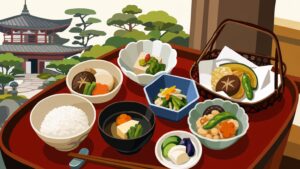
Other foods associated with the area, such as dote-yaki, takoyaki, okonomiyaki, and simple rice-based meals, also reflect Osaka’s practical food culture. The city has a strong tradition of building social connections through affordable eating. Food is not merely a regional symbol; it is part of how people maintain relationships, spend time, and show that there is always room for one more person at the table.
The tower is a cultural signal, not just an attraction
Tsutenkaku is the visual centre of Shinsekai, but its deeper importance lies in what it conveys. It represents Osaka’s willingness to make public identity visible, humorous, and commercial.
The original tower was built during Shinsekai’s early modern development, while the present tower emerged after the earlier structure was lost. Its design history connects Osaka with international models, but its local meaning is more significant than its architectural references. Tsutenkaku became a symbol of the city’s southern downtown and its entertainment culture.
In Tokyo, a major tower may suggest national modernity, corporate power, broadcasting, or metropolitan prestige. Tsutenkaku carries some of these meanings, but it is also more personal and slightly comic. It belongs to the neighbourhood. Its image appears on signs, restaurant branding, souvenirs, local promotions, and everyday visual culture. The tower is not distant from the people below; it is part of their commercial vocabulary.
This relationship reveals something about Osaka. The city often turns landmarks into characters. A building is not merely a structure; it becomes a neighbour, a mascot, a joke, or a familiar face. This helps explain why Osaka’s commercial signs can seem louder and more playful than Tokyo’s. The city is comfortable expressing a public personality.
For daily life, this can be reassuring. Osaka’s urban environment often gives you clues about how to behave. A sign may use humour to soften an instruction. A restaurant may use exaggerated decoration to signal informality. A shop may display a local reference that tells regular customers, “This is our kind of place.” You do not need to understand every joke, but recognising that the city communicates through humour will help you read it.
Smart Ball and the value of low-cost pleasure
Smart Ball New Star is often presented as a retro attraction, but its significance is social rather than nostalgic. The game belongs to an older form of leisure in which entertainment did not require a large screen, a reservation, or a substantial budget. Players could spend a small amount of money, focus for a few minutes, and perhaps exchange their winnings for a simple prize.
The game resembles a mechanical combination of pinball and early pachinko. Its continued existence reflects Shinsekai’s resistance to the idea that every leisure activity must become technologically advanced or premium. The hall has been described as one of Osaka’s few remaining dedicated smart-ball venues, with a history stretching back more than half a century.
A foreign resident may see this as charmingly old-fashioned. A local may view it as something more ordinary: a place where the price, pace, and social scale feel manageable. That matters in a city where entertainment can otherwise become expensive and crowded.
The same principle can be seen in older cafés, small karaoke rooms, public bathhouses, neighbourhood festivals, and standing bars. Osaka’s culture is not defined solely by famous food or jokes. It is also shaped by the availability of small pleasures that do not require wealth or status.
This is one reason the city can feel more socially mixed than Tokyo’s central districts. The comparison should not be overstated; Osaka also has inequality, exclusion, and expensive areas. But Shinsekai makes visible a tradition of public life in which a worker, pensioner, visitor, student, and shopkeeper may share the same commercial space without needing to come from the same social background.
The neighbourhood’s language: teasing, testing, and trust
To understand people in Osaka, pay attention to how humour works.
Osaka humour is often associated with comedy culture, but everyday humour tends to be less theatrical. It might be a quick comment at a shop counter, a teasing observation about your pronunciation, or a deliberately exaggerated complaint. The aim is not always to make you laugh. Sometimes it is a way to see whether you are relaxed, whether you recognise irony, or whether the relationship can move beyond formal distance.
A foreigner may hear a blunt remark and assume hostility. Another may hear the same remark and assume instant friendship. Both interpretations can be wrong.
The real meaning depends on repetition, context, tone, and what happens afterwards. Does the person continue helping you? Do they make room for you? Do they remember you the next time? Do they tease everyone, or only you? Communication in Osaka is often relational. A single sentence tells you less than the pattern of behaviour surrounding it.
If someone jokes with you, you can respond lightly without trying to outdo them. If a comment makes you uncomfortable, you are allowed to set a boundary. Osaka’s directness is not a licence for people to disregard consent. Nor should foreigners assume that every local person appreciates loud English, forced jokes, or attempts to imitate the Kansai dialect.
The Kansai language itself has social nuances. The rhythm and vocabulary of Osaka speech can make a conversation sound more animated, but using a few phrasebook words will not automatically create intimacy. In some situations, it may be appreciated; in others, it may sound performative. Listen first. Learn how the people around you speak to one another. Use standard Japanese confidently rather than treating dialect as a costume.
Shinsekai and the Osaka–Tokyo contrast
The comparison between Osaka and Tokyo is useful only when it goes beyond the usual clichés.
Tokyo often rewards controlled self-presentation. People may protect their privacy, avoid unnecessary confrontation, and allow social distance to remain visible. Osaka also values restraint, but in many settings, it places greater emphasis on responsiveness. Conversations may become personal more quickly. A shopkeeper may be more willing to comment, while a colleague may openly challenge an idea but treat the disagreement as temporary.
Tokyo’s scale can make anonymity feel comfortable. Osaka’s scale, particularly in older neighbourhoods, can make recognition more important. The same shop, café, clinic, or station staff member may appear repeatedly in your daily life. People notice routines. They may know that you shop on Sunday mornings, take the same train, or always order the same lunch.
For foreigners, this can be both comforting and demanding. You may receive more informal help, but you may also find that your behaviour is remembered. If you are rude once in a small local business, your next visit may feel different. If you show consideration, the relationship can grow warmer over time.
Tokyo can sometimes feel easier for foreigners who prefer to remain invisible. Osaka may feel easier for those who want everyday contact but do not mind being noticed. Neither city is one-dimensional, and neighbourhoods vary greatly. Even so, this distinction is useful when considering where to live.
Shinsekai sits at the more visible end of the Osaka spectrum. It is not a quiet residential enclave. It displays both its history and its contradictions. In a compact area, you can encounter commercial energy, poverty, religious life, tourism, and ageing. The city does not always separate these worlds into neatly branded zones.
That closeness can feel untidy. It can also feel honest.
The changing economics of Shinsekai
Shinsekai is changing because the economics of central Osaka are changing. Tourism, hotel development, short-term accommodation, foreign visitors, food media, and redevelopment have brought increased attention to districts once treated as marginal.
This process can bring benefits. New businesses open, buildings are repaired, and streets become busier. Local food traditions gain customers, while people who previously avoided the area may discover its history. Foreign residents may find more affordable accommodation and better access to transport than in the city’s most fashionable areas.
However, development can also simplify a neighbourhood. A complicated place may be repackaged as “retro Osaka”. The poverty that shaped its history may be hidden or treated as visual atmosphere. Long-time businesses may face rising rents or changing customer expectations. Residents may be asked to accept noise, crowding, and surveillance in exchange for the promise of economic improvement.
This is not unique to Osaka. Cities around the world turn older districts into lifestyle products. What distinguishes Shinsekai is the density of the contrast. A brightly lit restaurant may stand only a short walk from people experiencing severe hardship. A new foreign-owned accommodation business may operate beside a long-established local shop. A tourist may photograph the same street where a resident is heading to a welfare appointment.
The ethical question is not whether outsiders should visit, but whether they can enter without reducing people to scenery.
For someone considering living in Osaka, pay attention to the pace and direction of change. Ask whom the neighbourhood serves at different times of day. Are there supermarkets and everyday services, or mainly restaurants and accommodation? Do the streets become empty after the tourist businesses close? Are local residents still visible in the commercial spaces? Are rents rising? Is transport convenient enough for work and school?
These questions are more useful than asking whether an area is “authentic”. Authenticity is not a stable property. It is often the name given to a neighbourhood just before its social composition changes.
What daily life around Shinsekai actually feels like
Daily life is less dramatic than the district’s image suggests. On a typical morning, shutters open, deliveries arrive, workers pass through the stations, and older residents follow familiar routes. The signs may still appear theatrical, but the rhythm is practical.
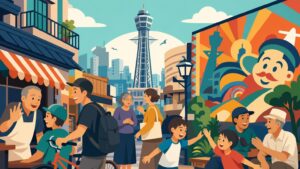
In the afternoon, the area can feel mixed. Visitors move between restaurants and arcades, while local customers run errands and schoolchildren pass through. People meet for coffee. Some streets are lively, whereas others are quiet enough for residents to hear bicycles and delivery carts.
In the evening, the atmosphere depends greatly on the specific street. Some eateries are busy, while some older establishments close earlier than outsiders might expect. Shinsekai is not one continuous all-night district in the way parts of Namba or Dotonbori can be. Many traditional restaurants and retro arcades typically close between 8:00 PM and 10:00 PM, although individual hours vary and newer businesses may stay open later.
This matters if you are planning for everyday life rather than a sightseeing schedule. Do not assume that a district known for nightlife will offer late-night services on every street. Your preferred supermarket, pharmacy, café, or restaurant may follow a very different timetable from the tourist image of the area.
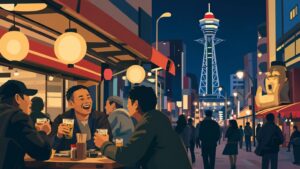
Late afternoon and early evening often show the district at its best. The signs are illuminated, restaurants are active, and residents are still using the streets. Later at night, the visitor population may thin out as some businesses close and other forms of nightlife become more prominent. The area may remain safe, but it may not feel equally comfortable to everyone.
A foreign resident should visit at several different times before deciding whether to live nearby. Go on a weekday morning, a weekend afternoon, and an evening. Listen to the noise, check the walk from the station, and look at the nearest supermarket. Notice how far you must travel for a clinic, gym, or quiet workspace. A neighbourhood’s reputation cannot answer these practical questions.
How to behave if you live nearby
Treat the street as shared space
Do not stop in the middle of narrow roads to take photographs or check your phone. Move to the side instead. Keep luggage and bicycles away from entrances. If a delivery worker or resident needs to pass, let them through immediately.
Ask before photographing people
Shinsekai offers many visually striking scenes, but residents are not part of a public display. Avoid photographing people who are sleeping, receiving assistance, arguing, or simply sitting alone. If a shop owner or performer welcomes photographs, follow the conditions they provide.
Learn the difference between a public business and a private community
A restaurant, arcade, café, or bar may be open to customers, but it can still have local expectations. Seating may be limited. Ordering may take place at a machine. Cash may be preferred. A regular customer may have an informal place. Observe before acting, and ask without embarrassment when necessary.
Do not confuse informality with permission
Osaka’s casual tone can make foreigners feel that they may say anything. That is not the case. Jokes about poverty, homelessness, nationality, sex, or appearance can become cruel very quickly. A local person making a joke within a long-standing relationship is not automatically giving a stranger permission to repeat it.
Accept that not every place is designed for you
Some small establishments may have no English menu, no card payment, no room for luggage, or no interest in serving a large group. This is not necessarily discrimination. Sometimes the business is physically small, old, family-run, or operating on a narrow margin. If the arrangement does not suit you, leave politely and choose another place.
Build recognition slowly
If you want to develop local relationships, return to the same places. Learn a few names. Say hello. Remember basic routines. Osaka friendliness is often cumulative, growing through repeated, low-pressure contact rather than one dramatic conversation.
Is Shinsekai a good place to live?
The honest answer is that it can be, depending on what you value.
Shinsekai may suit a foreign resident looking for central transport, strong local character, older buildings, inexpensive food, and easy access to Tennoji, Namba, and Nishinari. The area can be more affordable than fashionable central districts, although prices vary by building, station, and the changing accommodation market. The transport network is practical, offering access to Dobutsuen-mae Station, Ebisucho Station, Shin-Imamiya Station, and nearby connections to Tennoji.
It may not suit someone who prefers quiet streets, polished surroundings, predictable late-night services, or a neighbourhood where social problems are mostly out of sight. Families should inspect the exact block rather than judge the district as a whole. Remote workers should check noise levels, natural light, and apartment insulation. People who are sensitive to cigarette smoke, alcohol-related activity, or crowded tourist streets should visit in the evening before signing a lease.
The key decision is not whether you like the district for two hours, but whether you can live with its full daily cycle.
You should also distinguish Shinsekai from the broader areas around it. The streets near Tsutenkaku, Janjan Yokocho, and the main concentration of restaurants have a different atmosphere from the quieter edges toward Tennoji, Ebisucho, or Nishinari. Station access can significantly change the experience. An apartment described as “near Shinsekai” may be close to a lively commercial street or a much quieter residential lane.
For foreigners, another consideration is how much visibility you want. In a highly international district, you may find familiar food and services but experience less local interaction. In an older neighbourhood, you may have more opportunities to become known, but you may also need greater patience with paperwork, communication, and unspoken expectations.
How Shinsekai explains Osaka
Shinsekai is valuable because it prevents us from developing an overly polished understanding of Osaka.
It presents a city that enjoys spectacle but does not always separate spectacle from ordinary life. It shows that humour can function as a social tool rather than a personality label. It demonstrates that commercial energy can coexist with poverty, ageing, and memory. It reveals that a neighbourhood can be safe without feeling comfortable in every emotional sense. It also shows that redevelopment can improve a place while threatening the relationships that made it meaningful.
Most importantly, Shinsekai demonstrates that Osaka’s openness is not the same as universal ease. People may speak more directly, joke more quickly, and welcome strangers into informal spaces, but they still expect attention, reciprocity, and respect for local boundaries.
If you are living in Osaka, or considering moving here, spend time observing these small exchanges. Watch how a customer greets a shopkeeper. Notice who waits for whom at a narrow entrance. Listen to whether a joke invites participation or brings a conversation to an end. Observe how people use a public bench, a shopping street, or a restaurant counter. These details reveal more about the city than any list of famous attractions.
Shinsekai was once built as a “New World.” Today, its soul lies in the fact that several worlds remain visible at once. The retro theme park is still there, beneath the lights and signs. Around it, however, are workers, residents, business owners, newcomers, older people, tourists, and people navigating difficult lives. The district’s future will depend on whether Osaka can modernise without flattening these differences into a single marketable image.
For a foreign friend asking what Osaka people are really like, I would not begin by saying that they are simply friendly. I would say this instead: Osaka often gives you room to enter the conversation, but it expects you to notice where you are standing. Shinsekai is where that lesson becomes impossible to miss.