

A corporate meeting in Osaka can begin with the same quiet ritual found in offices across Japan: laptops open, documents aligned, coffee placed carefully beside the notepad, and everyone waiting for the senior person to speak. Then someone makes a small joke about the presentation, the train delay, the weather, or the impossible number of revisions requested by headquarters. A few people laugh. The room loosens. The discussion moves.
For foreigners living in Osaka, this can be confusing. Is the joke a sign of disrespect? Is the speaker avoiding the real issue? Is a senior manager testing the room? Or is everyone simply being friendly?
Often, the answer is more practical than emotional. In Osaka workplaces, banter can be a way to make disagreement speakable. It can lower the temperature of a meeting, reduce the distance between people, and help a group move from personal tension back toward a shared problem. The humor is not always gentle, and it is not always successful. But when it works, it functions almost like office equipment: not decorative, but useful.
This does not mean every Osaka company is relaxed, informal, or constantly funny. Japanese workplaces still contain hierarchy, indirect communication, long silences, and strong expectations about responsibility. Osaka is not a comedy stage. The important difference is that many Osakan interactions leave more room for a quick verbal turn, a playful complaint, or a self-deprecating remark that would feel risky in a more formal setting.
The city’s reputation for humor comes partly from its history as a merchant city, or akindo culture, and partly from the continued influence of Kansai entertainment. Researchers have connected Osaka’s culture of laughter with merchant negotiation, horizontal social relationships, and the need to ease tensions during competition. In everyday office life, that history appears not as a grand philosophy but as a small habit: say something that lets people breathe before asking them to compromise.
The map below is not a sightseeing route. It is a reminder that Osaka’s working life is spread across different kinds of neighborhoods: business districts, residential areas, shopping streets, factories, universities, and commuter suburbs. The tone of an office can change from Umeda to Namba, from Honmachi to Higashiosaka, and from a global company to a family-run business. Osaka is one city, but it is not one workplace culture.
The Real Question: Is the Joke Helping or Avoiding?

When an Osakan colleague jokes during a meeting, the safest first question is not, “Was that funny?” but, “What did the joke make possible?”
A joke may allow someone to disagree without sounding aggressive. It may signal that a difficult topic is open for discussion. It may invite a quieter colleague to join the conversation. It may also conceal discomfort, delay a decision, or put pressure on the person least able to respond.
The same sentence can serve different purposes depending on timing, relationship, and hierarchy. A manager saying, “Well, that plan has only three small problems,” may be inviting the team to continue. A junior employee saying the same thing about a senior manager’s proposal may be taking a serious risk. The words are identical, but the social position is not.
Foreign residents sometimes make one of two opposite mistakes. They assume Osaka banter is always harmless because people are laughing, or they assume every joke is coded criticism that must be translated into a serious complaint. Neither approach is reliable.
A better method is to observe what happens next.
If the meeting becomes more specific, the joke probably helped open the issue. If people begin offering alternatives, asking questions, or acknowledging their own concerns, the humor served a cooperative purpose. If the room laughs but nobody addresses the problem, the joke may have provided pressure relief without producing consensus. If one person stops speaking, looks down, or becomes unusually formal, the joke may have crossed a line.
In Osaka, laughter does not automatically mean agreement. It can indicate recognition, embarrassment, politeness, surprise, or simply enjoyment of the speaker’s timing. Do not record every laugh as approval. In a meeting, the real evidence is the quality of the discussion that follows the laugh.
The Roots of Osaka Business Humor: A Merchant City’s Legacy
Why Osaka Does Business Differently from Tokyo
The contrast between Osaka and Tokyo is often exaggerated into a cartoon. Tokyo is supposedly cold and formal, while Osaka is supposedly warm and funny. Real life is more complicated. Both cities have formal companies, blunt managers, quiet employees, aggressive sales teams, and generous colleagues.
Still, the contrast does exist as a difference in conversational expectations.
For centuries, Osaka developed as a commercial center where traders gathered, goods moved, prices were negotiated, and relationships had to be maintained across repeated transactions. Osaka is often called the “kitchen of Japan” because of its role in rice trading and distribution, while local expressions such as kuidaore reflect a culture that views food, spending, pleasure, and practical value as interconnected parts of life.
A merchant does not need to project the dignity of a warrior. A merchant needs to make the deal workable. Doing so requires reading the other person, checking whether trust exists, understanding what can be adjusted, and keeping the relationship alive even when negotiations become tense.
This is one reason Osaka’s traditional communication style is often associated with what scholars describe as a relatively horizontal merchant society. Humor can soften status differences, make self-criticism possible, and reduce the risk of direct confrontation. The point is not that Osakans reject hierarchy. They do not. Rather, hierarchy may become temporarily easier to handle when someone can laugh at the situation without damaging the relationship.
By comparison, Tokyo’s business culture is often experienced through national institutions, headquarters, ministries, major corporations, and more standardized forms of speech. This does not make Tokyo less human. It means that the surface of interaction can be more controlled, particularly when people do not yet know one another.
In Osaka, the conversational surface may become informal sooner. A colleague may complain about a client, tease the boss, or turn a failed sales pitch into a story before the relationship feels fully established. This can seem wonderfully direct to one foreign resident and dangerously familiar to another. Both reactions are understandable.
The Art of the Icebreaker in Kansai Corporate Culture
An Osakan icebreaker often does not sound like an icebreaker. It may take the form of a complaint disguised as a joke.
“The budget is healthy. It simply does not want to move.”
“The client requested a quick revision, so naturally we prepared for the next fiscal year.”
“The meeting room is available, which means someone forgot to book it.”
These lines do not resolve the budget, deadline, or booking problem. They perform a smaller but important function: they give the group a shared description of the absurdity. Once people recognize that they are dealing with the same inconvenience, it becomes easier to discuss what should be done.
This is particularly useful in meetings where everyone already understands the problem, but nobody wants to be the first to state it plainly. A humorous remark can serve as a trial balloon. If the room responds positively, the speaker can become more direct. If the room remains silent, the speaker can withdraw and rephrase the point in formal language.
That flexibility is one of the practical strengths of Osaka-style banter. It gives people a way to test the emotional atmosphere before committing to a confrontational statement.
Humor as a Horizontal Gesture
A useful Osakan joke usually does not say, “I am above you.” Instead, it says, “We are all caught in this situation together.”
The speaker may make fun of their own mistake, exaggerate the difficulty of the task, or point out the strange logic of company procedures. This creates a temporary horizontal space within a hierarchical meeting. The manager remains the manager. The client remains the client. The junior employee remains junior. But for a few seconds, everyone is looking at the same ridiculous problem.
That shared perspective can make consensus easier. People do not have to agree that the situation is pleasant. They only need to agree that it is recognizable.
This is why self-deprecating humor is often safer than direct teasing. A manager who says, “I have once again created a beautiful schedule that no human being can follow,” is giving the team a way to respond. A manager who says, “You people never understand schedules,” is assigning blame.
The difference is not simply whether the words are funny. It is where the responsibility falls.
Banter as a Practical Tool for Consensus
It Creates a Shared Emotional Starting Point
Consensus does not come from data alone. A team may understand the facts and still remain divided because people feel blamed, ignored, or embarrassed.
Banter can establish a shared emotional starting point before the group returns to the facts. Someone might say, “We have reached the rare situation where sales, production, and accounting are all unhappy.” The sentence does not provide a solution, but it acknowledges that the problem is spread across departments.
Once the group recognizes the problem as shared rather than belonging to one person, negotiation becomes less defensive. The sales team no longer needs to prove that production caused the delay, and production no longer needs to prove that sales made an impossible promise. The question can shift to, “What can each side change this week?”
This is where Osaka’s practical communication style can be useful. The humor is not necessarily intended to be clever. Instead, it turns a threatening situation into a shared scene.
It Allows Disagreement Without Immediate Escalation
Japanese workplace communication often relies on indirectness, but indirectness does not always indicate agreement. A colleague may say, “That could be difficult,” when they mean, “We cannot do that.” A manager may say, “Let us consider the timing,” when they mean, “Not now.” Foreign residents can spend months learning to recognize these soft refusals.
Osakan banter adds another layer. A colleague might respond to an unrealistic proposal with a laugh and say, “That is a very ambitious dream.” The phrase may sound playful, but it also serves as a warning. If you interpret it as enthusiasm, you may miss the message.
At the same time, humor can make disagreement feel less personally threatening. Rather than saying, “Your estimate is wrong,” someone may say, “That estimate is living in a very optimistic neighborhood.” The criticism remains, but the wording gives the other person an opportunity to revise without publicly losing face.
This is not always fair. Humor can also be used to avoid accountability. However, within a cooperative relationship, it can preserve a person’s dignity while still making the problem visible.
It Turns Conflict into a Story the Group Can Handle
Office conflict often becomes easier to manage when people can describe it as a situation rather than as a moral failure.
Imagine a project that has missed two deadlines. In a formal meeting, the discussion may turn into a series of defensive explanations. In a more Osakan exchange, someone might say, “This project has developed its own calendar.” The phrase is amusing because it is almost true. It also gives the group a new framework: the process is malfunctioning, and the group needs to redesign it.
The humor does not remove responsibility. A good facilitator follows it with a specific question: “So which part of the calendar should we change first?”
This is the essential transition from banter to consensus. Humor opens the door, but specific action must still pass through it.
It Invites Informal Knowledge
The most valuable information in a workplace is not always included in the meeting materials. A junior employee may know that a supplier will never accept the proposed delivery date. A veteran assistant may understand which client request is temporary and which will become a permanent burden. A technician may know that the official process is impossible to follow on the factory floor.
A rigid meeting can keep this knowledge from surfacing. People speak only when directly invited, and they may soften the truth until it becomes useless.
A light joke can encourage hidden information to enter the discussion. “The official process is very elegant. Has anyone tried using it on a real Tuesday?” This kind of comment signals that practical experience is welcome.
Foreign employees sometimes worry that laughing at company rules is disloyal. In Osaka, mild criticism of the system can indicate that people care about making it work. The key is whether the speaker follows the joke with useful knowledge or merely performs cynicism.
How an Osakan Meeting May Feel Different
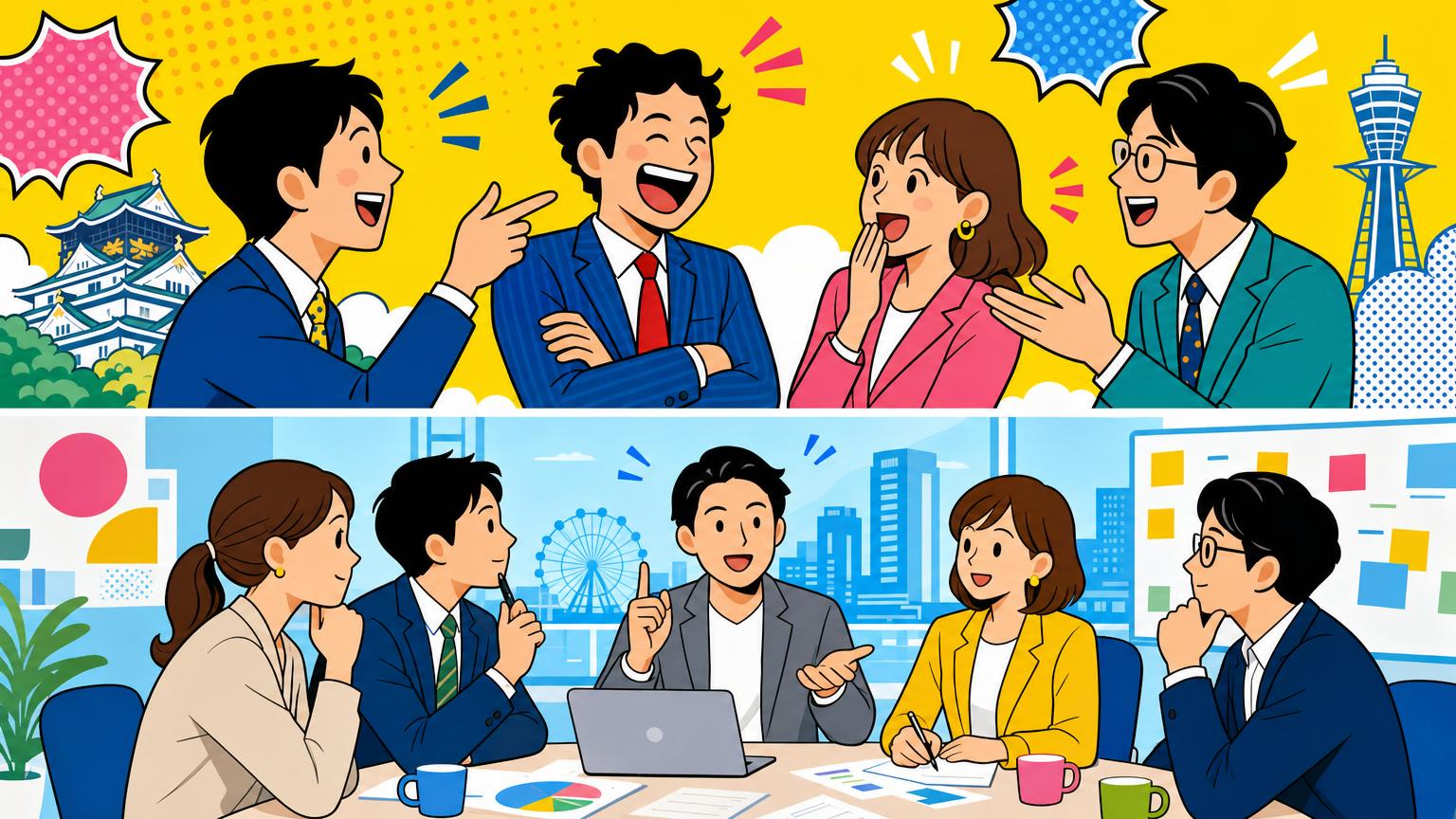
The Room Can Become Informal Before a Decision Is Made
In many Japanese offices, formality does not disappear simply because people are joking. A meeting may shift from polite language to casual banter and back again several times.
This movement is not random. A speaker may use formal Japanese when representing the company, then briefly switch to Kansai-ben to express surprise, empathy, or humor. Research on Kansai business interactions has described these shifts as a way of creating an informal frame within a formal conversation, particularly when participants are working to resolve a problem.
For a foreign listener, this sudden change can be difficult to follow. The same person who says, “We will review the matter internally,” may later say, “That is a bit much, no?” in a warmer local register. The second sentence may convey more emotional information than the first.
Listen for the change in stance. Formal language often signals the company’s official position. A softer or more local expression may reveal the speaker’s personal reaction, sympathy, doubt, or willingness to negotiate.
Silence Still Matters
Osaka’s reputation for talk does not mean that meetings there are noisy from beginning to end. Silence remains meaningful. After a joke, people may pause while deciding how far they can go. A delayed response may indicate uncertainty rather than disapproval.
Do not rush to fill every silence with more humor. One joke can open a door, while three jokes may seem like an attempt to control the room.
The most effective Osakan communicators often alternate between energy and restraint. They make a quick remark, wait, and then listen carefully. The banter works because it is not a monologue.
The Meeting May Continue Informally in the Corridor
A formal decision is sometimes prepared before or after the official meeting. People may discuss the real obstacles while walking to the elevator, making coffee, or waiting for a taxi after a client dinner. A joke made during the meeting can become the starting point for this quieter conversation.
For foreign residents, this means that the scheduled meeting’s conclusion may not mark the end of the discussion. If a colleague says, “Let us talk about the real version later,” take the invitation seriously. The real version may contain the practical information needed to implement the formal decision.
This does not mean you must participate in every after-hours gathering. It does mean that trust in Osaka workplaces is often built through repeated informal contact, not solely through polished presentations.
Kansai-ben and the Language of Workplace Banter
Kansai-ben is not a single, perfectly uniform dialect. The term broadly refers to varieties of speech associated with the Kansai region, including Osaka, Kyoto, Kobe, and surrounding areas. Osaka speech has its own sounds, vocabulary, rhythms, and social meanings. Someone from Osaka may immediately notice when a foreigner has learned a phrase from television rather than through local conversation.
You do not need to imitate Kansai-ben to build good relationships. In fact, forced dialect can sound theatrical. It is safer to understand a few expressions and use them sparingly, especially once you are already comfortable with the other person.
“Hontoni?” and “Honma?”
Standard Japanese hontō? means “really?” Kansai speech often uses honma? or honma ni? in much the same way. Depending on the tone, it can express genuine surprise, skepticism, amusement, or concern.
In a workplace, a gentle “Honma?” after hearing about an unexpectedly high cost may invite an explanation. A sharper version might mean, “You cannot seriously be proposing this.” The intonation matters more than the vocabulary.
Foreigners should not use it as a replacement for every “really?” A little restraint will make it sound more natural.
“Mōkarimakka?”
This phrase is strongly associated with Osaka’s merchant culture. It literally asks whether business is profitable, but among ordinary colleagues, it is not usually a serious financial inquiry. Historically, it served as a merchant greeting and a playful acknowledgment of commercial life.
A newcomer who uses it dramatically may sound like a television character. It is better understood as a cultural reference than as an everyday office greeting.
“Nandeyanen!”
This phrase is famous because of manzai, the two-person comedy form built around a funny speaker and a correcting partner. In English, it can be loosely understood as “What are you talking about?” or “Why would you do that?”
In actual office life, using it requires care. Among close colleagues, a quiet “Nandeyanen” can be a reaction to a ridiculous situation. With a client or senior manager, however, it may sound overly familiar or disrespectful.
The important lesson is not to collect comic catchphrases. Rather, it is to understand the underlying rhythm: one person makes an exaggerated or unreasonable statement, and another brings the conversation back to reality.
“Shōganai” and “Akan”
Kansai-ben often uses akan where standard Japanese uses dame, meaning “no good,” “cannot,” or “not acceptable.” Shōganai, commonly translated as “it cannot be helped,” is not uniquely Osakan, but in Osaka its use can sound especially practical rather than tragic.
A colleague might say, “Akan na,” with a half-smile when a plan is clearly impossible. The phrase may soften the refusal, but it remains a refusal. Do not focus only on the smile.
“Boke” and “Tsukkomi”
These terms come from manzai. The boke creates the comic mistake, exaggeration, or misunderstanding. The tsukkomi points out that the statement is absurd and brings the audience back to ordinary logic. Osaka’s comedy culture is strongly associated with manzai, rakugo, and other forms of humor that remain connected to everyday speech.
In workplace banter, this pattern can appear without anyone consciously thinking of it as comedy. A manager proposes an impossible deadline. A colleague responds, “By tomorrow morning? Should we also invent a new week?” The first statement is the boke. The second is the tsukkomi.
The practical value lies in the correction. The group can laugh at the exaggeration and then return to a realistic schedule.
How to Use Humor Without Damaging Trust
Begin with Yourself
Self-directed humor is generally the safest way to begin. Mention your own language mistake, confusion about an internal process, or failure to understand a local expression.
For example: “I have read the procedure three times, and now I understand it even less. This may be a personal achievement.”
This works because you are not asking anyone else to accept a loss of status. You are showing that you can remain competent while acknowledging imperfection.
For foreigners, self-deprecation can also help prevent the impression that you are judging Osaka or Japan from the outside. There is a difference between saying, “This process is strange,” and saying, “I may be the strange part because I have not yet learned how this process actually works.” The second approach invites correction.
Make the Situation the Target
If you need to ease tension in a meeting, joke about the situation rather than the person with the least power.
Safer targets include an impossible spreadsheet, a confusing software update, an overcomplicated approval process, or weather that has delayed half the office. Riskier targets include someone’s accent, age, appearance, salary, nationality, marital status, or mistake in front of a client.
A joke about a system can help the group examine that system. A joke about an individual can force that person to defend their dignity.
Do Not Use Humor to Hide a Serious Request
Foreign managers sometimes assume that a joke will make a request easier to accept. It may not. If you need someone to work late, correct an error, or take responsibility, state the request clearly first. A joke can soften the transition, but it should not replace the necessary information.
“Another small emergency has arrived” may be a useful opening. “You do not mind staying late again, right?” followed by laughter is not necessarily friendly. It may be pressure disguised as playfulness.
Osakan banter can be direct, but it is not magic. People still notice unfairness.
Learn When to Stop
A good joke creates a little space. A bad joke fills all of it.
Stop when a colleague responds only with a polite smile. Stop when the topic involves an accident, harassment, a health problem, job insecurity, or a serious customer complaint. Stop when someone asks for clarification. Stop when the same person repeatedly becomes the target.
In Osaka, people may tolerate a joke in public and complain about it later in private. Laughter is not consent. Pay attention to participation, not just sound.
How Banter Can Diffuse Office Conflict
The Dispute Between Sales and Operations
Consider a familiar conflict. Sales has promised a delivery date, while Operations says the date is impossible. Each department comes to the meeting prepared to prove that the other side caused the problem.
A direct accusation may lead to a defensive exchange:
“Sales never checks capacity.”
“Operations never supports customers.”
A humorous reframe might sound like this:
“Excellent. We have successfully sold a product that currently exists only in the imagination of the sales team and in the future plans of Operations.”
The line is risky if aimed at one person. Used carefully by a neutral facilitator, however, it can highlight the shared absurdity. The next question should be concrete: “What promise can we keep, and what message must go back to the customer today?”
The humor has done its job when the group stops arguing about identity and begins discussing options.
The Conflict Between a Senior and a Junior Employee
A junior employee may hesitate to challenge a senior person’s assumption. An Osakan colleague might use a playful question to create an opening:
“So, shall we tell the client that the prototype is ready, or should we wait until it becomes ready?”
The sentence is indirect but clear. It allows the senior person to revise the statement without being labeled incompetent in front of the group.
However, junior employees should not be expected to carry the burden of making every senior person comfortable. If a manager repeatedly relies on jokes to avoid accountability, the workplace has a management problem, not a humor problem.
The Conflict Between Foreign Staff and Local Staff
Foreign employees sometimes interpret indirect Japanese criticism as vague or passive-aggressive. Local employees may interpret direct criticism from foreign colleagues as angry or arrogant. Humor can bridge the difference, but only if both sides understand that the real issue still needs to be discussed.
A foreign employee might say, “I think I have discovered the Japanese office meaning of ‘soon.’ It is a beautiful concept, but I need a date.” The joke makes the cultural misunderstanding visible without accusing the team of dishonesty.
A local colleague might answer, “Yes, our ‘soon’ is flexible. Let us write Friday.” The group now has a shared definition.
This kind of exchange works because the foreigner is not laughing at Japanese people. The speaker is laughing at their own attempt to understand a different workplace rhythm while still requesting practical clarity.
The Conflict Created by a Mistake
When an error occurs, humor can keep panic from turning into blame. A manager might say, “The system has kindly reminded us that humans are still involved,” and then move directly to containment: “What needs to be corrected before noon?”
This does not give anyone permission to minimize the mistake. Instead, it separates the emotional shock from the operational response.
The danger is that a serious error may be treated as a personality trait: “That is just how he is.” Osaka’s relaxed tone should not become an excuse for weak controls. A useful rule is simple: laugh at the surprise, investigate the cause, and improve the process.
What Foreigners Commonly Misunderstand About Osaka Banter
“Everyone Is Friendly, So Everything Is Fine”
Osaka’s conversational warmth can make newcomers feel welcome, but warmth does not remove boundaries. A colleague may speak easily with you while still expecting punctuality, careful reporting, and respect for seniority.
A joke may be an invitation to build trust, but it may also test whether you can read the room. Do not mistake social ease for unlimited access.
“Direct Means Honest”
Osakan speech may sound more direct than standard business Japanese, but directness is not the same as complete transparency. People still protect relationships, avoid public embarrassment, and communicate through implication.
If someone says, “That is a little difficult,” the practical meaning may still be “No.” If someone laughs at your proposal, the laughter may also signal doubt. Ask a calm follow-up question instead of assuming the joke has settled the matter.
“If They Tease Me, They Dislike Me”
Teasing can indicate that a colleague feels comfortable enough to include you. However, it can also be a power move. Context matters.
Ask yourself whether the person also shares their own mistakes, whether others are teased in the same way, whether you can respond, and whether the relationship continues normally afterward. Mutuality is important. If the other person can laugh at themselves and allows you to answer, the exchange is more likely to be friendly.
If only one side is exposed, it is not banter; it is hierarchy speaking through humor.
“I Should Become Funny to Fit In”
You do not need to perform Osaka. Many foreign residents become uncomfortable because they believe they must master rapid wordplay, dialect, and comic timing before they can belong.
You do not. Listening carefully, responding warmly, and recognizing when a serious point is hidden within a joke are more valuable than producing clever lines.
A simple response is often enough:
“Ah, I see what you mean.”
“That is a good way to put it.”
“So the real issue is the deadline?”
These responses show that you understood both the humor and the practical message.
Osaka Workplace Banter Compared with Tokyo
The Osaka-versus-Tokyo comparison should serve as a guide, not a rulebook. Companies vary by industry, age, ownership, and international exposure. A global technology firm in Umeda may feel more formal than a small manufacturer in the suburbs. A Tokyo-born manager may enjoy Kansai humor, while an Osaka-born manager may dislike casual conversation at work.
Still, foreign residents often notice several tendencies.
In Tokyo, workplace speech may stay closer to standardized Japanese for longer, particularly in meetings involving unfamiliar people, headquarters, government bodies, or major clients. Humor may come after the relationship has been established.
In Osaka, a small personal remark may appear sooner. A speaker may use local rhythm, a complaint, or playful exaggeration to gauge the relationship. The group may shift more quickly between formal and informal registers.
Tokyo can sometimes feel like a city where a meeting must first establish the proper role of each person. Osaka can sometimes feel like a city where people establish the relationship by talking first and locating the role within that conversation.
Neither style is automatically better. Tokyo’s formality can protect clarity and boundaries, while Osaka’s informality can encourage exchange and problem-solving. The difficulty arises when people assume that the other style lacks structure.
Osaka banter has structure. It follows timing, rank, reciprocity, and local knowledge. A foreign employee who sees only spontaneity may overlook the rules beneath it.
Practical Ways to Participate in an Osakan Meeting
Before the Meeting
Prepare the serious content first. Humor cannot save a presentation that is unclear, late, or insufficiently supported.
Learn who will be attending and what level of formality is expected. A local startup, a traditional family business, a multinational corporation, and a public institution may each use Osaka speech differently.
If you are unsure whether the meeting is formal, begin with standard polite Japanese or clear, professional English. Let others establish the level of informality, and follow gradually.
During the Opening Minutes
A brief observation is safer than a prepared joke. You might mention the train, the weather, a shared logistical inconvenience, or your own difficulty locating the correct meeting room.
Avoid jokes about Osaka stereotypes, food, money, or loudness unless the other person introduces the topic first. Residents hear these clichés constantly. A foreigner who repeats them may seem less observant rather than more culturally aware.
When Disagreement Appears
Acknowledge the shared problem before defending your position.
“You are right that the current schedule is difficult. If we want to keep the customer promise, we need to change the production sequence.”
If the relationship allows, a light remark can follow:
“The schedule is asking for a miracle, so let us at least offer it a realistic alternative.”
Then return to the facts. The humor should support the transition, not replace it.
When You Do Not Understand the Joke
Do not laugh automatically if the joke may contain criticism. You can smile and say, “I may be missing the nuance. Do you mean the deadline is not realistic?”
This is a strong response because it respects the humor while seeking clarity. Many colleagues will appreciate that you are trying to understand rather than pretending.
When the Joke Is at Your Expense
If the relationship is friendly and the joke is harmless, you can respond lightly. If it bothers you, do not feel obligated to laugh.
A calm sentence is enough: “I understand the joke, but I would prefer to keep that topic private.”
In a professional setting, clear boundaries are more useful than a forced display of good humor.
The Role of Manzai in Everyday Office Thinking
Manzai is often described as a two-person comedy performance in which one person plays the foolish or exaggerated role while the other corrects them. The form is strongly associated with Osaka and the Kansai region, although it is enjoyed throughout Japan.
Its influence on workplace speech does not mean that every office conversation turns into a performance. Rather, manzai offers a familiar model for dealing with mismatch. Someone says something too excessive, too strange, too optimistic, or simply incorrect. Someone else identifies the gap and restores a sense of normality.
This pattern is useful in meetings because organizations are full of mismatches:
The sales forecast does not align with production capacity.
Company policy does not align with customer behavior.
The official schedule does not align with the train, the weather, or the actual workload.
A good tsukkomi does not simply insult the boke. It brings the conversation back to reality. That is why the office version of banter can be productive when handled with care.
The danger is that the correction becomes personal. In comedy, the audience understands the framework. In a workplace, a new employee or foreign colleague may not know whether the exchange is playful or disciplinary. Skilled colleagues signal the difference through tone, repetition, and repair. If a joke falls flat, they move on or clarify.
When they do not, the banter becomes exclusionary. It rewards those who already understand the local code and penalizes everyone else.
When Humor Fails
Osaka’s reputation for humor can create pressure to tolerate more than is healthy. A workplace should never excuse harassment, bullying, discrimination, or intimidation simply by calling it a joke.
Warning signs include repeatedly teasing the same person, making jokes about protected characteristics, publicly embarrassing someone and then saying, “I was only kidding,” pressuring others to laugh, and making jokes that disappear when senior managers enter the room.
Another warning sign is using humor to shut down legitimate disagreement. If every concern is met with “You are too serious,” the workplace is not using humor to build consensus; it is using humor to protect the status quo.
A healthy Osakan workplace can laugh while still documenting decisions. It can criticize a process while still assigning responsibility. It can tease a colleague while still respecting a boundary. The joke is not the test; the repair is.
When conflict continues, step outside the comic frame. Use a clear statement. Confirm the decision in writing. Ask for a private conversation. Involve a manager or human-resources contact when necessary. Osaka’s informal culture does not take away your right to a professional workplace.
Daily Life Beyond the Office
The same patterns can be found in places foreigners encounter every day: apartment management, neighborhood associations, clinics, schools, small shops, and part-time jobs.
A landlord may make a joke before explaining a strict rule. A shop owner may tease a regular customer while offering practical advice. A neighbor may complain about garbage separation with a smile. In each case, the social wrapping may be light, while the instruction remains serious.
Foreign residents often focus on the emotional surface: “They were laughing, so perhaps the rule is flexible.” Usually, it is better to listen for the action being requested.
At the same time, a small joke can keep an ordinary inconvenience from becoming a relationship problem. If you put out the wrong garbage on collection day and a neighbor says, “The cans are becoming international,” the comment may be an invitation to learn rather than a formal complaint. Thank them, ask what to do next time, and remember the rule.
In Osaka, practical kindness may arrive in a comic form.
Is Osaka a Good Place to Live for Someone Who Prefers Quiet Communication?
It can be, but you may need time to understand the local rhythm. Osaka is not a city where everyone speaks loudly or expects constant joking. Many residents are private, tired, shy, or simply busy. The stereotype of the endlessly entertaining Osakan can be just as limiting as that of the silent Japanese office worker.
For someone who prefers quiet communication, one advantage is that Osaka banter can make social entry easier. A colleague may offer a small opening rather than expect a perfect introduction. A neighbor may use humor to reduce the pressure of a formal exchange. A mistake may be recoverable if you show that you understood and will correct it.
The challenge is that indirect meanings can be hidden within casual language. You may need to ask more questions than you would in a culture where disagreement is expressed plainly. You may also need to learn that a warm conversation does not guarantee a firm commitment.
Living in Osaka becomes easier when you distinguish among three things: warmth, agreement, and responsibility. A person can be warm without agreeing. A group can laugh without making a decision. A manager can be friendly while still expecting excellent work.
What Osakan Workplace Banter Really Does
The most useful way to understand Osaka humor is not as a personality trait, but as a social technique shaped by a city with a strong commercial history, dense relationships, and a long tradition of public entertainment.
Banter can test the room before making a difficult statement. It can temporarily make a hierarchy more horizontal. It can turn a private embarrassment into a shared problem, create space for a junior employee’s knowledge, and prevent disagreement from becoming a direct attack. It can also help a group acknowledge that a plan is unrealistic without forcing one person to lose face.
But humor cannot create trust where trust does not exist. It cannot replace a decision, excuse unfairness, or make every conflict harmless.
For foreigners, the most practical lesson is to listen for what is happening beneath the joke. Is the speaker opening a conversation, signaling doubt, correcting an exaggeration, inviting solidarity, or avoiding responsibility? What happens after the laughter? Does the group move toward a clearer agreement, or does the issue disappear?
Osaka’s workplace banter is at its best when it brings people back to reality together. The joke says, “We can see how strange this situation is.” The next sentence says, “Now, what are we going to do about it?”
That combination—lightness followed by practical action—is one of the clearest ways to understand how Osaka works. It is not simply that people like to laugh; it is that laughter can make a difficult truth easier to place on the table, where everyone can finally see it.