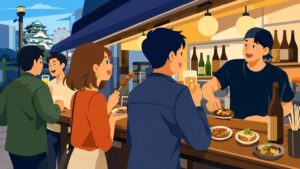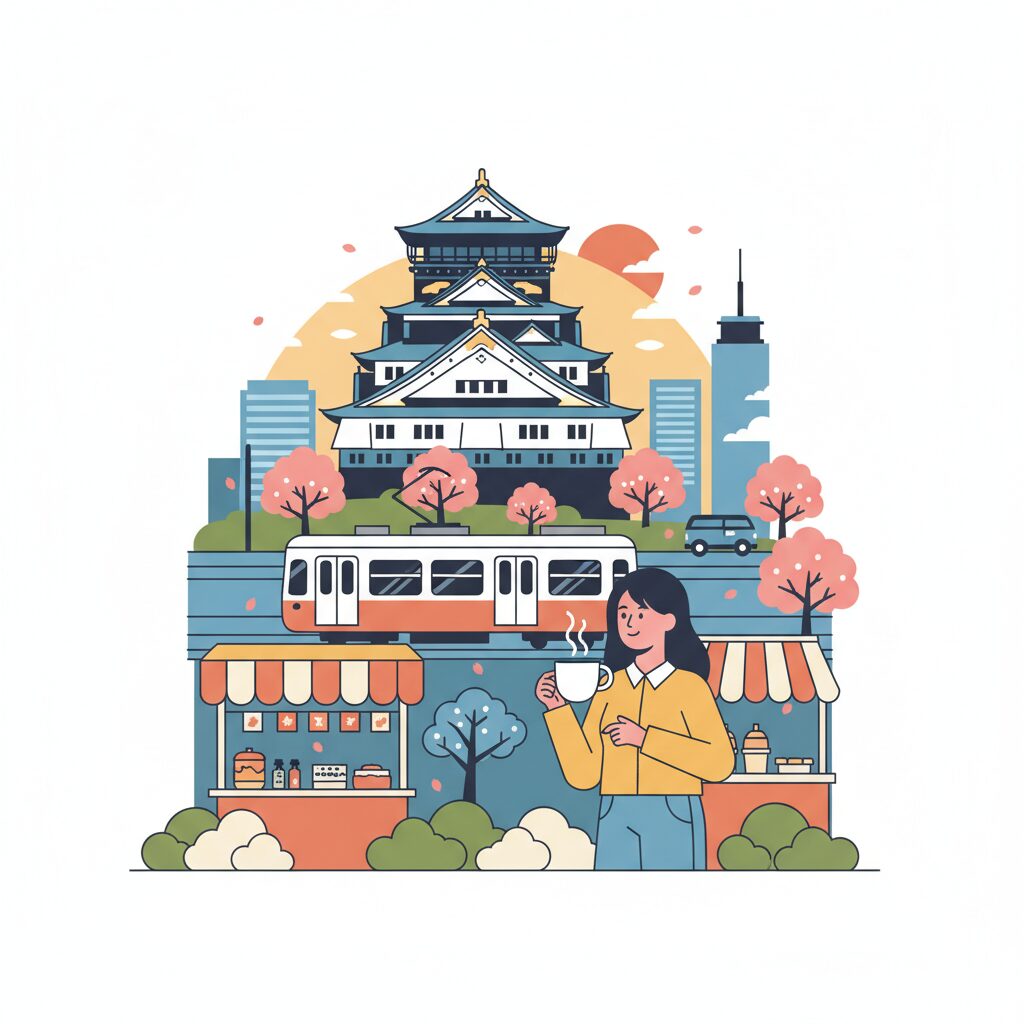
I’ll admit, my first encounter with Osaka’s “Morning” service was deeply confusing. I saw the sign outside a dimly lit, wood-paneled shop: a simple hand-painted board offering “モーニングセット” (Morning Set) for 450 yen. For the price of a single cup of coffee, it promised toast, a hard-boiled egg, and a small salad. My Tokyo-calibrated brain immediately flagged this as a typo or a gimmick. In a world of 700-yen lattes, this level of value felt suspicious. It seemed like just another breakfast deal, a cheap way to fuel up before the day began. I couldn’t have been more wrong. What I discovered was that Osaka’s Morning isn’t a meal; it’s a social institution. It’s the city’s living room, its real-time social network, and the most tangible expression of a merchant philosophy that defines this region. To dismiss it as “breakfast” is to miss the point of Osaka entirely. It’s in these quiet, smoky coffee shops, known as kissaten, that the city’s true character unfolds—a character built on community, pragmatism, and a unique form of generosity that feels a world away from the polished efficiency of Tokyo. This isn’t about grabbing a quick bite; it’s about renting a piece of the neighborhood for an hour, and in doing so, participating in the daily rhythm of Osakan life.
This daily rhythm is often set by the vibrant community found in the local shotengai shopping streets.
The Anatomy of an Osaka Morning: It’s Not About the Food

To grasp the Morning set, you first need to understand the Japanese notion of “service.” This differs from “customer service” as understood in the West. Here, サービス (sābisu) often refers to a freebie, an extra, something included as a token of appreciation. It’s a bonus not listed on the menu—like an additional scoop of ice cream for a child or a small dish of pickles alongside your beer. In Osaka, the city of merchants (akindo no machi), this idea is almost sacred. The Morning set perfectly embodies this philosophy. The food itself—the thick, fluffy slice of shokupan toast, the perfectly boiled egg, the small pot of yogurt—is the “service.” What you are truly paying for is the coffee.
The “Service” Mentality in Practice
Consider the economics. A siphon-brewed coffee, carefully prepared by the shop’s “Master,” might cost 450 yen. For the same price, the Morning set offers a substantial breakfast. The profit margin on the food is razor-thin, if it exists at all. So why do it? Because it’s more than a transaction; it’s an invitation. It’s a gesture of goodwill saying, “Come in, sit down, stay a while. We value your presence more than the small extra income from a plate of eggs.” This is a central principle of the Osakan merchant spirit. It’s about building relationships, nurturing loyalty, and creating a sense of jō (情)—a deep, human connection that goes beyond commerce. The free toast isn’t just toast; it’s a piece of that bond, a tangible sign of the silent understanding between the shop and the customer. You support them by visiting, and they support you with a warm, affordable start to your day.
Paying for a Seat, Not a Meal
A common misconception among many foreigners (and even many Tokyoites) is that they are paying for breakfast. They are not. They are paying for their seat. They are renting a comfortable chair, a quiet corner, access to a rack of freshly delivered newspapers, and the right to linger without pressure. In a city where apartments are often small and public spaces crowded, the local kissaten becomes an extension of home. It serves as a third space—neither work nor home—where you can read, reflect, or simply watch the world pass by. The owner doesn’t want you to rush. Your continued presence gives the shop its atmosphere, its energy, and its purpose. A full kissaten, even if everyone is only nursing a single cup of coffee, is a successful kissaten. This stands in sharp contrast to the fast-paced café culture of cities like Tokyo, where lingering often feels inappropriate. In an Osaka kissaten, the opposite applies. Leaving too soon can almost seem impolite, like dropping by a friend’s house only to leave after five minutes.
The Kissaten as a Community Hub: Osaka’s Living Room
Step into a classic Osaka kissaten around 8 AM on a Tuesday, and you find yourself entering a living diorama of the neighborhood. These are not trendy, Instagram-worthy cafes. Often relics of the Showa Era, they feature dark wood paneling, worn velvet seats, soft jazz or classical music drifting from vintage speakers, and the faint, sweet aroma of coffee mixed with stale cigarette smoke. They serve as time capsules, yet remain vibrant community hubs, sustained by two essential figures: the Master and the regulars.
The Master and the “Jōren” (The Regulars)
At the core of every great kissaten is the “Master” (マスター). Typically an older man or woman who owns and runs the shop, often for decades, the Master is more than a barista; they are the community’s linchpin. They know everyone’s name, their usual coffee order, their favorite baseball team (usually the Hanshin Tigers), and the latest neighborhood gossip. The Master is the confidant, the social connector, the quiet observer who maintains the delicate balance of the establishment. Watching a Master at work is like watching a conductor. They move with practiced efficiency, brewing coffee, wiping counters, exchanging a few words with one customer, a knowing nod with another. They set the atmosphere for the entire place.
Their audience is the jōren-san (常連さん), the regulars. These are the people who have frequented the same shop, at the same time, for years or even decades. Each has a designated seat: Mr. Sato takes the corner booth to read his newspaper, while Mrs. Yamamoto and her friends gather around the round table by the window after their morning walk. They aren’t just customers; they are the shop’s lifeblood. They greet each other, share parts of the newspaper, and engage in a low, comfortable murmur of conversation in the distinctive, melodic rhythm of Kansai-ben. For a foreigner, entering this circle might seem intimidating, but it’s surprisingly welcoming. It requires patience and consistency. Show up regularly, order the same item, offer a polite greeting, and gradually you’ll move from being a stranger to a familiar face. When the Master starts making your coffee before you even order, you’ll know you’ve arrived. You’ve become part of the scenery.
A Place for Every Generation (and Every Profession)
The clientele of a kissaten reflects a cross-section of Osaka life. Early in the morning, you’ll see elderly retirees for whom this is their main social outing of the day. They are followed by local shopkeepers from the shōtengai (shopping arcade) taking a quiet moment before opening their stores. Then come salarymen in suits, holding quick, informal meetings over coffee and toast instead of in sterile office boardrooms. You’ll spot housewives catching up after dropping off their kids at school, their lively conversations acting as a counterpoint to the rustling newspapers. Sometimes you’ll find a university student hunched over textbooks, using the ambient noise as a study aid. The television is almost always on, tuned to a morning news program, serving as a communal reference point—a source of shared sighs over political news or collective chuckles at a weather forecaster’s jokes. This shared experience, however small, knits together a disparate group of strangers into a temporary, unspoken community.
The Unspoken Rules of the Kissaten
As with any social space in Japan, the kissaten has its own set of unspoken rules. Though not posted on the walls, they are understood by all who enter. First, acknowledge the Master. A simple “Ohayō gozaimasu” (Good morning) when arriving and “Gochisōsama deshita” (a phrase to thank for the meal) when leaving are essential. Second, keep your volume down. While conversation is normal, loud phone calls are a major faux pas. If you must take a call, step outside. Third, read the room. Though it is more acceptable to strike up conversations with strangers here than in many other places in Japan, pay close attention to social cues. If someone is absorbed in their book or the horse racing section of the paper, it’s best to leave them be. But if eye contact is made and a smile appears, a comment about the weather or the latest Hanshin Tigers game can serve as a welcome icebreaker. Respecting these subtle rules is key to earning acceptance into the kissaten’s inner circle.
The Economics of Generosity: How Does This Even Work?
From a strictly logical, profit-oriented standpoint, the Osaka Morning model appears irrational. The low prices and generous portions seem destined to cause bankruptcy. Yet this is precisely where Osaka’s distinctive business philosophy comes into play. This mindset has been shaped over centuries of commerce in a city long recognized as Japan’s merchant capital. It is perfectly embodied by a single, powerful proverb: Son-shite toku-tore.
The Osaka Merchant Mindset: “Son-shite Toku-tore”
損して得取れ, or “son-shite toku-tore,” roughly means “accept a small loss for a greater gain.” It represents the idea of strategic sacrifice: losing a little now to achieve much more later. The Morning service is a living example of this proverb. The kissaten Master deliberately takes a small loss (or at best breaks even) on each Morning set sold. They sacrifice potential food profits. But what they gain is far more valuable: a loyal customer. Someone who comes for the 450-yen Morning set is likely to return for a 900-yen lunch special, perhaps stop by later for coffee and a 600-yen slice of cake, or bring their family on the weekend. They become a walking advertisement, spreading the word about the great little kissaten they discovered. The inexpensive Morning set acts as a marketing tool, a relationship-builder, and a long-term investment all in one. This approach places human connection and loyalty above immediate profit, standing in sharp contrast to Tokyo’s often more clinical, efficiency-driven business culture, where scalability and maximizing profit per square foot usually take priority.
The Coffee Ticket System: A Subscription to Community
Further strengthening this bond is the clever kōhī chiketto (コーヒーチケット), or coffee ticket system. Regular customers can purchase a tsuzuri, a small booklet of prepaid vouchers, typically priced for ten cups but granting eleven. On the surface, it’s simply a discount. But its cultural meaning runs far deeper. Buying a ticket book is a declaration of commitment—an unspoken promise to the Master: “I am a regular. I will return. I am investing in this establishment.” For the Master, it provides vital cash flow and guarantees future business. For the customer, it affirms their status as a jōren. There’s a certain pride in presenting your ticket booklet instead of cash. It’s akin to holding a membership card to an exclusive, yet very welcoming, club. This micro-economy, founded on mutual trust and a shared desire for the community’s success, is quintessentially Osakan. Such a system would be challenging to establish in a more anonymous, transient city.
Regional Variations and the Tokyo Contrast
While Osaka’s Morning culture is iconic, it forms part of a larger cultural phenomenon spanning central and western Japan. Recognizing its place within this broader context, especially in contrast to Tokyo, reveals what makes Osaka’s version uniquely tied to its identity.
Beyond Osaka: The Nagoya Morning Spectacle
If you think Osaka’s Morning is generous, Nagoya’s takes it to another level. In neighboring Aichi Prefecture, particularly in its capital Nagoya, Morning service reigns supreme. The competition there is so intense that the “service” has grown almost absurd. For the price of a single coffee, it’s common to receive not only toast and an egg but also a bowl of udon noodles, a savory egg custard called chawanmushi, a plate of spaghetti, or a mountain of salad. Nagoya’s Morning is a spectacle, reflecting a culture of competitive hospitality. Though impressive, it often feels more about the sheer abundance of free food than the communal spirit. Osaka’s approach, by contrast, is more measured, emphasizing the kissaten’s role as a social space rather than merely a spot for an outrageously cheap meal.
The Tokyo Disconnect: Why Morning Culture Didn’t Take Root
Why hasn’t this culture developed similarly in Tokyo? The answer lies in the fundamental differences between the cities. Tokyo is a commuter metropolis, where people travel long distances to work, leaving little time for a relaxed neighborhood breakfast. The pace is relentless, and efficiency rules. The cafe scene mirrors this: dominated by national chains like Starbucks and Doutor, designed for quick visits, solo work, and rapid customer turnover. While neighborhood identity exists in some areas, it plays a less central role in daily life than in Osaka, where many still live and work locally. In Tokyo, cafes tend to be functional, impersonal spaces. In Osaka, kissaten offer a personal, intimate experience. A foreigner could live in Tokyo for years, subsisting on convenience store coffee and chain cafe lattes, never encountering the deeply rooted community of a local kissaten. In Osaka, doing so would mean avoiding the city’s very heartbeat.
Finding Your Own Morning: A Foreigner’s Guide to the Kissaten
For any non-Japanese resident eager to truly experience Osaka, discovering a local kissaten and becoming a semi-regular is one of the most fulfilling things you can do. It serves as a gateway to the authentic city, away from the usual tourist spots. However, knowing where to begin can be intimidating.
Reading the Signs: How to Recognize a Genuine Kissaten
First, learn how to spot the right kind of place. Forget the sleek, modern cafes with minimalist decor. Instead, seek out signs of age and character. Look for the rotating, tricolor barber-pole-like sign—for some historical reason, this became a symbol for kissaten in Japan. Notice the plastic food models (shokuhin sampuru) displayed in a glass case outside, showcasing the Morning set in all its waxy detail. The shop’s name will often be written in old-fashioned kanji, perhaps something like “珈琲館” (Coffee House) instead of the contemporary katakana “コーヒー”. The exterior might be tiled, with slightly fogged windows. Peeking inside, you’ll see a dimly lit interior featuring dark wood and plush, low-backed chairs. These are all good indicators. Ideal places to explore include the endless Tenjinbashisuji Shopping Arcade, the retro-bohemian district of Nakazakicho, or the local shōtengai in residential neighborhoods like Tennoji or Kyobashi.
Your First Visit: Breaking the Ice
Taking the first step is often the hardest. Slide open the door and a small bell will likely jingle, announcing your arrival. The Master will look up from behind the counter, perhaps with a neutral, slightly curious expression. Don’t be intimidated. Greet clearly with a simple “Ohayō gozaimasu.” Find an available seat. The magic phrase follows: “Mōningu, onegai shimasu” (Morning, please). The Master might ask, “Hotto? Aisu?” to confirm if you want hot or iced coffee. That’s it—you’ve successfully placed your order. Now, relax. Don’t feel pressured to fill the silence. Pull out a book or simply observe. Watch the interactions. Listen to the rhythm of the language. Absorb the atmosphere. Other regulars may glance at you, but it’s nearly always curiosity, not hostility. They’re just wondering about your story. With time and repeated visits, their glances will evolve into nods, and eventually, those nods might turn into conversation.
A Personal Anecdote
I found my kissaten tucked away on a quiet side street near Sugamo, Tokyo’s “Granny’s Harajuku,” but the experience captured the spirit of Osaka perfectly. It was run by an elderly couple. For the first week, my morning visits were met with polite silence. I ordered my Morning set, read my book, and left. During the second week, the Master’s wife asked where I was from, and we shared a brief, friendly chat. By the third week, the Master slid a small, complimentary bowl of red bean paste alongside my toast. “Sābisu,” he said with a gruff smile. It was a small gesture, but it felt monumental—a sign of acceptance. From that day forward, I was no longer just a customer; I became part of their morning routine, and they became part of mine. That’s the true power of the kissaten.
The Future of the Morning: A Fading Ritual?
It would be misleading to depict Osaka’s Morning culture without recognizing the difficulties it currently faces. Many of these cherished kissaten are operated by owners in their 70s or 80s. Their children have often moved away or pursued different careers, leaving no successor for the business. For every enduring classic kissaten, another quietly shuts down, replaced by a convenience store or a chain café. The slow, deliberate pace of the kissaten clashes with the modern demand for speed and convenience. The once-common smoking culture in these establishments is also becoming less sustainable in an increasingly health-conscious Japan.
Still, there is cause for optimism. A new generation of younger entrepreneurs, tired of the soullessness of corporate café culture, are beginning to appreciate the value of the classic kissaten. Some are opening new shops that authentically recreate the retro Showa atmosphere, while others are taking over existing shops from retiring Masters, preserving the legacy while introducing modern elements like specialty coffee beans or smoke-free environments. They recognize that what they offer is not just coffee; it’s community, slowness, and a real connection to the neighborhood. For them, the Morning service is not an outdated business model but a bold expression of anti-corporate hospitality.
In the end, the Morning ritual serves as a perfect reflection of Osaka itself. It may feel somewhat old-fashioned and a bit rough around the edges compared to the polished Tokyo scene. But beneath that surface, it is deeply practical, profoundly human, and fiercely loyal. It follows its own logic, one that values people over profit and relationships over transactions. It stands as a daily reminder that in this city of merchants, the best business happens over a shared meal, no matter how humble. Sitting in an Osaka kissaten with a 450-yen coffee and a free slice of toast is to experience the soul of the city. It is a living piece of history, a lesson in economics, and the most genuine welcome one could hope for.