You see it before you understand it. It’s 8 AM on a Tuesday, the air thick with the promise of summer humidity. You’re walking down a covered shotengai, one of those long shopping arcades that act as the arteries of any real Osaka neighborhood. Past the shuttered fishmonger and the vegetable stand just setting up its wares, there’s a place with a faded plastic food display in the window. A plastic parfait droops sadly next to a plate of spaghetti Neapolitan, both bleached by decades of sunlight. The sign above, maybe written in a swirly, anachronistic font, says something like “Coffee Shop Swan” or “Cafe Brazil.” Inside, through the condensation on the glass, you see silhouettes. The same silhouettes you saw yesterday. The same ones you’ll see tomorrow.
This is the Osaka kissaten, the neighborhood coffee house. And this morning ritual, this gathering of the same faces in the same velvet-backed booths, is the key to everything. It’s not about getting a caffeine fix on the way to the office. It’s not a business meeting. It’s not a trend. It’s a social institution, a living room for the community, and the most honest expression of the Osaka mindset you’ll ever find. Forget the flashy lights of Dotonbori and the grand history of Osaka Castle for a moment. If you truly want to understand how this city breathes, how its people connect, and why it feels so fundamentally different from the polished, reserved energy of Tokyo, you need to slide into one of those booths, order the “Morning Service,” and just watch. This isn’t just about coffee. It’s a daily ceremony of identity, community, and unapologetic pragmatism, served up with a slice of thick, buttery toast.
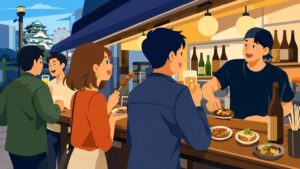
For a different but equally authentic evening take on this communal spirit, you can find a similar sense of belonging at one of Osaka’s many standing bars.
The Anatomy of a Kissaten Morning
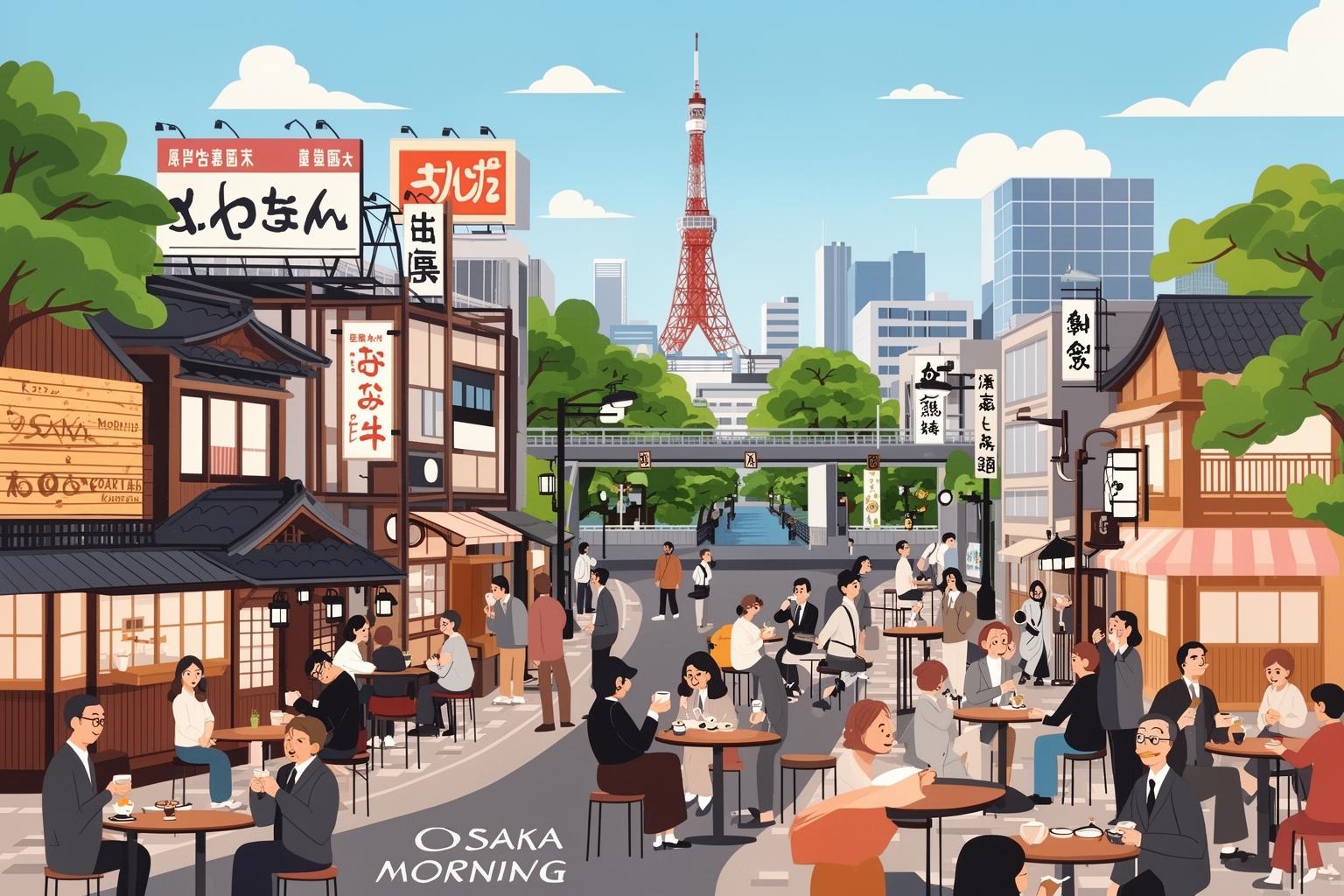
Before you can interpret the social dynamics within, you first need to understand the setting itself. Entering a classic kissaten is like stepping into a time capsule, a preserved gem of the Showa Era (1926–1989). It’s an immediate, sensory immersion that sharply, defiantly contrasts with the bright, minimalist style of the global coffee chains located just a few meters away.
The Setting: A Theater of Faded Grandeur
The first thing that hits you is the air—a complex mix of scents: the dark, slightly bitter aroma of long-brewed siphon coffee, the lingering ghost of yesterday’s cigarette smoke clinging to the velvet upholstery, a subtle sweetness from sugar and cream, and perhaps a faint trace of grilled fish wafting in from the neighboring restaurant’s exhaust fan. It’s not a sterile scent; it’s a lived-in one. It’s the smell of a place that has absorbed the conversations, disputes, and laughter of thousands of mornings.
The décor embraces comfortable, unpretentious retro style. Forget sleek Scandinavian design or industrial chic. Here, you’ll encounter dark wood paneling, damask-patterned wallpaper, and low-hanging lamps made of colored or cut glass casting a warm, dim glow. The chairs aren’t built for ergonomics; they are throne-like pieces crafted from carved wood and cushioned velvet, often in shades of burgundy, forest green, or deep royal blue. They invite you to sink in, linger, and settle for the long haul. The tables are typically small, dark laminate surfaces, sometimes with an 80s tabletop arcade game preserved under glass, its screen now permanently dark. There is almost always a television, not muted with subtitles but playing at conversational volume, tuned either to the morning news or, season permitting, a high school baseball tournament. It provides a constant, communal background—a shared soundtrack to the morning ritual.
This isn’t a space designed for a quick, transactional visit. It’s not optimized for laptop work or rapid takeaway orders. It’s a den. A refuge. Its slightly worn, well-loved comfort makes a statement in itself. In a country that often values the new and pristine, the kissaten’s unapologetic age is its strength. It signals stability, reliability, and a long history of serving the community. It says, “We have been here for you every morning for forty years, and we will be here for you tomorrow.”
The “Service”: An Act of Radical Value
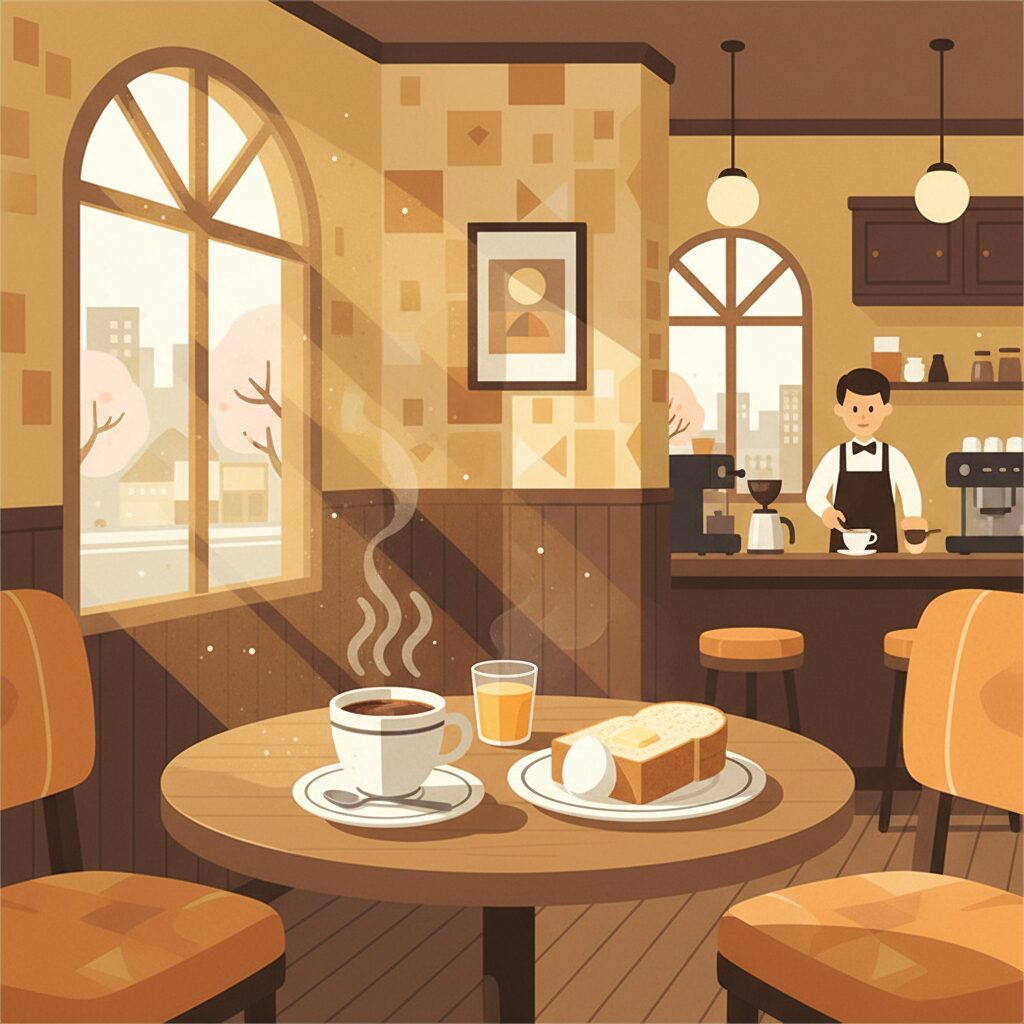
Now, the main attraction: the “Morning Service,” or mōningu sābisu. This concept often confounds newcomers, especially those from Western coffee cultures where every item carries an à la carte price. In Osaka, you order a single drink—typically coffee or tea, costing between 400 and 500 yen—and for that price, you receive a complimentary breakfast. This is neither a gimmick nor a limited-time deal; it is the standard practice.
The classic “Morning” set is a sacred trio of carbs and protein. First, a cup of coffee—usually a dark, robust roast, brewed with a siphon or a large-batch drip machine. It’s not a nuanced single-origin pour-over; it’s a straightforward, strong, no-nonsense cup. Accompanying it is a slice of shokupan (Japanese milk bread), toasted to a perfect golden brown. This isn’t just any toast—it’s exceptionally thick, often over an inch, with a fluffy, cloud-like interior and a satisfyingly crisp crust. It’s pre-buttered, the melted butter soaking into every nook. Alongside the toast, there’s almost always a hard-boiled egg, peeled and resting in a small dish, sometimes with a tiny salt shaker. That’s it: coffee, thick toast, and an egg—all for the price of the coffee alone.
Some places offer variations. You might receive a small dish of red bean paste (anko) or jam for your toast. Occasionally, a tiny salad of shredded cabbage with dressing, a piece of fruit, or a small glass of yogurt. But the core principle remains: incredible value. This isn’t about gourmet fare. It’s about offering a simple, hearty, and remarkably affordable start to the day. This tradition resonates deeply with the Osaka merchant’s spirit. It’s the ultimate expression of otoku—getting a great deal. It’s a pragmatic, almost aggressively sensible approach to breakfast that starkly contrasts with Tokyo, where you might pay 800 yen for an artisanal latte and another 600 for a single croissant. In Osaka, spending that much on breakfast is considered imprudent. Why pay more when you can get a full, satisfying meal for the price of a drink? This isn’t about being cheap (kechi); it’s about being smart (ken’yaku). It’s a daily affirmation of a core cultural value.
The Players: A Cast of Morning Regulars
A kissaten lives through its people. The space is a stage, and the daily performance gives it life. The cast of characters is remarkably consistent across neighborhoods.
At the center is the Master (masutā). Often a man in his late 60s or 70s, he moves quietly and efficiently behind the counter. He may seem gruff or distant at first, but he is the silent conductor of this morning orchestra. He knows every regular’s order without being asked. He remembers that Tanaka-san takes his coffee with one sugar, that Sato-san prefers her toast lightly browned, and that the group of ladies in the corner booth wants their water glasses refilled every fifteen minutes. He is the keeper of the community’s secrets, the quiet confidant, the stable core around which the neighborhood revolves. His relationship with his customers is not one of subservience but of longstanding mutual respect.
Then come the Regulars (jōren-san), the lifeblood of the kissaten. In one corner, a group of elderly men, each with a sports newspaper spread out before them, debate the Hanshin Tigers’ latest game with the gravitas of world leaders negotiating a treaty. They don’t just read their own papers; they share sections, pointing out articles, grumbling, and laughing. In another booth sit a group of obachan—middle-aged and elderly women, impeccably dressed—who act as the neighborhood’s true information brokers. Their lively, overlapping Osaka-ben conversations form the local newswire. They discuss who’s in hospital, whose grandchild passed an exam, and the outrageous price of daikon radish at the local supermarket. You might also spot a solo salaryman methodically eating toast and egg before heading to the office, or the owner of the local hardware store having a quick chat with the Master before opening his shop.
And then there’s you, the Outsider. For your first few visits, you’ll be observed with polite curiosity. You are a new element in a delicate, long-established ecosystem. But consistency is key to acceptance. If you start showing up at the same time every week, order the same thing, and quietly nod to the Master and fellow patrons, the invisible walls will gradually soften. One day, the Master might ask where you’re from. The obachan next door might offer you a piece of candy with a warm, crinkly smile. This is the moment you move from customer to something closer to a regular. You are slowly, surely woven into the social fabric of the neighborhood.
Kissaten as a “Third Place”: The Osaka Edition
Sociologists refer to the concept of the “third place”—a social setting distinct from the two main ones of home (the first place) and work (the second place). Consider pubs in England, cafes in France, or barber shops in various cultures. These serve as the pillars of community life, places where people gather, unwind, and connect. In Osaka, the kissaten stands out as the quintessential third place, yet it possesses a distinctive character that differentiates it from similar venues elsewhere, especially within Japan.
An Extension of the Living Room
While a third-wave coffee shop in Tokyo may also serve as a third place, its role tends to be more individualistic. It’s a spot to work on a laptop, quietly read a book, or hold a private conversation. The ambiance often leans toward calm, focused anonymity. By contrast, an Osaka kissaten is entirely different. It is not a place for silent reflection but rather a communal living room—lively, boisterous, and interactive.
The noise level offers the first hint. People speak, and they speak loudly. Laughter bursts from the obachan corner. Men debating baseball raise their voices in spirited disagreement. The television hums constantly in the background. There is no expectation of silence like that in a library. This is a venue for performance, social interaction, and being noticed. Patrons don’t merely occupy the space; they bring it to life. They call out to the Master, comment on the news program on television to no one in particular, and lean over to the next table to ask questions. The invisible bubbles of personal space carefully maintained in Tokyo’s public places seem to vanish here. The purpose of the kissaten is not to offer escape from the world but rather to provide a comfortable stage on which to engage with it together.
This communal vibe is what makes the kissaten feel like an extension of home. It’s where you can drop your guard and not worry about maintaining perfect behavior. It’s a place of relaxed familiarity, where social rules are loosened and interactions are sincere, even if they might appear a bit nosy or overly familiar to strangers. It’s the neighborhood’s shared spot, where everyone feels a sense of belonging and ownership.
The Neighborhood’s Information Exchange
Long before the internet and social media existed, the kissaten was the original social network. It was, and for many older residents still is, the main hub for sharing local information. This goes well beyond mere gossip. It fuels the local economy and serves as the core of the community’s support system.
The sports-paper-reading men aren’t just chatting about baseball. One might be a retired plumber who knows who to call for a leaky pipe. Another could be a small-time landlord with a vacant apartment. Quiet business deals, handshake agreements to fix a roof, or hiring a nephew for a part-time job, often happen over morning coffee. The Master, overhearing everything, frequently acts as a central connector in this network, linking people who have needs with those who can provide solutions.
The obachan group serves as the community’s welfare department. They know who is sick and needs a meal brought over. They keep track of which elderly neighbor living alone hasn’t been seen in days and needs checking on. They organize collections for funerals and celebrate new births. This isn’t idle chatter; it is crucial, invisible work maintaining the community. They act as the neighborhood’s eyes and ears, and the kissaten is their headquarters. Being a regular here means being plugged into this vital flow of information and mutual aid. It is a safety net woven from daily conversations and shared cups of coffee.
The Osaka Mindset on Display
If you want a crash course in the psychological and cultural makeup of the Osakan, spend a week of mornings in a kissaten. The behaviors, values, and social norms on display there serve as a microcosm of the city’s character. It’s in this setting that the abstract clichés you hear about Osaka—“friendly,” “practical,” “different from Tokyo”—transform into tangible, observable realities.
Pragmatism, Value, and the Gospel of Otoku
The very existence of the Morning Service stands as the most potent symbol of Osaka’s deep-rooted pragmatism. This is a city shaped by merchants, and the merchant’s mindset—a keen eye for value, a distaste for waste, and a passion for a good deal—infuses every aspect of daily life. The concept of otoku (お得), roughly meaning “getting good value” or “a beneficial deal,” is a powerful cultural motivator.
In Tokyo, there is often a greater readiness to pay extra for aesthetics, brand prestige, or a unique or luxurious experience. A beautifully designed café serving carefully sourced coffee for 1,000 yen can flourish because the experience itself is the product. In Osaka, that logic is frequently met with skepticism. The question is not “Is it beautiful?” but “Is it worth it?” The Morning Service is the ultimate answer to this question. For about 450 yen, you get a seat in a comfortable place, a hot drink, and a meal that will sustain you until lunch. It is an exercise in supreme economic efficiency. To an Osakan, paying more for less is not seen as sophistication; it’s regarded as foolishness. This isn’t a judgment, but a fundamental difference in worldview.
The kissaten itself embodies this pragmatism. It doesn’t strive to be trendy. It doesn’t redecorate every few years to keep pace with the latest styles. Its furniture is old but functional. Its coffee is good but not artisanal. Its purpose is to provide reliable, affordable, comfortable service to its community, day in and day out. It is a utility, not a luxury. This emphasis on function over form, substance over style, is a hallmark of Osaka’s character.
Human Connection over Polish
One of the first things foreigners notice about Osaka is that people are more direct, expressive, and willing to engage with strangers. This can be misunderstood. Coming from the more reserved and formal culture of Tokyo, the casual, sometimes teasing, and often personal tone of conversation in Osaka can feel intrusive or even rude. The kissaten is the perfect place to realize this isn’t rudeness; it’s simply a different approach to human connection.
In a Tokyo café, your interaction with staff will likely be impeccably polite, efficient, and distant. In an Osaka kissaten, the Master might comment on your new haircut or ask why you look tired. The woman at the next table might start a chat about the weather, which quickly evolves into questions about where you come from, what you do, and whether you’re married. This is not nosiness for its own sake; it is an act of inclusion. It’s an effort to break down the barrier between stranger and acquaintance, pulling you into the warm, lively circle of the community.
This prioritization of warm human interaction over polished formality defines life in Osaka. People here seem to have a profound need to connect, find common ground, and share laughter. The kissaten offers the perfect setting for this. It’s a place where the formal rules of Japanese society are softened, and a more direct, emotional, and human style of communication is the norm. It teaches you that in Osaka, a personal question isn’t a breach of privacy; it’s an invitation to connect.
Expanding the Circle: Uchi vs. Soto
Japanese culture is famously structured around the concept of uchi-soto, which distinguishes between one’s “inside” group (uchi) and everyone else (soto, or “outside”). Your family and close colleagues are uchi; strangers on the train are soto. The rules of communication and obligation vary widely depending on which category a person falls into.
In much of Japan, the boundary between uchi and soto is rigid and difficult to cross. In Osaka, that boundary appears more porous and flexible. The kissaten exemplifies this. Through the simple act of frequent attendance, someone can transition from soto (an anonymous customer) to uchi (a recognized community member). The kissaten becomes a trusted uchi space for its regulars. It is a place where they are known, belong, and are cared for by the Master and fellow patrons.
This ability to quickly and warmly expand the “inside” group may be the real meaning behind the cliché that “Osaka people are friendly.” It’s not just about smiling at tourists. It’s a deep cultural instinct to create and sustain strong, local, face-to-face communities. In the sprawling anonymity of a modern metropolis, the neighborhood kissaten acts as a powerful anchor, constantly redrawing the circle of uchi to include those who choose to participate. It stands as a testament to a form of social technology that fosters belonging, one cup of coffee at a time.
The Unspoken Rules of the Kissaten
Like any long-established social institution, the kissaten follows a set of unwritten rules and subtle etiquette. These aren’t posted on a sign by the door, yet every regular understands them. For newcomers, learning to interpret these social cues is essential to fitting in and truly enjoying the experience. It’s a delicate balance of observation and respect.
Seating Etiquette: The Invisible Boundaries
When you enter a kissaten during the morning rush, you might spot a few empty seats and assume they are free. Be careful. For the regulars, this is not a first-come, first-served place. Invisible boundaries have been set by years, sometimes decades, of habit. The booth by the window might be reserved for the obachan group. The counter seat nearest the television is always occupied by Suzuki-san, who arrives precisely at 7:45 AM daily. The table in the back corner is where the local real estate agent holds his informal morning meetings.
Taking one of these “reserved” seats won’t provoke any shouting—that’s still Japan. But it will upset the delicate social balance. You might catch some curious, lingering stares. The Master might hesitate briefly before taking your order. The regulars may have to quietly adjust themselves. As a newcomer, the safest approach is to choose a seat that is clearly unoccupied and fairly central or simply ask the Master, “Doko demo ii desu ka?” (“Is anywhere okay?”). By showing this small courtesy, you acknowledge that you are a guest in their space and respect the established order. Over time, as you become a regular yourself, you will naturally find your own place in this social ecosystem.
Interacting with the Master: A Relationship Built on Respect
The dynamic between customer and proprietor in a kissaten is fundamentally different from that in a modern café chain. You are not an anonymous consumer, and the Master is not merely a service worker. The connection is one of mutual, long-term respect. You are a patron of their establishment, and they are the guardian of this cherished community spot.
This means interactions should not be purely transactional. When you enter, make eye contact and greet with a clear “Ohayō gozaimasu” (Good morning). When ordering, keep it simple and without fuss. When your coffee arrives, a slight nod or a quiet “Arigatō” is appreciated. The Master notices everything, and these small signs of respect are remembered. You are not expected to engage in lengthy conversation, especially at first. But you should treat the Master not as a servant but as a respected host whose home you are visiting. As you become a familiar face, the relationship will naturally warm. The Master might start a brief chat about the weather or ask how your day is going. This signals acceptance and that you are becoming part of the kissaten’s uchi (inner) group.
The Art of Lingering: Sensing the Atmosphere
In many busy city cafés, there’s an unspoken pressure to finish your drink and leave promptly to free the table for the next customer. This is known as kaiten-ritsu, or table turnover rate, and it is vital to their business model. The kissaten follows a completely different economic and social approach. Here, lingering is not just accepted; it is often the very purpose.
The low price of the Morning Service isn’t meant for a quick in-and-out visit. It serves as an entry fee to a few hours of comfortable refuge. It is perfectly fine to nurse a single cup of coffee for an hour or more while reading the newspaper, chatting with friends, or simply gazing out and watching the world go by. The kissaten sells time and space as much as it sells coffee.
However, there is an important condition: you must learn to read the room. If it’s a small, popular place with a line of people waiting during the peak 8 AM rush, it’s polite to finish up and leave within a reasonable span. But if it’s 10 AM on a weekday and the shop is half-empty, feel free to stay. The key is to be aware of the surroundings and the business’s needs. Regulars understand this rhythm instinctively. They know when to stay and chat for hours and when to drink their coffee, pay their 450 yen, and say a quick “Gochisōsama” (a phrase to thank for the meal) as they leave. Mastering this art of lingering shows you understand the reciprocal nature of the kissaten’s social contract.
Osaka vs. Tokyo: A Tale of Two Coffee Cultures
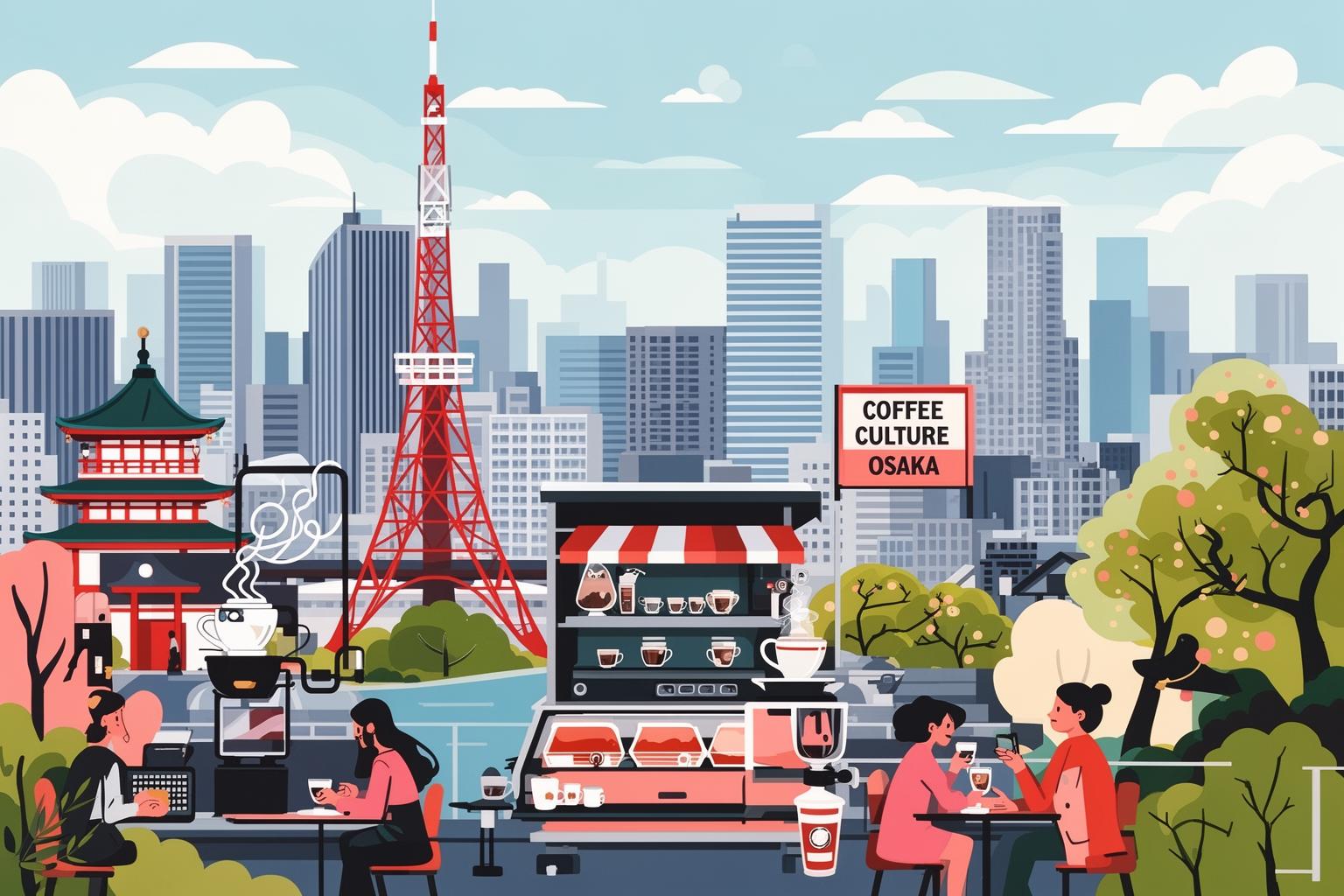
The differences between Osaka and Tokyo are a constant source of fascination and internal discussion within Japan. These distinctions go beyond dialect or cuisine; they reveal profound disparities in history, economy, and cultural values. This contrast is most strikingly illustrated by the coffee cultures of the two cities. Exploring how coffee is consumed in each metropolis offers significant insights into what people prioritize in their daily routines: community versus individuality, function versus aesthetics, comfort versus style.
Tokyo: The Stylish, Specialized, and Solitary
Tokyo’s cafe culture is a dazzling expression of its status as a global hub of trends and sophistication. It is varied, refined, and often highly specialized. The emergence of the third-wave coffee movement has brought roasters who treat coffee beans with the same care that sommeliers give to fine wines. In these establishments, brewing is an art form—the careful pour-over, precise temperature control, and detailed descriptions of the bean’s origins and flavor profiles. The emphasis is firmly on the product, with customers willing to pay a premium for this exceptional quality and craftsmanship.
There are also visually driven cafes designed for the Instagram generation. These spaces embody minimalist design, featuring concrete walls, light wood, and thoughtfully placed greenery. Here, coffee plays a secondary role to the overall visual aesthetic. Patrons come to be seen, to photograph their latte art, and to engage in a distinctly urban, fashionable lifestyle.
Lastly, cafes function as practical spaces for individuals. In a city marked by long commutes and small living spaces, cafes become vital third places for remote work and study. These venues are known for their quiet ambiance, plentiful power outlets, and fast Wi-Fi. Social interaction is minimal as everyone focuses on their laptops, wrapped in a bubble of productive solitude. In Tokyo, cafes often serve individual pursuits—whether it be the perfect cup, the perfect photo, or the ideal work environment.
Osaka: The Communal, Comfortable, and Cost-Effective
Where Tokyo’s coffee culture centers on the individual and the product, Osaka’s kissaten culture focuses on community and place. The coffee itself often takes a backseat. It acts as a medium for social interaction rather than the main attraction. Typically, kissaten coffee is a straightforward, dark, comforting roast—reliable and familiar, much like the cafes themselves. No one is there to analyze the tasting notes of an Ethiopian Yirgacheffe bean.
The emphasis lies on comfort and social utility. Plush seats encourage long conversations rather than short bursts of focused work. The atmosphere is lively and interactive, not quiet or studious. The economic model, built around the great value of the Morning Service, favors accessibility and loyalty over premium pricing. An Osaka kissaten’s success is measured not by Yelp ratings or design magazine features, but by the steady stream of regulars visiting daily, year after year.
This isn’t to say Osaka lacks chic, modern cafes—they certainly exist. But the cultural heart of the city, the institution that truly embodies its spirit, is the humble Showa-era kissaten. It represents the city’s preference for substance over style, warm community over cool anonymity, and practical value over fleeting trends.
What Foreigners Often Misunderstand
Foreigners, especially those whose experience of Japan is limited to Tokyo, might enter a traditional Osaka kissaten and experience culture shock. The decor might appear outdated or even worn. The lingering scent of old smoke in the upholstery (a holdover from before smoking bans were fully enforced) may be off-putting. The coffee might taste simple or slightly bitter compared to the nuanced brews they expect. The direct questions from nearby patrons could feel intrusive.
It’s easy to misread these traits as flaws. To see “dated” instead of “steadfast.” To see “worn” instead of “well-loved.” To taste “simple” coffee instead of “unpretentious.” To feel “intruded upon” rather than “welcomed.” The key is recognizing that these cafes are not meant to be Tokyo-style third-wave coffee shops. They succeed at an entirely different goal. Their aim is not to impress with design or coffee complexity but to be the dependable, beating heart of their neighborhood. They function as vital social hubs, and appreciating them requires a fundamental shift in perspective—from the values of the individual consumer to those of the community member.
The Future of the Kissaten
For all its timeless charm and social significance, the traditional kissaten faces an uncertain future. It is an institution pressured from various directions, with no guarantee of survival. Yet, even as the old generation fades away, the spirit of the kissaten is showing signs of revival in new and unexpected forms, indicating that its core values still deeply resonate in today’s world.
A Declining Tradition?
The most apparent challenge is demographic. The devoted patrons of the classic kissaten are growing older. The men who have debated the Hanshin Tigers in the same booth for forty years are now in their 70s and 80s. Their children and grandchildren, raised amid Starbucks and global café culture, may not share the same attachment to these neighborhood staples. Meanwhile, the Masters themselves are aging as well. Many run their shops alone, and upon retirement, there is often no successor to carry on the business. Each year, more of these cherished local landmarks quietly shut down, taking a small piece of the neighborhood’s soul with them.
Competition from powerful chains is also relentless. They can secure prime locations, provide modern amenities like Wi-Fi and smoke-free spaces, and deploy vast marketing budgets. To a younger generation accustomed to these conveniences, the old-fashioned kissaten can seem like a relic from a bygone era.
The Neo-Kissaten and the Appeal of Retro
Yet, a curious phenomenon has emerged on the brink of extinction. The very “oldness” once perceived as a drawback has transformed into a sought-after aesthetic. A “retro” (retoro) boom has swept Japan’s younger generation, who are developing a fresh appreciation for the style and atmosphere of the Showa Era. This has given rise to the “neo-kissaten.”
These new establishments, often started by younger entrepreneurs, lovingly recreate the look and ambiance of the classic kissaten but with modern touches. They may feature the same dark wood, velvet chairs, and siphon coffee makers, but the coffee itself is likely to be specialty-grade, high-quality beans. The menu might include the classic thick toast and Neapolitan spaghetti, alongside avocado toast or vegan curry. Importantly, they are almost always non-smoking and equipped with Wi-Fi. They strive to capture the soul of the kissaten while updating its form for a 21st-century audience.
While these venues demonstrate the enduring charm of the kissaten aesthetic, the question remains whether they can fulfill its social role. Can they cultivate the same deep-rooted, daily community of regulars while also attracting tourists and trend-seekers? The answer is still uncertain, but the endeavor itself shows that the desire for the kind of space the kissaten embodies has not vanished.
Why It Continues to Matter
Whether in its classic form or neo-retro iteration, the kissaten remains a vital part of Osaka’s identity because it represents something increasingly rare in our hyper-connected yet socially fragmented world. It symbolizes the importance of place, the value of face-to-face interaction, and the quiet strength of a community that shows up for each other daily.
To understand the kissaten is to grasp Osaka’s deeply held belief that a city is more than a collection of buildings and economic outputs; it is a network of human relationships. It is to appreciate a culture that values a good deal not only in money but in social capital. It is to recognize that a simple, daily ritual—sharing a coffee and a piece of toast with neighbors—can be one of the strongest tools for building a humane and resilient society.
So next time you are in Osaka, walk past the bright lights and famous logos. Find a quiet side street, look for that faded sign and plastic food display, and push open the door. Take a seat, order the Morning Service, and just listen. In that one hour, you will learn more about the real, living, breathing soul of this incredible city than you ever could from the top of a skyscraper.