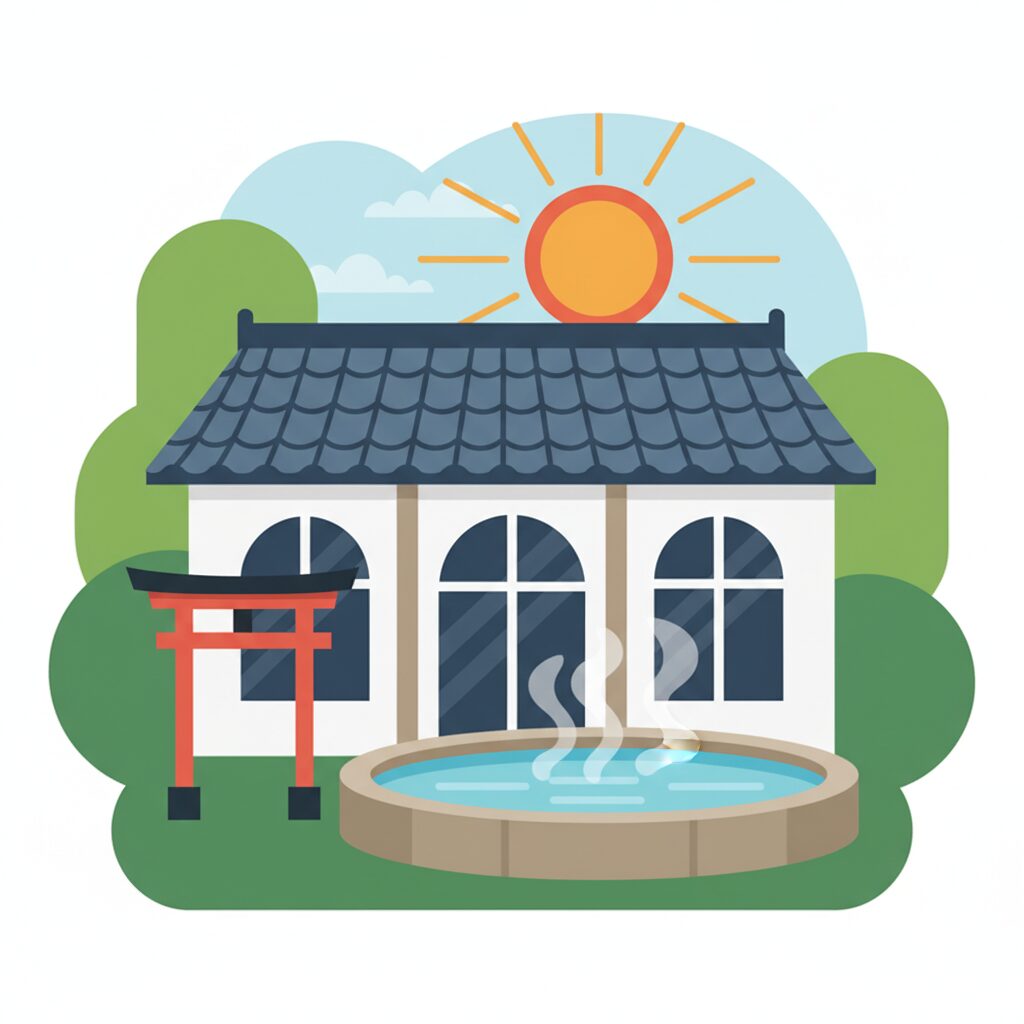
So, you’ve moved to Osaka. You’ve got your apartment, you’ve figured out the train lines, and you’ve probably noticed something curious tucked away in your neighborhood, between the takoyaki stand and the family-run greengrocer. It’s a building with a tall chimney, a traditional tiled roof, and a short curtain, or noren, hanging over the door, often with the character ゆ (yu, for hot water) printed on it. This is a sento, a public bathhouse. And your first, very logical question is probably, “Why does this still exist?” Every apartment in Japan, no matter how small, has a shower and a bath. The practical need for a public washing place vanished decades ago. Yet, here it is. And on any given evening, you’ll see people shuffling in and out, a small towel and a basket of soap in hand.
To understand Osaka, you have to understand the sento. This isn’t about getting clean. It’s about community, connection, and a specific flavor of human interaction that is quintessentially Osakan. It’s a social institution masquerading as a utility. While Tokyo races toward a future of private, individualized experiences, Osaka stubbornly holds onto these public, shared spaces. The neighborhood sento is a living, breathing museum of a certain kind of life, a place where the city’s unspoken rules, its unique dialect, and its deep-seated values are on full, naked display. It’s the city’s communal living room, its unofficial counseling center, and its most honest stage. Forget the gleaming towers of Umeda and the neon chaos of Namba for a moment. If you really want to get under the skin of this city, you need to understand what happens when people take their clothes off, step into the steam, and talk. This isn’t a tourist guide to a quaint cultural relic; it’s a field guide to the heart of daily life in the real, unvarnished Osaka.
To truly appreciate the city’s unique social fabric, consider exploring other quintessential Osaka experiences, such as a weekend trip into Osaka’s Satoyama countryside via the Nose Dentetsu.
More Than Just a Bath: The Sento as Osaka’s Social Hub
Across Japan, the story of the sento is one of gradual, graceful decline. As private baths became common in households after World War II, the number of public bathhouses sharply decreased. In cities like Tokyo, they are now often regarded as novelties, retro weekend experiences, or preserved architectural treasures. The bond to everyday, routine life has weakened. Yet in Osaka, while the pulse is fainter, it continues to beat with a persistent rhythm. This resilience is deeply embedded in the city’s history and identity.
The Disappearing Act and Why Osaka Holds On
Osaka was, and in many ways remains, the city of merchants. Its character was shaped in the bustling markets and crowded tenements where business and life were inseparable, blending into one chaotic, intertwined flow. People lived closely together, worked alongside each other, and socialized within these tight-knit communities. Community was not a mere abstract idea; it was essential for survival. Your neighbor wasn’t just someone next door; they were your customer, your supplier, your drinking companion, and the person who’d watch your children for a while. In this setting, the sento was more than just a place to wash away the day’s dirt. It served as a vital third space, a neutral ground beyond the cramped home and the pressures of the workplace. It was where information was shared, gossip exchanged, and social ties strengthened—all for the simple price of a hot bath.
This historical background explains why the sento feels distinct in Osaka. In Tokyo, society often appears more segmented and compartmentalized. There is a time and place for everything, with a clear division between work roles and private life. The social expectation to uphold appearances, the concept of tatemae (one’s public face), is strong. For many Tokyoites, the idea of casually chatting with their boss or client in a bathhouse is almost unimaginable. In Osaka, those boundaries have always been less defined. The city thrives on familiarity and personal connection, and the sento embodies this perfectly. It’s a place where social defenses come down, both literally and figuratively.
“Hadaka no Tsukiai”: The Great Equalizer
The phrase often used to describe this is hadaka no tsukiai, which means “naked communication” or “naked relationship.” It is fundamental to understanding the Osaka mentality. The idea is simple: when everyone is stripped of their clothes, they are also stripped of their status. The company president in his fine suit, the construction worker in his dusty outfit, the shopkeeper in his apron—in the bath, they are all just naked bodies in hot water. All outward signs of wealth, occupation, and social rank are left behind in a locker alongside wallets and watches.
This creates a space of raw, unfiltered equality cherished deeply in Osaka’s culture. The city has a long-standing skepticism toward authority and a fondness for the underdog. People here tend to judge you by your character, humor, and conversational skills, not by your business card. The sento is the perfect setting for this. Conversations start easily between complete strangers. An elderly man might ask a young man about his haircut. Two women might bemoan the rising cost of daikon radishes. And inevitably, someone will bring up the Hanshin Tigers, Osaka’s beloved and often exasperating baseball team.
This sharply contrasts with the often quiet, almost meditative ambiance of many Tokyo sento. There, a polite nod may be exchanged, but striking up a conversation with strangers is much less common, often seen as an intrusion into their private relaxation. In Osaka, silence can feel distant. The shared bath experience is an invitation to connect. A foreigner might be taken aback when an elderly man offers unsolicited advice on how to properly soak to ease back pain. This is not rudeness; it reflects Osaka’s way of recognizing a shared humanity. Within the steam-filled sento, everyone is simply a neighbor.
The Unspoken Rules and Rhythms of the Neighborhood Bath
To an outsider, an Osaka sento might appear chaotic and intimidating—noisy, steamy, and governed by unspoken rules that everyone but you seems to know. Yet grasping this social choreography is essential to understanding the daily rhythm of life in the city’s residential neighborhoods. This isn’t a sterile spa; it’s a living entity with its own heartbeat.
The Pre-Bath Ritual: The “Bandai” and the Locker Room
Your journey starts at the entrance. You slide open the door and step into a small area called the genkan to remove your shoes. You place them in a small wooden locker, often secured with a large, old-fashioned wooden tag (shimofuda) serving as the “key.” Then you head to the bandai or, in more modern places, a front desk. The bandai is a raised platform, traditionally positioned to overlook both the men’s and women’s changing rooms (a holdover from an older, more practical design). Sitting there is the master of this small world: the owner, often an elderly man or woman who has likely been there for decades. They act as the neighborhood’s living memory.
They greet regulars with a hearty “Maido!” (a classic Osaka merchant greeting meaning “Thanks for your continued patronage”) or a gruff but warm “Ou!” The exchange is brief but a ritual of recognition. They know who comes on which day, whose son just got married, and who’s been under the weather lately. As a newcomer, a simple “Konnichiwa” and holding up one finger to indicate one person is enough. You pay the fee, which is legally fixed for all basic sento in Osaka Prefecture, currently 490 yen. You might receive a locker key, or it could be first-come, first-served.
The changing room, or datsuijo, is the next social stage. It isn’t quiet or contemplative. A small, old television is usually on in a corner, tuned to a baseball game or variety show. Older men stand around, hands on hips, loudly debating the Tigers’ latest performance. Women catch up on neighborhood news. There’s a constant hum of chatter, the clatter of plastic baskets, and the creak of a vintage large-dial scale that everyone uses. Regulars have unofficial “spots”—specific lockers or favorite benches. As a foreigner, you may attract mild curiosity—a few glances, but rarely hostility. It’s more a “Huh, someone new” kind of vibe. The key is to be confident, find a spot, and get on with it.
“Kake-yu” and the Washing Area: The Art of Shared Space
Once undressed, you take your small towel (for washing and modesty) and soap into the bathing area to face the most sacred, inviolable rule of the sento: you must wash yourself thoroughly before entering the tubs. This is non-negotiable. It’s the fundamental agreement for sharing public water. Entering a tub without washing is a major social faux pas, a sign of disrespect to others. This is where Osaka’s character shines. In Tokyo, breaking this rule might earn icy stares and silent disapproval; in Osaka, an obachan (an older, often feisty woman) will not hesitate to call you out bluntly: “Nani shiten no, anata! Saki ni arai ya!” (“What do you think you’re doing! Wash first!”). It’s direct but effective, leaving no room for misunderstanding—a form of communal maintenance.
The washing area consists of a row of low-faucet stations, each with a small plastic stool and bucket. You find an empty one, sit down, and scrub. This space also follows unspoken rules—you avoid splashing neighbors, and if it happens, a quick “Ah, sumimasen” (Ah, sorry) is expected. You don’t hog the faucet. When finished, you rinse your stool and the surrounding area with hot water from your bucket to prepare it for the next person. These small acts of consideration are the lubricant that keeps the communal machinery working smoothly. Watching regulars is educational—they bring personalized caddies with special shampoos, soaps, and even pumice stones. The washing ritual is not a quick splash; it’s a dedicated process.
The Social Geography of the Tubs
After washing, it’s time to soak. An Osaka sento typically offers several baths, each with its own culture. The main tub, usually quite hot (atsuyu), often belongs to the older generation—men and women who believe near-scalding water promotes good health. Then there may be a cooler tub (nuruyu), a jet bath (denki-buro), and sometimes a special medicinal bath (kusuriyu) infused with herbs.
The denki-buro, or electric bath, is a uniquely Japanese experience popular in Osaka. It passes low-voltage electric currents between two plates in the water, creating a tingling, buzzing sensation meant to relax muscles. For newcomers, it can be a literally shocking experience, but regulars swear by it. Watching someone ease into the denki-buro for the first time is a common source of quiet amusement.
Here, conversations from the changing room continue and deepen. The hot tub hosts discussions about politics and sports. The jet bath is where folks share tips on finding the best grocery deals. If there’s an outdoor bath (rotenburo), it’s often the most relaxed and chatty spot. Foreigners sometimes treat it like a jacuzzi from home, launching into deep, personal talks. But sento conversations tend to be lighter, more like a stream of consciousness—sharing a moment rather than baring souls. Topics are public, communal, and immediate: the weather, local news, neighborhood happenings. It’s the community’s oral history, refreshed daily.
The Sento and the Osaka Mindset: A Case Study
If you spend enough time in Osaka’s sento, you begin to see that the behaviors and attitudes within the bathhouse perfectly reflect the city’s broader culture. The way people engage with the space and with each other reveals key aspects of the Osaka mindset: fierce pragmatism, a preference for straightforward communication, and a strong belief in the power of community.
Pragmatism and Value: The “Moto o Toru” Spirit
Osaka is a city that values a good deal. This isn’t about being cheap; it’s about being savvy with your money and appreciating true value. This mindset is known as moto o toru, which literally means “to get your principal back,” or more colloquially, “to get your money’s worth.” For the 490-yen entrance fee, an Osakan extracts the maximum possible value. This involves more than a quick soak—it’s a thorough, multi-stage relaxation ritual. They soak in every tub, move back and forth between the hot bath and the cold plunge pool (mizuburo), and, if there’s a sauna, they use it multiple times, sweating until they can’t anymore.
This contrasts with a more rushed, efficiency-driven approach you might find elsewhere. The goal is not just to get clean but to make full use of the facility. The sento is an affordable luxury, and visitors aim to enjoy every yen spent. This extends to the post-bath routine. Almost every sento features a vintage vending machine or refrigerator stocked with small glass bottles of milk—plain, coffee-flavored, and fruit varieties. Drinking a cold bottle of milk, hands on your hips after a hot bath, is an inseparable part of the sento experience. It’s the final, satisfying step in the moto o toru process. After a long soak and sauna session, you enjoy a refreshing drink—you’ve gotten the full experience.
Directness, Not Rudeness: The Art of Osaka Communication
As noted earlier, Osaka communication is famously direct compared to the rest of Japan. What might come across as confrontational or rude in Tokyo is often seen as honest and efficient in Osaka. The sento is an ideal setting for grasping this nuance. There’s no room for passive aggression when someone is splashing water on you—you speak up. When an elderly man sees a young person shivering instead of fully immersing in the hot tub, he might bark, “Kata made tsukare!” (“Get your shoulders in!”). It’s not a command but tough-love advice, a way to look out for someone.
This directness also applies to curiosity about foreigners. While tattoos remain a complex issue in Japan and are often banned in gyms and spas, neighborhood sento tend to be more relaxed. Don’t be surprised if an old man points at your tattoo and asks, “兄ちゃん、それ何や?” (“Hey brother, what’s that?”). The tone is usually sincere curiosity, not judgment. They may inquire about where you’re from, what you do, and whether you like the Hanshin Tigers. It’s their way of breaking down barriers and inviting you into the communal space. In a more reserved city, you might be stared at from afar; in Osaka, they’ll just ask. Although this can feel abrupt at first, it stems from a desire to connect, not offend. It’s the hadaka no tsukiai spirit in action: let’s get straight to the point—we’re all here together.
The Interwoven Community: More Than Neighbors
The sento doesn’t stand alone. It anchors the local neighborhood, closely tied to the surrounding shotengai (shopping arcade) and the lives of residents. The sento owner knows the tofu shop owner, who knows the butcher, who knows the woman running the small kissaten (old-style cafe). The sento is a hub in this web of relationships.
After their bath, people don’t rush home. Relaxation continues. A group of elderly men might head to a nearby tachinomi (standing bar) for a quick beer and some snacks, still flushed from the heat. A mother and her kids might stop at the butcher shop to pick up freshly fried korokke (croquettes) for dinner. Conversations that began in the bath overflow onto the street. This creates a powerful, village-like atmosphere that is increasingly rare in Japan’s major cities. It’s a stark contrast to the anonymous, transient nature of many Tokyo neighborhoods, where you might live for years without ever speaking to your neighbors.
Numerous stories tell of the sento as an informal social safety net. If an elderly regular who lives alone misses a few days, the sento owner notices and mentions it to another patron, often the local mailman. The mailman checks if the person’s mail is piling up. This informal system of care is a vital, yet often invisible, part of Osaka’s community life. The daily ritual of the bath quietly ensures that no one slips through the cracks.
Navigating Your First Osaka Sento: A Practical Guide for Residents
Theory and cultural analysis aside, stepping into a sento for the first time can still feel intimidating. The key is to approach it with some knowledge and plenty of humility. Remember, you are a guest in a long-standing local institution. Observing and following the lead of regular patrons is always the best approach. Here’s a practical guide to help make your first visit go smoothly.
Finding Your Local Gem
First, forget the large, modern “super sento” complexes. While they can be enjoyable, they’re more like spa theme parks. The authentic experience lies in the small, family-run neighborhood sento. How do you discover one? Just wander. Explore the residential backstreets of wards like Nishinari, Taisho, Asahi, or Joto. Look for the tall chimney and the noren curtain bearing the ゆ symbol. The exterior may appear a bit worn, and the paint might be peeling, but that’s a mark of authenticity. These places have served their communities for generations. Don’t be put off by their old-fashioned look; it’s all part of the charm.
What to Bring, What to Expect
Although many sento offer a “tebura set” (“empty-handed set”) with rental towels and soap for a small additional fee, it’s best to bring your own if you plan to visit regularly. Here’s your basic kit:
- A small towel: This is the most essential item. It’s used for washing your body and for modesty when walking around. It should never be placed in the bath water.
- A large towel: For drying off fully in the changing room after your bath.
- Soap/shampoo/conditioner: Bring your preferred products in a small plastic basket or waterproof bag.
- Change: Have coins ready for the entrance fee and perhaps a drink from the vending machine afterward. Some places still accept cash only.
Set your expectations. It won’t be silent. The facilities may be old, but they are clean. People might stare, especially if you are clearly not Japanese. Take it in stride. A simple nod and a smile go a long way.
A Step-by-Step Walkthrough for Beginners
- Entrance: Remove your shoes and place them in a shoe locker. Take the wooden key tag with you.
- Payment: Proceed to the bandai or front desk. Say “Hitori desu” (One person) and pay the fee.
- Changing Room: Enter the correct changing room. 男 (otoko) is for men, marked by a blue curtain. 女 (onna) is for women, marked by a red curtain. Find an empty locker or basket for your clothes and get completely undressed.
- Enter the Bathing Area: Take only your small towel and washing supplies with you. Leave your large towel in your locker.
- Wash First: This is a crucial step. Find an empty washing station. Sit on the stool, use the faucet and bucket to wash your entire body and hair thoroughly with soap. Be careful not to splash others.
- Rinse Your Station: After washing, use your bucket to rinse off the stool and the floor around you for the next person.
- Enter the Tubs: Now you can soak. Enter the water slowly, as it may be very hot. Place your small towel on your head (which helps prevent dizziness) or on the edge of the bath. Never let it touch the bath water.
- Relax and Observe: Try different baths and listen to conversations. This is your moment to relax.
- Pre-Drying: Before returning to the changing room, use your small, damp towel to wipe off as much water as possible from your body. This prevents dripping in the changing room.
- Drying Off: Use your large, dry towel to dry yourself completely in the changing room.
- Post-Bath: Dress up. Now’s the time for that cold bottle of milk. Relax for a while in the changing room; there’s no need to rush.
- Leaving: Make sure you haven’t forgotten anything. As you leave, nod to the owner at the bandai and say “Arigatou gozaimashita” (Thank you very much) or, for extra local flavor, “Oki ni,” the Osaka dialect equivalent.
The Future of the Sento in an Ever-Changing Osaka
No matter how culturally significant they are, economic realities cannot be ignored. Sento continue to close in Osaka, just as they do elsewhere. The owners are aging, and their children often hesitate to take over the demanding, low-margin business. The cost of fuel for heating water keeps rising. Although the customer base remains loyal, it is shrinking as older generations fade away. The future of neighborhood sento is far from guaranteed.
Yet, there are signs of hope. A new generation of younger Japanese people, feeling isolated in an increasingly digital world, are rediscovering the joy of these analog, communal spaces. Artists and designers are purchasing and renovating old sento, preserving the traditional architecture while incorporating modern elements such as craft beer on tap, art installations, or live music events. They are reimagining what a public bath can be in the 21st century.
Foreign residents are also contributing. Once they overcome initial cultural barriers, many come to appreciate the authenticity and warmth of their local sento. They become regular visitors, adding a fresh strand to the community’s rich tapestry. In a city as dynamic and ever-evolving as Osaka, the sento stands as a quiet symbol of enduring values: the need for connection, the comfort of ritual, and the simple joy of shared experience.
Ultimately, the sento perfectly reflects Osaka itself. It may not be as sleek or polished as Tokyo. It can be a little loud, somewhat old-fashioned, and occasionally in-your-face. But it is deeply human. It’s a place where social pretenses vanish, leaving only the raw, honest, and often humorous reality of people living their lives side by side. To live in Osaka without ever visiting a neighborhood sento is to miss an essential part of the city’s soul. It’s where you don’t just wash your body; you immerse yourself in the very essence of the community. It’s where the city lowers its guard and, in doing so, invites you to do the same.