Welcome to Osaka. You’ve probably noticed the cityscape is a blur of motion. Trains glide overhead, crowds surge across intersections, and weaving through it all is a constant, shimmering river of bicycles. From a distance, it looks like pure, unadulterated chaos. A two-wheeled free-for-all where sidewalks are treated like highways and red lights feel like mere suggestions. Your first thought might be, “How does anyone survive this?” Your second might be, “Should I get a bike?” That second question is the big one. Because getting a bike in Osaka isn’t just a transportation choice; it’s a deep dive into the city’s psyche. This isn’t Tokyo, where cyclists often move with a certain hesitant, rule-bound precision. This is Osaka, and the rules of the road are written in an invisible ink of instinct, eye contact, and a shared understanding that the ultimate goal is to just keep moving. This guide isn’t about the official traffic laws you can read online. This is about the living, breathing, chaotic dance of daily cycling. It’s a guide for the patient navigator, the urban explorer who can find the rhythm in the noise. It is absolutely not for the impatient commuter who sees the world as a series of obstacles. So, before you invest in your own mamachari, let’s break down the unspoken symphony of the Osaka streets.
Once you’ve mastered the rhythm of the streets, you might find yourself seeking a quiet place to reflect, perhaps in one of Osaka’s cozy kissaten.
The Sidewalk is Not Just for Walking: Welcome to the Shared Domain
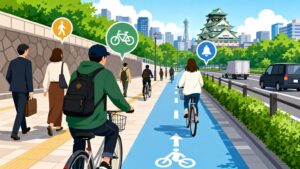
The very first mental shift you need to make is a significant one. In many parts of the world, and even in other Japanese cities, riding a bicycle on a pedestrian sidewalk is considered a major offense. It’s rude, illegal, and will earn you disapproving looks or even a fine. In Osaka, however, all of that is reversed. The sidewalk is the default cycling lane. It’s a shared, contested, and constantly negotiated space where pedestrians, cyclists, and the occasional scooter coexist in a delicate, often unsteady balance. The road is for cars, and while you’ll see plenty of confident cyclists navigating traffic, most daily riders—the mothers with children, the students, the elderly running errands—stick to the pavement. This isn’t an occasional practice. It’s the norm.
Deconstructing the Sidewalk Hierarchy
To the untrained eye, it may seem chaotic. But spend enough time observing, and you’ll notice the patterns—the unspoken hierarchy that controls the flow. Pedestrians, theoretically, have the absolute right of way. In reality, it’s far more fluid. The true ruler of the sidewalk is whoever has the most momentum and the least maneuverability. A mother on a heavy mamachari bicycle, carrying two kids and a week’s worth of groceries, is like an urban battleship. She doesn’t stop or make sharp turns. Pedestrians instinctively step aside for her. She is the cornerstone of this ecosystem. An elderly person with a walker or a shopping cart ranks close behind. They are fixed points in this universe; the flow of bikes and people must navigate around them. Fast-moving high school students headed to school, salarymen rushing for trains, and delivery riders on electric bikes form the next tier. They are assertive, agile, and expect awareness from those nearby. Then there are the casual strollers, those absorbed in their phones, and tourists. They are wild cards, often unaware of the currents they disrupt. As a cyclist, your responsibility is to read this entire cast in a split second and weave through them without causing collisions. It’s less about rigid rules and more about reading the environment—or, in this case, the 10 meters of sidewalk in front of you.
The “Sumimasen” Bell: A Tool for Negotiation, Not Aggression
In this crowded setting, your bike’s bell is not a horn. It’s not an angry demand for people to move aside. Ringing it loudly and aggressively is the quickest way to mark yourself as an outsider—someone who doesn’t understand the rules. The Osaka bell is a subtle means of communication. A gentle, almost apologetic chirin-chirin is a polite notification, not a command. It conveys a range of courteous messages: “Pardon me, I’m right behind you,” or “Excuse me, I’d like to pass when you can,” or simply, “Just a friendly heads-up that a bicycle is coming.” It’s like a soft tap on the shoulder. Many Osakans even avoid using the bell entirely, opting for an even gentler approach. You might hear a quiet, breathy “suimasen” as they glide past. Sometimes a subtle throat clearing. Occasionally, the only warning is the clicking of the bike’s freewheel as they coast behind you. The key is subtlety. It’s about making your presence known without startling anyone, allowing pedestrians to naturally adjust their path. It’s a polite invitation to join the dance, not a demand to clear the floor.
The Unwritten Laws of the Road (and the Sidewalk)
Beyond the sidewalk ballet, a wider set of unwritten rules governs cycling in Osaka. These guidelines distinguish a smooth, flowing ride from a jarring, stressful experience. They are learned through observation and osmosis, often valuing practicality over strict adherence to the law. Mastering these rules is essential to grasping the city’s unique rhythm and the mindset of its people, who view rules as flexible guidelines aimed at maximizing efficiency.
Rule #1: Eye Contact is Everything
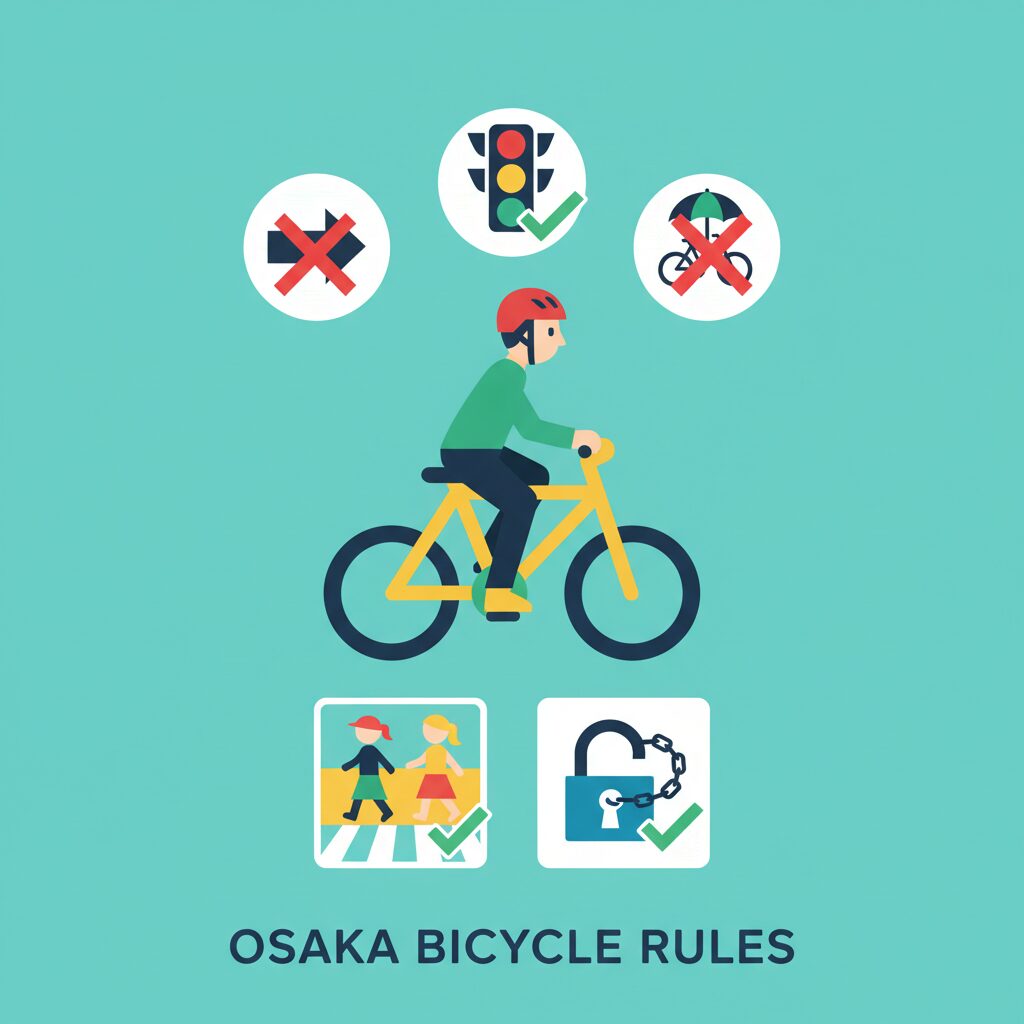
This is arguably the most crucial unspoken rule in all of Osaka. At smaller intersections without traffic signals, or when navigating a chaotic mix of people and vehicles, official right-of-way takes a backseat to the silent pact of eye contact. Whether it’s a driver waiting to turn, a scooter darting out of an alley, or another cyclist approaching from a side street—the interaction remains the same. You lock eyes briefly. In that glance, a negotiation unfolds: a subtle nod, a slight pause, a flicker of intent. One party yields, the other proceeds. This exchange happens in a split second and rests on mutual awareness. Unlike a system based purely on fixed rules where you assume others will stop for you, in Osaka you assume nothing and confirm everything with your eyes. For newcomers, this can be daunting, feeling uncertain and risky. For Osakans, it is a deeply ingrained, highly effective system that keeps the city moving—a belief that human interaction and awareness are more trustworthy than blind reliance on signs and regulations.
Rule #2: Momentum is King
If Osaka had a patron saint of physics, it would be the guardian of momentum. An object in motion stays in motion, and cyclists in Osaka go to great lengths to maintain it. Coming to a full stop is viewed as a failure, a waste of precious energy and time. This mindset shapes many street behaviors. Watch a cyclist approaching a red light meant for cars. Do they stop and wait? Rarely. More often, they veer onto the wide sidewalk, merge seamlessly with pedestrians crossing, then smoothly hop back onto the road without their feet touching the ground. They prefer longer, winding routes through parks over shorter, direct paths with stop signs. This commitment to continuous motion explains the city’s signature weaving style. Rather than braking behind a slow walker, a cyclist performs a series of quick, fluid swerves to pass. It’s all about preserving that forward glide, that effortless flow. This isn’t mere laziness; it reflects a core value of the city’s merchant spirit: efficiency above all. Wasted motion equals wasted time, and time is a precious resource.
Rule #3: The Invisible Lane
Stroll through any of Osaka’s vast, covered shopping arcades—the renowned shotengai. The Tenjinbashisuji Shopping Street, Japan’s longest, is a prime example. It’s a dense, chaotic river of humanity—people stopping to browse shops, children running, vendors calling out. Gliding right through the middle is a steady flow of bicycles. There’s no painted bike lane, no signs. Yet there is an invisible lane—a channel subconsciously created and maintained by everyone. Pedestrians naturally drift to the sides, leaving a central corridor about a meter or two wide for cyclists to pass. Shoppers stepping out instinctively check both ways before entering this “lane.” It’s a remarkable display of collective, unspoken coordination. Cyclists adjust their speed, using a gentle bell or soft voice when approaching thicker crowds. They become part of the arcade’s ecosystem, not an interruption. This phenomenon isn’t limited to the shotengai; it appears on wider sidewalks and pedestrian-heavy zones throughout the city. It’s a testament to shared spatial awareness that allows Osaka to function smoothly despite an apparent absence of formal structure.
The Arsenal of Osaka Cycling: Know Your Ride
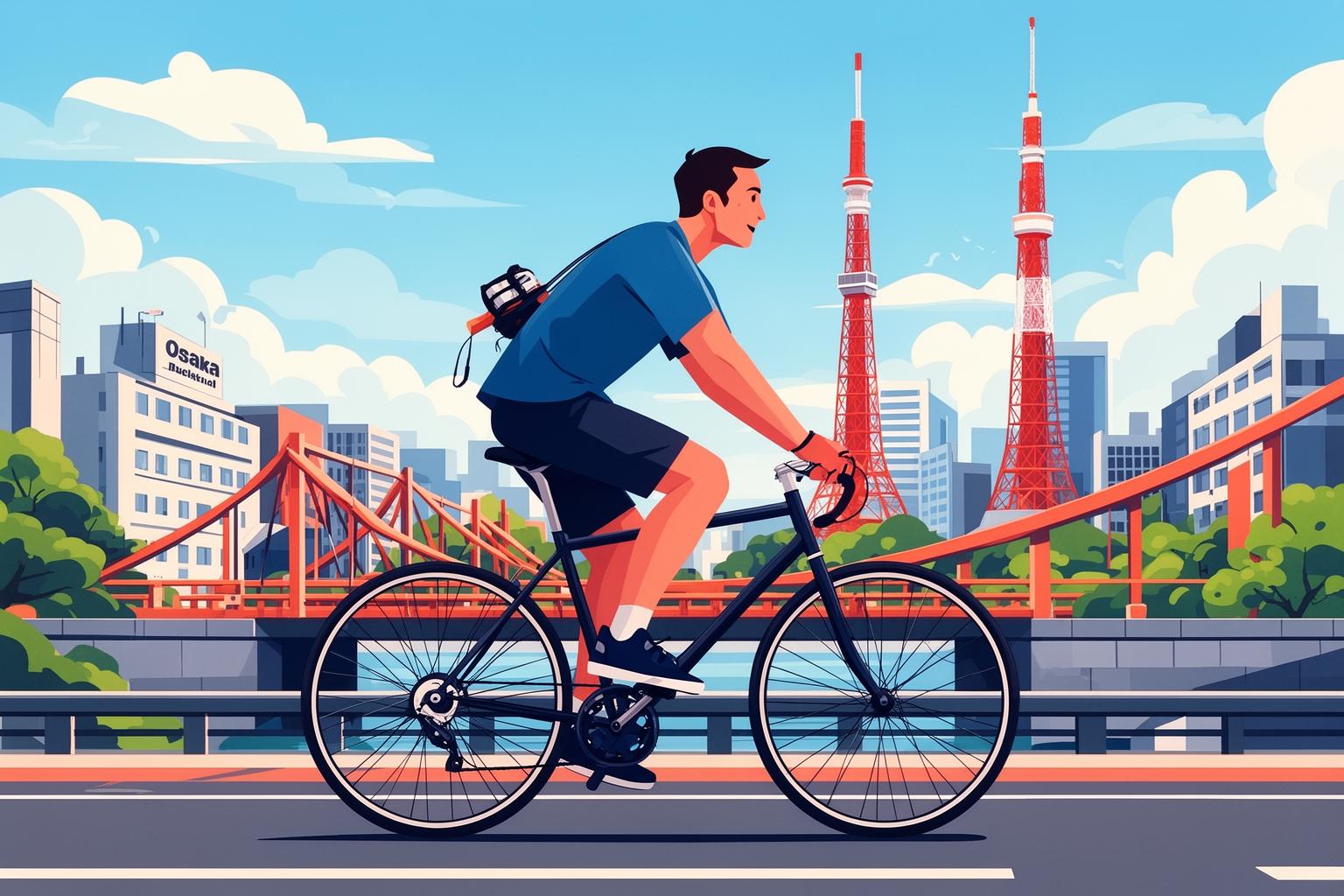
Not all bicycles are made the same, and in Osaka, the type of bike you choose reveals much about your role within the urban environment. The bike you ride shapes how you travel, how others perceive you, and what your daily routes entail. Knowing the main types is essential to grasping the dynamics on the road. Each kind has its own character, its unique strengths, and its specific place in the sidewalk hierarchy.
The Mamachari: The Unstoppable Urban Tank
Meet the undisputed queen of Osaka’s streets: the mamachari, or “mom’s chariot.” This isn’t a sleek, lightweight bike. It’s a workhorse, a utilitarian powerhouse designed for one thing: carrying loads. Usually featuring a sturdy step-through frame, a wide, comfy seat, a large front basket, and often a rear basket or child seat, the mamachari is the backbone of the city’s households. It’s heavy, slow, and has a turning radius like a small cargo ship. Yet it’s unstoppable. These bikes transport the lifeblood of families—children, groceries, laundromat bags, often all at once. When you see a mother expertly navigating one of these loaded vehicles through crowded streets, give her room and respect. She’s a master of applied physics and urban maneuvering. She won’t make sudden moves, but she won’t be pushed aside either. Challenging a mamachari for space is a losing battle. You yield. Always yield. They are the slow-moving, deeply respected foundation of the city’s cycling culture.
The Fixie and the Road Bike: The Nimble Messengers
At the other end of the scale are the fast movers: students on single-speed fixies, devoted commuters on sleek road bikes, and food delivery riders on electric-assisted speed machines. These riders are the sharks and dolphins of the urban ecosystem, darting and weaving where the mamachari plows straight ahead. They tend to ride in the street, mixing it with cars to maintain speed. They are quick to hop curbs and cut through sidewalk crowds to evade traffic jams. Their riding style is confident, sometimes aggressive. Their moves are sharp and decisions instantaneous. Whereas a mamachari announces itself with undeniable bulk, these riders use agility to slip through gaps others wouldn’t dare try. They’re the ones most likely to surprise you by suddenly appearing at your side, having squeezed between a lamppost and a group of tourists.
The Foldable and the Commuter: The Practical Hybrids
Between these extremes lies a broad middle ground. This includes the simple single-speed commuter bike, visible in the thousands outside every train station, as well as the clever foldable bike, perfect for apartment living and mixed-mode travel. These riders represent the everyday cyclists. They tend to be pragmatic, traveling at moderate speeds, comfortable on both sidewalks and quieter streets. They are the most versatile group. They’ll patiently follow a crowd but can also burst forward to clear an intersection. They express the balanced, practical spirit of Osaka cycling. They’re neither chasing speed records nor hauling families. They’re just trying to get from point A to point B with maximum efficiency and minimal hassle in the city’s chaotic landscape.
Parking Pandemonium: The Final Challenge
You’ve successfully navigated the crowded sidewalks, mastered the art of non-verbal negotiation, and reached your destination. Now comes the final challenge: parking. The sheer number of bicycles in Osaka far exceeds the available legal parking spaces. This mismatch creates a city-wide puzzle that unfolds every day on every block. Finding a spot to leave your bike is an art that combines luck, spatial reasoning, and a calculated assessment of risk.
Official Spots vs. “The Gray Zone”
Most train stations and large department stores offer official, designated bicycle parking areas. Some of these are massive, multi-level automated garages that seem straight out of a science fiction movie. You roll your bike onto a platform, a machine whisks it away into an underground silo, and you receive a ticket to retrieve it later. These facilities are secure, often charge a small fee, and are fantastic options. There are also simple ground-level lots where you can lock your bike to a metal rack. The problem is, these official spots fill up quickly, especially during peak commuter times. This leads everyone to the great “gray zone.” The gray zone is the expansive, undefined area of guardrails, telephone poles, fences, and any other stationary objects you can lean a bike against. You’ll see bikes lined up in long, neat rows along sidewalks, tucked discreetly in alleys, and clustered near building entrances. This is technically illegal, and the city does enforce the rule. The dreaded sign of a parking violation is a yellow or silver paper notice wrapped tightly around your frame or handlebars. This is a warning. Leave it there too long, and you risk returning to find your bike gone, replaced by a chalk outline and a notice of impoundment. Recovering your bike means traveling to a distant, inconveniently located pound and paying a hefty fee. Every gray zone parker makes a silent gamble, weighing the convenience of their chosen spot against the real risk of being towed.
The Bicycle Jigsaw Puzzle
Even when you secure a spot, whether official or in the gray zone, your task isn’t over. You now face the bicycle jigsaw puzzle. Bikes aren’t parked with generous spacing; they’re packed together with surgical precision. Handlebars are interwoven, pedals interlocked, and baskets jammed against each other. Maneuvering your bike into or out of this dense cluster is both a physical and mental challenge. It requires gently lifting your bike, angling the front wheel just right, turning the handlebars to their narrowest profile, and sliding it through the gaps. Inevitably, you’ll have to touch and slightly adjust other people’s bikes. This is a crucial piece of unspoken etiquette. It’s perfectly acceptable to gently move a neighboring bike to free your own, with one essential condition: you must leave their bike in a stable, secure position—preferably locked if they forgot. Simply pulling yours out and letting theirs topple over is a major breach of the social contract. Everyone is part of this puzzle, and the system only works if everyone shows a basic level of respect for their fellow cyclists’ property.
Is This Chaos for You? A Practical Self-Assessment
So, we return to the original question: after exploring the intricate, chaotic, and oddly captivating world of cycling in Osaka, is it right for you? The answer depends less on your cycling ability and more on your personality and tolerance for uncertainty. It’s about mindset. This is an opportunity to be honest with yourself about what you need to feel secure and comfortable in your everyday life. It’s a fantastic way to experience the city, but it’s not suited for everyone.
You Might Be an Osaka Cyclist If…
You may thrive on two wheels here if you value flow and efficiency over strict rule-following. If you’re good at interpreting non-verbal signals—the slight shift in a pedestrian’s posture, the intention in a driver’s glance—you already possess the key skill needed. You’ll fit in well if you can tolerate close calls and view a crowded sidewalk not as a frustrating obstacle, but as a dynamic puzzle to solve. A crucial trait is staying calm and composed. You will be cut off. Someone will step out in front of you without warning. If you can accept this as part of the natural chaos without taking it personally, you’ll do fine. After all, just minutes later, you’ll probably be the one prompting someone else to hit their brakes. It’s a system of give and take, and having a short memory is a major advantage.
You Might Want to Stick to the Train If…
Conversely, daily cycling in Osaka could be a constant source of stress if you prefer clear, predictable rules. If you firmly believe that sidewalks are only for walking and red lights always mean stop, no exceptions, you’ll find the local customs aggravating. If the idea of weaving through a dense crowd with only centimeters to spare makes you anxious, it’s best to avoid it. If you rely on abundant, well-marked, and easily accessible parking to feel comfortable, the daily uncertainty of this gray area will wear you down. Most importantly, if you are naturally an “impatient commuter,” prone to frustration and anger when your way is blocked, this environment is not for you. The Osaka cycling culture demands deep patience and an almost Zen-like acceptance of the flow. Resisting it is a losing battle that will only leave you drained.
A Final Word: It’s a Dance, Not a Fight
Ultimately, the best way to grasp Osaka cycling is to see it differently. It’s not a battle for space, nor a conflict between bikes, pedestrians, and cars. It’s a vast, complex, and largely spontaneous dance. Every person on the street is your partner, whether they realize it or not. The grandmother on her mamachari sets a slow, steady tempo, while the high school student on a fixie leads with sharp, quick moves. The crowd of pedestrians acts as the corps de ballet, flowing and parting in unison. To navigate this successfully, you must learn the steps, feel the rhythm, and find your place in the choreography. This system perfectly mirrors Osaka’s character: a bit rough around the edges, highly pragmatic, incredibly efficient, and held together not by strict rules but by a shared, unspoken understanding that everyone is simply trying to get where they’re going. It’s about creating functional harmony amidst the chaos, not eradicating the chaos itself. If you choose to join in the dance, my advice is straightforward: start slow, observe how others move, tune into the city’s rhythm before adding your own beat, and maybe invest in a friendly-sounding bell. If you follow this, you just might fall in love with the exhilarating freedom of Osaka’s two-wheeled hustle.