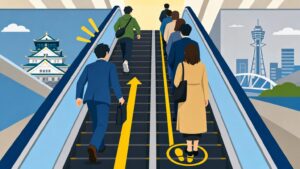
There’s a specific feeling you get after about six months of living in Osaka. It’s not burnout, not exactly. It’s more like sensory saturation. It usually hits me on a Tuesday afternoon in the local supermarket. The fluorescent lights seem to hum at a frequency designed to vibrate your teeth. The store’s jingle, a relentlessly cheerful loop of synthesized trumpets, drills into your skull. An announcer on the PA system is enthusiastically describing the day’s specials on daikon radish with the urgency of a disaster warning. To your left, two obachan, Osaka grandmothers with magnificent perms, are conducting a conversation at a volume that could cross prefectural lines, their laughter sharp and percussive. To your right, a fishmonger is yelling a throaty ‘Irasshai!’ to every single person who wanders past his display of glistening squid. You’re trying to remember if you need soy sauce or mirin, but your brain feels like a web browser with a thousand tabs open, all of them playing different videos at full volume. The physical space is just as crowded. Aisles are narrow, designed for maximum product display, not for the comfortable passage of human beings. You perform a delicate ballet of avoidance, tucking in your elbows, turning sideways to let a salaryman pass, your shopping basket constantly threatening to snag on a tower of instant noodle bowls. This isn’t an unusual day. This is just… Tuesday in Osaka. The city operates at a constant, fever-pitch of human interaction, noise, and presence. There is no empty space. Not in the soundscape, not in the landscape, and certainly not in a conversation.
For a long time, I thought this was just the nature of a big city. I’m from near Sydney; I’m no stranger to urban hustle. But Osaka is different. Tokyo is dense, but it often feels like a collection of millions of individual silences moving in unison. Osaka feels like a single, massive, interconnected, and very loud organism. The energy is infectious, it’s vibrant, it’s one of the reasons many of us fall in love with this place. It’s real and unapologetically human. But it is also utterly relentless. It fills every crack and crevice of your day until you feel completely full, stuffed to the brim with sound and light and interaction. And that’s when you realize what you’re missing. It’s a Japanese concept that the city of Osaka seems to have collectively decided it can do without: ‘Ma’ (間). Ma is often translated as ‘negative space,’ but that’s a pale, two-dimensional version of what it truly is. Ma is the silent pause between notes that gives music its rhythm. It’s the unpainted part of a scroll that draws your eye to the painted subject. It’s the empty space in a room that makes it feel calm and liveable. It is the gap, the interval, the void that gives meaning to everything around it. And in Osaka, the search for Ma can feel like a fool’s errand. The city is all content, no container. So, what do you do when your soul needs that pause, that breath, that empty space to reset? You don’t look for it in the city. You get on a train. You head south for about an hour, to a place where the sky is bigger than the buildings and the loudest sound is the wind in the rice fields. You go to Asuka Village in Nara, not as a tourist, but as a pilgrim seeking the profound relief of emptiness.
If you’re looking for a different way to navigate the city’s vibrant chaos, consider exploring Osaka’s unique cycling culture.
The Osaka Wall of Sound and Presence
Before grasping the cure, you first need to accurately diagnose the condition. What does this ‘fullness’ of Osaka truly feel like day to day? It’s a multi-sensory onslaught—a beautiful, chaotic, and utterly exhausting barrage that defines life here. Many foreigners, especially those arriving with a preconceived image of a serene, quiet Japan, often misunderstand it. They mistake the noise for aggression, the closeness for intrusion, and the constant chatter for a lack of seriousness. But it’s none of those things. It’s simply the Osaka way of life, a culture that abhors emptiness.
The Auditory Landscape
Let’s begin with the sounds. From the moment you step outside, you are enveloped. In my Tennoji neighborhood, the day starts with the distant clang of the JR loop line crossing—a rhythmic signal that the city is awake and moving. Soon after, motorbikes delivering newspapers whine by, joined by the rumble of the first trams. Yet these are just the background noise. The real soundtrack of Osaka is made by human voices. Shopkeepers in the local shotengai (covered shopping arcade) don’t simply open their doors; they announce their presence. The fruit and vegetable vendor, his face a map of cheerful wrinkles, has a voice strong enough to shatter glass. He doesn’t just arrange tomatoes; he sings their praises, calling out ‘Yasui de! Oishii de!’ (‘Cheap! Delicious!’) that bounce off the corrugated roof. Nearby, the tofu seller engages in a friendly shouting match with the butcher about last night’s Hanshin Tigers game. This isn’t a performance; it’s the standard way of communication here. A quiet shop in Osaka means a struggling shop. Sound equals life, energy, and good business.
Over this are layered mechanical sounds. Pachinko parlors, their doors forever open, spill a cacophony of digital explosions and triumphant jingles onto the street. The crosswalk signal’s tinny, upbeat melody gets lodged in your brain for days. Each major train station has its own unique departure jingle, a Pavlovian cue for a last-minute dash. Supermarkets play their own theme songs. Don Quijote stores have maddeningly catchy tunes designed to spur frantic shopping. Political candidates cruise residential streets, not just during elections but year-round, broadcasting their names and slogans from loudspeakers. In winter, the sweet potato truck’s mournful, looping chant of ‘yaki-imo…’ evokes nostalgia for locals but puzzles newcomers. It’s a nonstop symphony of commerce, transit, and public announcements.
The Visual and Physical Clutter
Visually, Osaka is just as intense. The idea of zoning feels like a polite suggestion that was thoroughly ignored. Buildings are tightly packed, mixing functions chaotically. A tiny, ancient shrine might be squeezed between a multi-story car park and a sleek new condo. Overhead, wires and cables hang in thick, tangled webs, a testament to decades of piecemeal upgrades. But the true visual hallmark is the signage. In places like Namba, Shinsaibashi, or Umeda, every inch of vertical space battles for your attention. Flashing neon, giant mechanical crabs and dragons, video screens, and layers of signs in Japanese and English create a visual roar. No wall is bare, no corner quiet enough for your eyes to rest. Even in quieter residential areas, streets overflow with vending machines, utility poles plastered with ads, and shop banners fluttering in the wind. Shops don’t just occupy their interiors—they spill onto the pavement with baskets of produce, racks of clothing, and plastic signs advertising lunch specials, forming an obstacle course for pedestrians. This isn’t viewed as clutter but as vibrancy. An empty storefront looks sad, but a street brimming with signs of bustling business signals a thriving community.
This physical density directly translates into a scarcity of personal space. The invisible ‘bubble’ many Westerners expect does not exist here in the same way. On the Midosuji subway line during rush hour, you stand pressed against strangers with an intimacy usually reserved for close family. There’s no apology, no awkwardness; it is simply the reality of transporting millions through confined spaces. In busy restaurants, you might share a communal table, your elbow nearly touching the next person. The design philosophy is not about spacious, private comfort but maximizing seating for happy, paying customers. This closeness fosters a unique communal energy. You’re all literally in it together, and this shared experience bridges barriers, leading directly to the next point.
The Social Fullness
Perhaps the most defining and frequently misunderstood aspect of Osaka is its social fullness. Social spaces are as packed as the physical ones. Silence in social settings is seen as a problem to fix immediately. In Tokyo, sitting alone at a bar often means you’ll be left alone. In Osaka, it’s an invitation. The bartender, your neighbor, or a group at the far end of the counter will start a conversation: ‘Where are you from?’, ‘What brings you here?’, ‘Do you like okonomiyaki?’. These questions serve as bridges, efforts to fill silence and bring you into the fold. Osakans excel at ‘tsukkomi,’ the quick, witty retort central to their conversational style, rooted in the region’s history as Japan’s comedy hotspot (manzai). Conversations are rallies, games of verbal ping-pong: you say something funny (the ‘boke’), and they immediately respond with a tsukkomi. There is no room for long, thoughtful pauses; a break in the conversation is a missed opportunity. This dynamic can be exhilarating and explains why Osakans are considered friendly—they actively include you. But to an introvert or someone tired, it can be draining. There’s a social expectation to be ‘on,’ to perform, to engage. Quietness can be mistaken for unhappiness or worse, unfriendliness. You must always be ready to fill the space. The obachan on the train who shares her life story isn’t being rude; she’s being Osakan. She sees an empty space beside you and fills it with connection.
What is ‘Ma’? And Why You Won’t Find It on the Midosuji Line
To truly grasp the profound, soul-deep relief that a place like Asuka offers, it’s vital to understand the concept of ‘Ma’ beyond its straightforward translation. It forms a cornerstone of the Japanese aesthetic, and its absence in Osaka’s everyday life is what makes the city simultaneously exhilarating and exhausting. Ma is not merely emptiness; it embodies the energy and possibility contained within that emptiness. It is the silence that gives meaning to sound.
The Art of the Void
Consider a traditional Japanese ink wash painting, or ‘sumi-e.’ A twisted pine branch stretches across the paper, with a lone bird perched on its tip. The rest of the scroll remains blank, unpainted silk or paper. A Western artistic instinct might be to fill this space—with a sky, clouds, or a distant mountain range. However, the Japanese artist recognizes that the empty space, the Ma, is not just a background—it is the sky, the mist, the atmosphere. It provides the pine branch with context and strength. By leaving the sky unpainted, the artist invites your imagination to create it, making it infinitely more evocative than any painted depiction could be. The void is an active, essential part of the composition. Similarly, in ‘ikebana,’ the art of flower arrangement, the focus is not only on the flowers, stems, and leaves but also on the spaces between them. The way a single, gracefully curved branch creates a pocket of empty air is as vital to the piece’s beauty as the most flawless blossom. This empty space imparts balance, rhythm, and a sense of life.
This principle also applies to architecture. A traditional Japanese room with tatami mats and sliding shoji screens may feel bare or empty to a Westerner used to rooms brimming with furniture. Yet, the purpose of that emptiness is flexibility and serenity. It is a space filled with potential. It can serve as a dining room, living room, or bedroom, depending on its use. The absence of clutter allows the mind to rest. Light filtering through the shoji paper creates shifting patterns on the floor, turning the empty space itself into a canvas. Ma is the quiet stage on which life unfolds. Even in music, especially traditional genres like gagaku court music, the pauses between notes are often held for an unnaturally long time. This silence builds tension, fosters anticipation, and lets the listener absorb what has just been played. Ma is not a lack of music; it is an integral part of it.
The Social Silence
When applied to social interaction, the difference between Osaka and other areas of Japan, especially Tokyo, becomes strikingly clear. Throughout much of Japan, Ma serves as a crucial communication tool. A moment of silence in a business meeting isn’t necessarily awkward; it’s a space for reflection. Rather than immediately filling the void with words, people allow a pause for thoughts to settle and for consensus to form silently. A bow is a physical expression of Ma, a moment of respectful space created between two individuals. In Tokyo, it’s common to ride an elevator to the 40th floor with colleagues in complete, comfortable silence. This shared, respected Ma allows each person to remain in their own world, with no need for small talk. The silence communicates politeness and acknowledges personal boundaries.
Now, imagine the same elevator ride in an office building in Umeda, Osaka. It’s nearly unimaginable. Someone would crack a joke about the weather. Another might comment on a new tie. Someone else might complain about the Hanshin Tigers. The silence would be instantly and reflexively filled. In Osaka, Ma in conversation is often seen as a breakdown in connection—it’s an empty space that demands to be filled with warmth, humor, and humanity. This is not a criticism; it’s a fundamental cultural difference. The Tokyoite uses silence to respect individual space, while the Osakan employs a continuous flow of interaction to express warmth and foster community. For foreigners, this can be challenging. We often rely on pauses to process, think, and simply be. When those pauses never come, social exhaustion creeps in slowly. It feels as if you’ve been at a never-ending party and forgotten what quiet feels like. This mindset is what creates the urgent desire to escape. This is when the Kintetsu line to Nara starts to feel like a lifeline.
The Escape Route: From Tennoji’s Chaos to Asuka’s Calm
The decision to go is usually made on a Friday night, following a particularly intense ‘Osaka’ week. The train journey itself marks the start of the therapy, a slow unwinding that is as integral to the experience as the destination. We begin at Tennoji Station, a place that perfectly captures Osaka’s overwhelming energy in miniature. It’s a sprawling, multi-level maze where the JR lines, the subway, and the Kintetsu private railway all intersect. The station is a chaotic dance of salarymen, students, shoppers, and tourists. The air is thick with the scent of takoyaki from a nearby vendor and the sound of a thousand rolling suitcases. Maneuvering through the crowds to reach the Kintetsu platform for the Yoshino-bound train is the final test of your urban stamina. You squeeze through ticket gates, dodge people absorbed in their phones, and finally descend to the platform, which is already buzzing with anticipation.
Boarding the express train brings the first small sigh of relief. The train cars are clean, the seats comfortable, and for a brief moment, there’s a sense of order. As the train pulls away, the cityscape of southern Osaka slides past the window. It’s a dense patchwork of low-rise apartment buildings, small factories, pachinko parlors, and tangled electrical wires, all packed together with remarkable efficiency. The train stops at several more bustling urban stations, each one a burst of noise and activity as passengers board and disembark. But then, a change begins. After passing Furuichi, known for its ancient burial mounds, the landscape starts to open up. The spaces between buildings widen. Small vegetable patches and greenhouses appear tucked behind houses. Concrete gives way to greenery.
The true transformation occurs as the train crosses into Nara Prefecture. The shift is not subtle; it is immediate and profound. Suddenly, buildings vanish, and the world outside the window expands into a vast expanse of green and brown. Rice paddies stretch out in every direction, their surfaces gleaming like glass if newly planted, or rippling like a golden sea near harvest. The sharp angles of the city are replaced by the gentle curves of the countryside. Low, rolling hills, blanketed in dense forest, frame the horizon. The sky, which in Osaka often feels like a narrow strip glimpsed between tall buildings, suddenly becomes immense. It dominates the view, a vast, open canvas of blue and white. The quality of light shifts too. It becomes softer, less filtered by haze and concrete reflections. The journey of under an hour feels like a passage to another world, another era. Sounds inside the train car change as well. The lively chatter of Osaka commuters is replaced by the quieter tones of families on day trips or elderly locals. The rhythmic ‘clack-clack’ of the train wheels on the tracks fills the air. You can feel the tension in your shoulders start to ease. You are moving into a space of Ma. When the automated announcement chimes, saying ‘Asuka, Asuka,’ it feels less like an arrival and more like a liberation.
Breathing in the Void: What Asuka Teaches an Osaka Resident
Stepping off the train at Asuka Station acts as a sensory reset button. The first thing that strikes you isn’t a sight or a sound, but the air itself. It’s clean and fresh, carrying the scent of damp earth, freshly cut grass, and a faintly floral note. It feels as if you can finally take a full, deep breath, expanding your lungs in a way that seems impossible in the city. The station itself is a small, quiet wooden building. There are no bustling crowds, no confusing electronic signboards, no competing jingles. Just the gentle breeze and the sound of cicadas in summer or birds chirping in spring. This marks the beginning of the lesson in Ma.
We always rent bicycles from one of the small shops just outside the station. This is essential because Asuka is best experienced at a human pace. A car is too fast; it disconnects you from the surroundings. Walking is a bit too slow to cover the wide, open valley. A bicycle is perfect. It lets you feel the sun on your skin and the wind in your hair. The moment you start pedaling down the narrow country road, leaving the small cluster of buildings around the station behind, is a moment of pure liberation. The roads meander through the heart of the rice paddies. For my children, used to the confines of small Osaka parks, this is paradise. They can ride ahead, their joyful shouts absorbed by the vast space, free from the constant worry of traffic or crowds. They are experiencing a freedom of movement the city simply cannot provide.
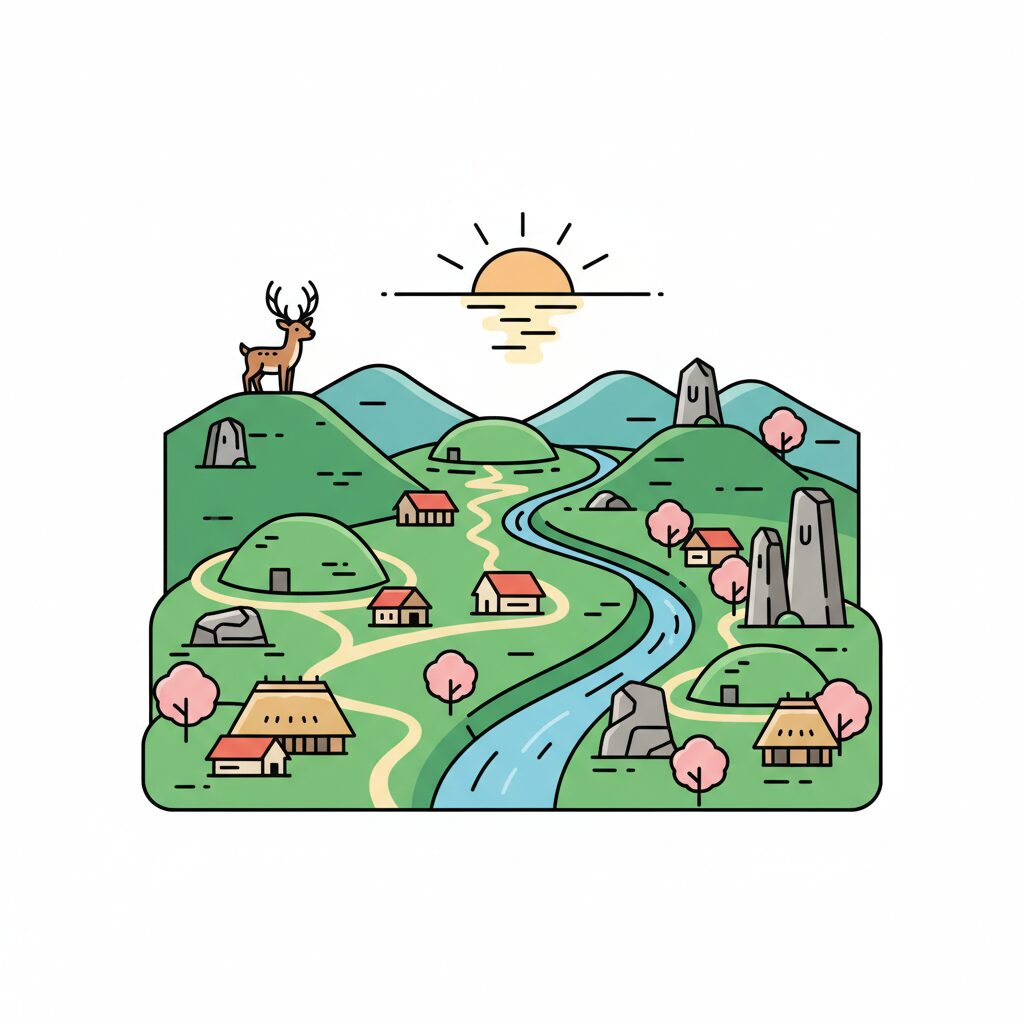
The landscape of Asuka is, at its core, a landscape of Ma. The valley is wide and flat, cradled by gentle mountains. But what makes it truly special are the ‘kofun,’ the ancient burial mounds scattered throughout the area. These are grassy, keyhole-shaped hills, tombs of emperors and powerful clans from over 1,500 years ago, when this region was the cradle of the Japanese nation. Some are enormous, like the Ishibutai Kofun, a massive stone chamber whose earthen mound has long since eroded away, leaving a skeleton of giant boulders you can walk inside. Others are small, unassuming bumps in the middle of a rice field. What they offer, beyond a history lesson, is a profound sense of perspective. Standing before a tomb that has stood since the 6th century, the frantic urgencies of modern Osaka life—the deadlines, social obligations, crowded trains—feel utterly insignificant. These mounds are monuments of silence and time. They hold a deep, quiet presence that pushes back against the noise in your mind. They are anchors of stillness in a fast-moving world. We often find a small, unnamed kofun, climb to the top, and simply sit. We watch farmers tending their fields, egrets stalking through the paddies, and clouds drifting across the vast sky. There is nothing to do. No agenda. We just occupy the empty space, allowing our own minds to become empty for a little while.
Even the interactions with people here are different. They move on Asuka time. We stop at a small, family-run café for lunch. The owner, an elderly woman, moves with slow, deliberate grace. She takes our order, then calmly prepares rice balls and vegetable tempura made from ingredients in her own garden. There is no rush, no loud ‘Irasshaimase!’. The conversation is gentle and quiet. She asks where we’re from, not with the rapid-fire curiosity of an Osakan, but with calm, genuine interest. The space between her question and our answer is allowed to breathe. Later, as we cycle past a field, a farmer in a straw hat looks up from his work and, instead of a loud greeting, simply gives a slow, deep nod. It’s a complete communication, a moment of mutual recognition requiring no words. It is an interaction built on Ma. This rhythm slows your internal clock. You stop thinking about what comes next and begin paying attention to what is right here, right now: the pattern of light on the water in the paddy, the sound of your tires on the gravel, the feeling of simple, delicious food. This is the recharge. It’s not about seeing sights or ticking boxes on a tourist itinerary. It’s about un-filling. It’s about letting the peace and quiet of the landscape seep into the cracks of your city-worn soul and wash away the noise.
The Return: Seeing Osaka with New Eyes
The return journey on Sunday evening offers a different experience. It’s decompression in reverse. As the train pulls away from Asuka, a quiet melancholy sets in, a hesitation to leave the tranquility behind. But as we approach Osaka and the rice paddies give way once more to densely packed houses and then to the towering buildings of the city center, the mood shifts. When we finally step off at the chaotic, roaring hub of Tennoji Station, the sensory overload that felt so overwhelming on Friday now feels different. It’s still loud, still crowded, still intense. But it no longer feels like an assault. It feels like coming home.
A weekend in Asuka doesn’t erase Osaka’s character; it recalibrates your capacity to handle it. After two days immersed in Ma, you return carrying your own internal reserve of calm. The city’s noise ceases to be mere noise; you start hearing the music within it again. The vendor’s shout isn’t an intrusion but a sign of the city’s vitality. The crowded subway isn’t a personal affront but a testament to a lively, bustling metropolis. The obachan who wants to chat isn’t draining your energy but a burst of human connection that makes the city special.
You come to realize Osaka isn’t a city that needs to be ‘fixed’ or quieted. Its relentless fullness defines its identity. It fuels its creativity, humor, warmth, and incredible commercial energy. To live here is to embrace that. But to live here happily and sustainably, especially as an outsider, you must learn to manage your sensory input. You won’t find Ma in the heart of Shinsaibashi—it simply isn’t there. You have to bring it in. You have to make a conscious pilgrimage to seek it, to fill yourself with emptiness, so you can return and dive once more into Osaka’s wonderful, chaotic fullness.
The trip to Asuka is more than a weekend escape. It’s a survival strategy. It reminds you that for every packed, noisy, vibrant ‘front’ (omote), there must be a quiet, empty ‘back’ (ura). Osaka abundantly offers the former. It’s up to you to discover the latter. Learning to navigate this rhythm—the city’s frantic dance followed by the countryside’s slow walk—is, I believe, the key to truly understanding and loving this magnificent, maddening, and utterly unforgettable city. You need the silence of Asuka’s ancient tombs to fully appreciate the glorious noise of a Tuesday afternoon in an Osaka supermarket. The void gives meaning to the substance.