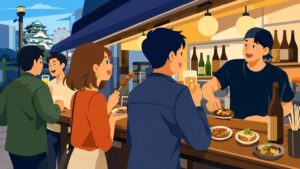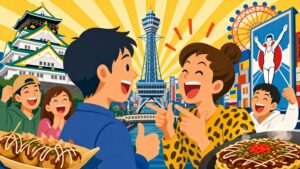
Spend any amount of time in Osaka, and you’ll quickly notice two things. First, the people here are masters of enjoying life. The city hums with a relentless energy, fueled by laughter, incredible food, and a genuine love for a good time. Second, you’ll hear constant, unabashed talk about money. Not in an arrogant, boastful way, but in a practical, analytical, almost sports-like commentary on prices, deals, and value. “You paid how much for that? I got it for 30% less in Tenjinbashi!” is a common, and celebrated, refrain. This might seem like a contradiction. How can a city so dedicated to pleasure also be so obsessed with thrift? The answer lies in a single, powerful word that unlocks the entire Osaka psyche: ‘Kenjitsu’ (堅実). It translates roughly to pragmatic, steady, reliable, and thrifty, but in Osaka, it’s an art form. It’s the philosophy that powers everything from their daily grocery shopping to their grandest weekend getaways. This isn’t about being cheap; it’s about being smart. It’s about squeezing every last drop of joy and value out of every single yen. While a trip planned in Tokyo might be defined by its elegance and exclusivity, an Osakan-planned trip is a masterpiece of strategic genius, a testament to their ability to achieve maximum fun for minimum waste. Forget sterile travel guides listing tourist traps. To truly understand Osaka, you need to understand how its people plan a simple weekend away, because it reveals the city’s very soul: pragmatic, resourceful, and utterly brilliant. It’s a mindset that transforms a simple holiday into a triumphant conquest of cost performance.
This strategic, value-focused mindset is also evident in how Osakans approach their daily social interactions, a concept deeply explored in our article on finding your place in Osaka’s social fabric.
The ‘Kenjitsu’ Compass: More Bang for Your Yen
Before we get into the details of planning a trip to Osaka, you need to grasp the idea of ‘Kenjitsu.’ It acts as the guiding star, the true north on their planning compass. For an Osakan, value isn’t just an added perk; it’s the very essence of the transaction. Wasting money is more than a financial setback; it’s a moral error, a sign of poor judgment. This marks a fundamental cultural contrast with Tokyo, where appearance and status are often displayed through conspicuous spending. In the capital, reserving a stay at a famous, magazine-featured luxury ryokan is a statement that says, “I have refined taste and the wealth to back it.” An Osakan, however, views it through an entirely different perspective. They might see that same ryokan and think, “It’s nice, but is it really five times better than the place down the road? I’m paying for the brand, not the experience.”
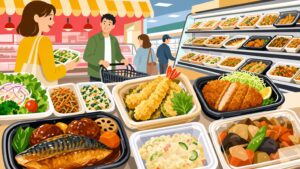
The real Osakan victory lies not in spending lavishly, but in uncovering a hidden gem. It’s about finding that slightly old-fashioned yet impeccably clean, family-run inn in a coastal town in Wakayama. The one where the elderly owner serves a breakfast of freshly caught fish and local vegetables that far surpasses a fancy hotel buffet, all at a fraction of the price. Discovering this place isn’t luck; it’s the product of careful research, combing through Japanese-language review sites, and trusting the recommendations of a cousin who visited last year. When they return, the story they share with friends won’t focus on the expensive, branded sake they drank. Instead, it will be a proud, detailed retelling of the incredible bargain they found. The pride in their voice is unmistakable. They didn’t just enjoy a vacation; they outsmarted the system. They won. This ‘Kenjitsu’ mindset fosters a culture of collective savvy. People enthusiastically exchange tips on where to find the best value, from secret parking spots near popular beaches to the exact moment local supermarkets discount their bento boxes. This shared pursuit of value is a fundamental part of social life in Osaka, connecting people through a common quest for smart living.
Mastering the Art of ‘Mottainai’ on the Road
If ‘Kenjitsu’ represents the proactive strategy, its defensive counterpart is ‘Mottainai’ (もったいない). This traditional Japanese term, which conveys a profound sense of regret over waste, is skillfully employed by Osakans in their travel planning. Anything seen as a waste of resources—whether time, money, food, or opportunity—is labeled ‘mottainai’ and eliminated with relentless efficiency. This philosophy guides every choice, transforming the trip itinerary into a precisely fine-tuned plan aimed at maximizing value.
Time is Money (Literally)
An Osakan planning a trip approaches their schedule with the meticulousness of a military strategist. Time lost equals opportunity lost, and opportunity lost equals money lost. Even before booking a hotel, they will have the entire transportation route thoroughly mapped out. This involves far more than simply checking train departure times. They scrutinize the entire journey, weighing the cost-effectiveness of every possible route. Is the Limited Express train, which saves 20 minutes, worth the extra 1,500 yen? For many, that is a rhetorical question with an obvious answer: no. That 1,500 yen isn’t just a number; it represents a tangible future pleasure—perhaps a round of beers at an izakaya, a rich dessert, or admission to a quirky local museum. Spending it for a minimal time saving is fundamentally ‘mottainai.’ They happily take the local train, using the extra travel time to enjoy an onigiri packed from home, review their plans, or simply appreciate the scenery, content that their journey is cost-optimized. This careful consideration applies to every aspect of the trip. You won’t find an Osakan family wandering aimlessly at a station, unsure of their next move. They will know the exact bus number to catch, its schedule, and the bus stop location, having studied it in advance via Google Street View. Taxis are a true last resort, a sign of planning failure. Every minute is accounted for—not from anxiety, but from a desire to ensure that not a single precious moment of their hard-earned vacation goes to waste.
The All-You-Can-Ride Obsession
Nowhere is the Osakan blend of ‘Kenjitsu’ and ‘Mottainai’ more evident than in their intense passion for transportation passes. For typical tourists, a rail pass is mainly a convenience; for an Osakan, it is a gauntlet thrown down, a challenge to be embraced and utterly conquered. The aim isn’t just to save money but to extract an almost comical, absurd amount of value from the pass. The Seishun 18 Kippu, a seasonal ticket offering five days of unlimited travel on local and rapid JR trains, is legendary in the Osakan travel toolkit. Armed with this ticket, an Osakan will devise epic, cross-country journeys, meticulously planned to maximize its use. They might endure an eight-hour train ride with several transfers to reach a remote part of Japan, not solely because they want to visit that place, but because the pass allows it. The journey itself becomes a testament to their thriftiness and endurance. The same principle applies to regional passes like the Kintetsu Rail Pass or the Kansai Thru Pass. Their trip planning often begins not with a destination but with the pass itself. “The pass covers everything up to Ise in Mie Prefecture. What’s the best food in Ise?” The pass’s boundaries define the boundaries of their adventure. They might pause for an hour in a small, inconspicuous town simply because it’s the last station covered by their pass, ensuring they get their money’s worth. It’s a game of optimization, and they are masters of it. The final calculation after the trip—tallying what individual fares would have cost compared to the pass price—is a moment of supreme satisfaction, the final score in a game they were determined to win.
Food First, Sights Second: The Gourmet Pilgrimage
In Osaka, the old saying “kuidaore” (食い倒れ), meaning to eat oneself into bankruptcy, isn’t a caution; it’s a life ambition. It’s no surprise, then, that for many Osakans, travel is primarily a culinary adventure. Historical landmarks, scenic vistas, and famous temples often take a backseat, serving as pleasant pauses between the main attractions—the meals. The choice of destination usually hinges on its ‘meibutsu’, or renowned local specialty. Instead of simply saying, “Let’s go to Hyogo Prefecture,” they’ll say, “Let’s go eat Akashi-yaki in Akashi,” or “I’m craving the botanebi (peony shrimp) from Kasumi.” Japan’s entire geography is reimagined as a vast menu awaiting exploration.
‘Kose-pa’ is King
The culinary journey is guided by ‘kose-pa’ (コスパ), a common Japanese-English slang for “cost performance.” This concept is the core of the Osaka food culture, both locally and when traveling. ‘Kose-pa’ doesn’t mean seeking the cheapest meal possible. A true Osakan would never settle for poor food just because it’s inexpensive; that would be a waste, the ultimate ‘mottainai’. Rather, ‘kose-pa’ is the relentless quest for the perfect balance where quality, portion size, and price meet harmoniously. It’s about discovering that ramen shop where the broth simmers for 18 hours, the noodles are handmade, the chashu pork melts in your mouth, and a generous bowl costs a reasonable 900 yen. They’ll eagerly wait in line for 45 minutes because they recognize the exceptional ‘kose-pa’. In contrast, they’ll bypass a beautifully decorated restaurant in a prime tourist spot charging 4,000 yen for mediocre pasta. It’s not the price alone, but the lack of matching value. The research involved in hunting down great ‘kose-pa’ spots is thorough. They comb through review sites like Tabelog, focusing on comments from locals, not easily impressed tourists. Word-of-mouth recommendations hold the most weight, forming a trusted, informal culinary network. The joy of the meal grows from knowing they’ve found a place offering outstanding quality without an inflated price—another win for the ‘Kenjitsu’ mindset.
The Souvenir Strategy: Practicality Over Prettiness
The ‘Kenjitsu’ philosophy extends to the final part of any trip: buying ‘omiyage’, or souvenirs, for friends, family, and coworkers. Across much of Japan, especially Tokyo, ‘omiyage’ culture tends to be highly formal, emphasizing elaborate packaging and prestigious brands, sometimes overshadowing the product itself. An Osakan’s approach is, unsurprisingly, far more pragmatic. While presentation is appreciated, their main criteria are taste, quantity, and value. They consider the end-user experience carefully. Will their office colleagues genuinely enjoy these treats? Is there enough in the box for everyone to have a fair share? A small, elegant box of six delicate, pricey wafers from a Ginza department store might come off as slightly pretentious and poor value. Instead, an Osakan is more likely to bring back a large, simple bag of freshly made senbei (rice crackers) from a beloved local shop they discovered, or a bottle of distinctive regional ponzu sauce that people can actually use in cooking. The gift is about sharing an authentic taste of the place visited, not about fulfilling a social obligation. It’s a tangible, practical, and delicious token from their trip, chosen with the same sharp eye for cost performance that guided their entire journey. The message says not, “Look how much I spent,” but, “Taste this great deal I found.”
Debunking the “Cheap” Myth: It’s About Smart, Not Stingy
Outsiders, especially those from more status-conscious Tokyo or Westerners unfamiliar with the culture, often misinterpret Osakans’ relentless focus on value and label them simply as “cheap” or “stingy.” This is a fundamental misunderstanding of the local character. Being cheap is a passive trait; it means defaulting to the lowest price, often at the expense of quality. The ‘Kenjitsu’ mindset is quite the opposite. It is an active, intelligent, and deeply engaged pursuit of maximum value. It demands research, planning, and a sharp, discerning eye. It’s not about deprivation; it’s about optimization.
The Joy of the Hunt
For an Osakan, the planning phase—the search for the deal—is an essential and genuinely enjoyable part of the travel experience. It’s a puzzle to solve, a game to win. The excitement of uncovering an amazing, under-the-radar hotel or a transportation hack that saves thousands of yen delivers satisfaction separate from the trip itself. When Osakans gather after their holidays, their conversations are revealing. They don’t just share photos of temples and landscapes; they exchange stories of their strategic victories. One might boast, “We stayed at a ‘minshuku’ in Shirahama, and the owner was a retired fisherman. He took us out on his boat for free! Can you believe it?” Another might add, “I timed our trip to coincide with a local festival not found in any guidebook. The street food was incredible and half the price of the tourist spots.” The stories aren’t just about what they saw; they’re about how cleverly they arranged the experience. The ingenuity behind the trip is as much a source of pride as the destination itself. It’s a shared celebration of their collective cleverness and resourcefulness.
Where They Do Splurge
The clearest proof that Osakans are not merely stingy is that they are willing to spend significant amounts of money when they see true, undeniable value. The ‘Kenjitsu’ mindset isn’t about hoarding money; it’s about using it effectively. They are experts in the strategic splurge. An Osakan might save money by taking local trains and staying in a modest business hotel for two nights, only to spend those savings on one spectacular, multi-course ‘kaiseki’ dinner at a restaurant famed for its culinary artistry. They will gladly pay a premium for front-row seats at a concert of their favorite band or tickets to a crucial Hanshin Tigers baseball game. Why? Because these experiences are unique and irreplaceable. There’s no cheaper, high-quality alternative. You can’t get a 50% off version of a live performance. When the value is obvious and the experience unique, Osakans open their wallets without hesitation. Their spending is always deliberate, targeted, and justified. Frivolous, thoughtless spending on items with poor ‘kose-pa’ is the enemy. Spending wisely on something that brings immense joy is the entire point. It’s the final, crucial piece of the ‘Kenjitsu’ puzzle: save where you can so you can spend where it truly matters.
To understand daily life in Osaka, you need to look beyond the neon lights of Dotonbori and the towering castle. You need to observe how people live, how they think, and how they prioritize. And there is no clearer window into the Osakan soul than watching them plan a weekend trip. This ‘Kenjitsu’ philosophy—this pragmatic, value-driven, and joyful hunt for the best possible experience at the best price—is woven into the city’s fabric. It’s in the sharp negotiations of merchants in the Shotengai shopping arcades, the discerning palates at crowded food stalls, and the warm, no-nonsense advice shared between neighbors. It’s a mindset that rejects superficiality in favor of substance. So, next time you hear an Osakan proudly recounting the amazing deal they found, don’t mistake it for cheapness. Recognize it for what it truly is: the masterful expression of a culture that has perfected the art of living well—not by spending more, but by spending smarter.