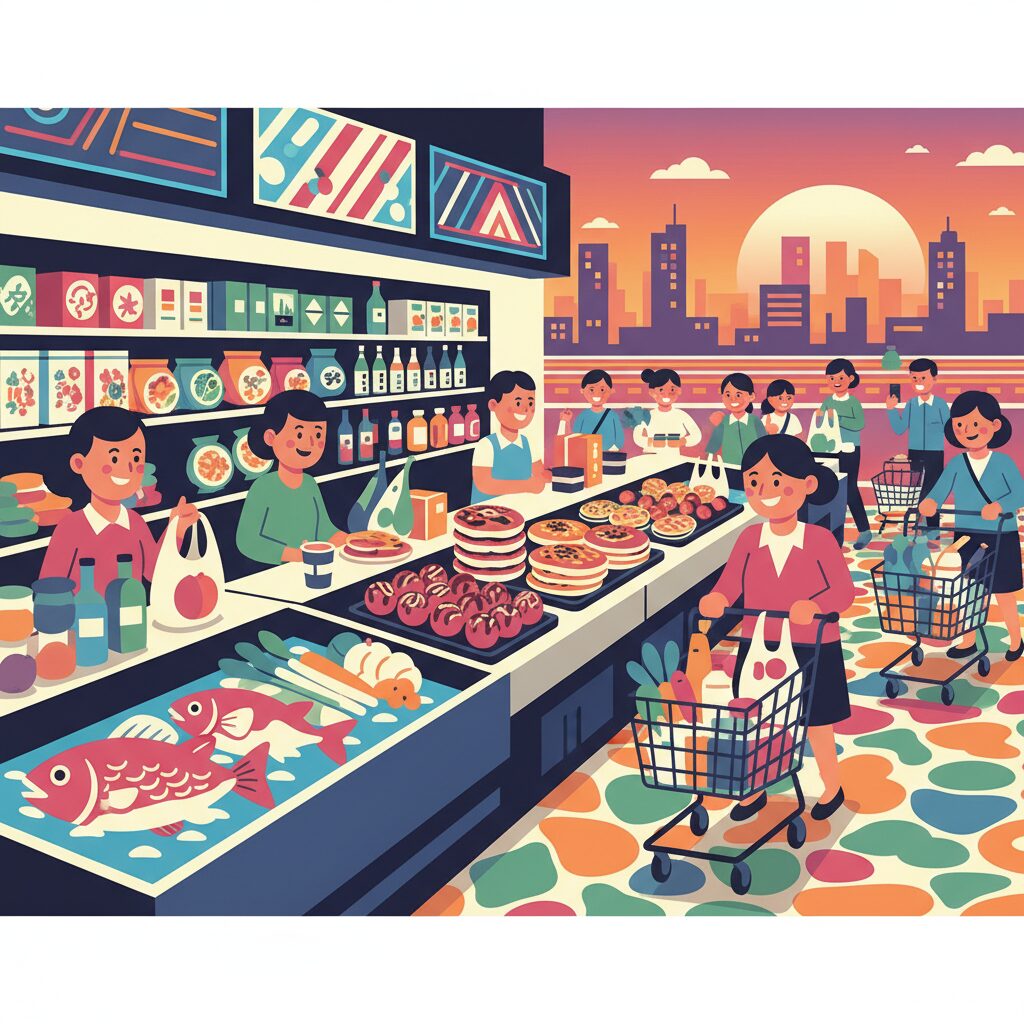
Walk into a supermarket in Tokyo, and you’ll find a certain rhythm. It’s a place of quiet consideration. The lighting is soft, the aisles are wide, and the produce is arranged with the precision of a museum exhibit. Each apple seems polished, each bento box a miniature work of art. The experience is designed to be seamless, pleasant, and, above all, orderly. It’s a reflection of a city that prizes polish and presentation. Then, you come to Osaka and walk into a place like Super Tamade. The experience is less like shopping and more like walking into a pachinko parlor that decided to sell groceries. A blast of neon light hits you from a sign that looks like it belongs in Las Vegas. A relentlessly cheerful, slightly distorted jingle burrows its way into your brain. Hand-written signs in thick, explosive fonts scream prices at you from every direction. Everything is bright, loud, and unapologetically chaotic. It’s not just different; it’s a fundamental challenge to everything you thought you knew about Japanese retail. You’re left standing in the aisle, clutching a basket, with one burning question: what on earth is going on here? This isn’t just about a quirky store chain. This is about understanding the very soul of Osaka, a city that dances to a beat all its own. The supermarket isn’t just a place to buy food; it’s a classroom for Osaka culture.
For those drawn to Osaka’s vibrant chaos, a local onsen crawl experience offers an equally immersive excursion into Japan’s colorful cultural landscape.
The Unspoken Rule: Value Is Everything

To truly understand Osaka, you first need to grasp its connection to money. It’s not about being cheap; it’s about being clever. In Tokyo, quality is often linked to a high price. A beautifully wrapped melon with an astronomical cost serves as a status symbol. In Osaka, however, the ultimate status symbol is acquiring top quality at an unbelievably low price. This obsession, known as “cos-pa”—short for cost performance—is the driving force behind the Osaka shopper. It’s a game everyone eagerly plays to win. That’s why Super Tamade’s famous “1-Yen Sales” are more than just a gimmick; they’re a brilliant marketing move that resonates with the local mindset. The store promotes a particular item—eggs, noodles, or a block of tofu—for just one yen, provided you spend at least 1,000 yen. To an outsider, this might seem ridiculous. But for an Osakan, it’s a challenge. It’s a clever lure that draws them in, and the pride of scoring that 1-yen deal makes the effort worthwhile. They were going to spend 1,000 yen on groceries anyway, but now they have a tale to tell. They’ve outsmarted the system. This mentality goes beyond the sales. You’ll notice shoppers carefully comparing price-per-100-grams on meat packages, weighing the value of slightly bruised but heavily discounted onions, and stocking up on anything offering a great deal. It’s a form of financial savvy practiced right in the aisles. Boasting about how much you paid for something in Tokyo might be seen as uncultured. In Osaka, boasting about how little you paid is a mark of pride. It shows you’re shrewd, practical, and a genuine citizen of this merchant city.
An Assault on the Senses: The Purpose of Chaos
In a city buzzing with visual noise—from the flashing lights of Dotonbori to the dense signage of the shotengai—standing out is essential for survival. Osaka supermarkets, particularly chains like Tamade, have wholeheartedly embraced this mindset. The style isn’t one of calm, curated elegance; rather, it’s an intentional, high-energy chaos meant to capture your attention and create a sense of urgency.
The Neon Glow and Shouting Signs
The exterior of a Super Tamade is an event on its own. It forgoes the subdued earth tones and refined logos commonly seen in Tokyo stores, opting instead for blazing yellow and red, adorned with flashing neon lights that proclaim “激安” (gekiyasu – super cheap). It feels less like a supermarket and more like an entertainment arena. This atmosphere continues inside, where there are no minimalist, professionally printed signs. Instead, you’re met with a forest of hand-written posters, often on brightly colored paper, with prices marked in thick, aggressive marker. Words are circled, underlined, and emphasized with multiple exclamation points. This visual style isn’t mere decoration; it’s a direct, unfiltered form of communication. It shouts, “This is a bargain! Pay attention! Buy it now!” While Tokyo stores whisper suggestions, Osaka stores grab you by the collar and tell you what you need to know. It’s honest, loud, and remarkably effective.
The Soundtrack of Savings
Beyond the visuals, there’s the sound. A typical Tokyo supermarket offers relative quiet, broken up by polite, pre-recorded announcements and the gentle beeps of scanners. In contrast, an Osaka supermarket is a symphony of noise. First, there’s the unavoidable store jingle, a simple yet maddeningly catchy tune that loops endlessly, embedding the brand into your subconscious. Then come the live announcements. Staff, often speaking with a distinctive Kansai accent, grab the microphone to announce “time sales” with the energy of a sports commentator. “Tadaima yori, tamago no taimu seru desu!” (“Starting now, it’s a time sale for eggs!”). This sparks a flurry of activity as shoppers rush in. It turns an ordinary shopping trip into a live event. The constant murmur of conversation, the rattling of carts, the spirited shouts of staff—all blend into a soundscape that is uniquely Osaka. It’s the soundtrack of a city that’s alive, engaged, and always pushing forward.
Substance Over Style: A Reflection of “Kuidaore” Culture

Osaka is famously known as the city of “kuidaore,” which translates to “eat until you drop” or, more precisely, “eat yourself into bankruptcy.” While this phrase is often linked to the city’s renowned restaurant culture, the true essence of kuidaore is experienced daily in its supermarkets. The emphasis is overwhelmingly on the food itself—its flavor, freshness, and price—rather than on its presentation. This is where the contrast with Tokyo becomes strikingly clear.
The Unpretentious Product
Stroll through the produce section of an upscale Tokyo store, and you’ll find perfectly uniform vegetables wrapped in immaculate plastic. In Osaka, however, you’re more likely to encounter irregularly shaped carrots and knobby potatoes sold loose in bins or packed in simple, no-frills bags. The underlying message differs. Tokyo says, “We offer you perfection.” Osaka says, “This is fresh, tastes great, and is reasonably priced. What else do you need?” This practical approach extends to the store layout. Aisles can feel tight and crowded, with boxes sometimes piled in corners. It’s not designed for a leisurely, aesthetically pleasing visit. It’s a workshop for cooks, a pantry for the city. You’re there to pick up ingredients for a great meal, not to admire the decor.
The Kingdom of Sōzai
Nowhere is the spirit of kuidaore more apparent than in the sōzai (prepared foods) section. It is, without exaggeration, the heart of the Osaka supermarket. The sheer variety and volume are astounding. Large trays overflow with glistening tempura, golden-brown korokke (croquettes), karaage (fried chicken), and grilled fish. The bento boxes aren’t the delicate, compartmentalized masterpieces you might find in a Tokyo depachika (department store food hall). They are substantial, filled to the brim with rice, a main protein, and a few simple side dishes, often priced at just a few hundred yen. This is the fuel that sustains the city. For the office worker needing a quick lunch, the single person who prefers not to cook, or the family wanting to supplement a home meal, the sōzai section is an indispensable resource. The quality is surprisingly high because competition is fierce and customers are discerning. An Osakan won’t tolerate soggy tempura or bland croquettes, no matter how cheap. This is where cost performance hits its peak: delicious, hearty food at a price that feels like a bargain.
The Merchant’s Mindset vs. The Curator’s Eye
The differences between the supermarkets in Osaka and Tokyo are far from arbitrary. They are profound cultural reflections of how each city perceives itself. Tokyo, as the political and modern corporate capital, operates with the eye of a curator. Its supermarkets often resemble galleries where products are carefully chosen and displayed to create a distinct experience for the consumer. It emphasizes refinement, order, and a quiet appreciation of quality. The shopper is treated as a guest, an observer guided through a thoughtfully curated selection.
Osaka, with its rich history as Japan’s merchant hub, approaches business with a trader’s mindset. Its supermarkets are lively marketplaces, bustling and chaotic spaces where deals are struck and value reigns supreme. The experience isn’t curated; it’s forged in the moment through the interaction between the store, its staff, and the shoppers. It prioritizes directness, efficiency, and the excitement of the hunt. The shopper is not a passive guest but an active participant, a savvy player in the commerce game. This is why foreigners sometimes misinterpret Osaka. They might view the chaos of places like Super Tamade as disorganized or indicative of low quality. However, they miss the real point. The chaos signals vibrancy. The aggressive pricing reflects respect for the customer’s intelligence. The absence of pretension demonstrates confidence in the product itself.
The Broader Ecosystem of Bargains
While Super Tamade stands out as the most flamboyant example, this value-driven ethos influences Osaka’s entire food shopping scene. Chains like Gyomu Super (“Business Supermarket”), though national, enjoy a cult-like following in Osaka. Its warehouse-style stores, offering bulk products, directly cater to the local preference for stocking up and saving. More importantly, many supermarkets are located within or near a shotengai, a traditional covered shopping arcade. This creates a vibrant setting where supermarkets must compete not only with other chains but also with the local butcher selling freshly ground mince, the family-run fishmonger showcasing the day’s catch, and the greengrocer whose family has sold vegetables on that spot for generations. These small, independent shops keep supermarkets honest. If prices rise too high or quality declines, customers simply walk a few steps to their trusted local vendor. This ongoing street-level competition ensures that the principle of “cos-pa” remains firmly upheld.
What It All Means for Life in Osaka
Living in Osaka means adjusting your expectations. It means learning to appreciate the beauty of a perfectly fried piece of tempura, even if it’s sold under a flickering fluorescent light. It means recognizing that a loud, bustling atmosphere is not a sign of rudeness but a reflection of engagement and community. It means adopting a more direct, practical, and unpretentious lifestyle. The supermarket becomes your training ground where you learn to navigate crowded aisles, watch for time sales, and feel genuine excitement when you find a great deal on your favorite snack. You begin to realize that the city’s energy is not just for show; it’s the driving force of everyday life. So the next time you step into a supermarket in Osaka and experience a culture shock, don’t be alarmed. Take a deep breath, grab a basket, and dive in. You’re not simply buying dinner—you’re getting a taste of what makes Osaka one of the most dynamic, honest, and truly human cities in the world.