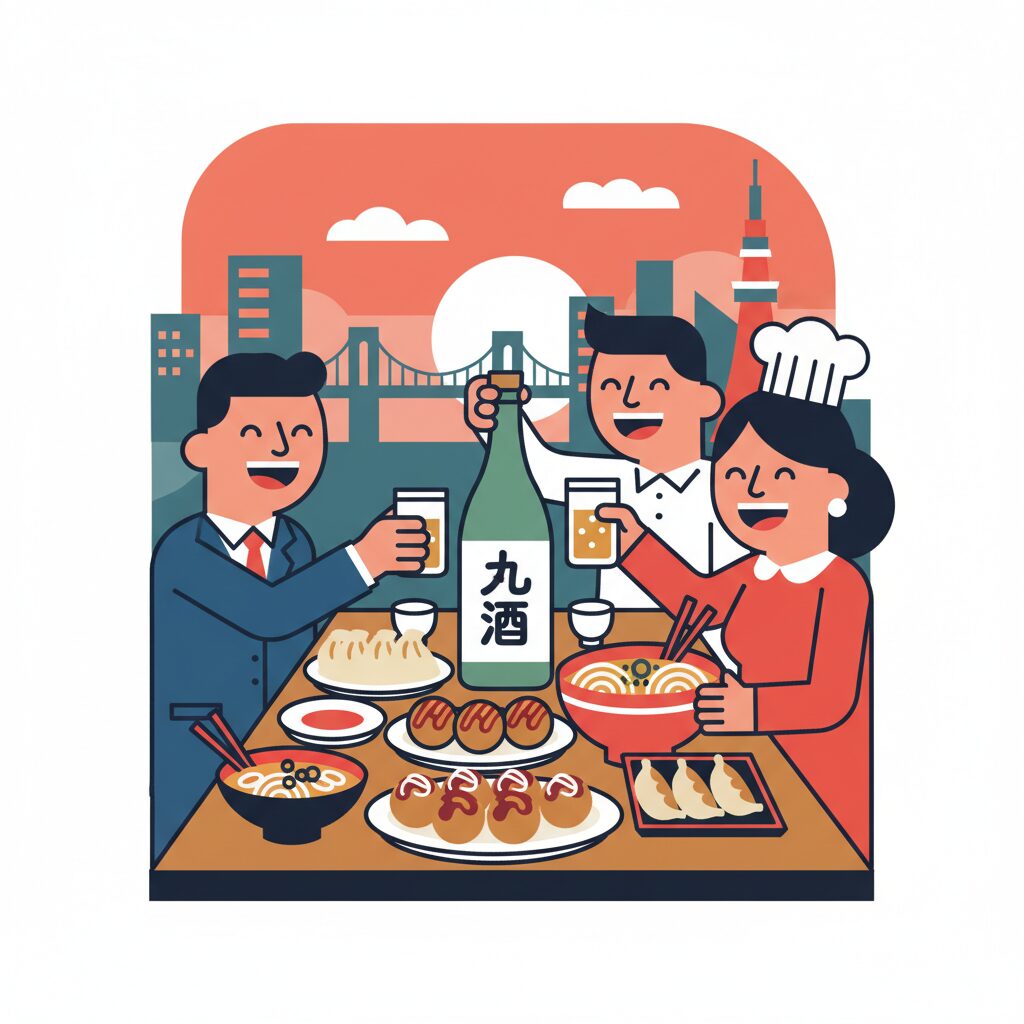
You see the email pop up, the subject line glowing with a mix of excitement and social pressure: “Team Nomikai at Izakaya Nanba!” Your stomach does a little flip. On one hand, this is it. This is your chance to bond with your colleagues, to see the legendary Osaka work-hard-play-hard ethos in action, to finally understand the inside jokes that fly around the coffee machine. It’s a rite of passage, a key that unlocks a deeper level of belonging in your new Osaka life. On the other hand, a cold wave of anxiety washes over you as you scan the menu link. Tempura, karaage, tonkatsu, yakitori. It’s a minefield. You’re a vegetarian. Or you have a gluten allergy. Or for religious reasons, pork is completely off the table. Suddenly, the fun social event morphs into a complex strategic challenge. How do you possibly navigate this without being “that person”—the difficult foreigner, the party pooper, the one who disrupts the all-important harmony of the group? In Tokyo, you might get a polite, but firm, “that might be difficult.” In Osaka, the reaction is harder to predict, but the stakes feel just as high. The fear is real: will your dietary needs brand you as an outsider before you’ve even had a chance to fit in? This isn’t just about dinner. It’s about your social survival. But here’s the secret Osakans know but don’t always say out loud: there is a way. It’s a path that requires a bit of planning, a dash of cultural understanding, and a healthy dose of the pragmatism that defines this city. Forget what you think you know about Japanese group dynamics being an unbreakable wall. In Osaka, that wall has a few well-placed doors, if you know which ones to knock on.
If deciphering Osaka’s nomikai etiquette has left you yearning for a quieter reprieve, consider exploring retro co-working spaces for remote workers that offer a relaxed setting to recalibrate.
Understanding the ‘Nomikai’ Landscape in Osaka

First, let’s adjust your perception of what a ‘nomikai’ truly entails. It’s not simply an informal gathering with coworkers; it’s a crucial, unspoken element of the job. It’s where hierarchies become less rigid, where honest opinions are exchanged over beer and edamame, and where the relationships that enable a team to work smoothly are built. The entire event is grounded in a concept you’ve likely encountered: ‘wa’ (和), or group harmony. However, Osaka’s interpretation of ‘wa’ differs markedly from that of the rest of Japan, and grasping this distinction is key to your success.
More Than Just a Meal: The Role of ‘Wa’ (Harmony)
In any Japanese setting, ‘wa’ acts as the unseen force that shapes social interactions. At a nomikai, ‘wa’ means everyone shares the same collective experience. Food is commonly served on large platters, family-style, for everyone to choose from. Drinks are poured for each other, not for oneself. The aim is to establish a smooth, shared bubble of enjoyment. An individual making a special request can feel like a small puncture in that bubble to the group. It singles them out, demands extra effort from the restaurant and organizer, and subtly changes the collective experience. This explains the source of the anxiety. It’s not that people want to exclude you; rather, the system is designed for inclusion through uniformity. Your unique need, no matter how valid, represents a break from that shared experience, and the cultural instinct is to avoid such disruptions to maintain the evening’s harmonious flow.
The Osaka Twist: Pragmatism Over Rigid Formality
This is where living in Osaka benefits you. Although ‘wa’ remains foundational, Osaka is a city built by merchants, not samurai. The principle here is not strict formality for its own sake, but ‘jitsuri-shugi’—pragmatism, focusing on practical solutions that work well. An Osakan will face a problem and think, “What’s the most logical way to handle this with minimal hassle?” They prioritize directness, efficiency, and a positive outcome for everyone involved. They care less about the subtle, unspoken rituals typical of Kyoto or Tokyo business culture and more about genuine connection and making sure everyone enjoys themselves. This merchant mindset means they are surprisingly open to a clearly communicated, reasonable request. They recognize allergies, deeply held beliefs, and medical necessities not as inconvenient preferences but as unalterable facts. And like any good merchant, they know success comes from adapting to the reality on the ground—whether closing a deal or hosting a party.
The Wrong Approach: Common Foreigner Pitfalls
Before we outline a successful strategy, it’s essential to recognize the common pitfalls. Many well-intentioned foreigners, aiming to maintain ‘wa’, unintentionally cause more disruption than they would have by speaking up. These are the mistakes to avoid.
The Silent Sufferer
This is perhaps the most frequent mistake. You attend the nomikai, say nothing about your dietary restrictions, and spend the evening pushing a cucumber slice around your plate. You politely refuse dish after dish, saying you’re not hungry or had a late lunch. You leave hungry, feeling isolated and resentful. You believe you’ve been polite and selfless, but the reality is quite different. People notice. Your boss, sitting across from you, sees your empty plate. Your colleagues notice you passing up the tempting gyoza. They don’t think, “How considerate of them.” Instead, they wonder, “Are they not enjoying themselves? Did I choose a bad restaurant? Do they not like us?” In Osaka, where showing enjoyment is part of social etiquette, your silent refusal to eat can dampen the party more than any allergy announcement. Someone might even confront you directly, in that blunt Osaka style: “Eh, nande taben no?” (Hey, why aren’t you eating?). Now you’re on the spot, forced to awkwardly explain yourself in the middle of the meal—the very situation you sought to avoid.
The Last-Minute Announcement
This is the worst breach of nomikai etiquette. The first course arrives—a beautiful, steaming plate of ‘buta no kakuni’ (braised pork belly). As everyone reaches for it, you suddenly announce, “Oh, I can’t eat pork!” The mood halts. The atmosphere stiffens. You’ve just created a nightmare for the ‘kanji’ (the designated organizer). The ‘kanji’, usually a junior staff member, has spent days coordinating with the restaurant, arranging the set menu and price. Your announcement sends them into a frantic scramble. They must flag down a busy waiter, apologize repeatedly, and try to order a special dish last minute. This disrupts the meal’s flow, creates awkwardness, and embarrasses the ‘kanji’. You’ve turned a smooth event into a stressful logistical mess. You may end up with a tofu plate, but you’ve also gained a reputation for being inconsiderate of the organizer’s effort.
The Vague or “Picky Eater” Excuse
There is a huge difference between a need and a preference, and this distinction is vital in a group-focused culture. Saying things like, “I just don’t really like fish,” or “I’m trying to avoid fried food,” will not be well received. It appears childish or selfish. The cultural norm, especially among older generations, values ‘gaman’ (endurance or perseverance). You’re expected to endure minor discomforts for the group’s sake. Expressing a mere preference is seen as putting your trivial wants ahead of the collective experience. To be taken seriously, your reason must be presented as a non-negotiable condition—a medical necessity, a deeply held ethical belief, or a religious rule. It must be a “can’t eat,” not a “don’t want to eat.”
The Osaka-Approved Strategy: Proactive and Principled Communication

So, how do you do it correctly? The key lies in a strategy that is proactive, respectful, and aligned with Osaka’s practical values. It’s a multi-step process that takes place almost entirely before you ever arrive at the izakaya.
Timing is Everything: The Pre-Game Huddle
The most important action you can take is to communicate with the ‘kanji’ well ahead of time. Not on the morning of the nomikai. Not the day before. Ideally, you should approach them as soon as the event is announced, or at least two to three days in advance. This allows them sufficient time to discuss with the restaurant without any last-minute pressure. Reach out to them privately, either in person or via a polite email. Avoid making a public announcement. Your opening line should always express gratitude and enthusiasm. Start with, “Tanaka-san, thank you so much for organizing the nomikai! I’m really looking forward to it. It sounds like a lot of fun.” This immediately shows you’re a team player eager to participate. You’re framing your following request not as a complaint, but as a logistical detail to ensure you can fully and happily take part.
Framing Your Request: From “I Can’t” to “This is My Situation”
How you phrase your request is crucial. You’re not making a demand; you’re sharing information and seeking their help. The tone should be slightly apologetic, recognizing that you’re asking for something out of the ordinary. This humility works as a crucial social lubricant.
For Allergies and Medical Needs
This is the most straightforward category and the one likely to receive the most immediate understanding. Be direct, clear, and specific. Vague statements like “I have some food issues” don’t help. Provide precise, actionable details. For example: “Actually, I have a serious allergy to shellfish. Even a small amount can be dangerous for me.” Or “I have celiac disease, so I cannot eat anything containing wheat, including soy sauce.” Follow immediately with an apology for the inconvenience and an offer of flexibility. “Gomeiwaku okake shimasu ga, yoroshiku onegaishimasu.” (I am very sorry for the trouble, but I would appreciate your help.) This combination of clear facts and polite social cues is unbeatable. It presents a practical problem that the pragmatic Osakan ‘kanji’ can then solve.
For Religious or Ethical Beliefs (Vegetarian, Vegan, Halal, etc.)
This can be somewhat more challenging since these concepts may be less familiar to some. The key is to present it as a firm principle, not merely a lifestyle choice or diet. Use phrases that express unwavering conviction. “Jitsu wa, shukyo-jo no riyu de butaniku wo taberarenain desu.” (Actually, for religious reasons, I am unable to eat pork.) For vegetarianism or veganism, you might say, “Began/bejitarian na node, o-niku ya o-sakana wa chotto…” (Because I am vegan/vegetarian, meat and fish are a bit…) The “chotto…” (a bit…) softens the statement. The most critical part of this communication is managing expectations and demonstrating great flexibility. After stating your core need, immediately add something like: “I know this can be very difficult to accommodate in Japan, so please do not go to any major trouble! I’m perfectly happy to eat whatever is possible, even if it’s just edamame and rice. The most important thing for me is to be able to join everyone.” This is the magic phrase. It tells the ‘kanji’ that your top priority is the group experience, not gourmet food. You’ve given them an easy out and shown you’re not a demanding guest. Paradoxically, this kind of flexibility often motivates them to find a good solution for you.
The Power of the Apology (Even When It’s Not Your Fault)
In Japan, apologies are not always admissions of guilt. They’re often used to smooth social interactions. Phrases like “Moushiwake arimasen ga…” (There is no excuse, but…) or “Otesuu okake shimasu ga…” (I’m sorry to trouble you, but…) are essential. You are not apologizing for having an allergy or a belief system. You are apologizing for the ‘meiwaku’ (trouble/inconvenience) that your special requirement might cause the organizer. It’s a sign of respect for their time and effort. It demonstrates that you recognize you’re requesting an exception and appreciate their work in making accommodations. This small act of humility yields great goodwill.
Navigating the Actual Nomikai: On-the-Ground Tactics
If you’ve handled the pre-game communication well, the evening itself should proceed quite smoothly. Your role now is to be an ideal guest: attentive, cheerful, and easygoing.
The Organizer is Your Ally
Upon arrival, the ‘kanji’ will probably have everything well managed. They might quietly inform you which dishes from the set menu are safe. Alternatively, a special plate of food could be placed before you discreetly. Your task is to accept this graciously and quietly. Avoid making a fuss or rehashing your entire dietary history to the person next to you. The ‘kanji’ has already taken care of the issue—let them take the credit. A simple, private “Tanaka-san, hontou ni arigatou gozaimasu. Oishii desu!” (“Thank you so much, Tanaka-san. This is delicious!”) is sufficient. This shows your gratitude and affirms their efforts.
The Art of Discretion and Diversion
Despite the best preparation, some shared dishes you cannot eat will inevitably appear. The key is subtle misdirection. Don’t blatantly ignore or push the plate away. Instead, concentrate on what you can eat. Keep your small plate (‘torizara’) visibly active. If you have your own special dish, enjoy it. If you’re selecting from shared plates, take some salad, tofu, or pickles. The goal is to avoid having an empty plate at all times. More importantly, shift attention away from the food and toward the social exchange. Be proactive in pouring drinks for seniors (a key nomikai tradition). Ask your boss about his weekend golf game. Laugh at your colleague’s jokes. In the lively, noisy, and free-flowing atmosphere of an Osaka nomikai, an engaged participant is rarely scrutinized for eating habits. Your social involvement acts as your camouflage.
What If Someone Asks? The Quick, Positive Deflection
It can still happen. A curious coworker might notice you haven’t touched the yakitori and say, “Aren’t you having any? It’s really good!” Don’t worry. Avoid giving a lengthy explanation. This isn’t the right time or place. You need a brief, positive response. Acknowledge, gently state your boundary, then swiftly change the subject. Something like: “Ah, I can’t eat chicken, unfortunately. But wow, this dashimaki tamago (rolled omelet) is amazing! Have you tried it yet?” In one smooth move, you’ve answered without drama and redirected the focus to a shared positive experience. You’re not the person who can’t eat yakitori; you’re the one enjoying the tamago. This subtle shift keeps the atmosphere light and harmonious.
Why This Works in Osaka: The Logic of ‘Naniwa no Akindo’

This entire approach of proactive, polite, and practical communication is highly effective because it resonates deeply with the core of the Osaka mindset: the spirit of the ‘Naniwa no Akindo’ (the merchants of old Osaka). Merchants are inherently problem-solvers who value clear terms, efficient transactions, and nurturing strong long-term relationships. A problem hidden until the last minute is a broken deal; it harms business by causing chaos, wasting time, and eroding trust. Conversely, a problem clearly and politely presented upfront is just a part of the negotiation. It enables the merchant to adapt, find a new solution, and successfully close the deal, leaving everyone satisfied. When you address the ‘kanji’ in advance, you’re not being a difficult foreigner but a good business partner, providing the necessary information to execute their project—the nomikai—successfully. You’re helping them perform their role well and avoid public failure. This gesture will be understood and respected on a deep, almost instinctual level. While in other cities the priority might be adhering strictly to established form, in Osaka, the emphasis is on achieving the desired outcome—a fun, bond-building party—in the most logical way possible. By managing your needs with foresight and consideration, you demonstrate your understanding of this fundamental Osaka logic, proving that you are equally focused on a successful result and securing your place in the team far more effectively than simply accepting everything presented to you ever could.