You’ve seen them. Of course you have. Tucked into the narrow alleys of Namba, nestled under the train tracks in Tenma, or glowing softly on a quiet residential street in the deep suburbs of Osaka. They’re the little bars with no windows, a sliding door often veiled by a short noren curtain, and a name spelled out in glowing katakana that you can’t quite place. From inside, you might hear the muffled, reverb-drenched strains of an 80s power ballad being sung with more passion than skill, followed by a ripple of warm laughter. You pause, intrigued, maybe a little intimidated. It’s clearly not a bright, anonymous chain izakaya with picture menus and English-speaking staff. It’s something else entirely, something deeper and more opaque. This is the world of the Japanese ‘snack bar,’ or sunakku. And if you truly want to understand the social heartbeat of Osaka, beyond the glitz of Dotonbori and the grandeur of the castle, you need to understand what goes on behind that mysterious door. These aren’t just places to drink; they are the living rooms of the community, the unofficial counseling offices, and the stages for the un-televised dramas of daily life. And at the center of it all is the formidable, indispensable figure known as the ‘Mama-san.’ This isn’t just about grabbing a beer; it’s about finding a place where you belong, even if just for a few hours a week. It’s a pillar of social infrastructure hiding in plain sight.
The intimate guidance offered by a Mama-san in a neighborhood snack bar mirrors the enriching experience of engaging with a knowledgeable local master in one of Osaka’s community cafes, deepening your connection to the city’s unique social fabric.
What Exactly is a ‘Snack Bar’? It’s Not What You Think
First, let’s address the biggest misconception, which actually begins with the name. A ‘snack bar’ isn’t a place you go when you’re hungry for a full meal. The term is a holdover from a bygone era, and the ‘snacks’ offered are usually just a small bowl of peanuts, rice crackers (arare), or perhaps some dried squid. These are called otsumami and aren’t the main attraction. They serve as salty accompaniments to an evening filled with drinking, singing, and conversation.
The true operation of a snack bar is based on a completely different economic model than the Western bars you might be familiar with. You don’t simply walk in and pay per drink. Instead, you encounter a system that may seem confusing at first but is designed entirely to foster loyalty and build a base of regular customers. The two key concepts here are the ‘set charge’ and ‘bottle keep.’
The Set Charge: Your Entry to the Community
When you sit down, you’ll almost always be charged a ‘set charge’ (setto ryōkin). Think of it as a cover charge or table fee. This fee, ranging from a couple thousand to several thousand yen, secures your seat for the evening. It usually includes the small snacks mentioned earlier, along with unlimited ice and water for mixing your drinks. This system immediately differentiates the snack bar from a high-turnover pub. The aim isn’t to get as many patrons in and out as possible; it’s to create a comfortable space where a select group can settle in for the night. You’re not just paying for a stool; you’re buying into the atmosphere for a few hours.
Bottle Keep: Your Name on the Shelf
Here’s where loyalty really comes into play. Rather than purchasing individual, overpriced glasses of whiskey or shochu, the usual practice is to buy an entire bottle. The Mama-san will write your name on a paper tag and hang it around the bottle’s neck. This bottle is now yours. It stays here, waiting for you on a crowded shelf behind the counter, silently marking your status as a regular. When you arrive, she’ll fetch your bottle, allowing you to drink from it throughout the night, paying only the set charge. A single bottle can last several visits, making each subsequent trip much more economical. But beyond the financial benefits, ‘bottle keep’ (botoru kīpu) serves as a strong social anchor. Having a bottle on that shelf means you’re part of the club. You’re not a passing customer; you’re a member of this small, intimate family. It’s a promise you’ll return.
The Heart of the Snack: The ‘Mama-san’
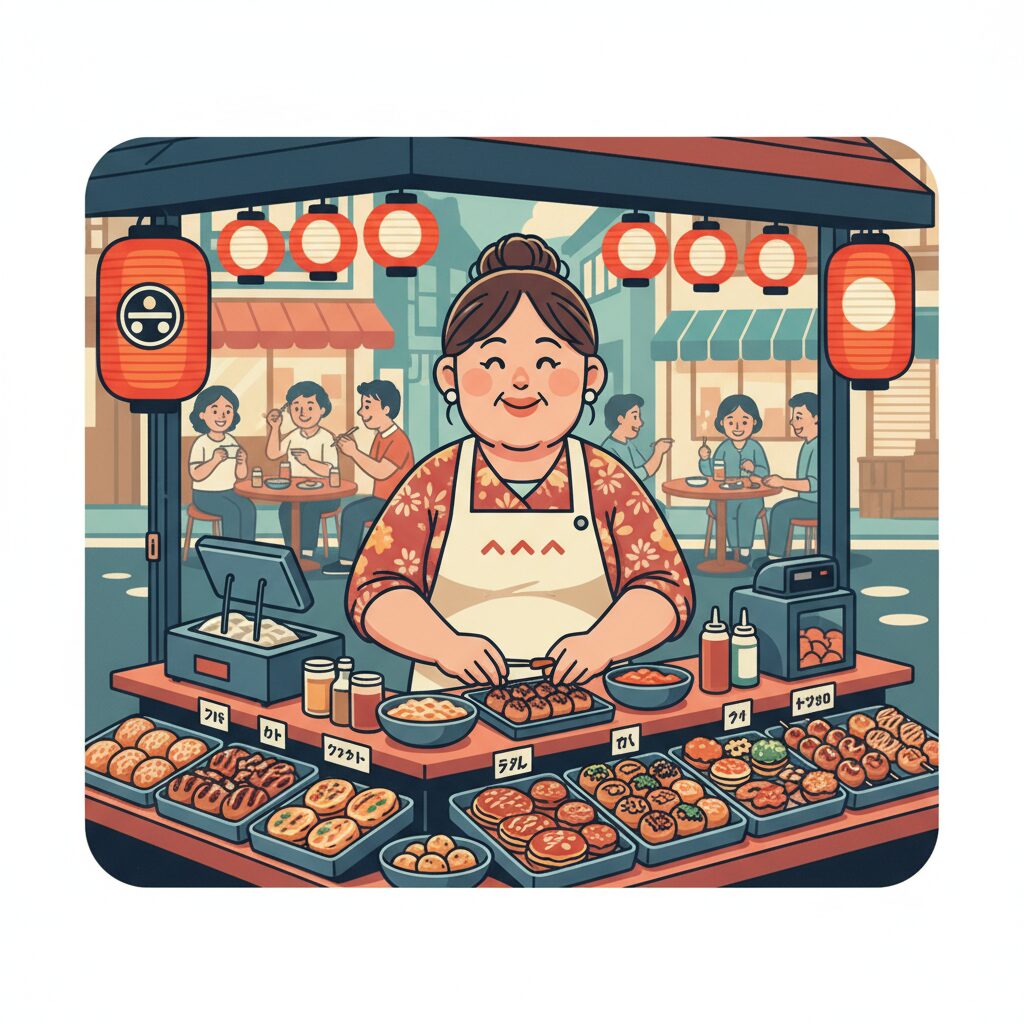
If the snack bar serves as the community’s living room, then the Mama-san is its matriarch. She embodies everything: owner, bartender, bouncer, accountant, DJ, therapist, and social director all in one. Typically, she is a woman of a certain age—sharp-witted, with a photographic memory for her customers’ drinks, jobs, and personal stories. Her authority is unquestioned, yet her approach is personal. She doesn’t just serve you; she shapes your entire experience.
The Mama-san is the central hub of the social network. She knows everyone who sits at the counter. She’s aware that Mr. Sato from the accounting firm is struggling with his new boss, and that Ms. Tanaka’s daughter recently passed her university entrance exams. Her role is to keep conversations flowing, skillfully connecting diverse people. She might turn to you, the newcomer, and say, “Alex-san, this is Ito-san. He’s a big Hanshin Tigers fan, just like you!” Just like that, a bridge is formed. She’s an expert at reading the atmosphere, knowing when to gently include a quiet customer or when to let someone enjoy their solitude.
Her interaction with customers is far removed from the reserved service found elsewhere in Japan. A good Mama-san in Osaka isn’t afraid to tease you, offer blunt, unsolicited advice, or gently chide you if you’re drinking too much. This isn’t rudeness; it’s a form of closeness. It is the osekkai culture of Osaka—a meddlesome yet heartfelt caring—in its purest form. She might say, “You look tired today. Are you working too hard again? You need to take better care of yourself.” In that moment, she ceases to be just a service worker; she becomes a surrogate mother, an aunt, a trusted elder. Earning her respect and affection is the key to truly experiencing the snack bar.
More Than a Bar: The Snack as a ‘Third Place’
Sociologists refer to the “third place“—a setting distinct from the demands of home (the first place) and work (the second place) where individuals can gather, connect, and foster community. In many Western societies, this function is commonly served by pubs, cafes, or community centers. In urban Japan, particularly in Osaka, the snack bar embodies the quintessential third place.
For many patrons, usually older male salarymen but increasingly diverse in age and gender, the snack bar serves as an essential outlet. It’s a space where the rigid hierarchies of the corporate world temporarily fade away. At the counter, a department head and a junior employee might sing a duet, their workplace roles momentarily set aside. This sanctuary allows people to vent frustrations about their job or spouse without judgment, as everyone shares this purpose. The shared vulnerability, eased by alcohol and expressed through karaoke, forges strong connections.
Central to this experience is the karaoke machine. The focus is rarely on performing well but on participating. When a shy, reserved man who usually spends his days hunched over spreadsheets takes the microphone to belt out a classic rock anthem, he’s not simply singing; he’s shedding his corporate facade and revealing a fragment of his authentic self. The enthusiastic, if sometimes off-key, chorus from fellow patrons is more than polite applause—it’s an act of collective acceptance. In the snack bar, imperfection, emotion, and a bit of silliness are welcome. It offers a profound psychological release in a society that often values conformity and restraint.
Osaka’s Snack Culture vs. Tokyo’s
Although snack bars can be found throughout Japan, their flavor in Osaka stands out as distinct. The difference is subtle yet noticeable, reflecting the broader cultural contrast between the Kansai region and Tokyo. If a Tokyo snack bar is a quiet, refined salon, an Osaka snack bar is like a lively family gathering.
First, the atmosphere is simply louder and more engaging. In Osaka, the unspoken rule is that the counter is one big conversation. It’s completely normal, and even expected, to join a chat happening three stools away. Strangers quickly become friends, united by a shared joke or mutual fondness for a particular song. This mirrors Osaka’s reputation as a city of merchants and comedians, where communication is direct, rapid, and often infused with humor. The classic boke (funny man) and tsukkomi (straight man) routine is performed nightly by the Mama-san and her regulars.
The Osaka Mama-san herself perfectly embodies this difference. She’s less likely to be the reserved, elegant hostess typical of a Ginza establishment and more likely to be a down-to-earth, talkative woman with a booming laugh and sharp wit. She’ll treat you less like a revered guest and more like a nephew who needs some keeping in line but is ultimately cherished. This can be surprising for those accustomed to Tokyo’s polished formality, but it is a sign of genuine Osakan warmth.
Additionally, there’s a strong sense of pragmatism. Osaka snack bars often offer better value for money, reflecting the city’s historical passion for a good deal. The whole experience feels less pretentious. You come as you are, and you’re accepted as you are, as long as you’re willing to share a laugh.
A Foreigner’s Guide to Navigating the Snack Bar
Walking into a snack bar for the first time can feel like crashing a private party. The door slides open, the music stops, and a dozen pairs of eyes turn toward you. It can be intimidating, but it doesn’t have to be that way. With the right approach, you can move from being an outsider to a welcomed guest.
The Golden Rule: Go With a Regular
By far the easiest and most effective way to get your foot in the door is to be invited by a regular. This immediately validates you. You become a friend of a friend, and the Mama-san and patrons will greet you warmly. If you have a Japanese colleague or neighbor who frequents a snack bar, dropping hints about your curiosity is the best strategy.
Going Solo: A Braver Path
If you choose to go alone, select a place that seems more inviting. Perhaps you can hear a lively and cheerful atmosphere from outside. When you enter, a polite greeting like “Konbanwa, haitte mo ii desu ka?” (“Good evening, may I come in?”) goes a long way. Be ready for a brief moment of assessment. The Mama-san will evaluate if you’ll fit in. A friendly smile and a humble attitude are your strongest assets. Don’t hesitate to ask about how things work. A simple “Hajimete desu. Shisutemu o oshiete kuremasu ka?” (“It’s my first time. Could you explain the system?”) shows respect and lets them know you understand this isn’t a typical bar.
Unspoken Etiquette
Once inside, follow a few important rules. Engage with the Mama-san first and foremost—she is your host. Don’t just sit silently staring at your phone. If someone speaks to you, respond and interact. Consider buying a drink for a new acquaintance or for the Mama-san herself as a gesture of goodwill. If karaoke begins, show your appreciation. You don’t have to sing, but clapping and cheering for others is essential. It’s about contributing to the collective enjoyment.
A Critical Distinction
One of the most important things for a foreigner to grasp is that a snack bar is not a hostess club (kyabakura). This is a common and serious misconception. In a hostess club, young women are paid to sit with, flatter, and entertain male customers. In a snack bar, the Mama-san is the owner and operator. The patrons are her customers, not her dates. The conversation is genuine, not transactional. Confusing the two is highly insulting to the Mama-san and will mark you as unaware. The visual differences are usually clear: snack bars are run by one or two mature women, while hostess clubs often feature many young women in dresses, sometimes with staff trying to beckon you in from the street.
Why It Matters for Understanding Osaka
So why should you, a foreigner living in or thinking about moving to Osaka, care about these smoky little bars? Because the snack bar is a microcosm of Osaka itself. It’s where the city’s abstract cultural values become tangible, lived experiences. You often hear clichés about Osaka being ‘friendly’ or ‘down-to-earth,’ but in a snack bar, you witness what those qualities truly mean.
It signifies a directness in communication that prioritizes honesty over formal politeness. It embodies a community spirit, ninjō, that goes beyond surface-level pleasantries. It’s the social safety net that supports people. It’s the belief that laughter is the best social lubricant. It’s the understanding that community isn’t something you stumble upon; it’s something you create, night after night, through shared drinks and off-key songs.
In a world that is becoming more digital and isolated, the snack bar stands as a strongly analog institution. It’s a tribute to the enduring human need for a physical space to connect. To understand the snack bar is to grasp the social fabric of neighborhood life in Osaka. It’s to realize that behind the city’s bustling, modern facade, there are countless small, warm circles of light, each with a Mama-san at its heart, nurturing the flame of human connection.