
Welcome to Osaka, where the ink on your business card is still drying, but the expectation to land a punchline is already in the air. If your image of a Japanese office is one of silent, harmonious deference, where feedback is cushioned in layers of polite ambiguity, prepare for a cultural recalibration. You’ve landed in a city where business is conducted with the sharp timing of a comedy duo and the brisk efficiency of a fish market auction. The hushed reverence you might associate with a Tokyo boardroom is often replaced by boisterous laughter and declarations so direct they could make a seasoned diplomat blush. This isn’t a breakdown of professional decorum; it’s the engine of Osaka’s unique corporate culture, a system built on a foundation of humor, honesty, and a deeply ingrained merchant’s pragmatism.
For many non-Japanese professionals, this environment can feel like a paradox. How can a workplace be simultaneously demanding, hierarchical, yet audaciously funny and informal? The answer lies in understanding that in Osaka, humor isn’t a distraction from work—it’s a tool for it. Directness isn’t rudeness; it’s a form of respect. These aren’t just quirks; they are the unwritten rules of engagement, the local dialect of professional communication. Mastering this dialect is the key not just to surviving, but to thriving in the energetic, fast-paced world of Osakan business. This guide will take you beyond the caricatures of loud-talking comedians and into the nuanced reality of a workplace where a well-timed joke can be as valuable as a well-structured proposal, and where getting straight to the point will earn you more respect than a thousand carefully worded emails. Forget what you thought you knew. This is how work gets done in Osaka.
Embracing both direct candor and playful humor in Osaka’s work culture also means appreciating the city’s vibrant local kissaten culture, where business and community seamlessly intertwine.
The Comedy Club in the Conference Room: Humor as a Business Tool

Step into an Osaka office during a team meeting, and you might wonder if you’ve inadvertently wandered into a rehearsal for a manzai comedy show. The energy is tangible, the banter rapid, and laughter often interrupts serious discussion. This isn’t unprofessional behavior; it’s the local business communication style in action. In Osaka, humor is considered a sophisticated communication skill, an advanced tool for building relationships, softening criticism, and encouraging a collaborative atmosphere. While a Tokyo office might emphasize a calm, almost solemn environment, an Osaka workplace thrives on energetic, interactive exchanges. A quiet, unsmiling colleague isn’t viewed as serious and focused but rather as potentially disengaged or unfriendly. Being able to join this playful back-and-forth shows that you are part of the team, understand the unspoken norms, and can be trusted.
This humor culture is not random; it follows a clear structure. It frequently adheres to the classic Japanese comic formula of boke and tsukkomi. Grasping this dynamic is your first step in effective workplace communication. The rhythm of conversations, brainstorming sessions, and even feedback delivery can often be seen through this comedic lens. It’s a performance where everyone has a role, and knowing how to play yours is essential for professional integration and success.
Deconstructing Osaka’s Comic DNA: Boke and Tsukkomi
The entire system of Osakan humor can be boiled down to two basic roles: the boke and the tsukkomi. The boke is the fool, the one who utters something absurd, exaggerated, or outright silly—they set up the joke. The tsukkomi is the straight man, the one who quickly points out the absurdity with a sharp, witty comeback—they deliver the punchline. This isn’t a fixed, assigned role; it’s a fluid dynamic that shifts between people and conversations. In the workplace, this interaction happens constantly.
Picture a sales meeting. Your section chief, Tanaka-san, reviews the latest figures and deadpans, “Our sales this month were so good, I’m considering buying a private jet.” This is a typical boke move. A junior colleague from Tokyo might nod awkwardly, unsure how to respond. But your Osakan coworker, Sato-san, immediately retorts, “With those numbers? You’ll be lucky to afford a new bicycle! Let’s focus on next quarter’s target.” The room bursts into laughter. Tanaka-san smiles. The tension dissolves. The point is made. Sato-san isn’t being insubordinate—this is a textbook tsukkomi. He acknowledges the boke, grounds the comment in reality, and in doing so creates a moment of shared understanding and camaraderie. He shows that he’s listening, engaged, and comfortable enough to join the banter. This is how bonds form.
For newcomers, the safest and most effective role to play is the tsukkomi. You don’t have to be a natural comedian or invent outrageous boke lines. Your task is simply to respond. When your boss jokes about his thinning hair, a lighthearted, “Bucho, at least you have less to wash in the morning!” is a perfect tsukkomi. It shows you’re paying attention and understand the joke. A flat, nonreactive demeanor can be perceived as cold or distant. Learning to spot the boke and deliver a gentle tsukkomi is your pass into the social fabric of the office.
Why Laughter is Serious Business
Don’t confuse this ongoing joking with a lack of seriousness about work. In Osaka, humor is used with strategic intent. It’s a highly functional tool for navigating complex social and professional situations. When a manager needs to offer critical feedback, they might start with a joke to lower defenses. For instance, instead of saying sternly, “Your report had many mistakes,” an Osaka manager might say, “I was reading your report, and for a moment I thought I was reading a creative novel! The numbers had some very interesting plot twists. Let’s review page three together.” The message is clear—the report needs improvement—but it’s conveyed in a way that prevents resentment and promotes a cooperative approach to problem-solving.
This method also humanizes the corporate hierarchy. Throughout much of Japan, there is a wide, formal gap between senior managers and new employees. In Osaka, a boss who can joke about their own flaws or engage in witty banter with their team is seen as a more effective and approachable leader. This doesn’t erase the hierarchy—everyone still knows who’s in charge—but it smooths the communication channels, allowing ideas and information to flow more freely up and down the chain of command. Laughter builds a psychological safety net, fostering an environment where people feel comfortable speaking up, admitting mistakes, and suggesting unconventional ideas. In a city driven by the high-stakes, fast-paced world of commerce, this ability to communicate well and maintain strong team morale isn’t just a perk—it’s a vital business strength.
“Just Say It!”: The Art of Osakan Directness
If Osakan humor is the playful jab, then Osakan directness is the straight right hook. It’s strong, efficient, and if you’re unprepared, it can leave you stunned. In a country known for indirect communication and the emphasis on reading the air (kuuki wo yomu), Osaka stands as a stronghold of unfiltered frankness. The carefully layered politeness and ambiguity that often define communication in Tokyo are set aside in favor of a style that values clarity, speed, and honesty. This isn’t driven by a wish to be confrontational; it’s grounded in deep pragmatism. For Osakans, especially in business, the quickest way to solve a problem is to identify it, analyze it, and fix it. Anything else is seen as wasting precious time.
This can be one of the most surprising adjustments for foreigners and even Japanese from other areas. You will hear “no” more frequently. Feedback will be straightforward. Your ideas might be rejected in meetings without the soft cushioning you may be accustomed to. The key is to grasp the intention behind the words. In Osaka, directness is not a personal attack—it’s a sign of professional respect. It means your colleagues trust you to handle the truth and that everyone is focused on the same objective: achieving the best possible outcome.
Honne vs. Tatemae: The Osaka Remix
Everyone studying Japanese culture learns about honne (one’s true feelings) and tatemae (the public façade). Across most of Japan, successfully balancing these two is crucial for social harmony. You express your tatemae in public to keep peace, while your honne is reserved for close friends and family. In Osaka, this divide is much less clear. Osakans often lead with their honne, or at least a version closer to their true opinion than you’d find elsewhere.
Take a project proposal, for example. In a Tokyo office, if your boss finds an idea unworkable, feedback might be, “Thank you for this detailed proposal. It includes many interesting points. Perhaps we could explore some alternatives at the next meeting?” This soft rejection is wrapped in layers of tatemae. In an Osaka office, feedback is more likely to be, “This won’t work. The budget on page five is unrealistic and the client will never accept that timeline. We need to rethink this part completely. What other ideas do you have?” The delivery is blunt but extremely efficient. There’s no ambiguity—you know exactly what’s wrong and what to do next. The feedback targets the work, not you personally. The expectation is for you to absorb this, respond, and return with an improved solution. Spending time reading between the lines is viewed as unproductive.
This doesn’t mean tatemae disappears entirely. Osakans remain Japanese and value social harmony. However, the line for when and where honne is appropriate is much lower, especially in professional settings where results matter most. They have simply shifted the balance toward clarity and action.
Navigating the Direct Feedback Loop
For those unfamiliar with this style, receiving such direct feedback can feel like a personal attack. The natural reaction might be defensiveness or feeling your work was unfairly dismissed. This is the biggest misconception foreigners have about the Osaka workplace. The key is to depersonalize the feedback. When a colleague says, “That idea is akan” (akan being the common Osaka-ben for “no good” or “won’t work”), they don’t mean you are no good. They mean the idea, as it stands, is no good. It’s an objective evaluation.
Your best move is to respond to directness with constructive engagement. Rather than withdrawing, lean in. Ask clarifying questions like, “Thank you for the feedback. Could you specify which part of the budget is the biggest issue?” or “I understand the timeline concerns. What if we adjusted the scope this way?” This shows you’re resilient, solution-focused, and not overly sensitive. It signals that you share their goal of getting things done efficiently. By embracing directness instead of recoiling from it, you quickly gain respect. Your Osakan colleagues will see you as a practical, no-nonsense professional they can depend on. In a way, this blunt communication, once you adjust to it, can feel more honest and transparent than the indirect styles found elsewhere, fostering stronger and more straightforward working relationships.
The Merchant’s Mentality: Efficiency and Relationships

To truly grasp why workplaces in Osaka function with this distinctive mix of humor and straightforwardness, one must look back at the city’s history. Osaka was not established by samurai or aristocrats; it was founded by merchants, artisans, and entrepreneurs. It served as Japan’s commercial center, the nation’s kitchen (tenka no daidokoro), where rice changed hands, fortunes were forged, and deals were made with speed and sharpness. This heritage as a city of commerce (akinai no machi) is more than a historical detail; it is the living essence that shapes the modern Osakan mindset, especially in the business world.
The merchant’s mindset is inherently pragmatic. Time equals money. Relationships are assets. Results matter most. This ethos has been handed down through the generations, cultivating a culture that prizes efficiency, practical problem-solving, and the ability to quickly establish rapport. The communication style found in offices today is a direct legacy of the language used in the busy marketplaces of long ago. It’s a style forged in conditions where clarity, speed, and trust were crucial for survival and success.
Born from Commerce: The Roots of Osaka’s Pragmatism
In a competitive merchant town, there was no time for the elaborate, indirect customs of the courtly or samurai classes. Deals had to be negotiated and finalized swiftly. This demanded clear, unambiguous language. You needed to state your price, lay out your terms, and gauge your counterpart’s honesty within moments. Beating around the bush was not only inefficient; it invited suspicion. Someone who couldn’t speak plainly was seen as potentially hiding something. Thus, directness became synonymous with honesty and reliability.
This historical backdrop explains why Osakans today are so comfortable getting straight to the point. The question, “So, what’s the bottom line?” (de, youken wa nani?) is not rude; it’s a customary way to cut through unnecessary talk and concentrate on what truly matters. Meetings in Osaka are often shorter and more decisive than in other parts of Japan. There is a shared impatience with discussions that circle around without clear goals or outcomes. This relentless goal-oriented focus is a direct inheritance from their merchant forebears, for whom a successful day was measured not by exchanged pleasantries but by goods sold and profits earned.
Humor also held a vital role in this commercial setting. In a bustling market, quick wit and a friendly smile could draw customers and establish instant connections. Laughter served to break the ice, create a sense of shared humanity with potential business partners, and make the tense negotiation process more manageable. It was a social lubricant that eased transactions. By sharing a joke, merchants could quickly assess each other’s character and build trust. This tradition lives on in the modern office, where humor helps foster the team cohesion necessary to reach business objectives.
Building Trust the Osaka Way
In many corporate cultures, trust develops slowly through a series of formal interactions, demonstrated reliability, and strict respect for hierarchical protocols. In Osaka, trust often forms much faster through authentic, unguarded human interactions. The blend of humor and directness is central to this process.
When a colleague playfully teases you, they’re testing your ability to relax and not take yourself too seriously. Responding with a good-natured comeback means you pass the test. When a manager offers blunt, straightforward feedback, they’re evaluating your resilience and dedication to a shared goal. Accepting the feedback professionally and focusing on solutions means you pass the test. Each of these exchanges is a building block of trust. They signal that everyone is on the same team, willing to be vulnerable and honest for the sake of better outcomes.
This approach is fundamentally different from the Tokyo model, where trust often depends on showing respect for established processes and seniority. In Osaka, you earn trust by revealing your true self. Can you take a joke? Can you handle the truth? Are you focused on practical results? If yes, you will be welcomed as a dependable and valuable team member. This merchant-style trust is strong and practical. It’s less about ceremony and more about character, creating a workplace that can feel intensely demanding but also deeply loyal and supportive once you’re accepted.
Practical Tips for Thriving in the Osaka Office
Grasping the theory behind Osaka’s workplace culture is one thing; navigating it on a Monday morning is quite another. The lively mix of humor and bluntness can feel like a rapid, improvisational act. As a newcomer, you might feel pressured to instantly become either a stand-up comedian or a tough negotiator. The good news is, you don’t have to be. Success in the Osaka office hinges less on innate talent and more on mastering a few key responses while adopting a resilient, open-minded mindset. Here are some practical strategies to help you not only survive but also thrive in this distinctive environment.
Think of it like learning a new dialect. At first, the slang and rhythm may seem unfamiliar, but with observation and practice, you’ll begin to catch the flow. Your aim isn’t to change who you are but to acquire new communication tools that demonstrate your understanding and respect for the local style. Even small efforts will be noticed and appreciated.
Your Survival Guide to Workplace Banter
Don’t Be a Wallflower: The biggest error you can make is staying silent and unresponsive during office banter. You don’t have to deliver a perfect punchline, but you must react. A smile, a chuckle, or a nod is the minimum. When a colleague cracks a joke, your reaction shows you’re tuned in and part of the group’s social fabric. A blank look can be seen as disinterest or disapproval, creating social distance.
Master the Simple Tsukkomi: As mentioned, the easiest role to play is the tsukkomi. You don’t need to be clever or witty. A simple, almost formulaic response works well. The classic and beloved Osaka tsukkomi is “Nande ya nen!,” meaning roughly “Why?!” or “What the heck?!” When a colleague dramatically claims they didn’t sleep for a week because of work, a playful “Nande ya nen!” with a laugh is an ideal response. It’s a clear signal that you’re in on the joke. Another easy option is to repeat the absurd part of their statement as a question.
Observe the Characters: Every office has its main players. Notice who fills the role of the boke—the one making funny, exaggerated remarks. Identify the key tsukkomi who respond quickly. Watch their interactions. Learn which topics are acceptable for humor (e.g., workload complaints, self-deprecating jokes) and which are off-limits. By observing, you’ll catch the comedic rhythm of your team and find your place to join in comfortably.
Receiving and Giving Direct Feedback
Develop a Thick Skin: When you get blunt feedback, your initial reaction may be to feel hurt or defensive. Train yourself to pause and separate the comment from yourself. Remember: This is about the work, not me. This is Osakans showing respect for your ability to improve. See it as a gift of clarity, not hostility. A simple, confident “Wakarimashita. Arigatou gozaimasu” (I understand. Thank you.) is the best response. It shows professionalism and composure.
Ask, Don’t Argue: If you hear direct criticism like “This is not going to work,” don’t respond defensively. Instead, switch to problem-solving. Ask clear questions to get the details you need. For example, “Could you tell me specifically which part is most problematic?” or “What kind of solution would you suggest?” This turns a potentially confrontational moment into a collaborative one and strengthens your reputation as a practical team player.
Embrace the Word “Akan”: You will hear akan (no good, impossible, won’t work) frequently. It’s the Swiss Army knife of Osakan rejection. Unlike the standard Japanese “dame,” which can sound harsh, “akan” is part of everyday, functional language. When your boss says, “Kono puran wa akan wa” (This plan is no good), don’t panic. It’s just the starting point for negotiation or revision. Your role is to uncover why it’s akan and how to make it acceptable. It’s a challenge, not a final judgment.
Calibrate Your Own Directness: As you gain confidence, you can be more direct yourself. However, start cautiously. Frame your feedback collaboratively. Instead of saying, “Your idea is flawed,” try, “I have a concern about this point. I’m worried the client might react negatively. How can we improve this part?” This conveys the direct message but uses team-focused language, showing your goal is to help, not criticize.
Beyond the Office: How Workplace Culture Spills into Daily Life
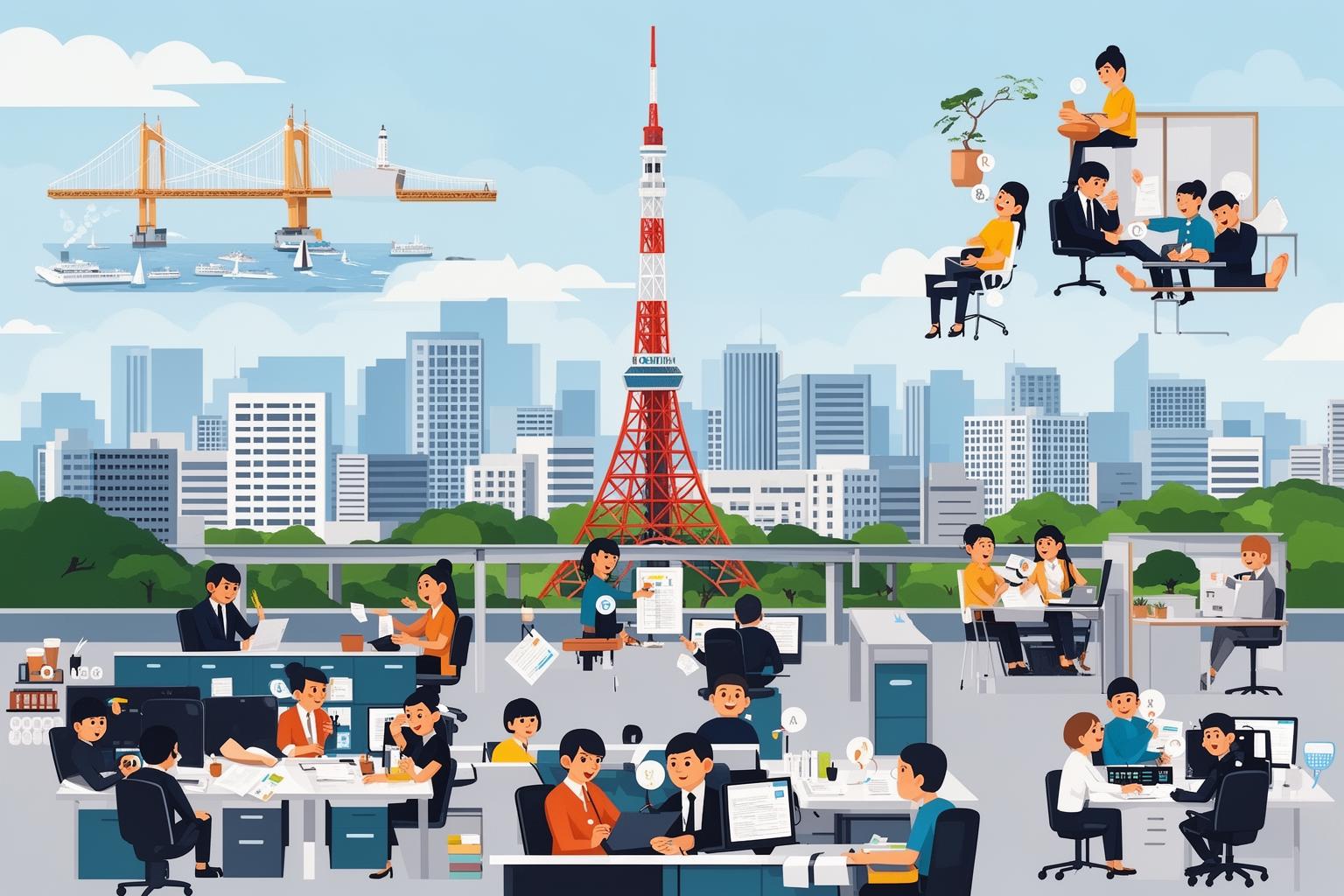
The energetic, straightforward, and humor-filled communication style you excel at in your Osaka office isn’t confined to the 9-to-5 workday. It’s the city’s default way of interacting, evident in almost every part of daily life. The skills you hone while navigating meetings and team banter will also prove useful when buying groceries, chatting with neighbors, or dealing with local bureaucracy. This cultural consistency is part of what makes living in Osaka such an immersive experience. The boundary between professional and public life is fluid, with the same core values of pragmatism and human connection driving both.
Step outside your office into a local shotengai (shopping arcade), and you’ll see the merchant’s mindset in its natural environment. The shopkeeper at the vegetable stand won’t just sell you tomatoes; she might tease you, “Buying these again? You must really love them! Don’t you ever eat anything else?” This isn’t rudeness—it’s engagement. It mirrors the rapport-building techniques your colleagues use. The expected response is not to take offense, but to joke back: “Only yours are any good! The ones from the supermarket have no taste.” This playful exchange turns a simple purchase into a meaningful human connection.
This directness extends to everyday rules and social etiquette. If you accidentally put your garbage out on the wrong day, a Tokyo neighbor might silently endure it or leave a polite, anonymous note. Your Osaka neighbor will more likely catch you in the hallway and say, in a friendly but firm tone, “Hey, just so you know, today is for burnable trash. Cans and bottles go out on Wednesday. You don’t want the crows to make a mess, right?” The feedback is immediate, clear, and practical. It’s not meant to shame you but to solve the issue efficiently. It stems from the same pragmatic, community-conscious spirit that drives an office team to fix a flawed report.
Even interactions that tend to be formal elsewhere may carry an Osakan twist. While dealing with city hall, you might find staff more conversational and willing to offer straightforward advice than their counterparts in other cities. They might cut through bureaucratic jargon to give you the simple, direct answers you need. All this contributes to the feeling that Osaka is a city where people talk to each other, not at each other. The culture promotes an active, engaged approach to life. It might sometimes feel noisy, a bit chaotic, and occasionally intrusive, but it is rarely cold or anonymous. Mastering the communication style of the Osaka workplace is, in essence, mastering the art of living in Osaka itself. It’s about embracing a culture that values a good laugh as much as a good deal, and above all, honest truth.