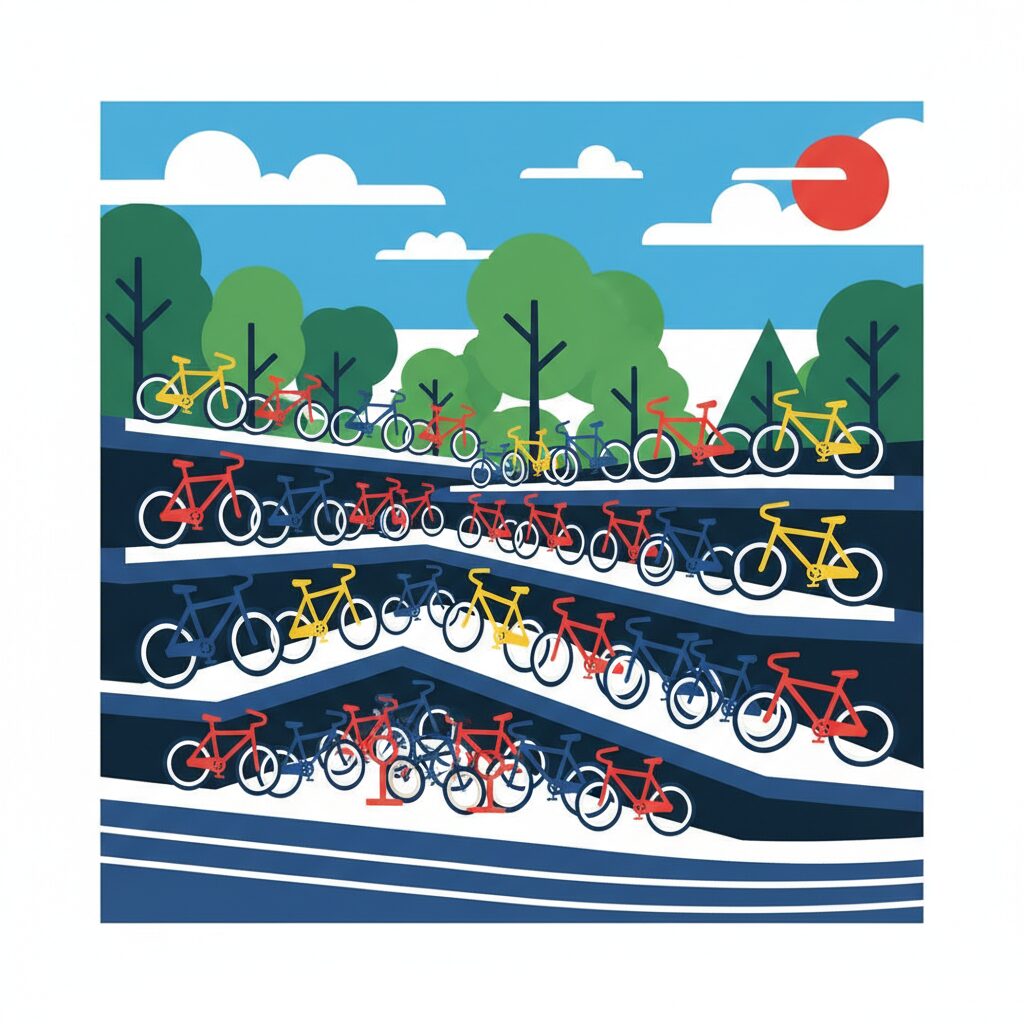
Osaka moves on two wheels. Stand on any street corner, from the polished avenues of Umeda to the covered shotengai arcades of Tenma, and you’ll witness a constant, silent river of bicycles. They flow around pedestrians, glide past buses, and come to rest in metallic clusters at every destination. For a newcomer, particularly one hailing from a car-centric culture, this vision of pedal-powered freedom is intoxicating. The city is overwhelmingly flat, its layout a dense, explorable grid. The bicycle, or the ‘charinko’ as it’s affectionately known, feels less like a choice and more like the city’s natural, intended mode of transport. It promises a life untethered from train schedules and expensive taxi fares. A life of pure, unadulterated convenience. This perception, however, is a beautiful and expensive illusion. The true cost of this freedom isn’t the price of the bicycle itself, but the relentless, non-negotiable price of telling it where to stop. In Osaka, you don’t just own a bike; you rent its place in the urban ecosystem. This isn’t a mere suggestion; it’s a deeply embedded system of rules, fees, and consequences that reveals the city’s core pragmatic philosophy: everything has its place, and every place has its price. Understanding the world of monthly bicycle parking isn’t just about avoiding a fine; it’s about decoding the unspoken social contract that keeps this sprawling, chaotic metropolis from grinding to a halt.
Diving deeper into the city’s cycling culture reveals a labyrinth of unspoken norms, as seen in daily cycling habits in Osaka that subtly influence every turn.
The Logic of Paid Parking: Why You Can’t Just Leave Your Bike Anywhere
A City on Two Wheels
To understand why Osaka takes bicycle parking so seriously, you first need to recognize the vast size of its cycling population. The city’s geography is ideal for cyclists. Unlike the hilly areas of Tokyo or Kobe, central Osaka is an expansive, flat plain. This topographical benefit, combined with a dense network of neighborhoods where shops, clinics, and schools are all within a ten-minute ride, makes the bicycle the most practical means of daily transport. An Osakan’s reasoning is clear and pragmatic. Why pay 230 yen for a two-minute subway ride when you can pedal that distance for free? Why wait for a bus that might get stuck in Midosuji traffic when you can move through side streets at your own pace? This mindset, driven by a strong mix of frugality and efficiency, fills the streets with hundreds of thousands of bicycles every day. They are essential to local commerce, favored by parents taking children to daycare, students going to school, and office workers completing the last leg of their commute from the station. However, this widespread use brings an unavoidable, enormous challenge: storage. Every trip ends somewhere, and at every destination, the bicycle must be parked. This creates a constant, high-stakes struggle for limited space.
The Unspoken War for Sidewalk Space
In many cities, a bicycle chained to a lamppost is a quaint urban sight. In Osaka, it is a challenge to public order. The word ‘hochūrin’—illegally parked bicycle—is more than bureaucratic terminology; it causes real daily tension. A single badly parked bike can block tactile paving strips vital for the visually impaired. A row of them can block a ramen shop’s entrance, costing the owner customers, or force pedestrians onto the street. In a city where every inch of public space is heavily used, such blockages are unacceptable. This is where the system shows its toughness. The city government sends out fleets of small, silver trucks with uniformed workers who systematically patrol no-parking areas. Their method is highly efficient. They identify offending bikes, attach a brightly colored warning tag with the violation and date, and after a short grace period, they return. With practiced skill, they cut locks with powerful bolt cutters, load the bicycles onto the truck, and haul them away. To an unsuspecting foreigner, this may seem harsh. For longtime residents, it’s simply part of urban life—a natural consequence of breaking a well-known rule. The local view of this system is not anger, but grudging acceptance. People dislike the enforcement but understand that without it, Osaka’s sidewalks would become impassable jungles of metal. It’s a classic Osaka compromise: a small loss of personal freedom in exchange for a significant gain in shared, practical order.
Navigating the System: Your Guide to Monthly Parking (‘Teiki Riyō’)
The Two Tiers: Public vs. Private Parking
Once you accept the inevitability of paid parking, you enter a structured environment with definitive choices. The scene is dominated by two primary types of facilities: those managed by the city municipality and those operated by private companies. They serve somewhat different needs and budgets, reflecting the city’s multi-layered economy.
City-Operated Lots (‘Shiritsu Chūrinjō’)
These are the giants of bicycle parking. Often situated directly next to or beneath major train stations, they are large, utilitarian structures, sometimes spanning multiple underground levels or rising into multi-story concrete garages. Functionality is their sole focus. They are generally the most affordable option, with monthly fees, called ‘teiki riyō’, ranging from about 2,000 to 3,500 yen, depending on the desirability of the location. Securing a spot in one of these prime locations, however, is not as simple as arriving with cash in hand. Demand far exceeds supply. As a result, the city frequently uses a lottery system (‘chūsen’) to allocate spaces, especially during the busy peak season in late March and early April when students and new employees compete for contracts. This process is a prime example of Japanese bureaucracy: you fill out a form, submit it by a deadline, and wait to learn if your number is selected. Success feels like winning a small prize; failure means rushing to find alternatives. This system highlights a key truth of life in Osaka: convenience is a resource that is allocated, not guaranteed.
Private Parking Lots (‘Min’ei Chūrinjō’)
Filling the gaps left by public facilities are private operators. Their lots tend to be smaller, often nestled on the ground floor of office buildings, in narrow spaces between apartment blocks, or within sections of shopping center parking areas. They often provide better amenities—improved lighting, 24-hour electronic access, or even security cameras. This comes at a higher cost. Private lots typically charge higher monthly fees, but in return, they offer immediate availability and a more straightforward application process. For many, the extra thousand yen per month is a worthwhile expense to avoid the uncertainty of the public lottery and to secure a spot closer to their actual destination. This trade-off between public and private, cost and convenience, is a daily consideration for millions of residents, reflecting a firmly embedded consumer mindset.
The Application Ritual: A Rite of Passage
Obtaining your first monthly parking pass is an essential experience for any new resident. It usually involves visiting the small management office (‘kanrijimusho’), often a modest booth staffed by a retired gentleman, tucked away in a corner of the parking facility. Here, you will be given the necessary paperwork. You’ll need to provide your name, address, phone number, and often the make and registration number of your bicycle. Your Residence Card (‘Zairyu Card‘) is required for identification. The process serves as a gentle yet firm initiation into the meticulous record-keeping that supports Japanese society. Once your application is approved and the first month’s fee is paid, you receive the ultimate prize: the parking sticker (‘chūrin shīru’). This small adhesive rectangle, printed with the lot’s name, your designated spot number, and the contract’s expiration date, is more than just proof of payment. It acts as a shield. Affixed prominently to your bicycle’s rear fender, it signals to the world—and crucially to the wardens in their silver trucks—that you are authorized. Your bicycle becomes a legitimate, registered member of the local transport community. It now has a home. This sticker transforms your bike from a potential public nuisance into a compliant part of the urban system.
The Economics of Two Wheels: A Cost-Benefit Analysis

Temporary Parking (‘Ichiji Riyō’) vs. Monthly Passes
For those who don’t bike to work every day, the ‘ichiji riyō’ or temporary use system offers greater flexibility. These are the rows of individual locking racks you often see outside supermarkets and department stores. The process is straightforward: you park your bike, the rack secures your wheel, and you pay when you return. Typically, the first hour or two is free—a smart incentive from the business to encourage shopping. After that, the fee is usually around 100 or 150 yen for every few hours. This setup is ideal for quick errands. However, the costs can add up quickly. A cost-conscious Osakan will swiftly do the math. Parking for eight hours during work could easily cost over 500 yen per day. Over twenty working days, that totals about 10,000 yen a month. Suddenly, the 3,000 yen monthly pass fee doesn’t just seem reasonable; it becomes a savvy financial choice. This ongoing, almost instinctive cost-benefit assessment reflects the local mindset. Money is not wasted, and systems are leveraged for maximum advantage.
The Cost of Getting Caught: The Impound Lot (‘Jitensha Hokanjo’)
The strongest reason to pay for parking is the alternative: having your bicycle towed. The experience is both confusing and highly inconvenient. You return to where you left your bike, only to find an empty spot and, if you’re fortunate, a small notice from the city posted nearby. This notice explains what happened to your bike and includes a map to its new temporary location—the municipal impound lot, or ‘jitensha hokanjo’. These lots are deliberately situated in inconvenient areas—beneath remote expressway overpasses, on reclaimed industrial land, or in far-flung suburbs requiring a combination of train rides and long walks. The journey itself becomes part of the penalty. Once you arrive at the large lot holding thousands of confiscated bikes, you must show identification, prove ownership, and pay a retrieval fee, typically between 2,500 and 5,000 yen. The process is polite and bureaucratic, but the message is unmistakable: you broke the rules, and here is the cost. The fine, transportation expenses, and lost time almost always exceed the monthly parking pass fee. Most locals only make this mistake once. The lesson is learned not from civic responsibility but from the unmistakable logic of economics and inconvenience. Following the rules is simply the cheaper, smarter, and easier choice.
More Than Just Parking: What the System Reveals About Osaka
Pragmatism Over Polish
The bicycle parking system serves as an ideal metaphor for Osaka’s character. It may not always be elegant, but it is ruthlessly effective. In some areas of Tokyo, there is often more emphasis on aesthetics and maintaining a pristine streetscape, sometimes at the expense of cyclists’ convenience. Osaka’s approach contrasts with this. The city embraces the bicycle as an essential element of its identity and economy. Rather than discouraging their use to maintain tidiness, it fully commits to creating large, practical, and occasionally unattractive infrastructure to manage reality. The multi-story bicycle garages around stations like Umeda or Namba may not be beautiful, but they stand as proof of a dedication to practical problem-solving. It is function over form, offering solutions that benefit the many rather than ideals that satisfy the few. This is the essence of Osaka: a city more focused on functionality than appearance.
A Collective, Unspoken Agreement
What often perplexes outsiders is the apparent contradiction. They witness the city’s vibrant, sometimes chaotic energy—the confident jaywalking, the direct speech that can feel abrupt—and assume the rules are casual. Yet the parking system runs on a different logic. It works because of a widespread, unspoken consensus. Most people pay their fees and park in designated spots because they understand that the alternative would be a descent into disorder that would ultimately harm everyone. A foreigner might notice a few illegally parked bikes and believe this to be common practice, overlooking the millions of bikes properly parked in nearby lots. They see the small exception but miss the vast, invisible rule governing the majority. This is a frequent misunderstanding when interpreting Osaka: confusing its informal social style with an absence of underlying order.
The ‘Chanto Suru’ Mentality
Beneath Osaka’s famously relaxed manner lies a deep respect for ‘chanto suru’—a concept roughly meaning ‘doing things properly’. It’s not about blind obedience but a mature awareness of one’s responsibilities within the community. Paying your bicycle parking fee is an act of ‘chanto suru’. It means avoiding ‘meiwaku’, or causing trouble, for your neighbors. It’s about fulfilling your part of the social contract that enables millions to coexist in a densely packed environment. This mindset is crucial to understanding the city. While an Osakan might laugh louder and stand closer than someone from Tokyo, they also have a strong sense of an orderly civic framework, especially in matters of money and shared convenience. The system isn’t imposed from above but sustained from within.
The bicycle symbolizes Osaka, though not in the way tourists might expect. It doesn’t just stand for freedom; it embodies a complex daily balance between personal convenience and collective responsibility. The shift from viewing the bike as a free tool to recognizing the need for paid storage is a journey into the city’s very logic. That monthly sticker on your fender is more than a permit; it is a passport. It shows you have looked beneath the surface, learned the unwritten rules, and grasped the pragmatic, economic, and deeply human systems that keep Osaka running. You have acknowledged the hidden cost, and by paying it, you have earned your place in the city’s relentless, rhythmic, and remarkable flow.