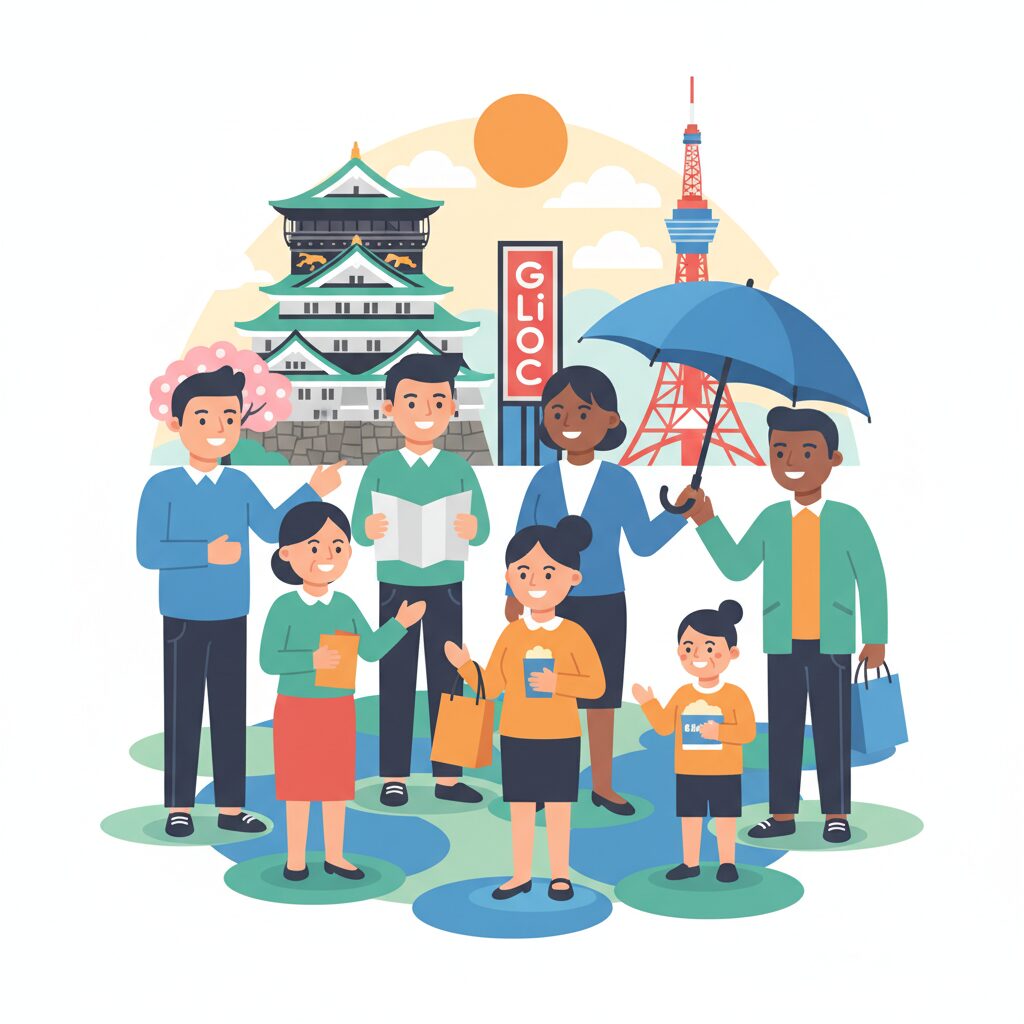
The first time it happened, I was utterly bewildered. Standing on a street corner in Tenma, hopelessly lost, I wrestled with a map that felt more like a tablecloth. Suddenly, a tiny woman with a perm of magnificent violet and a leopard-print blouse appeared at my elbow. She didn’t ask if I needed help. She snatched the map from my hands, clicked her tongue, and pointed a determined finger. “Here,” she declared in a thick Kansai dialect, “You go wrong. This way. Go.” Before I could even stammer out a thank you, she had folded my map with terrifying precision, shoved it back into my hands, and disappeared into the crowd, leaving me stunned but, crucially, no longer lost. This wasn’t the polite, deferential Japan I had read about. This was something else entirely. This was Osaka. And that was my first real taste of ‘osekkai,’ the city’s signature brand of well-meaning, unsolicited, and deeply ingrained friendly meddling. It’s a concept that lives at the very heart of this vibrant, chaotic city, a social currency that explains why life here feels so fundamentally different from the polished reserve of Tokyo. To live in Osaka is to learn the rhythm of osekkai, to understand that a stranger fixing your collar isn’t a violation of your personal space, but a welcome into the city’s sprawling, noisy, and incredibly caring family.
This vibrant tradition of osekkai is evolving alongside modern trends, as witnessed in the surge of AI-enhanced direct hotel bookings that are reshaping the industry.
What Exactly is ‘Osekkai’? More Than Just Meddling
Defining the Undefinable
Translating ‘osekkai’ directly into English is a futile effort. Dictionaries might offer terms like “nosy,” “meddlesome,” or “officious,” but these carry negative connotations. They suggest an unwelcome intrusion, crossing boundaries for selfish or harmful reasons. That’s not what osekkai represents. At its essence, osekkai is proactive, unsolicited kindness. It’s the social instinct to step in and assist someone without being asked, born from a sincere, if occasionally blunt, sense of communal responsibility. It assumes we’re all part of the same urban ecosystem, and if one person faces a problem—a piece of lint on their shoulder, a tag sticking out of their shirt, a puzzled expression—it becomes everyone’s concern to help resolve it. It’s a philosophy that says, “I see you, I notice your minor inconvenience, and I’m going to fix it for you because we’re neighbors, even if we’ve never met.” This isn’t about being nosy for gossip’s sake; it’s about being attentive for the sake of a smoother, friendlier collective life. It’s a form of social grooming, a continuous, low-level upkeep of the community’s well-being, one unsolicited piece of advice at a time.
The Anatomy of an Osekkai Encounter
An osekkai moment unfolds in a pleasantly predictable way. First, there is observation. An Osakan’s eyes, honed by generations of communal living, can spot an inefficiency or minor issue from afar. It might be your grocery bag about to tear, your shoelace coming undone, or you about to pay full price for cabbage when the discounted one is right behind you. The second step is verbal or physical intervention. There is no hesitation or awkward consideration of social protocols. A hand quickly steadies your bag. A voice calls out, “Anata, himo!” (“Hey you, your shoelace!”). A finger points decisively toward the cheaper cabbage. The final stage is the swift resolution and departure. The advice is offered, the problem fixed, and the helper moves on, often without waiting for a lengthy thank you. The intention wasn’t to spark a long conversation or receive praise; it was to identify a problem and resolve it efficiently. It’s a practical act of care, delivered with the speed and confidence of a seasoned expert. You’re left standing there, your issue solved, feeling a mixture of surprise and gratitude.
The Osaka-Tokyo Divide: A Tale of Two Social Contracts
Tokyo’s Wall of Polite Distance
To fully understand osekkai, you need to first grasp its complete opposite: the social environment of Tokyo. Life in Tokyo is guided by a subtle, unspoken agreement of mutual non-interference. The city’s remarkable efficiency and order stem from everyone respecting each other’s personal space. In Tokyo, the highest form of politeness toward a stranger is to not disturb them. You keep to yourself on the train, avoid small talk while waiting in line, and would never dream of pointing out someone boarding the wrong subway line unless absolutely necessary. Offering unsolicited help can feel slightly awkward for both parties involved. It suggests the person can’t handle things alone and interrupts the smooth, anonymous rhythm of urban life. This isn’t coldness or apathy; it’s a different kind of respect based on self-reliance and safeguarding personal space in one of the world’s most densely populated cities. In Tokyo, you are the master of your own world, and no one dares interfere.
Osaka’s Communal Living Room
If Tokyo is a series of private worlds coexisting side by side, Osaka is one large, lively living room shared by all. The social contract here is completely reversed. In Osaka, the greatest kindness you can show a stranger is to look out for them. Ignoring someone clearly having trouble—whether with a map, a heavy suitcase, or a fashion mishap—is seen as distant and unfriendly. The city’s legacy as Japan’s kitchen and commercial center shaped this attitude. It was a place of merchants, artisans, and workers, where success came not through strict samurai ranks but through flexible relationships, trust, and mutual aid. In the busy markets and crowded shotengai (shopping arcades), your reputation was everything, and being known as a helpful, straightforward person was good for business. This merchant tradition, or shonin bunka, valued practicality, frankness, and human connection over formality. Osekkai is a contemporary reflection of that spirit. It’s the belief that the city’s welfare is a collective effort, and everyone has a part to play—even if that role means telling a tourist they look cold and should button their coat.
Reading the Signs: When Osekkai Happens to You
The Classic ‘Obachan’ Intervention
The undisputed experts of osekkai are the Osaka obachan, the city’s formidable older women. They are the tradition’s guardians, dispensing unsolicited advice with the precision of a surgeon and the warmth of a grandmother. Encountering an Osaka obachan is a rite of passage for any foreigner living here. You’ll be standing in the supermarket when one suddenly appears beside you to inform you that the brand of miso you’ve chosen is inferior to the one on the next shelf, which is not only cheaper but also what she has used for fifty years. While waiting for a train, one might approach you, ask where you’re from, and then, without waiting for a reply, pull a small, hard candy from the mysterious depths of her handbag and press it into your palm. This is the legendary ame-chan, a candy that serves as a universal symbol of goodwill. She might comment on the weather, your haircut, or the fact that your child isn’t dressed warmly enough. This isn’t an interrogation; it’s a ritual of connection—a way of acknowledging your presence and folding you, just for a moment, into the city’s social fabric.
Beyond the Obachan: Osekkai in Daily Commerce
While the obachan are the tradition’s most famous practitioners, osekkai permeates the entire commerce culture in Osaka, especially in the city’s beloved shotengai. Here, the line between customer and acquaintance completely fades away. The man at the vegetable stand won’t just sell you tomatoes; he’ll tell you which ones are best for salad versus sauce and then ask if you’re eating well because you appear a bit pale. The butcher might question your choice of cut, insisting that a cheaper one would be more flavorful for the dish you’re planning to make. The owner of the tiny okonomiyaki shop will remember you after one visit and ask why your friend from last week isn’t with you this time. This isn’t merely good customer service or a calculated upselling tactic. It’s a genuine investment in the lives of the people who frequent their businesses. Commerce in Osaka isn’t a sterile transaction; it’s an ongoing conversation, a daily check-in with the community.
Navigating Unsolicited Advice
For a foreigner used to a culture of personal space, the initial reaction to osekkai can be confusion or even annoyance. Why is this stranger commenting on my clothes? Why is this shopkeeper questioning my choices? It’s easy to misread this behavior as rude or intrusive. However, reacting defensively is a cultural misstep. To refuse an act of osekkai is to reject the goodwill behind it. The appropriate response is almost always a smile, a slight bow or nod, and a warm “ookini” (the Osakan way of saying “thank you”). You don’t have to take the advice—you can still buy the expensive miso. But you must acknowledge the gesture. It’s a form of social theater, and your role is to be the gracious recipient. By accepting the interaction with good humor, you show that you understand the local customs. You signal that you appreciate the sentiment, and in doing so, you validate the communal spirit that keeps the city running.
The Psychology Behind the Meddling: Why Osaka is This Way
Merchant Roots and Pragmatism
Osaka’s character was shaped by commerce rather than by seats of power. While Edo (Tokyo) served as the center of the shogun’s strict government and Kyoto housed the emperor’s elaborate court, Osaka thrived as the nation’s bustling economic hub. In this setting, there was little room for the ornate, indirect language of the aristocracy. Communication needed to be straightforward, honest, and efficient. Deals were struck, goods transported, and fortunes gained or lost on the basis of direct talk and mutual trust. This pragmatic spirit is deeply ingrained in the city’s identity. Osekkai, in many respects, reflects this mindset. It is a form of communal problem-solving that cuts through unnecessary formalities to focus on solutions. Your tag is missing? Let’s fix it. You’re lost? Here’s the right way. It’s the quickest route from problem to resolution, and in a city built on efficiency, it fits perfectly.
Humor as a Social Lubricant
It’s no accident that Osaka is known as Japan’s comedy capital. Humor is the key ingredient that makes osekkai easier to accept. The meddling rarely comes with a stern or judgmental tone. More often, it’s delivered with a joke or playful tease. The dynamic between boke (the silly fool) and tsukkomi (the straight man who calls out the foolishness) forms a core rhythm of Osakan conversation. Acts of osekkai frequently serve as tsukkomi. Someone might say, “Hey, you’ve got a piece of rice on your cheek! Saving it for a snack later?” while gently wiping it off. This use of humor immediately eases any awkwardness, turning a potentially embarrassing moment into shared laughter that strengthens social bonds rather than creating tension. It’s a brilliant social tool that allows people to be direct and intervene without ever seeming hostile.
A Fading Art? Osekkai in the Modern Age
It’s important to recognize that today’s Osaka differs from the city of fifty years ago. Like many big cities, it faces the homogenizing effects of globalization and technology. Younger generations, raised on smartphones and influenced by Tokyo’s more reserved customs and Western norms, tend to engage less frequently in overt osekkai. You are more likely to encounter it in older, traditional neighborhoods, in covered shotengai, or from older residents. However, calling osekkai a dying art would be inaccurate. The spirit behind it—the shared sense of community, comfort with directness, and instinct to help—remains very much alive. Though it may now be expressed more subtly, it continues to be a defining trait of the city’s character, a cultural undercurrent that profoundly shapes everyday interactions.
Living with Osekkai: A Foreigner’s Survival Guide
Embrace the Chaos, Find the Warmth
So, what does this mean for someone thinking about living in Osaka? It means you need to be honest with yourself. If your ideal lifestyle requires a high level of anonymity, predictable interactions, and a large, untouchable personal space, Osaka may feel overwhelming. The constant, subtle social engagement can be exhausting if you’re not ready for it. But if you’re open to a bit of beautiful, human chaos, if you yearn for genuine connection rather than polite distance, then Osaka can be an incredibly rewarding place to live. It’s a city that asks you to be present and involved. You have to be willing to be surprised, to be spoken to, to have your day interrupted by an unexpected act of kindness from a complete stranger. If you can embrace that, you’ll discover a city full of warmth and a sense of community that is increasingly rare in today’s world.
How to “Do” Osekkai Yourself
The real sign that you’re beginning to fit into life in Osaka is when you start performing acts of osekkai. It’s a gradual journey. It begins small. You might see another foreigner confused by a ticket machine and, recalling your own early difficulties, step in to help. You might notice an elderly person on the train and loudly ask if someone will offer their seat, instead of just silently hoping someone else does. Giving an ame-chan to a crying child in the supermarket is a more advanced move. Taking part in this culture, even in small ways, is how you demonstrate you belong. It’s a statement that you’re no longer just a passive observer but an active community participant, willing to honor your part of the social contract. It’s how you transform from being a resident into being a neighbor.
The Gift of Being Seen
Ultimately, the best way to understand osekkai is to shift your perspective. In the lonely anonymity of most big cities, it’s easy to feel invisible, like just another face in the crowd. Osekkai is the antidote to that invisibility. It’s the city’s way of saying, “I see you.” It may be a stranger noticing the tag on your shirt, a shopkeeper sensing the tiredness in your expression, or an elderly woman recognizing the confusion in your eyes. But in that moment, you are seen. Someone cared enough to break the silence, to cross the invisible boundary that separates strangers, and to engage with your reality. They offered a small piece of themselves to brighten your day. It’s a daily reminder that you are not alone. You are part of the vast, intricate, and deeply human fabric of Osaka, a city that meddles and probes, all out of a whole lot of heart.