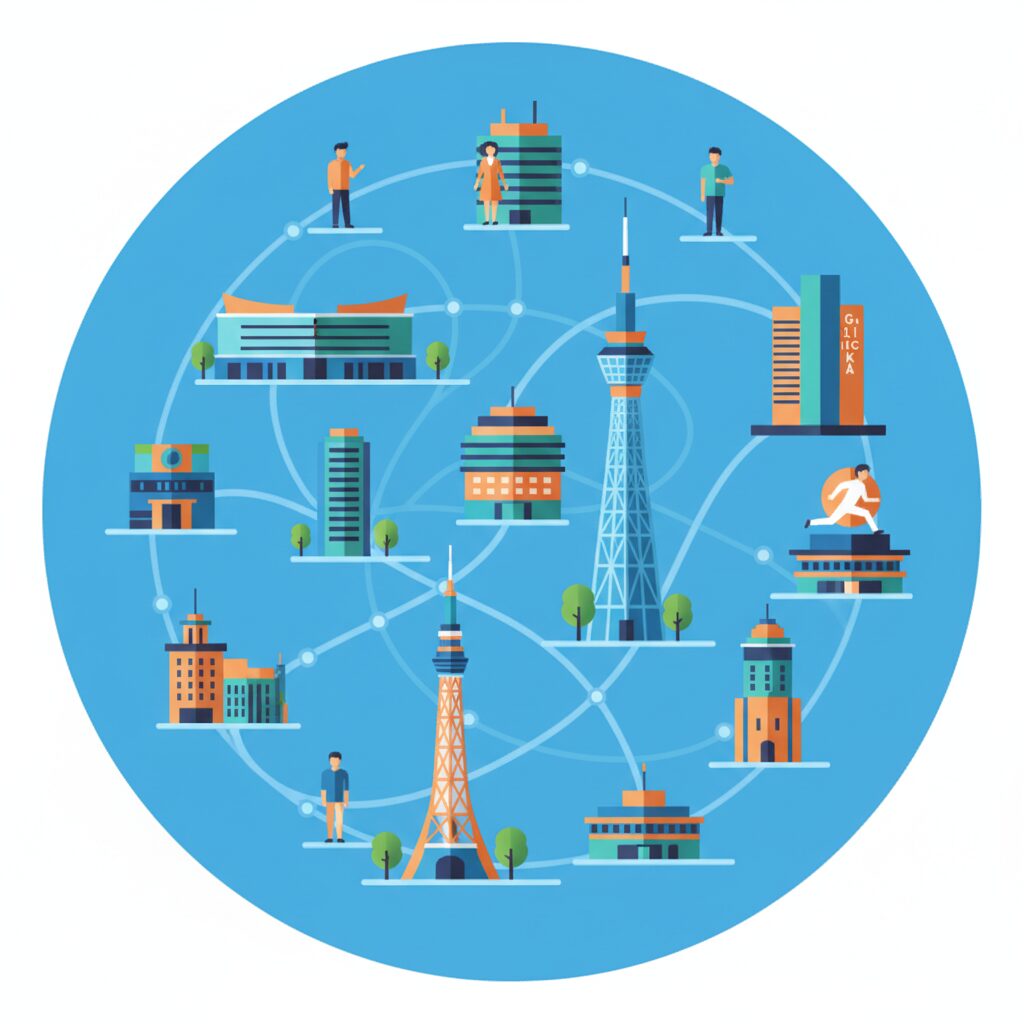
Ever walked down a quiet residential street in Osaka and felt like you were being watched? You probably were. Not by cameras, not by security guards, but by a network far more powerful and efficient: the Osaka Obachan. You see them everywhere, watering plants on the sidewalk, sweeping the pavement in front of their homes, or gathered in small clusters on street corners, chatting with an intensity that suggests they’re trading state secrets. As a foreigner trying to build a life here, you might see them as just a charming part of the local scenery. But make no mistake, this isn’t just idle chatter. This is the central nervous system of neighborhood life in Osaka. This is the human internet, the original social network, and understanding it is the key to figuring out if you’ll thrive or just survive in this city. People move to Tokyo for anonymity, to disappear into the silent, polite crush of the world’s biggest metropolis. People find a home in Osaka because disappearing is simply not an option. Here, you are seen, you are known, and your business quickly becomes everybody’s business, for better and for worse. This isn’t just about friendliness; it’s about a deep, tangled, and unavoidable interconnectedness that defines the soul of the city.
For a deeper insight into Osaka’s tightly knit community, consider exploring how osekkai culture shapes everyday neighborhood life.
The All-Seeing Eyes of the Neighborhood: Who Are the Obachan?

First, let’s clarify the definition. “Obachan” means “aunt” or “older lady,” but in Osaka, it’s not defined by age; it’s a social status, a title earned through years of neighborhood vigilance. These women, usually in their 60s and older, serve as the block’s matriarchs. They are the community’s living archives. They recall whose child scraped their knee on a specific patch of pavement a decade ago. They know the full family histories of those who run the local tofu shop. They are the custodians of unspoken rules and the keepers of local tradition. Their headquarters is often the front of their own home or the local shotengai, the covered shopping arcades winding through Osaka’s neighborhoods. This is their territory. While younger generations are at work or school, the obachan hold court. Their discussions, which might seem like simple gossip about the weather or the cost of daikon radishes, actually function as a sophisticated form of information exchange. They’re continually updating the neighborhood’s collective database. Who is ill? Who is expecting a baby? Who is the new foreigner in apartment 3B who doesn’t seem to understand the garbage sorting rules? Nothing slips past their notice. In Tokyo, you might live next to someone for ten years and never learn their name. There, relationships are built on mutual invisibility. In Osaka, the obachan will know your name, your occupation, and your favorite instant noodle brand before your moving boxes are even unpacked.
The Upside: Your Built-In Support System
Before you start feeling paranoid, consider this: for every moment you sense intrusion, there is an equal act of extraordinary kindness and support. This network isn’t merely for surveillance; it’s a strong, hyper-local safety net. For a foreigner adjusting to a new country, it can be an absolute lifesaver. It’s a support system you didn’t know you needed and certainly didn’t ask for, but one you’ll grow to depend on in ways you never imagined.
Instant Community and a Safety Net
Living in a foreign country can feel isolating. Bureaucracy is baffling, social cues are subtle, and loneliness can linger. The obachan network serves as a powerful remedy to this isolation. Once they accept you into the neighborhood, you gain a team of surrogate grandmothers watching out for you. Struggling with your keys at the door late at night? An obachan from two houses away might call out, “Daijoubu?” (Are you okay?), simply to let you and any potential troublemakers know someone is keeping an eye on you. Came down with a bad cold? Expect a neighbor to show up at your door with a thermos of okayu (rice porridge) and a bag of oranges, saying she heard you coughing through the walls. This is no exaggeration; this is a typical Tuesday in Osaka. They function as an informal emergency service. A friend of mine once locked himself out of his apartment. While panicking and searching for a locksmith on his phone, the obachan next door stepped out, made a quick call to the building owner (who she plays mahjong with every Friday), and had a spare key delivered within fifteen minutes. She then gave him a firm but motherly lecture on responsibility. Here’s the deal: you receive help, but it comes with some life advice. It’s a small price to pay.
The Hyper-Local Information Brokerage
Forget Google Maps. Forget Yelp. The most reliable, current, and practical information about your neighborhood resides in the collective knowledge of the obachan network. They are the ultimate information brokers. They know which butcher in the shotengai has the freshest ground pork on Wednesdays. They know that the small clinic down the street has a doctor who speaks a bit of English and is famously gentle with needles. They can tell you exactly which day to place your large items for garbage collection and will definitely scold you if you get it wrong. This is crucial, practical wisdom that could take months or years to learn on your own. They’ll share tips on where to get your bike repaired cheaply, which park boasts the best cherry blossoms without the tourist crowds, and why you should always buy your vegetables from Tanaka-san’s stand instead of the big supermarket. This exchange of information is a currency of community. Being part of it means you’re not just a resident; you’re a member. In Tokyo, you’re expected to figure things out independently; it’s a test of self-reliance. In Osaka, asking for help isn’t seen as weakness but as participation. Tapping into this knowledge is your way of showing you want to be woven into the neighborhood fabric.
The Downside: Privacy is a Foreign Concept
Now, looking at the flip side. The very network that provides a warm, comforting embrace can just as easily feel like a straitjacket. The price of entry to this cozy community is your privacy. If you come from a Western culture that values individualism and personal space, the Osaka neighborhood model can be quite a shock to your system. The idea of keeping to yourself simply doesn’t make sense here. Your life is viewed as a semi-public asset, a story unfolding that your neighbors feel entitled to follow.
The Gossip Mill Grinds Fast
All that information gathering isn’t solely for altruistic reasons. It’s also for entertainment. Your daily routines, your comings and goings, your successes, and your failures—everything is potential material for the neighborhood news cycle. The obachan who notices you putting out an unusual number of empty beer cans on recycling day isn’t just being observant; she’s collecting a data point. This will be cross-referenced with the fact that you came home late three times last week and looked tired yesterday morning. A narrative will be formed, discussed, and updated. Who was the person you brought home on Saturday night? Why did you get a package delivered from a fancy department store? It’s not necessarily malicious. It’s rarely meant to cause harm. It’s more like people following the plot of a favorite soap opera. You are the main character. For many Osakans, this is normal. It’s how community is sustained. But for an outsider, the sense of being constantly watched can be unsettling. The thin walls of Japanese apartments don’t help. Your neighbors know when you wake up, when you cook, and even what you’re arguing about. There are very few secrets on an Osaka street.
Unsolicited Advice and Meddling
With observation comes judgment. And with judgment comes a constant flow of unsolicited advice. This is where the boundary between caring and meddling becomes very blurry. The obachan might stop you on the street to tell you that your shirt is inside out. She might comment that you look thin and need to eat more meat. She might offer detailed, unsolicited instructions on how to properly clean your balcony. This is their way of showing care. They are trying to help you integrate, to smooth down your foreign edges so you fit better into the community machinery. They are correcting your behavior just as they would with their own grandchild. To them, it’s an act of love. To you, it might feel like a constant critique of your entire existence. Learning to smile, say thank you, and then quietly do whatever you intended anyway is a vital survival skill. Arguing or becoming defensive is a mistake. It brands you as someone who doesn’t grasp the rules, someone who rejects their care, which quickly earns the label of being a difficult person.
How to Navigate the Obachan Network
So, how do you live within this system without losing your sanity? You can’t resist it. You can’t ignore it. You have to learn to navigate it. Maneuvering through the obachan network is a subtle dance, but once you know the steps, you can access all the advantages while minimizing the drawbacks. It demands a proactive approach to community engagement.
The Power of a Simple Greeting (Aisatsu)
This is the absolute, non-negotiable first rule. You must perfect the art of the neighborhood greeting, or aisatsu. Each time you leave your apartment or walk down your street, stay alert. When you spot a neighborhood obachan, make eye contact, offer a slight bow or nod, and cheerfully say “Ohayo gozaimasu!” (Good morning!) or “Konnichiwa!” (Good day!). This simple gesture means everything. It shows that you acknowledge them, respect their role, and want to be a harmonious community member. Ignoring them is the ultimate social faux pas. It comes across as arrogant, cold, and suspicious. A friendly greeting costs nothing but earns you a vast amount of goodwill. It shifts their watchfulness from skeptical surveillance to protective care.
The Art of Sharing (Osusowake)
In Osaka, relationships are nurtured through small, reciprocal gestures. The tradition of osusowake, or sharing small gifts, is foundational here. When you take a trip, even a day trip to Kyoto, you bring back a small box of snacks to offer your immediate neighbors and the key obachan on your street. If you try a new recipe and have extra, you share a small portion. This isn’t about costly presents. It’s the thought that matters. It physically embodies your connection to the community. This gesture lubricates the social machinery. When you accidentally put your garbage out on the wrong day, the obachan is more likely to gently correct you with a smile rather than publicly shame you. It’s a deposit in your social bank account; be sure to maintain a healthy balance.
Setting Gentle Boundaries
Although you can’t build an impenetrable wall around your privacy, you can establish a polite fence. When faced with overly personal questions, you don’t have to answer directly. The key is to stay friendly but vague. Perfect the art of the non-answer. If an obachan asks why you aren’t married yet, you can laugh and say, “It’s difficult, isn’t it!” or “I’m focusing on my work right now!” then quickly shift the conversation by asking about her grandchildren or complimenting her flowers. It’s a conversational judo move—you use the momentum of their question to redirect the energy elsewhere. This allows them to save face and helps you protect your private information. It communicates a boundary without confrontation, which is the heart of successful communication in Japan.
Why This is Quintessentially Osaka
This close-knit, interconnected community model is no coincidence. It directly stems from Osaka’s history as a merchant city. Unlike Tokyo, the center of the stoic, formal samurai government, Osaka was the nation’s kitchen—a hub of commerce where reputation was your most valuable asset. For merchants, neighbors were not merely those who lived nearby; they were customers, suppliers, and lenders. A strong reputation, spread through word-of-mouth (kuchi-komi), made the difference between success and failure. This fostered a culture where everyone was deeply involved in each other’s affairs. Harmony, reliability, and mutual support were crucial for the entire economic system to thrive. That merchant spirit still runs strong in Osaka’s residential areas. The constant conversation, oversight, and support are all a modern continuation of the age-old commercial drive to maintain a well-functioning, transparent, and cooperative community. The boundaries between personal and community life remain intentionally blurred because, historically, they were one and the same.
Is This Lifestyle for You?
Ultimately, whether Osaka’s neighborhood culture feels like a dream or a nightmare depends entirely on your personality and what you are seeking. If you are someone who thrives on social interaction, desires to be deeply rooted in a local community, and values support and safety over anonymity, this city can offer you a home like no other. You will be welcomed, cared for, and never truly alone. Conversely, if you need a high level of privacy, dislike unsolicited advice, and prefer to keep social interactions at a polite distance, life here may feel like a constant challenge. You might feel overwhelmed by the very community that aims to embrace you. There is no right or wrong answer—it’s a trade-off. You exchange some personal freedom for a strong sense of belonging. Understanding the obachan network is the first step to making an informed decision. It’s the invisible system that powers this city, a complex and fascinating network that makes life in Osaka uniquely distinctive.