When you first move to Japan, you get this picture-perfect image burned into your brain. You know the one: serene temples, minimalist design, a society that moves with a quiet, polite hum. And then you move to Osaka. The hum becomes a roar, the minimalism is buried under a glorious mountain of neon and clutter, and serenity? Well, that’s a conversation for another day. I thought I understood Japan, but Osaka handed me a whole new script. The biggest plot twist wasn’t in the flashing lights of Dotonbori or the sharp wit of the local dialect; it was in the steam, the faded tiles, and the bubbling hot water of the neighborhood sento, or public bath.
Forget what you think you know about bathing. In Osaka, a trip to the sento isn’t just about getting clean. Your perfectly functional apartment shower has nothing to do with it. The sento is the city’s living room, its unofficial community center, its confession booth. It’s where the unspoken rules of Osaka life are laid bare for all to see. For foreigners trying to decode this incredible city, skipping the sento is like reading a book with the last chapter ripped out. It’s where you’ll learn why Osaka feels so fundamentally different from Tokyo, why people are so shockingly direct, and what daily life really, truly looks like beyond the tourist trail. This isn’t just an itinerary for a weekend soak; it’s a map to the heart of Osaka itself, one steamy, retro neighborhood at a time.
For those balancing work and leisure in Osaka, exploring akindo networking opportunities can provide a fresh perspective on the city’s uniquely dynamic community.
The Sento as Osaka’s Living Room: More Than Just a Bath
Why Your Apartment Bathroom Isn’t the Point
In most modern cities, the notion of paying to bathe alongside your neighbors seems quaint, perhaps even a bit unusual. But in Osaka, the sento is deeply embedded in the city’s fabric. Decades ago, many older homes and apartments were constructed without private baths, making the public bathhouse an essential amenity. This simple architectural reality gave rise to a significant social phenomenon. The sento became the great equalizer, a space where everyone—from shopkeepers to construction workers—shed their clothes and, along with them, their daily roles. It nurtured a culture known in Japanese as hadaka no tsukiai, or “naked communication.”
However, here’s the Osakan twist. In other regions of Japan, this idea might carry a certain formal, almost spiritual significance. In Osaka, it’s simply practical. It’s less about baring your soul and more about the casual, unfiltered conversations that unfold when social barriers are literally removed. You’re not going to engage in deep philosophical talks. Instead, you’ll overhear an old man grumbling about the Hanshin Tigers’ latest defeat or two women exchanging tips on where to find the cheapest daikon radishes. It’s life, raw and genuine. This tradition continues not out of necessity but because it fulfills an important social role: it keeps the neighborhood connected in a way that social media or planned gatherings never can.
Reading the Room: Sento Etiquette, Osaka Style
If you’ve visited an onsen in Hakone, you might expect a sento to be a place of quiet reflection. Brace yourself for a surprise. An Osaka sento is rarely silent. The tiled walls create perfect acoustics that amplify the lively conversations bouncing around the room. This is your first insight into the Osaka mindset: public spaces are for engagement. Silence can often seem standoffish; a bit of noise indicates that everyone is comfortable and at ease.
The basic sento etiquette applies everywhere: wash thoroughly at the showers before entering the tubs, avoid letting your small towel touch the bathwater, and dry off as much as possible before returning to the changing room. But in Osaka, there’s an unwritten social code typically enforced by the local obachan, the older women who reign supreme in the bathhouse. If you slip up, they won’t whisper behind your back. They’ll approach you mid-soak and tell you exactly what you’re doing wrong. It’s not meant to be rude; it’s a form of tough love. These women are the guardians of this shared space, and their bluntness is a distinctive feature of Osaka communication. People here prize clarity over ambiguity. They prefer a moment of awkward correction to letting an issue linger. It’s a practical approach to community care that might feel harsh initially, but once understood, it reveals a genuine sense of concern.
A Weekend Deep Dive: The Itinerary
This journey isn’t about checking off boxes. It’s about fully immersing yourself in the unique ecosystems of Osaka’s neighborhoods. Each sento reflects the character of the surrounding streets, serving as a living museum of local life.
Saturday Morning: The Showa Time Capsule of Nishinari
Your Destination: Nadai Tsuruhashi Onsen
Begin your journey in Nishinari, a neighborhood that wears its history openly. This is the Osaka you won’t find in guidebooks. It’s gritty, raw, and profoundly human. Nadai Tsuruhashi Onsen is its vibrant center. Stepping inside feels like traveling back to the Showa Era. The air is heavy with steam and the scent of soap. Though the tilework may be chipped and the lockers aged, everything is impeccably clean and well-maintained. This isn’t a nostalgic show; it’s stubbornly authentic.
The patrons represent a cross-section of the community: elderly men who have visited for fifty years, day laborers washing off the day’s grime, and a few students from nearby guesthouses. Conversations are grounded and genuine, touching on health issues, pension concerns, and the simple joy of a good meal. Visiting this sento offers a powerful insight into Osaka’s working-class roots. There is no pretense here. Life is hard, but community makes it bearable. It embodies the city’s resilience and deep commitment to looking after one another.
Saturday Afternoon: Art and Energy in Shinsekai
Your Destination: Spa World (The Exception That Proves the Rule)
From Nishinari’s grit, we shift to the bright, gaudy spectacle of Shinsekai and its bathing giant, Spa World. To be clear: Spa World is not a traditional sento. It’s a super sento—a multi-level bathing theme park with floors dedicated to different global themes. One month the men enjoy the “European” zone while the women visit the “Asian” zone, then they switch the next month. It’s loud, packed with families and tourists, and completely unlike the intimate neighborhood baths.
Why include it on the itinerary? Because it reveals another crucial side of Osaka’s personality: the love for kote-kote (over-the-top, even tacky) experiences that deliver great value. Spa World’s concept is pure Osaka logic. Why settle for a simple Japanese bath when you can enjoy a Roman bath, Finnish sauna, Persian grotto, and Balinese spa—all for one ticket? It’s about squeezing maximum entertainment out of every yen. Big, bold, and a bit ridiculous—just like the city itself. Here, you see Osaka families at play, friends laughing and splashing, letting loose completely. It shows that while Osakans cherish tradition, they also have an insatiable appetite for fun, novelty, and getting the most out of life.
Sunday Morning: The Hipster Remix in Nakazakicho
Your Destination: Hinode Yu
Sunday brings us to Nakazakicho, a maze of narrow alleys where old wooden houses have been lovingly transformed into independent boutiques, quirky cafes, and art galleries. This neighborhood showcases Osaka’s unique urban development approach. While Tokyo often follows a “scrap and build” model, Osaka prefers to preserve and repurpose, layering new on old. Hinode Yu exemplifies this. It’s a classic, beautiful old sento with an elegant sweeping roof and a charming garden, now embraced by a younger crowd.
The water remains just as hot, and the Mt. Fuji mural is as iconic as ever, but the visitors are different. Here, you’ll find artists discussing projects, students unwinding after exams, and couples enjoying weekend dates. The atmosphere is more relaxed—a bridge between old sento traditions and the neighborhood’s modern creative energy. Hinode Yu highlights Osaka’s remarkable ability to evolve without erasing its past. Tradition isn’t a static relic; it’s a living, adaptable force relevant to new generations. It’s a stylish, breathing piece of history.
Sunday Evening: The Quiet Residential Heart of Juso
Your Destination: Hanafuku Onsen
For our final stop, we venture to Juso, a neighborhood with a complex identity—part busy transport hub, part slightly seedy entertainment district, and part quiet residential area. Hanafuku Onsen is tucked away in this last section. This offers the purest neighborhood sento experience available. No tourists, no hipsters—just locals engaged in their weekly ritual. As a foreigner, you may stand out, but you will be greeted with curious acceptance.
Here, you become an observer of the quiet rhythms of everyday life. Conversations are soft and familiar, centered on neighborhood dramas: whose child got into which school, the latest sale at the local shotengai (shopping arcade), or the health of an elderly neighbor. Soaking in Hanafuku Onsen’s waters teaches you about the intricate web of community relationships. It reminds you that beneath Osaka’s loudness and bravado lies a foundation built on small, tight-knit residential pockets. This is where you truly grasp that living in Osaka means being part of a larger organism where people look out for each other in everyday ways.
Post-Sento Rituals: The Second Act of Osaka’s Social Life
The Vending Machine Beer and the Bench
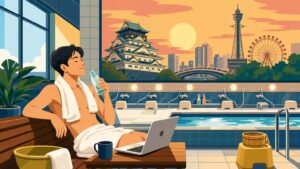
In Osaka, the sento experience continues even after you leave the water. The next chapter unfolds in the lobby. Nearly every sento features a lounge with old benches, a buzzing television, and, most importantly, vintage vending machines filled with glass bottles of milk, coffee milk, and beer. Enjoying a post-bath drink is an essential ritual.
Sharing a cold beverage here, still warm and relaxed from the bath, sparks the best conversations. It’s a moment of pure, simple bliss. This humble pleasure captures the essence of Osaka. It’s affordable, communal, and completely unpretentious. You don’t need an upscale craft beer bar; you just need a cold Asahi from a rattling machine and a bench to sit on with a friend or a friendly stranger. It’s about discovering deep satisfaction in the simplest things, a philosophy that resonates with the city’s practical spirit.
From the Bath to the Izakaya
The social energy generated in the sento doesn’t simply vanish; it flows into the neighborhood. A sento visit often serves as the prelude to a night out. Refreshed and relaxed, groups of friends or neighbors spill out of the bathhouse and head to a nearby standing bar or local izakaya. There’s a natural and effortless transition between these communal spaces.
This flow reveals how public and social life are woven together in Osaka. It’s not about separating different activities. Life is fluid. The sento, the shopping arcade, the restaurant—they’re all interconnected hubs within the neighborhood’s social web. You might even raise a glass alongside someone you just saw in the bath. This spontaneous, organic social life stands in contrast to the more formal, reservation-driven culture found in other cities. Here, life is lived openly, on the streets, and among the community.
What Sento Teaches You About Osaka
The Beauty of Imperfection
If you’re seeking the flawless, Zen-inspired aesthetic of Kyoto, you won’t find it in an Osaka sento. Instead, you’ll encounter cracked tiles, faded murals, and a charming sense of well-worn history. This captures Osaka in a nutshell. The city isn’t fixated on perfection; it values character. It embraces its own wabi-sabi—the beauty found in imperfection and impermanence. This is often what foreigners misunderstand about Osaka. They interpret the grit and age not as character, but as neglect. In truth, it’s a badge of honor. It signals a real place, for real people, with a genuine history that hasn’t been polished away for tourists.
Community Over Conformity
The chatter, the directness, the shared sense of ownership of the space—all highlight a fundamental truth about Osaka. This is a city that values the strength of community over the comfort of strict, individualistic conformity. In Tokyo, the unspoken rule in public spaces is often to minimize your presence and avoid disturbing others. In Osaka, the rule is to participate, engage, and be present. The sento teaches that being a good community member doesn’t mean being silent; it means understanding the rhythm, respecting shared resources, and not hesitating to speak up. It’s a noisier, messier, but arguably more connected way of living together.
Living in the Moment, Affordably
At its core, the sento experience costs about 500 yen. For the price of a fancy coffee, you gain warmth, water, relaxation, and a profound sense of belonging. This embodies the Osaka merchant spirit. It’s about kechi—not about being cheap, but about being wise with your money and extracting the maximum joy from every yen spent. Life’s finest pleasures, the sento suggests, shouldn’t be costly luxuries. They should be simple, accessible, daily rituals that ground you in your community and bring you back to yourself. Soaking in these waters, you don’t just gain a better understanding of Osaka’s people—you begin to appreciate a better, simpler way to live.