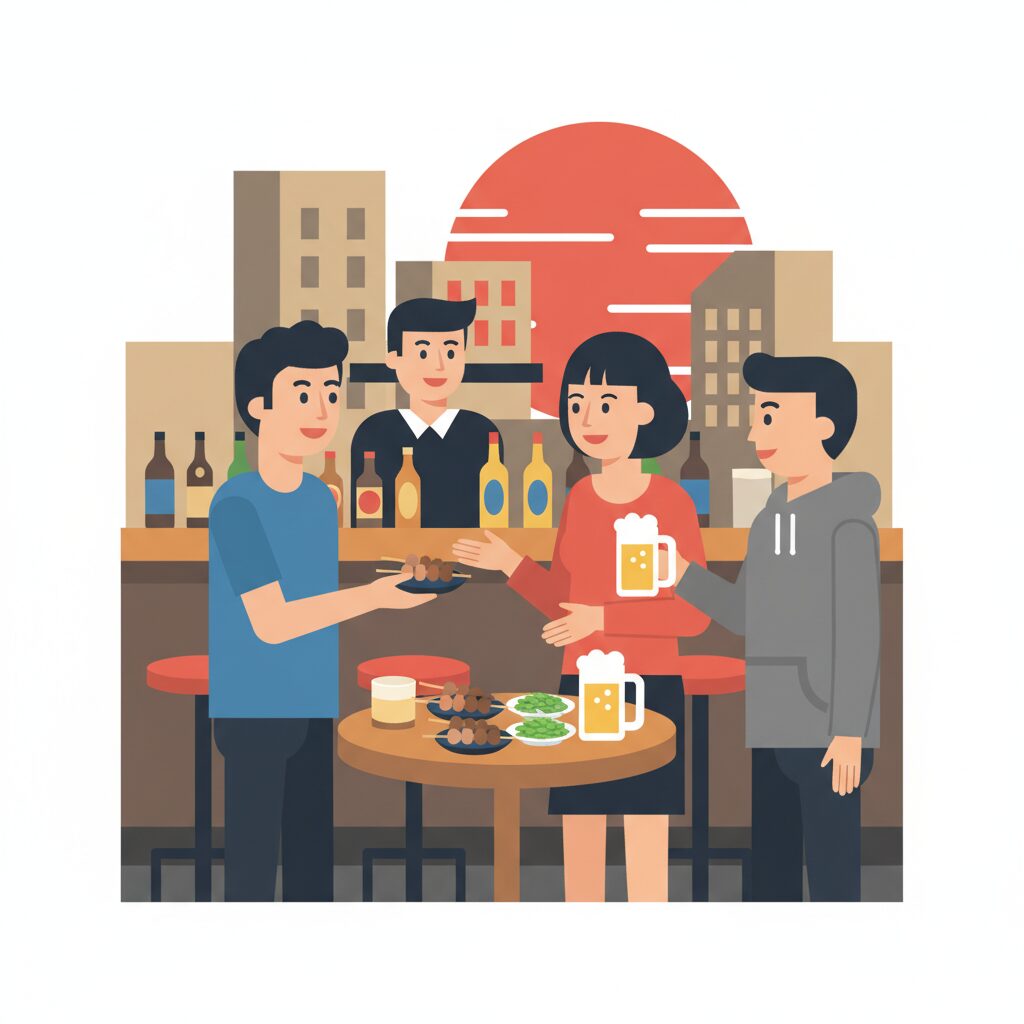
Step off the train at Kyobashi or Tenma after five, and you’re hit with a wall of sound and scent. It’s not the generic rush-hour hum of a city waking down. It’s something more specific, more concentrated. It’s the clatter of ceramic on wood, the hiss of hot oil, the low, rising roar of a hundred conversations packed into spaces the size of a generous walk-in closet. This is the world of the tachinomi, Osaka’s standing bars. From the outside, they look like chaotic, impenetrable fortresses of local life. Men in work jackets stand shoulder-to-shoulder with young women in stylish coats, all hunched over a narrow counter, gesturing with chopsticks and beer mugs. For a newcomer, especially one accustomed to the more delineated social spaces of Tokyo or the West, the immediate question isn’t just “What should I order?” but “How do I even get in?” These aren’t just places to grab a cheap drink; they are living, breathing theaters of Osakan social dynamics, a nightly performance where the script is unwritten and the rules are learned through observation and a little bit of nerve. To understand the tachinomi is to understand the city’s very pulse—its relationship with space, money, and strangers. It’s where the city’s famous friendliness is put to the test, revealing a complex system of tacit agreements that allow so many people to share so little space, not just peacefully, but joyfully. This is your guide to navigating that beautiful, boisterous chaos.
Navigating the pulsating chaos of Osaka’s tachinomi, you’ll find that many locals opt for a quick reset at higaeri onsen to momentarily escape the city’s relentless energy.
The Counter as a Stage: Decoding the Social Theater
In Osaka, the narrow wooden counter of a tachinomi serves as much more than just a surface for food and drinks. It acts as a stage, a shared battlefield, and a communal table simultaneously. The first thing you’ll notice is the complete absence of personal bubbles. The usual practice of maintaining a polite, arm’s-length distance—so important in much of Japanese society—vanishes the moment you step inside. Here, space is a fluid commodity, negotiated moment by moment with subtle shoulder shifts or the placement of an elbow. This closeness isn’t an unfortunate consequence of a small space; it’s a core aspect of the experience. It represents an unspoken agreement to temporarily dissolve social barriers in favor of a collective, lively energy. You’re not simply a customer at your own private table; you become an active participant in a shared public moment.
Finding Your Spot: The Art of the Squeeze
Your first challenge begins at the door. There’s no hostess, no waiting list, no polite queue. Peering into a packed bar, a Tokyoite’s instinct might be to wait for someone to leave or for a staff member to acknowledge them. In Osaka, this will leave you standing at the entrance all night. The proper approach is more assertive, yet requires social tact. You scan the counter for the tiniest gap, a space that seems impossibly small. You catch the eye of the person next to it, give a slight nod or a small gesture that says, “May I?” More often than not, they’ll shift, compressing their own space by a few crucial inches to let you in. The move is a swift, apologetic slide-in accompanied by a murmured “sumimasen” (excuse me) that serves as both apology and thanks. You have now entered the ecosystem. Your task is to occupy as little physical space as possible. Keep your bag at your feet, fold your coat tightly, and tuck in your elbows. You’ve earned your spot not by waiting but by skillfully merging into the existing physical flow. This act itself reflects the Osakan preference for practical, direct action over passive, formal procedures.
The Opening Line: Breaking the Ice, Osaka-Style
Once you’re settled, a new challenge emerges: the silence. Or rather, your silence amid a sea of chatter. In a Tokyo bar, striking up conversation with a stranger is rare and often met with suspicion. In an Osaka tachinomi, it’s practically the point. The close quarters grant an implicit permission to engage. A newcomer’s silence can be mistaken not for politeness but for aloofness. The key is to find a natural opening. A common tactic is to comment on your neighbor’s food. “Sore, oishisou desu ne. Nan desu ka?” (“That looks delicious. What is it?”) is a golden key. It’s both a compliment and a question, showing curiosity and respect for their choice. Another is to simply raise your glass for a quick “kanpai” when your neighbor gets a fresh drink. The reaction is almost always warm. This is where you’ll witness the famed Osaka humor in action. Your conversation partner might launch into a playful, teasing exchange, a lighthearted version of the boke (funny man) and tsukkomi (straight man) comedy routine that lies at the city’s cultural core. A friendly jab about your Japanese skills or a dramatic sigh about a long workday isn’t an insult; it’s an invitation. It says, “I see you, and I’m willing to share a laugh with you.” Responding with a touch of self-deprecating humor will earn you instant points.
Unwritten Rules of the Game: Tachinomi Taboos and Triumphs
Beneath its chaotic surface, the tachinomi follows a surprisingly strict set of unspoken rules. These unwritten guidelines enable the system to maintain its energetic, fast-paced turnover. Breaking them isn’t seen as a serious social offense but rather as disrupting the flow, like a musician playing out of tune. Observing these rules shows you understand the local culture and respect the shared space. Mastering these small rituals is what separates feeling like a tourist from feeling like a temporary local, even if only for one beer.
Cash on the Counter: The Economy of Trust
Many traditional tachinomi use a cash-on-delivery system, known as kyasshu on. Upon arrival, you’ll notice small plastic trays on the counter. The custom is to place a 1,000 yen or 5,000 yen bill in the tray. When you order, the staff take your money, bring your food and drink, and return your change to the tray. You then leave the change there for your next order. This system is incredibly efficient, removing the need to catch the attention of a busy bartender to pay, and keeping transactions as fast as the drinks flow. But it’s more than just practical—it’s built on mutual trust: staff trust you won’t run off, and you trust them to take the correct amount. This simple, elegant social technology reflects the pragmatic, no-nonsense spirit of Osaka merchants. Struggling with a credit card or asking for a complicated itemized bill at peak times is a surefire way to mark yourself as an outsider who doesn’t understand the system.
Ordering Etiquette: Speed and Precision
At its busiest, the pace of a tachinomi is relentless. The staff are constantly on the move, and their attention is limited. The rule for ordering is straightforward: know what you want, wait for the right moment, and be clear and concise. Don’t try to interrupt a staff member pouring three beers simultaneously. Watch their rhythm, anticipate when they’re free for a brief moment, make eye contact, and place your order. “Nama-biiru to doteyaki, hitotsu zutsu” (“One draft beer and one doteyaki, please”). Done. Requesting a detailed explanation of several menu items when others are waiting behind you is a major disruption. The expectation is that you learn by watching what others order or by taking a chance on something appealing. This isn’t rudeness, but a shared understanding that the system only functions if everyone respects the flow. The reward for your efficiency is receiving your food and drink with remarkable speed, keeping you in sync with the evening’s rhythm.
The Graceful Exit: Knowing When to Leave
A tachinomi isn’t a place to linger all night. It serves as a transitional space—a quick stop for a drink and snack before heading home or to the next venue. The concept of senbero—“getting tipsy for 1,000 yen”—is deeply embedded in the culture. The idea is to enjoy a couple of drinks, a small dish or two, then move on. This maintains a steady stream of customers and keeps the atmosphere lively. Overstaying, especially when there’s a line forming, is the biggest faux pas. The graceful exit is an art: finishing your last drink, gathering your things, and slipping out as smoothly as you came in, perhaps with a nod to staff and fellow patrons you just chatted with. Leaving your spot open for the next guest is the final act of participating in the tachinomi’s social contract—an acknowledgment that the space isn’t yours, but just loaned for a little while.
Beyond the Beer: What Tachinomi Reveal About Osaka’s Soul
These bars are much more than just a collection of rules and rituals. They offer a glimpse into the cultural psychology of Osaka. The behaviors you observe and engage in at the counter serve as microcosms of the broader civic attitudes that characterize the city and distinguish it from the rest of Japan. The tachinomi is where Osaka’s history as a city of merchants and artisans is enacted every night, highlighting pragmatism, community, and a healthy skepticism toward formal hierarchy. It’s a place where the city’s spirit is both maintained and expressed.
The Great Equalizer: Where Status Disappears
One of the most striking features of the tachinomi is its role as a social equalizer. Everyone stands. The company president stands beside the construction worker, who stands next to the university student. There are no private rooms, no VIP areas, no corner booths signaling status. The shared counter and standing arrangement level social hierarchies in a way rarely seen in more formal, seated venues. Here, your business card title matters far less than your ability to tell a good story or share a laugh. This echoes Osaka’s historical identity as a merchant city, where success depended on shrewdness, personality, and the ability to build quick rapport—not on inherited status or titles. The tachinomi carries forward this ethos today. It’s a place where human connection, however brief, is the key currency. People are judged not by their social rank but by their willingness to engage in the communal spirit of the moment.
A Safety Valve for the City’s Psyche
Life in a dense, sprawling metropolis can feel isolating. The tachinomi acts as a crucial “third place”—neither home nor work—where people can unwind and connect. It serves as a social safety valve for the city. Casual, low-pressure interactions with strangers foster a sense of community and belonging, even if only for the length of a single beer. This is where the stereotype of the “friendly Osakan” is most genuinely realized. The friendliness here is not about forming deep, lasting friendships; it is a practical, situational warmth born of necessity and a genuine curiosity about the people who share the city. It’s the willingness to briefly open your social circle to include the person standing next to you. This ongoing, low-level social friction energizes the city and wards off the urban anonymity that often plagues other large cities.
A Tokyo Curator’s Field Notes: Navigating the Difference

Coming from Tokyo, my initial experiences with Osaka’s tachinomi culture required a significant shift in social expectations. The norms I had come to accept—keeping distance, respecting privacy, avoiding unsolicited conversation—were not only irrelevant here but counterproductive. It felt like learning a new language, one communicated through posture, glances, and the timing of an order rather than words. This experience underscores a fundamental difference in how Japan’s two largest cities approach public social interaction.
The Wall of Silence vs. The Sea of Banter
In Tokyo, a solo drinker at a bar is often surrounded by a respectful wall of silence. Other patrons and staff usually leave you to your thoughts, phone, or book, which is considered a form of urban politeness—granting privacy in a crowded city. In an Osaka tachinomi, however, that same quietness can be interpreted as loneliness or even arrogance. The cultural norm is to engage socially; silence is something to be broken. Being left alone in a busy Osaka tachinomi might even feel like a slight. This contrast can be surprising. For someone accustomed to Tokyo’s quiet anonymity, the frequent social overtures in Osaka may initially feel overwhelming. Yet, once you adjust, it becomes clear that this openness stems from inclusiveness and the belief that a shared space should foster a genuine shared experience.
Practical Tips for the First-Timer
If you’re ready to dive in, having a strategy helps. First, avoid starting on a crowded Friday night. Opt for a weeknight, earlier in the evening—around 5:30 or 6:00 PM. The atmosphere will be calmer, giving you more time to observe and acclimate. Choose a venue with a visible menu and clearly marked prices to prevent any confusion about the payment system. Pick a spot at an open counter where you can easily see the staff and other customers. Have your first order ready before you settle in: a beer (nama-biiru) or a lemon sour (remon-chuhai) are usually reliable choices. Most importantly, don’t feel pressured to be the center of attention. It’s perfectly fine to be a quiet observer at first. A smile, a nod, and a genuine enjoyment of the atmosphere often suffice for a warm welcome. Locals can usually spot newcomers, and more often than not, they’re happy to help you find your way.
The Evolving Tachinomi: From Old Guards to New Waves
It would be incorrect to assume that all tachinomi are gritty, smoke-filled remnants of a past era, frequented solely by older men in work clothes. While these traditional establishments remain central to the culture, a new wave of standing bars has emerged throughout Osaka. Today, you’ll find stylish standing wine bars in Fukushima, craft beer tachinomi in Umeda, and minimalist sake bars in Namba. These contemporary venues cater to a younger, more diverse crowd, including groups of women and international visitors.
What’s intriguing is that even in these trendy new spots, the core essence of the tachinomi often persists. The spaces are still designed to promote mingling and quick turnover. The counters remain long and communal, the food typically consists of small plates, and the atmosphere—while possibly more polished—is still distinctly social. These new establishments demonstrate that the tachinomi concept is not merely a historical relic but a versatile and enduring social model. It reflects the Osakan belief that a great time doesn’t need ample space or a large tab, but rather good company and an openness to conversation.
Is This Your Osaka? Finding Your Place at the Counter
Ultimately, your response to the tachinomi serves as a reliable indicator of how you might feel about living in Osaka. It captures the city’s social dynamic in one lively, crowded, and thrilling experience. If the thought of squeezing into a small space, chatting briefly with strangers, and navigating a rapid, unwritten set of social norms excites you, then the essence of Osaka will probably resonate with you. You’ll value the city’s straightforwardness, its absence of pretense, and its focus on human connection rather than strict formality.
Conversely, if it seems like a stressful, intrusive challenge, you might find the constant social demands of the city overwhelming. There’s no right or wrong response; it simply reveals the significant cultural variations within Japan. Osaka’s social environment, as perfectly exemplified by its standing bars, requires a certain degree of engagement. It invites you to leave your private world behind and connect with the city’s chaotic, vibrant, and deeply human energy. Entering a tachinomi is not just about grabbing a drink; it’s about discovering whether you have a place at Osaka’s counter.