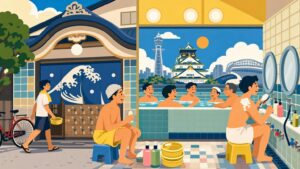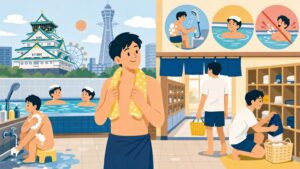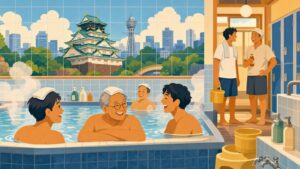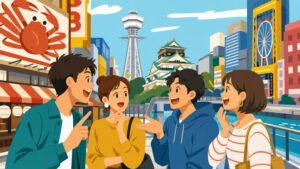
To the newcomer, Osaka presents itself as a relentless grid of concrete and commerce. It’s a city that moves at a clip, a place where business is direct and pleasantries are efficient. You land at Kansai International, take the train into Namba or Umeda, and you’re immediately plunged into a sensory torrent: the roar of the JR loop line, the sizzle of takoyaki grills, the unending sea of people flowing through subterranean shopping arcades. The energy is electric, infectious, but after a few months, a question starts to percolate in the back of your mind, especially on a crowded Saturday afternoon. How do people sustain this pace? In a city that seems to prize perpetual motion, where is the emergency brake? The answer, for a vast number of Osakans, lies not within the city limits, but just beyond them, in a ritual that is as practical as it is profound: the `higaeri onsen`, or the day-trip hot spring. This isn’t a luxury vacation or a tourist indulgence. It’s a deeply ingrained cultural habit, a maintenance tool for the mind and body, and a perfect window into the pragmatic soul of Osaka. To understand the city, you have to understand the need to escape it, and more importantly, how efficiently Osakans have perfected that very act.
Beyond the quick reset provided by a higaeri onsen, many Osakans also embrace the vibrant tradition of drinking with heart to balance their fast-paced urban life.
The Osaka Mindset: Efficiency in Relaxation
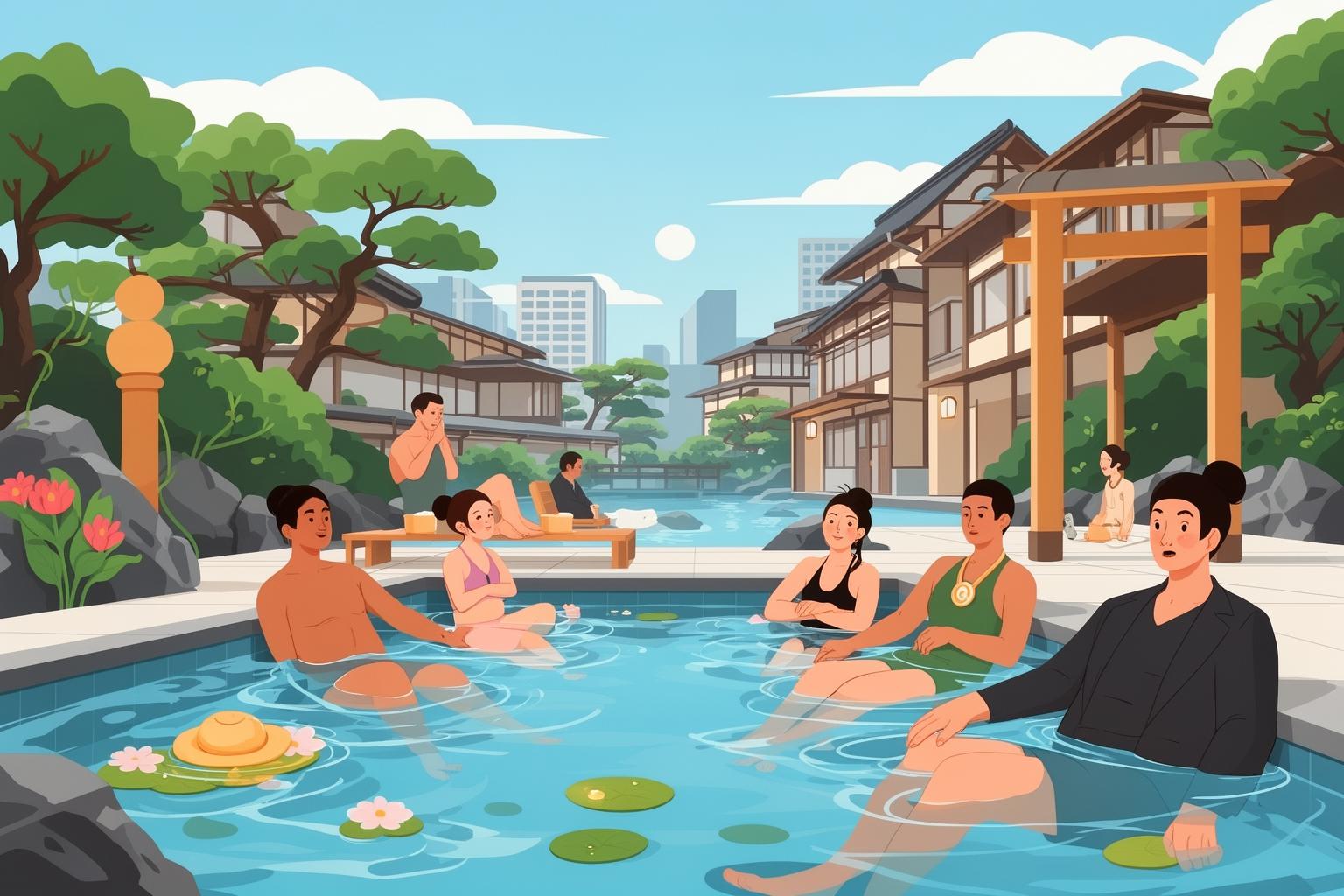
In Tokyo, organizing a weekend getaway often feels like a calculated operation. It requires booking train tickets months ahead, reserving a popular ryokan, and dedicating a considerable amount of time and money. The Osaka approach to recharging is fundamentally different. It’s less about an elaborate plan and more about a spontaneous, almost tactical choice. This practicality influences every facet of life here—from business negotiations to grocery runs—and importantly, it extends to leisure as well.
“Cha-cha-tto Ikou ya”: The Spontaneity of the Escape
On a Saturday morning in an Osaka suburb, you might catch the phrase, “Saa, cha-cha-tto onsen demo ikou ka?” which roughly means, “Alright, shall we quickly head over to a hot spring?” The vital term here is “cha-cha-tto.” It’s a classic Osaka dialect adverb meaning to do something quickly, briskly, and without fuss. It perfectly captures the local spirit: get it done, and get it done efficiently. This isn’t the language of a meticulously planned trip. It’s the tone of a necessary errand—like picking up groceries—but for the soul. The decision is often made over breakfast. The destination depends on traffic conditions. The aim is straightforward: maximum relaxation with minimum hassle. This attitude is driven by a principle Osakans deeply value: kosupa, or “cost performance.” Why spend a fortune and an entire weekend at a famous inn far away when you can reap 80% of the restorative benefit in six hours just a short drive from home? It’s a pragmatic calculation. The goal isn’t to craft an Instagram-worthy memory; it’s to release stress so you can perform at your best on Monday. Relaxation here is a tool, not a show.
A Calculated Escape from Urban Gridlock
To truly understand the appeal of the `higaeri onsen`, you need to experience the intensity of central Osaka on a weekend. Stand at the scramble crossing outside Osaka Station in Umeda or try navigating the covered arcades of Shinsaibashi. It’s a spectacular, overwhelming flow of humanity. The density, the noise, the visual bombardment—it’s the city’s lifeblood but also exhausting. The day-trip onsen is the immediate and effective antidote to that sensory overload. It’s a conscious trade-off. You exchange the clatter of the Midosuji subway line for the sound of water flowing over rocks. You swap the artificial glow of Don Quijote for sunlight filtering through cedar trees. You replace the crush of the crowd with the cool mountain breeze on your skin. This sharply contrasts with escaping Tokyo, where the Kanto Plain is vast—a sprawling megalopolis seemingly without end. Reaching authentic nature—the mountains of Hakone or the Izu Peninsula’s coastline—often means a long, crowded, and costly express train ride. In Osaka, the city’s edge feels much nearer and more clearly defined. The shift from urban to rural is sudden and easily accessible, making the mental break that much quicker and more effective.
The Geography of the Getaway: Why Osaka is Perfectly Positioned
The `higaeri onsen` culture is not merely a reflection of the Osakan mindset; it directly stems from the region’s distinctive geography. Unlike Tokyo’s vast, flat expanse, Osaka is nestled within a basin—a geographical fact that shapes the pace of life here. The city is enclosed, surrounded on three sides by mountains and bordered on the fourth by the sea. This confinement, which contributes to the city’s density and its famously humid summers, also serves as its greatest advantage for a weekend reset.
The Ring of Mountains and the Sea
Take a look at a map. To the east, the Ikoma mountain range forms a natural barrier between Osaka and Nara. To the north, the Hokusetsu mountains rise, home to areas like Minoo and Nose. To the west, beyond Kobe, are the Rokko Mountains, where the renowned Arima Onsen is tucked away. To the south, the landscape opens toward the mountains and coastline of Wakayama. For an Osakan, these aren’t distant or abstract places—they are essentially the city’s backyard, its shared garden. They loom as a constant visual presence on the horizon, a reminder that wilderness lies just a short drive away. This proximity means you can leave your apartment in Tennoji and, in less than an hour, be relaxing in a natural hot spring with panoramic views of the very city you just escaped. This easy access has nurtured a casual, functional relationship with nature. The mountains aren’t a once-a-year pilgrimage destination; they are a frequently used resource, integral to maintaining well-being. This geographical gift is something many Tokyo residents can only imagine, and it fundamentally influences the work-life balance of the Osaka area.
The Car Culture Connection
Though Osaka has an excellent public transportation system, the true driving force behind the `higaeri onsen` culture is the automobile. For many families living in the sprawling suburbs encircling the central city, owning a car is the norm. And it’s the car that provides the freedom and spontaneity this ritual demands. The weekend getaway follows its own rhythm. It usually begins with packing the family into a kei car or minivan. The first stop is almost always a local Lawson or FamilyMart to strategically pick up onigiri, snacks, and canned coffee for the road. From there, it’s onto the Hanshin Expressway, a network of elevated highways that bypasses city streets and gets you to the mountains in minutes. The drive itself is part of the decompression ritual. As the city’s concrete towers fade in the rearview mirror, replaced by bamboo groves and terraced fields, you can feel the week’s tension melt away. This dependence on the car creates a distinct kind of weekend freedom compared to the train-centered lifestyle common in Tokyo. It’s the freedom to explore, take detours, and discover a hidden noodle shop or roadside market selling local produce—all on your own timetable. It’s a small but meaningful expression of the independence that Osakans cherish.
More Than Just a Bath: The Unspoken Rules of the Onsen Reset
A foreigner might mistakenly see the `higaeri onsen` as just a place to bathe, much like calling a French bistro merely a spot for a quick snack. In reality, it is a comprehensive, multi-step ritual intended as a full system reboot. This well-orchestrated sequence of events each plays a crucial role in the process of unwinding. Grasping this sequence is essential to appreciating its cultural significance.
The Anatomy of a Day Trip
The experience begins the moment you enter the facility. First, you pay a modest entrance fee, usually between 800 and 1,500 yen. You place your shoes in a locker and head to the changing rooms. The initial essential stage is the bath itself. These facilities almost always offer a variety of options. The `uchiyu`, or indoor baths, are spacious, often equipped with powerful jets and different mineral blends. However, the highlight, the centerpiece, is the `rotenburo`—the outdoor bath. This is the core of the experience. There is something uniquely magical about soaking in steaming, mineral-rich water heated by the earth, while cool, fresh mountain air surrounds you. You look up at the sky, the forest around you, and the distant city lights twinkling, as the week’s mental noise slowly quiets. But the ritual doesn’t end here. After bathing, you don’t simply dress and leave. You slip into the `samue` or `yukata` provided by the facility. This simple gesture marks an important transition, shedding your civic identity—your work clothes and street persona—and adopting an outfit of pure relaxation. Next, you move to the `kyukeijo`, or communal resting area. Usually large `tatami` rooms, these spaces are furnished with reclining chairs, cushions, and low tables. Here, visitors nap, read from the facility’s extensive manga library, or simply gaze into space. This quiet lounging period is not optional; it is a critical part of allowing the hot water’s effects to settle into your body and mind.
The Social Dimension: Alone, Together
The final stage of the `higaeri onsen` experience revolves around food and drink. Emerging from the bath slightly light-headed and deeply relaxed, many first stop at a vending machine for an ice-cold bottle of coffee milk or fruit milk—a nostalgic treat for many Japanese. For adults, this is often followed by a frosty mug of draft beer—a pleasure so cherished it has an unofficial title: the `roten-biiru` (outdoor bath beer). Then comes the meal. The onsen’s restaurant is not just an afterthought but an integral part of the reset process. The menu typically features simple, hearty dishes such as soba noodles, tempura, and `katsudon`. Enjoying a satisfying meal while completely relaxed and clad in your `yukata` brings the experience full circle. The social dynamics of these spaces are equally insightful. Although you may arrive with family or friends, the time spent in the gender-separated baths is a moment of profound solitude—a silent shared experience. Conversation is kept to a minimum as everyone honors the quiet, reflective atmosphere. Yet, once you leave the baths and gather in the `tatami` rooms and restaurants, social interaction resumes. Families chat, couples relax side-by-side, friends share meals. This embodies a key principle of Japanese culture: the ability to be comfortably together in a shared space while respecting each person’s individual experience. It is a form of communal yet private rejuvenation.
Debunking Misconceptions: Osaka Beyond the Neon
The popular image of Osaka, often depicted in stark contrast to Tokyo, is that of a loud, gritty, and purely urban environment. It’s seen as the city of `kuidaore` (‘eating oneself into ruin’), flashing neon lights, and lively comedians. While this forms part of its identity, it’s an incomplete portrayal. The deeply rooted culture of the `higaeri onsen` directly challenges these stereotypes.
Not Just a Concrete Jungle
A common misconception is that Osaka is merely a concrete jungle, detached from nature. However, the weekly exodus to the surrounding mountains proves otherwise. Osakans are not only aware of the natural world around them; they maintain an active, ongoing relationship with it. They use the mountains and hot springs as a counterbalance to the intensity of city life. This connection isn’t driven by romantic or abstract appreciation but is intensely practical. Nature serves as a resource and a tool that makes living in a crowded, high-energy city not only feasible but enjoyable. The mountains encircling the basin are more than just a backdrop; they are an essential part of the city’s well-being infrastructure. Overlooking this means missing one of the most fundamental aspects of what daily life in Osaka truly feels like. The city’s relentless energy is sustained, in no small measure, by the accessible calm found just beyond the nearest hill.
It’s a Reset, Not a Vacation
For foreigners, a visit to an onsen might seem like a special cultural event to check off a list. For Osakans, it’s more like regular maintenance. It’s not a vacation; it’s a system reboot. It’s akin to a deep tissue massage, chiropractic adjustment, and therapy session all rolled into one afternoon. It’s how they recalibrate their internal compass after a week spent navigating the pressures of work and urban life. This is the secret behind the city’s seemingly endless energy. The reason people can work long hours and then dive into Namba’s vibrant nightlife is because they have a reliable, efficient, and affordable method for recovery. The `higaeri onsen` acts as the pressure release valve for the entire urban machine. It prevents city stress from becoming chronic and enables residents to keep engaging with its intensity without burning out.
To truly understand Osaka, you must look beyond the Dotonbori lights and the Umeda skyscrapers. You need to appreciate the city’s rhythm, which includes the regular, pulsating flow of its people moving out and back in. The `higaeri onsen` is more than a weekend routine; it’s a profound expression of Osaka’s character. It reflects a deeply ingrained pragmatism, a talent for maximizing value, and a shrewd understanding of the delicate balance needed to live fully in a powerful city. It shows how Osakans have perfected the art of the urban reset—not by slowing their city down, but by stepping just outside it for a few precious, restorative hours. Life in Osaka is lived at the heart of the metropolis, yet sustained by the tranquility found at its edges.