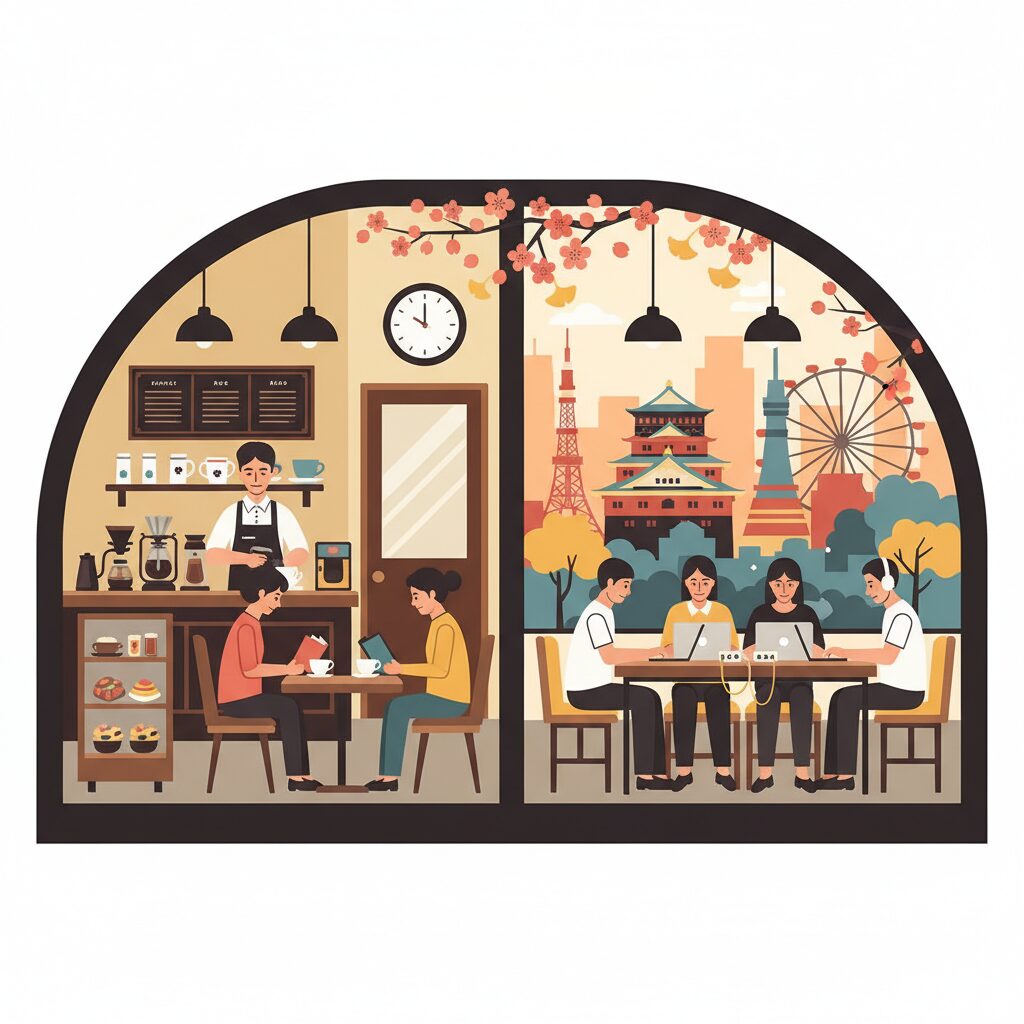
You see them everywhere now. Gleaming glass facades, minimalist wooden tables, the soft glow of Apple logos reflecting in designer glasses. The modern coworking space, a third place between home and office, feels like a recent invention. A sanctuary for the digital nomad, fueled by expensive oat milk lattes and the silent hum of collective ambition. We tap away on keyboards, isolated in our bubbles of productivity, connected by Wi-Fi but separated by invisible walls. It’s clean, it’s efficient, it’s global. And in Osaka, it’s completely beside the point.
Long before anyone coined the term “hot desking,” Osaka had its own version. It doesn’t have high-speed fiber or ergonomic chairs. It often smells faintly of stale cigarette smoke, fried eggs, and dark-roast coffee that’s been brewing since dawn. It’s the neighborhood kissaten, the humble coffee shop, and its morning ritual is the bedrock of the city’s social and economic life. Forget the sterile silence of a WeWork. The real deals, the truest connections, the most vital streams of information in this city flow not over Slack channels, but over the worn linoleum counters and cracked vinyl booths of these unassuming local institutions. To understand the kissaten, especially its legendary “Morning Service,” is to understand the pragmatic, relational, and deeply human heart of Osaka itself. This isn’t about finding a quiet corner to work; it’s about plugging into the city’s central nervous system.
These humble establishments not only fuel daily routines but also invite us to delve into Osaka’s value-for-money cafe scene where work and local culture blend seamlessly into everyday life.
The “Morning Service” Misconception: It’s Not Just Breakfast
Walk past any kissaten in Osaka between 7 AM and 11 AM, and you’ll notice a sign, often handwritten on a small chalkboard: モーニングサービス (mōningu sābisu). To outsiders, it appears to be a simple breakfast offer. Order a coffee, usually priced around 400 or 500 yen, and you receive a bonus: a thick slice of toasted shokupan, a hard-boiled egg, and perhaps a small dollop of potato salad or some shredded cabbage. It feels like a freebie—a charmingly generous gesture from a bygone era.
This is the first misconception. In Osaka, nothing is ever just a freebie. It’s a strategy. The idea of otoku, getting exceptional value for your money, is embedded in the city’s DNA. Osaka was founded by merchants, and the spirit of the deal is crucial. The Morning Service isn’t a gift; it’s an investment. The owner isn’t losing money on that egg and toast. They are buying your loyalty. They are creating a reason for you to pick their establishment over the soulless chain cafe down the street. They are building a base of regulars, or jōren-san, who will support their business not only for the morning but also for lunch, afternoon coffee breaks, and beyond.
In Tokyo, a transaction is often just that—an exchange of money for goods. It’s efficient and predictable. In Osaka, a transaction marks the start of a relationship. The Morning Service is the opening handshake. It says, “Come in, have a seat, I’ll take care of you. The price of this coffee gets you more than just a drink; it offers you a space, a moment of peace, a sense of belonging.” It’s a deeply practical form of hospitality. The kissaten owner knows that if they provide a comfortable, affordable, and valuable start to your day, you’ll return. You’ll bring your clients. You’ll recommend it to your friends. This isn’t just breakfast; it’s brilliant, relationship-driven marketing, Osaka-style.
The Anatomy of a True Osaka Kissaten
To view a kissaten simply as a coffee spot is like seeing a library merely as a place to store books. The physical space serves only as a vessel for a complex social ecosystem. Every detail, from the person behind the counter to the worn-out furniture, plays a vital role in its function as the neighborhood’s unofficial hub.
The “Master”: Your Unofficial Networker
Behind the counter, you won’t find a revolving door of part-time baristas. Instead, you’ll find the “Master” (or “Mama-san”). Often the owner, this person is the heart and soul of the establishment. They conduct the daily symphony, managing everything from brewing siphon coffee to nurturing the intricate web of social connections within the room. A great Master knows far more than just your coffee order—they know your name, your profession, your recent struggles, and your quiet dreams.
They serve as the ultimate social lubricant, casually introducing the real estate agent in the corner to the young couple searching for a new apartment, or passing a message from the hardware store owner to the contractor reading the sports section. They’re a living LinkedIn, a guardian of local secrets, and a trusted confidant. The Master acts as an anchor of trust in the community. In a world dominated by anonymous digital interactions, their steady presence offers a profound sense of stability. You’re not just paying for coffee; you’re implicitly paying for their social capital, their knowledge, and their quiet stewardship of the community’s well-being.
The Atmosphere: A Symphony of Smoke and Strategy
Modern cafes are designed for Instagram—bright, airy, and quiet. Osaka kissaten, however, are designed for life. Lighting is often dim, casting a warm, intimate glow from ornate, sometimes dusty, fixtures. The air is rich with the aroma of dark-roast coffee mingling with buttered toast and, often, the lingering haze of cigarette smoke. This is no health spa; it’s a workspace for working people.
The soundtrack isn’t a curated Spotify playlist but the clatter of ceramic cups on saucers, the rustling of newspaper pages, the murmur of a business deal unfolding in a corner booth, and the sharp hiss of the coffee siphon. It’s a productive hum, a white noise of human activity far more conducive to quiet reflection or focused work than the enforced library-like silence of many modern cafes. The velvet seats may be worn, the wallpaper peeling, yet the space feels lived-in, comfortable, and authentic. It’s a place where you don’t have to perform—you can simply be.
The Clientele: A Cross-Section of the City
Step into a kissaten on any weekday morning and you’ll witness the full spectrum of Osaka life. In one booth, two salarymen in slightly rumpled suits pore over architectural plans, using sugar packets to represent buildings. At the counter, a local shopkeeper catches up on the day’s gossip with the Master while flipping through a tabloid. Near the window, a university student highlights a textbook, a half-eaten egg sandwich beside them. In the back, a group of elderly women laugh, their conversation a rapid-fire exchange in thick Osaka-ben dialect.
This diversity is what makes the kissaten the ultimate coworking space. It’s not a monoculture of tech bros or graphic designers but a lively, chaotic mix of everyone. This cross-pollination is where the magic unfolds. A freelancer sketching designs overhears a conversation about a new building project and lands a client. A student grappling with a concept receives an unexpected explanation from the retired engineer sitting nearby. It is a space of serendipity—an analog social network where valuable information and opportunities flow freely, often without a screen in sight.
Where Deals Are Made and Ideas Are Born
To the casual observer, it might appear to be a room full of people simply killing time. But take a closer look. The kissaten is one of the most productive spaces in the city. It serves as an office, a boardroom, and a research hub all in one, available for the price of a single cup of coffee.
The Original Hot Desk
For generations of salespeople, small business owners, and freelancers in Osaka, the kissaten has functioned as their office. Why rent a dedicated space when you can access a network of them across the city for just a few hundred yen an hour? A salesman might begin his day at a kissaten near his home, planning his route. He can then meet a client at another kissaten halfway across town, using the table as a presentation area. Finally, he can wrap up his day at a third, filing reports before heading home.
These places are not meant for casual conversations; they are spaces for serious business. Contracts are signed at these tables. Heated discussions over pricing and deadlines take place quietly in corner booths. Job interviews, both formal and informal, happen over coffee and toast. The kissaten offers a neutral, comfortable, and affordable setting for commerce. It removes the stiff formality of corporate boardrooms, encouraging more honest and direct communication—a hallmark of the Osaka business style.
Information Exchange, Not Just Wi-Fi
The most valuable asset in a kissaten isn’t the power outlet or the (often unreliable) Wi-Fi. It’s the ambient information. In an age of curated newsfeeds and algorithm-driven content, the kissaten provides a stream of raw, unfiltered, local data. You learn which local politician is in trouble, which storefront is about to open, that the factory down the street is hiring, or that a competitor just lost a major contract.
This isn’t idle gossip; it’s actionable intelligence. Being a regular at a kissaten is like subscribing to the city’s most exclusive newsletter. You become immersed in the flow of the real economy, the kind that happens face-to-face. While the rest of the world is glued to their phones, the patrons of the kissaten engage in the timeless art of listening. The conversations you overhear, the people you meet, and the subtle cues from the Master—these are the data points that give you a true edge in a city that still runs on relationships and street smarts.
Why This Doesn’t Feel the Same in Tokyo
Certainly, Tokyo has plenty of coffee shops—thousands, in fact, ranging from upscale specialty roasters to international chains and a handful of traditional kissaten. However, the culture surrounding them feels fundamentally different. The role that kissaten play in Osaka’s social and business life is truly unique.
In Tokyo, cafes often come across as more transactional and goal-oriented. You visit a particular cafe for its renowned latte art, modern design, or dependable Wi-Fi. It’s a destination. The experience is carefully curated, polished, and frequently impersonal. You order, you consume, and then you leave. The staff is courteous and professional, but the deep, familial connection between a Master and their jōren-san is uncommon. Space is limited, and there is a clear expectation to vacate your seat after a reasonable time. Lingering is considered a luxury rather than the norm.
By contrast, Osaka’s kissaten culture is based on the exact opposite idea. It’s not a destination; it’s more like an extension of your home or office. It’s a practical amenity. The value lies not in novelty or aesthetics, but in its steadfast consistency and sense of community. The Osaka mindset values practicality above perfection. Who cares if the chairs are a bit worn, as long as they’re comfortable? Who needs elaborate latte art when the coffee is strong, hot, and served with a complimentary egg? The kissaten embodies the city’s pragmatic philosophy: cultivate relationships, provide real value, and the business will thrive naturally. It’s a community hub first and a coffee shop second—a distinction that gets to the very core of the difference between the two cities.
How to Find Your Own Kissaten Workspace
For any foreigner aiming to truly understand and integrate into Osaka, discovering your own local kissaten is a rite of passage. It serves as your gateway into the neighborhood’s inner circle. However, these places rarely advertise themselves with flashy signs or a strong social media presence. Here’s how to find your spot.
Look Beyond the Main Streets
The best kissaten seldom appear on the busy main streets. They are often tucked away in the covered shotengai (shopping arcades), down narrow side alleys, or on the ground floors of old residential buildings. They are the spots you might pass a dozen times without noticing. Let your senses be your guide. Follow the aroma of roasting coffee. Watch for the soft glow of a revolving barber-shop-style lamp outside. Listen for the subtle clatter of cups and voices.
Reading the Signs
Forget sleek, modern branding. A genuine kissaten reveals itself through quieter signs. Look for a faded plastic food model of a Morning Set in a dusty window. Notice a name written in elegant, old-fashioned katakana. The windows might be slightly fogged, obscuring the view inside—intimidating at first, but often a sign of a well-loved, cozy interior. Don’t be discouraged by a hand-painted sign or a facade that looks like it hasn’t changed since the 1970s. That’s not neglect; it’s a badge of honor, showing the place has thrived on its coffee and community, not on trends.
Becoming a Regular (Jōren)
Stepping into a kissaten for the first time can feel like entering a private party. Conversations may pause, and all eyes might turn toward you. Don’t worry. This is the test. Smile, give a slight nod, and take a seat. The key to breaking the ice is consistency and simplicity.
Avoid ordering a decaf soy latte with cinnamon on your first visits. Instead, order the “Morning” or the “Blend Coffee.” Visit around the same time for several days in a row. Make eye contact with the Master and say thank you when you leave. After a few visits, your coffee may appear at the counter as you sit down. The Master might ask a simple question about where you’re from. This is your opening. You’re no longer just a customer; you’re becoming part of the scenery. You’re becoming a jōren. At this stage, you’ve unlocked a whole new layer of life in Osaka.
The Future of the Original Coworking Space
It would be disingenuous to deny that the kissaten is a fading institution. The Masters are growing older, and their children frequently pursue different careers. The economics of operating a small, independent shop are becoming more difficult amid competition from large chains. For every cherished kissaten that has been a neighborhood staple for fifty years, there is another that has quietly shut its doors permanently.
However, their decline signifies more than just the loss of charming, nostalgic cafes. It reflects the diminishing of a particular kind of community, a mode of human connection that is increasingly rare in our digital age. The kissaten serves as an antidote to the isolation of the laptop era. It’s a place where you are recognized, where your presence matters, and where you belong to a tangible, local network.
For anyone living in Osaka, these establishments are not mere relics to photograph. They are living, breathing institutions that provide a masterclass in how the city functions. They teach the value of loyalty, the significance of worth, and the simple truth that the most meaningful connections are still those made face-to-face. So next time you need to send some emails or organize your day, skip the sterile cafes. Find a spot with worn velvet seats and a smoky haze, order a Morning Service, and plug into the real, enduring, and wonderfully human network of Osaka.