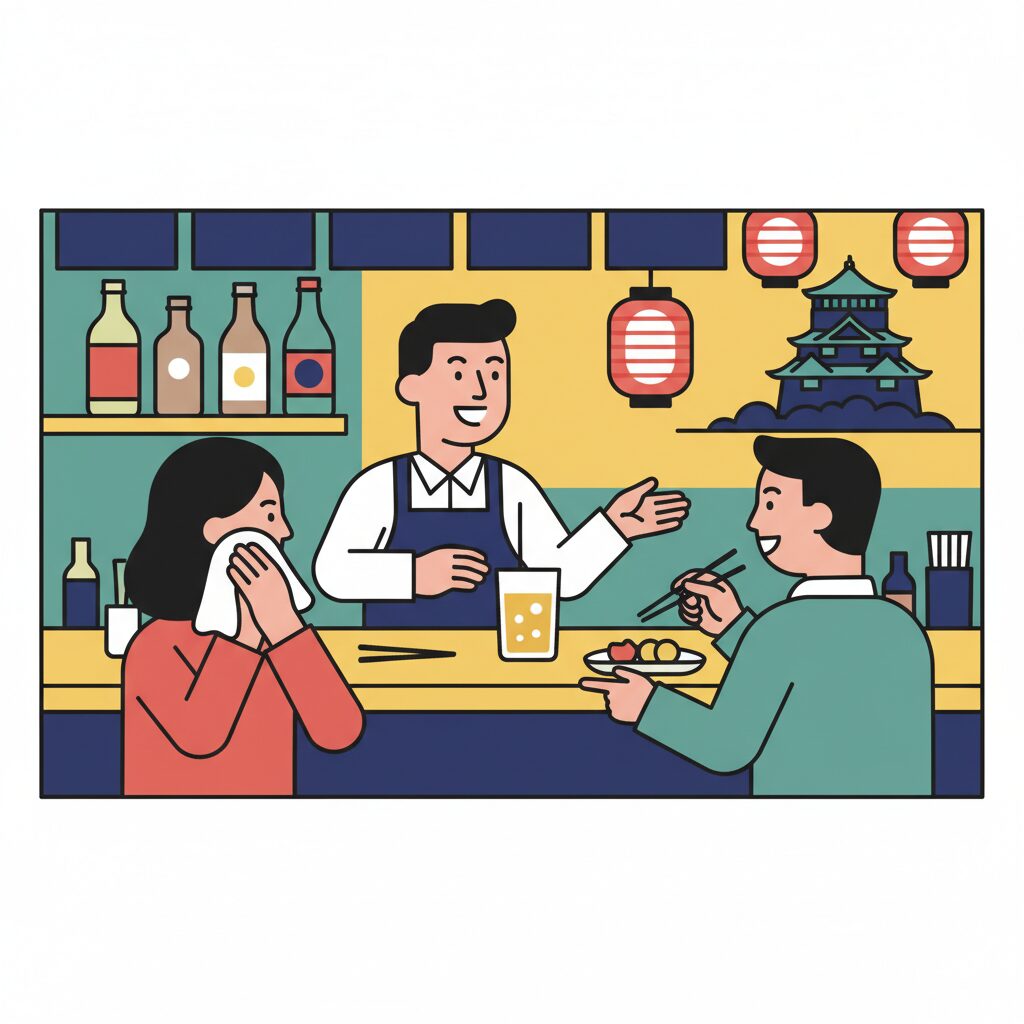
You push aside the short, faded noren curtain and step inside. The air hits you first—a warm, delicious cloud of grilled mackerel, savory dashi broth, and the faint, sweet scent of cheap shochu. It’s loud, but not in a chaotic way. It’s the sound of a city exhaling after a long day: the clink of glasses, the sizzle of food hitting a griddle, and a rolling wave of laughter and conversation spoken in the thick, musical cadence of Osaka-ben. This is a tachinomi, a standing bar. There are no chairs, just a long wooden counter worn smooth by a thousand elbows, and a dozen people packed shoulder-to-shoulder, making it work. For a newcomer, it can feel intimidating. It seems like a private party you’ve just crashed. You wonder, how do I fit in here? Where do I stand? Who do I talk to? This isn’t just a bar; it’s a microcosm of Osaka itself, a place where the city’s unwritten social rules play out in real time. Forget the guidebooks that tell you Osaka is just “friendly.” The reality is far more interesting, a complex dance of practicality, temporary community, and unspoken etiquette. To understand the tachinomi, you have to understand the rhythm of this city. It’s a place that moves fast, values efficiency, and finds its warmth not in polite distance, but in close, fleeting connections. These bars, scattered under railway tracks in Kyobashi or tucked into the labyrinthine alleys of Tenma, are the classrooms where you learn the real language of daily life in Osaka.
For a deeper dive into the unspoken customs that govern these lively spaces, consider checking out this guide to tachinomi etiquette to see how locals master the art of standing bar interactions.
The Tachinomi Trinity: Speed, Space, and Social Chemistry

Step into a standing bar in Tokyo, and you might encounter a quiet, almost sterile efficiency. Patrons stand in their assigned spots, nursing a single beer, and seldom interact. It serves as a functional space for a solitary drink. In Osaka, however, the purpose is completely different. The experience is shaped by a trio of unwritten principles that capture the city’s character: the swift pace of the visit, the fluid negotiation of personal space, and the vibrant potential for spontaneous conversation. It’s a performance, and once you learn the moves, you become part of the act. This isn’t about strict rules; it’s about a collective understanding, a shared social wavelength that everyone tunes into the moment they step inside.
The Art of the Quick Drink
One of the first things you’ll notice is the speed. A tachinomi is not somewhere to linger all night. It’s a pit stop, a social pause in the day. People come and go with a purpose. The salaryman, with his tie slightly loosened, is there for a quick beer and a skewer before catching the last train. The elderly couple grabs a glass of sake and a plate of simmered daikon before heading home for dinner. It’s a prelude, a post-work catch-up, a brief escape. This reflects Osaka’s deeply rooted merchant culture, where time is money and efficiency is prized. The phrase sassato nonde, sassato kaeru—drink quickly, go home quickly—is the unspoken creed. You order, you drink, you eat, you chat briefly, and then you move on. Lingering over one drink for an hour is socially frowned upon. It disrupts the flow and takes up valuable space. This constant turnover gives the bar its energy, its sense of being a living, breathing place. It stands in sharp contrast to the typically leisurely pace of an izakaya, where reserving a table for two hours is common. Here, the only reservation you make is finding an open sliver of counter space.
The Personal Space Negotiation
By design, these bars are tight. Personal space, as a Westerner might understand it, simply disappears. You’ll be standing elbow-to-elbow with a construction worker on your left and a young office worker on your right. Your backpack can’t remain on your back; it has to be tucked between your feet or placed on a high shelf, if available. This closeness isn’t an intrusion; it’s the heart of the experience. The charm lies in the unspoken choreography of accommodation. When someone new arrives, everyone instinctively shifts. Shoulders turn inward, drinks are pulled closer, and a space appears where there was none moments before. Nobody offers profuse apologies; a simple nod or a quiet sumimasen (excuse me) suffices. This isn’t the formal, structured politeness of Tokyo. It’s a practical, communal dance. It acknowledges that everyone is sharing this tight space, so let’s make it work. This physical proximity breaks down social barriers, creating a common context that makes conversation not only possible but almost inevitable.
The Unspoken Invitation to Chat
This is where Osaka truly stands apart from the rest of Japan. Elsewhere, striking up a conversation with a complete stranger in a bar is rare. In an Osaka tachinomi, it’s the main event. The close quarters and shared experience form a temporary social contract where talking is the default mode. It might begin with a simple question from your neighbor: “Sore, oishii?” (Is that good?), as they point to your plate of doteyaki. Or the bar master (taishou) might act as a connector, telling a regular, “Kono hito, Kanada kara kiten nen” (This person’s from Canada), and suddenly you’re engaged in a three-way chat about hockey and maple syrup. This isn’t merely casual friendliness. It’s a distinctive social dynamic rooted in Osaka’s identity as a city of commerce and entertainment. People value wit, a good story, and a quick laugh. Conversation is social currency, a way to create a welcoming atmosphere for everyone. It’s about sharing a moment of humanity with those who happen to be standing beside you for the next twenty minutes.
Reading the Room: Rules of Engagement
Though the atmosphere seems spontaneous, it actually relies on a series of subtle cues and expectations. Successfully navigating a tachinomi involves learning to read the room and grasp the roles everyone plays. It’s less about following a strict list of dos and don’ts and more about developing an intuition for the social rhythm. From how you place your order to whom you engage with, every action contributes to the delicate ecosystem of the bar. Mastering these nuances is essential to transitioning from a silent observer to an active participant.
Ordering Etiquette: Know What You Want
The bar master is the heart of the operation and is always busy. They pour drinks, take orders, cook food, and chat with regulars, often all at once. When it’s your turn to order, be prepared. Don’t hesitate. Make eye contact, clearly state what you want, and keep it brief. This isn’t the moment for a lengthy explanation of your dietary preferences. Pointing at the handwritten menu on the wall is perfectly fine. Many traditional tachinomi operate on a cash-on-delivery system, often called kyasshu on. You’ll notice a small tray or basket in front of you—place a few thousand-yen bills inside. When you order, the master will take the exact amount and return the change in the tray. This system is built on trust and remarkable efficiency. There’s no waiting for a bill at the end. When your tray is empty, it signals that you’re finished. This straightforward, no-fuss transaction is pure Osaka—the merchant’s way of doing business: clear, fast, and honest.
The Social Radius: Who to Talk To
The invitation to chat is genuine but has its boundaries. You don’t call out to someone at the far end of the counter. Conversations flow between you and your immediate neighbors—the person to your left, the person to your right, and the master in front of you. It’s all about reading body language. Is the person next to you absorbed in their phone? It’s probably best to leave them alone. Are they engaged in a deep conversation with a friend? Don’t interrupt. But if they’re glancing around, making eye contact with the master, or quietly enjoying their drink, that’s often your cue. The well-known Japanese concept of kuuki wo yomu (reading the air) applies here, but with an Osaka twist. In Tokyo, it’s generally about sensing what not to do in order to avoid causing trouble. In Osaka, it’s more about recognizing the opportunity—gauging whether the other person is open to a brief connection. It’s a more proactive, optimistic approach to reading the social atmosphere.
The Master’s Role: The Conductor of the Orchestra
Never underestimate the importance of the taishou. They are far more than just a bartender. They serve as the host, the conductor, and the social glue holding the entire establishment together. They know the regulars by name, remember their favorite drinks, and skillfully integrate newcomers into the ongoing conversations. Observing how regulars interact with the master is a lesson in itself. They share jokes, inquire about family, and treat the master with familiar respect. For a newcomer, engaging the master is a great way to break the ice. Ask for a recommendation (osusume wa?). Compliment the food. A small, genuine exchange with the master signals to everyone else that you intend to participate, not just consume. They set the tone for the whole bar. A cheerful, talkative master will foster a lively, interactive environment. A quiet, focused master will create a more subdued, respectful atmosphere. The bar reflects their personality.
What Foreigners Get Wrong (And How to Get It Right)
Because the atmosphere in an Osaka tachinomi is so relaxed and informal, foreign residents often misread the signals. The boundaries are less clear than in other parts of Japan, which can lead to common misunderstandings. Recognizing these potential pitfalls isn’t about fearing mistakes; it’s about appreciating the cultural nuances and engaging more meaningfully. Getting it right means you move beyond being just a customer—you become part of the scene, even if only for half an hour.
Mistake #1: Treating It Like a Tourist Bar
These are not tourist spots but vital parts of the local community’s everyday life. Entering with a large group, speaking loudly in English without considering the room’s volume, or snapping intrusive photos of other patrons is a major faux pas. The aim should be to blend in, not to draw attention to yourself. Observe first. Notice how others act. Keep your voice at a similar level to everyone else. If you want to take a photo of your food, do so quickly and discreetly. This space belongs to locals who treat it as a refuge after a long day. Respecting the environment means recognizing you are a guest in their world. The reward for this respect is being treated not as a tourist but as a temporary local.
Mistake #2: Misinterpreting Friendliness as a Deep Connection
An elderly man might buy you a drink. The woman next to you might spend twenty minutes sharing her life story. It feels genuinely welcoming—and it is. However, it’s crucial to understand this friendliness is often situational and performative. It’s about creating a fun, harmonious atmosphere while everyone shares that space. Osakans’ social skills are almost an art form. People play roles: the funny old man, the curious local, the welcoming host. They aren’t necessarily inviting you to become their close friend. Don’t ask for phone numbers or expect to meet again next week. Appreciate the interaction for what it really is: a delightful, fleeting human connection. Its beauty lies in its temporary nature, like sharing a joke with a stranger on a train platform—memorable but brief.
Mistake #3: Lingering Too Long
This is the most common—and easily avoidable—mistake. As mentioned earlier, these establishments depend on turnover. The business model relies on many people spending small amounts over short visits. Staying for two hours with only one beer and some edamame occupies a spot that could serve three or four other customers. Although there’s no official time limit, you can sense when it’s time to leave. Have you finished your food and drink? Has your conversation naturally wound down? Is the bar becoming crowded with newcomers looking for a spot? These are the signals. Settle your bill (if you haven’t been paying as you go), give a nod and a word of thanks (gochisousama deshita) to the owner, and make your exit. This graceful departure is as much a part of the etiquette as the friendly greeting when you arrive. It shows you understand the rhythm of the place.
The Osaka Mindset, Distilled

When you leave the tachinomi and step back into the cool night air, the sounds of the bar fading behind you, you carry more than just a stomach full of beer and grilled chicken hearts. You take with you a small, distilled piece of the Osaka soul. These standing bars are not merely places to drink; they are living expressions of the city’s core identity. Everything that sets Osaka apart from Tokyo or any other city in Japan is vividly displayed under the fluorescent lights of these modest establishments.
Practicality Over Formality
Every element of the tachinomi experience is rooted in pragmatism. The absence of chairs allows for more patrons in a compact space. The cash-on-delivery system is the quickest way to manage transactions. The direct, sometimes blunt, style of conversation gets straight to the point. This is the heritage of a merchant city, where results have always mattered more than strict adherence to formality. Osaka culture doesn’t indulge in the subtle, layered rituals that can define social interactions elsewhere. Instead, it embraces a straightforward, honest approach to life, business, and socializing. The tachinomi embodies this philosophy: a good time, at a fair price, with no frills.
A Different Kind of Community
The community formed at the counter of a standing bar is temporary but no less genuine. It’s a community of circumstance. For thirty minutes, you become part of a collective, united by the shared space and the experience of that particular evening. In a sprawling city like Osaka, these brief connections serve as an essential social lubricant. They puncture the anonymity of urban life, reminding you that you are surrounded by others with their own stories. This sharply contrasts with the more group-oriented, pre-arranged social life often found in Tokyo. The Osaka community is more spontaneous, open to chance encounters, and the tachinomi is its natural setting.
Life on Display
Ultimately, a standing bar is a place of raw honesty. There’s nowhere to hide. Your conversations are semi-public. Your choice of food and drink is visible to all. The exhaustion from your workday and the relief of your first sip of beer are plain for everyone to see. It’s a stage for everyday life, where people are unapologetically themselves. You witness the city with its guard down, stripped of pretense. It’s a chaotic, warm, efficient, and deeply human spectacle. By learning the unwritten rules and joining the flow, you don’t just observe the show—you become part of it.